‘Miss Bala’ exudes anti-Hollywood, anti-glamour realism

Miss Bala/2011/Canana Films/113 min.

“Miss Bala” is a grisly tale of crime and corruption, a grim neo-noir that chooses not to temper the darkness with snazzy visuals, sympathetic characters or sly one-liners.

The film starts with Laura Guerrero (Stephanie Sigman) posing in front of a mirror adorned with cut-outs from magazines; she imagines a glossy, improbable future that will whisk her away from her hardscrabble life in poverty-stricken Baja, a Mexican border city. Her potential escape is entering the Miss Baja California beauty pageant with her best friend Suzu. (Bala is a play on the word for bullet.)

Laura’s dream veers crazily off course when she agrees to go to a nightclub with Suzu the night before their audition. Amid the tacky lights and cranking music, armed men barge in and shoot dozens of patrons. Laura survives but cannot find Suzu; her attempt to re-connect throws her into the violent nightmare world of a drug lord named Lino (Noe Hernandez) who puts her to work for his gang. After completing smaller jobs, she crosses the border to exchange money for weapons with a corrupt U.S. officer.

Meanwhile, Lino uses his pervasive influence to ensure that Laura wins the beauty-pageant crown. Laura/Miss Baja is introduced to the general of the Mexican police at a formal event, which serves as the backdrop for another deadly ambush and an ironic climax.

Based on true events (outlined in a 2008 newspaper story), “Miss Bala” is Mexico’s entry for the Best Foreign Film Oscar. The film exudes anti-Hollywood, anti-glamour hyper-realism. We learn little about these opaque characters’ inner lives and dialogue is uncommonly spare. In fact, we never see drugs or hear them mentioned.

“These gangsters aren’t cool, going to parties and wearing gold,” said director Gerardo Naranjo at a round-table interview last week in Santa Monica. “These guys are living a pathetic life.”

This restraint and realism extends to the look of the film as well, with long takes, minimal editing and an absence of close-ups. Naranjo said he did not look to other movies or directors for stylistic inspiration. Instead, he said, everything in the story had to pass though a logic filter. How would it feel? How would it happen in terms of logic?

“Miss Bala” is told mostly from Laura’s point of view and she is very much a victim, one who believes that fighting back is pointless. Naranjo says this reflects the fact that Mexico is frozen with fear about drug cartels and their enormous power. Laura is a metaphor for fearful Mexican society, he says, even if that passivity might sometimes alienate the audience.

On a dramatic level, the lack of pushback does spur frustration. Though we feel sorry for Laura, it’s hard to connect emotionally with her. For her to resist would incur great risk, it’s true, but in terms of telling a story and melding realism with art, it would have been more dramatically satisfying, more soul-touching, if she’d tried. Despite that frustration, “Miss Bala” is a unique, gripping ride through a dark and dangerous world.

“Miss Bala” opens today in LA and New York.

Visually stunning ‘Pina’ immerses you in singular style, but lacks context

Pina/2011/Neue Road Movies, et al/106 min.

Wim Wenders

Having long admired Wim Wenders as a neo-noir director (“The American Friend,” “Hammett,” “The End of Violence,”) and documentarian (“Lightning Over Water,” Buena Vista Social Club,” “The Soul of a Man”), I always look forward to seeing his work. His latest film, “Pina” is a documentary about Pina Bausch, a German dancer, choreographer and teacher, who died in 2009 at the age of 68. It is the German entry for the Best Foreign Film Oscar.

Shot in 3-D and visually stunning, the film fully immerses you in Bausch’s singular aesthetic, vision and teaching style. From the first frame, you sense her intensity. And if you like German expressionistic dance, you might find the film illuminating, even moving. There are moments of humor as well.

If, like me, that style of dance is not your cup of tea, but you’re curious as to who this woman was, how she got started, how she made her mark and what critics thought, you’d best Google Pina Bausch beforehand. It’s definitely not in the film.

Oh all right, I’ll admit it, I’m a lazy American who doesn’t follow trends in Tanztheater, but I was hoping for maybe half a chapter of Bausch’s backstory and at least a glimpse of what made this woman tick. Interviews with people other than Bausch’s former students, perhaps?

Once you’ve done your Googling, be sure to follow critic Debra Levine’s brilliant suggestion for preparing to see this film and watch Mike Myers in “Sprockets.”

“Pina” opens today in LA and New York.

Free stuff from FNB: Win ‘We Need to Talk About Kevin’

In need of winter reading? Enter to win our January giveaway: A paperback copy of “We Need to Talk About Kevin,” by Lionel Shriver, a gripping tale of horrifying family dysfunction. Director Lynne Ramsay’s neo-noir movie version of “Kevin” started release in December and returns this month. Check your local listings for details. “We Need to Talk About Kevin” stars Tilda Swinton, John C. Reilly and Ezra Miller.


(Matthew is the winner of the December reader giveaway, the Bogie-Bacall DVD set. Congrats to Matthew and thanks to all who entered!)

To enter the January giveaway, just leave a comment on any FNB post from Jan. 1-31. We welcome comments, but please remember that, for the purposes of the giveaway, there is one entry per person, not per comment.

The winner will be randomly selected at the end of the month and announced in early February. Include your email address in your comment so that I can notify you if you win. Your email will not be shared. Good luck!

Does ‘The Girl with the Dragon Tattoo’ need Noomi Rapace to survive?

The Girl with the Dragon Tattoo/2011/Columbia Pictures/158 min.

By Michael Wilmington

Noomi Rapace

When it comes to playing dark heroines with burning eyes, black jackets, multiple piercings and deadly temperaments, Rooney Mara is alas no Noomi Rapace. But the American actress (Rooney), who put down Jesse Eisenberg so effectively in “The Social Network,” proves surprisingly adept at putting down (and messing up) chauvinists and uncovering serial killers in Noomi’s old role of hacker/heroine Lisbeth Salander, in David Fincher’s remake of the Swedish sensation, “The Girl with the Dragon Tattoo.”

It’s a very effective Hollywood movie as well, even if it’s one that, at least for “Dragon Tattoo” veterans, has few surprises. That’s because director Fincher (“The Social Network,” “Zodiac,” “Se7en”) and screenwriter Steven Zaillian (“Schindler’s List”) stay remarkably faithful to the original novels and the three hit Swedish movies made from the books.

Lisbeth of course is the astonishingly anti-social but utterly compelling heroine of the late Swedish journalist/novelist Stieg Larsson’s worldwide best-sellers: “The Girl with the Dragon Tattoo,” “The Girl Who Played with Fire” and “The Girl Who Kicked the Hornet’s Nest.”

Those novels, all published posthumously, follow the investigations of fictional journalist Mikael Blomkvist (a character many feel was modeled on Larsson) into the mysterious disappearance, 40 years earlier, of Harriet Vanger, beloved great-niece of Mikael’s employer, Henrik Vanger. The elite Vanger clan has many skeletons rattling around in their mansion closets.

In turn, Mikael (played in the original Swedish films by Michael Nyqvist and by Daniel Craig in Fincher’s film) hires the unorthodox Lisbeth as his researcher because of her incredible Internet skills. Soon the two are swimming in a whirlpool of family secrets, scandal and dread – a multi-plotted terror trap that Larsson kept up though all three of the novels.

Some critics have complained that Fincher and Zaillian haven’t changed the story enough. But it should be obvious by now that the vast audience for these stories doesn’t want them changed.

Hewing to the original as much as possible: That was super-producer David O. Selznick’s rule on adapting beloved best-sellers and classics to the screen, from “David Copperfield” to “Gone with the Wind” to “Rebecca.” And Selznick was usually right.

The more important things about the new “Dragon Tattoo” are that it’s been smartly and deftly adapted, extremely well cast, and beautifully and excitingly filmed. The movie has serious themes, a strong social/political dimension and engaging characters as well as an intricately assembled and finely crafted story that’s also pulpily lurid. Overall, it’s the sort of intelligent entertainment we don’t usually get from blockbusters.

Adding greatly to that intelligence, and to the entertainment value, is the new film’s excellent cast. In addition to Mara and Craig, there’s Robin Wright as Mikael’s editor-lover Erika (the original’s Lena Endre role), Christopher Plummer as Mikael’s employer, Henrik Vanger; the always-superb Stellan Skarsgard as genial Martin Vanger; Joely Richardson and Geraldine James as Vanger family members Anita and Cecilia; Steven Berkoff as the dour family attorney Dirch Frode; and Yorick Van Wageningen as Bjurman, Lisbeth’s amoral nemesis and subject of the trilogy’s most shocking and notorious scenes: the rape and anti-rape.

Why do murder mysteries and detective yarns, film noirs and neo noirs, still captivate audiences, usually the smarter audiences, so intensely? Perhaps it’s because the best of these stories imply that the world, in all its mysterious tangles, can be fathomed – that justice, in all its vagaries, is not as fragile as it sometimes seems, that life’s chaos and horrors can be straightened out or at least understood.

That’s the appeal of “The Girl with the Dragon Tattoo” in all its forms: as addictive novels, as arty foreign films and now as a Hollywood blockbuster. It’s a movie that doesn’t really need Noomi to survive, though it’s nice to know that she’s still around. And that Lisbeth still has her tattoo.

Roman Polanski, master of anxiety, is the perfect director for tense ‘Carnage’

Carnage/2011/Sony Pictures Classics/80 min.

By Michael Wilmington

“Carnage” shows us once again what a master Roman Polanski is of the claustrophobia of anxiety – even though this time the fear he paints is more comic and light-hearted than the sheer grinding terror of say, “Repulsion” or “Rosemary’s Baby.” In his new movie, which was adopted by the Iranian-French writer Yasmina Reza from her hit play “God of Carnage,” director Polanski traps us, once again, in close quarters and, once again also, in a tense game and battle of social intercourse that is going to degenerate into absurdity and cruelty.

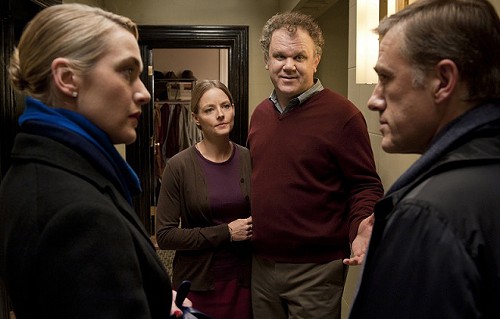
We are in the well-appointed Brooklyn apartment of the Longstreets: genial, rough-looking Michael (John C. Reilly), a salesman, and high-strung Penelope (Jodie Foster), a writer. Michael and Penelope have invited over a couple they don’t know – Alan and Nancy Cowan (Christoph Waltz and Kate Winslet), a corporate lawyer and an investment broker – to discuss the playground fracas between their respective sons, Ethan and Zachary (played by Eliot Berger and Polanski’s own son Elvis). The Cowan boy attacked the Longstreet kid and broke some teeth.

Kate Winslet, Jodie Foster, John C. Reilly and Christoph Waltz.

There’s tension right from the start, despite the atmosphere of good-natured civility and manners, and writer Reza and Polanski nurse it along expertly. Michael, whose eyes glower while his mouth grins, is a bit too friendly, and too loudly obliging. We sense that, though he’s talking the talk, he’s no liberal. Penelope, the real bleeding heart of the two, is wired tight, more and more uneasy and nervous.

Alan, slick, conniving and full of lightly veiled disdain for his social inferiors (almost everybody, but especially the Longstreets), keeps rudely interrupting the confab to bark orders over his cell phone. As for Nancy, she keeps her feelings tightly reined in, until the memorable moment when she suddenly projectile-vomits all over the Longstreet’s coffee table and Penelope’s treasured book of Kokoschka reproductions. From there it gets worse, and uglier, and funnier.

I’ve never seen the play, but I’m not surprised it’s an international critical and audience hit. The model, of course, is Edward Albee’s venom-laced, acidly funny chamber drama “Who’s Afraid of Virginia Woolf?” and the play that probably influenced Albee: Eugene O’Neill’s great tragic family drama “Long Day’s Journey Into Night.”

As in those two 20th century theater classics, “God of Carnage” (I prefer that title) gives us a small group of people, all hiding something, all gradually losing their inhibitions and their secrets, as they consume more and more booze.

So, one could use “Carnage” as a springboard for little essays on class warfare or the discreet charmlessness of the bourgeoisie or the beast that lies beneath all our skins or even on cell-phone etiquette. (What’s Alan like when he’s driving?) Or one could delve into the symbolism of the Longstreets’ lost hamster, a hapless creature who may be the equivalent for George and Martha’s “lost” child in “Virginia Woolf.” But, after 15 minutes of watching this filmed play, I knew why it had gotten all its awards, why Polanski wanted to do it and why he was the ideal director for the piece. [Read more…]

‘Cook County’ revels in atmosphere, skimps on story

Cook County/2009/Hannover House/93 min.

First-time writer/director David Pomes says he filmed “Cook County” in a way that would take the audience into the dismal world of crystal meth users in the woods of East Texas. True to his aim, the film does seem to live and breathe a sweaty, strung-out realness.

Ryan Donowho

Bump (Anson Mount) heads the household, which means he uses heavily, holds parties and snarls orders. His brother Sonny (Xander Berkeley), newly released from prison, struggles to stay clean and to reconnect with his 17-year-old son, wary and watchful Abe (Ryan Donowho). Bump and Sonny’s ghostlike father (Tommy Townsend) listlessly awaits his next hit.

It falls to Abe to take care of Bump’s little girl Deandra (Makenna Fitzsimmons) and protect her from her father, who’s not above bragging that he could put a bullet in her head if he wanted to. As Bump grows increasingly paranoid and unhinged, Abe must commit a fearsome act in order to keep Deandra safe.

Pomes skillfully evokes not just the “party” atmosphere but the bleak day-to-day existence of these desperate, seemingly doomed men. (Director of photography Brad Rushing used Super 16mm handheld for much the movie.) The writing is good and Pomes elicits authentic performances from his cast.

Mount nearly glows with menace as he becomes increasingly disconnected from reality. Berkeley brings scruffy amiability and lambent hopefulness to his part. Sonny wants something better but sees few ways out. Donowho is expressive and interesting to watch.

Unfortunately, once at the party, there’s not much to do. Yes, we see tension simmer between the brothers. We witness father/son confrontations. Beyond that, however, the plot is fairly thin. If you’ve never seen “Breaking Bad” or read about the problem of crystal-meth addiction, “Cook County” will open your eyes. But eye-opening realism and banjo music does not a story make.

“Cook County” opens today in LA and New York; it will play elsewhere starting Jan. 27.

Suspenseful, subversive ‘Blue Velvet’ continues to beguile

Blue Velvet/1986/MGM/120 min.

David Lynch

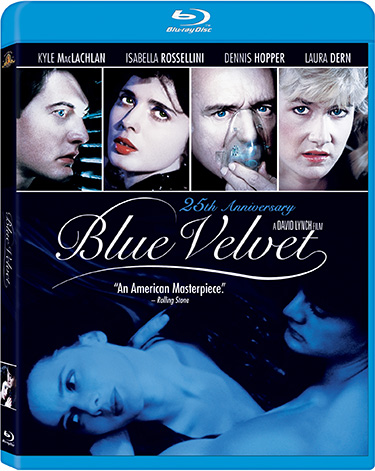
In “Blue Velvet,” writer/director David Lynch dazzles and disturbs us as he probes the evil beneath the surface of sunny small-town Americana. Twenty-five years later, its trippy shimmer has not dimmed, reminding us of Lynch’s auteur power. (The film was released last month on Blu-ray.)

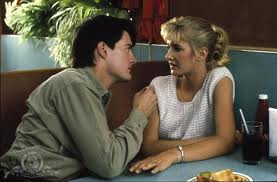
Setting the action in Lumberton, N.C., a real-life city with a retro vibe, Lynch introduces us to Jeffrey Beaumont (Kyle MacLachlan), a college student with an Eagle scout vibe. Jeffrey stumbles into a sordid mystery when he discovers a human ear lying in a field.

As he investigates, he’s aided by cute, cheerful Sandy Williams (Laura Dern), who is also the police chief’s daughter, always a plus when you’re short on clues. Jeffrey quickly finds that the bloody trail of badness traces back to Frank Booth (Dennis Hopper), a psychotic abuser you’ll never forget.

Kyle MacLachlan and Laura Dern

Top on Frank’s list of victims is a sad and broken nightclub singer named Dorothy Vallens (Isabella Rossellini), who sees death as her salvation. As Jeffery is pulled into Frank’s world, he finds himself falling for both Dorothy and Sandy, slowly spiraling until he meets the ugliest side of his soul.

The nightmarish world of “Blue Velvet” is a perfect melding of sly, suspenseful tone, subversive storytelling and marvelous, beguiling images that only painter-turned-filmmaker Lynch could concoct. There is baseball, apple pie and Chevrolet. There are also curtains, stages, disguises, halting juxtapositions.

Jeffrey finds the rank, insect-infested ear just seconds after a beautiful shot of brilliant color – red roses, a white fence, pure blue sky. Savage violence co-exists with moments of buoyant charm. (Compare the slow-motion shots of friendly firemen waving at us with Dorothy’s unrelenting degradation.) Lynch ferrets out the good guys’ guilty secrets and furnishes warped humor – such as the camp comic relief from Frank’s bisexual friends, including a twisted impresario played by Dean Stockwell.

The performances are particularly haunting. Fresh out of rehab, Hopper shrewdly saw that the role could launch a comeback for him. In the DVD extras, Rossellini recalls being moved by Hopper’s talent as he let tears fall down his face.

Rossellini brings uncommon depth and richness to her breakthrough American role. (Lynch originally wanted Helen Mirren). Ideally cast, MacLachlan and Dern nail their parts as well – soft-spoken and gentle straight-shooters who spend much energy suppressing their turbulent, darker desires.

Now 25 years old, “Blue Velvet” remains weird, wild, risky and wonderful.

‘Blue Velvet’ quick hit

Blue Velvet/1986/MGM/120 min.

Baseball, apple pie and Chevrolet. Gangsters, stray body parts and sadism. Writer/director David Lynch takes us on a journey to the seedy side of small-town America. Laura Dern is a sweet and sheltered high-school student. Her wholesome boyfriend Kyle MacLachlan can’t resist prying into the secrets of mysterious chanteuse Isabella Rossellini and her malevolent boyfriend Dennis Hopper. Disturbing, surreal, thoroughly mesmerizing.

Dreary, draggy, drawn-out, ‘I Melt with You’ is one to avoid

I Melt with You/2011/Magnolia Pictures/129 min.

I knew I was in for a long slog early on in “I Melt with You,” a noir-infused drama about an annual reunion of four 40something yuppie buddies, when one of them delivers this clunker: “Some things never change.”

Granted, writer Glenn Porter might be trying to indicate how stilted these relationships have become, but the mere fraying of friendship is incidental in comparison with the dreary nihilism that unfolds.

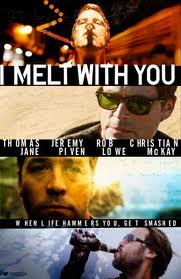
The friends are played by Thomas Jane, Jeremy Piven, Rob Lowe and Christian McKay; Mark Pellington directs. There is no shortage of generic male bonding and trying to talk during their stay in idyllic Big Sur – all through the blur of heavy drinking and drugging, music blaring, natch. (The movie’s title refers to the Modern English song from 1982; it was rerecorded for use in the film.)

Through this blur of excess, which would be nauseating if it were a little less boring, their Important Issues emerge: a broken marriage and washed-up career, stale grief, unchecked greed, chronic womanizing (shocker!) and a shelved dream.

As we learn more details about their histories and their current situations, we see that whatever they were in college, they are now angry, mean-spirited, self-indulgent, entitled, whiny dullards. When their drawn-out and draggy self-destruction becomes literal, prompting a local cop (Carla Gugino) to start asking questions, it’s hardly much of a loss.

I’m not really that hard to please. A little humility from a few of the characters, a whiff of intelligence, passable writing or solid acting might have redeemed this film somewhat. But, with the exception of McKay (who played Welles in “Me and Orson Welles”), the acting is risible. For example, when Piven’s character is called a rat, he actually begins twitching his nose and baring his teeth.

“I Melt with You” doesn’t melt fast enough – it’s a chore to endure.

A must-see, ‘In Darkness’ is uncompromising, deeply moving

Michael Wilmington

In Darkness/2011/Sony Pictures Classics/145 min.

By Michael Wilmington

Sometimes we let the horror of the past recede into a comforting mist of remembrance, melancholy and well-meaning cliché. We shouldn’t.

Agnieszka Holland’s “In Darkness” is a drama of the Holocaust, and a remarkable one, even given the high standards set by other real-life World War II film chronicles like “Schindler’s List” and “The Pianist.” The movie – which is Poland’s official submission for this year’s foreign language film Oscar – is almost fearsomely realistic, horrifically uncompromising and deeply moving.

Holland’s film, like Steven Spielberg’s and Roman Polanski’s, is based on a true story, a tale of terrible anguish, fear and, finally, of profound humanity. But it’s done with an excruciating physical realism those other two movies didn’t really try for.

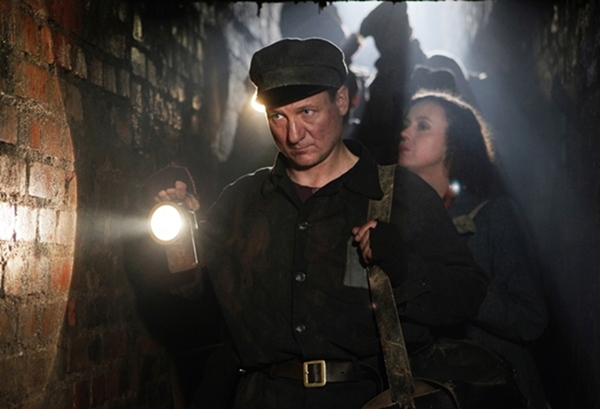
“In Darkness” is based on the true story of a small time criminal and burglar named Leopold (Poldek) Socha, who used his day job as a sewer inspector in Lvov, Poland, during the German occupation, to hide a small group of Jews in the sewers for 14 months. As we watch, we are plunged into an abyss of fear and suffering, lit by faint glimmers of incongruous hope. It is a great, stark, sometimes awesomely emotional film, with an incredible lead performance by the Polish actor Robert Wieckiewicz as Socha, and brilliant, penetrating direction by Holland.

Agnieszka Holland

Holland and her crew, especially cinematographer Jolanta Dylewska, make this experience so gritty and tactile that it almost hurts to watch it. The sewers of “In Darkness” are not like the sinister, shadowy and strangely romantic Viennese sewers of Carol Reed and Graham Greene’s masterful 1949 film noir “The Third Man,” those vast echoing tunnels through which Orson Welles ran like a rat in a maze.

Nor are they stark and grim and deadly like the Warsaw sewers where the anti-Nazi Polish partisans hid in Andrzej Wajda’s 1956 WWII-set masterpiece “Kanal.” The sewers of Lvov are smaller and inky black, steeped in an airless-looking gloom, cramped and comfortless, wet with sewage and slime. They are true hell-holes, and the people hiding there are a mismatched crowd of businessmen, operators, snobs, adulterers, families and even children.

There is daring Mundek Margulies (Benno Furmann), who twice eludes the Nazis. The Chiger family – father Ignacy (Herbert Knaup), mother Paulina (Maria Schrader), daughter Krystyna (Milla Bankowicz) and son Pawel (Oliwier Stanczak) – are a tight-knit group, being pulled apart.

They have entered this hell out of desperation. All around them, before their voluntary imprisonment begins, other Jews are being arrested and taken to the death camps, or shot on the streets or killed in the forests, as we and Socha see in the movie’s shattering opening scene.

Their “savior” Socha, isn’t acting out of the goodness of his heart. He does it for money and, when the story begins, even shows signs of anti-Semitism, something typical for many Catholic Poles (like Socha) in that era. As the months go on, as Socha has to feed and watch over the fugitives, reassure them and provide their only link to the outside world of daylight and fresh air – as he has to resort to ever more dangerous ruses to keep them all hidden – we see him change. Socha is a crook, but he’s also a fearsomely competent man, someone who dares to do what others can’t, and that very competency eventually helps humanize him, while as the Nazi “efficiency” turns them into monsters.

Robert Wieckiewicz as Socha leads the group into the sewer to hide.

Eventually Socha’s Jews run out of money and he must make a decision: to abandon them or to go on hiding and helping them. What he chooses to do, why he chooses to do it and what eventually happens make for an astonishing and inspiring story.

Socha’s story in fact provides something relatively rare in our movies: a true story of moral growth and redemption under the most extreme and terrifying conditions – centering on a character who initially seems far from heroic, even if he’s gutsier and sharper than the Nazis he keeps outwitting.

Playing this meaty role, Wieckiewicz gives us a human being so real and so full of seeming contradictions that he ultimately shocks us with the sheer human truth and rough grandeur of his performance. The rest of the cast are all fine, especially Furmann as Mundek and Michal Zurawski as Socha’s Nazi buddy Bortnik. But it’s Socha’s movie and he wins us easily, while always, like any great actor, letting his cast-mates shine as well. This movie is an extraordinary work, a link to the past. You feel it in your heart and soul and senses. And it demonstrates something we sometimes forget: Agnieszka Holland can be one of the world’s great filmmakers. [Read more…]