McQueen paints harrowing portrait of addiction in ‘Shame’

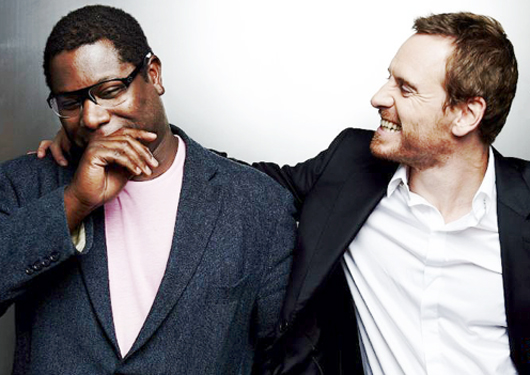
Steve McQueen and Michael Fassbender

“Shame” by London-born writer/director Steve McQueen is a searing study of a man, both buttoned-up and out of control, obsessively seeking oblivion and teetering on the edge of disaster. A sex addict perpetually on the outside looking in, he lives solely for his next physical encounter.

On the surface, the laconic, hauntingly good-looking Brandon (Michael Fassbender) seems very much together. His colleagues like and respect him, he lives in a stylish Manhattan apartment, women are easily drawn to him.

His sister Sissy (Carey Mulligan), a struggling singer, is not faring as well and lands on his doorstep because she has nowhere else to live. Starting with Brandon finding Sissy in his shower, the two begin a tense co-existence. Brandon attempts to keep his porn, rooftop trysts and hotel hookups private, but we sense Sissy is completely up to speed on his compulsion; she tries half-heartedly to curb her own partying and sleeping around.

Whereas Brandon strips any feeling from his encounters (the one exception is a colleague he courts, the ethereally pretty and warm-hearted Marianne, played by Nicole Beharie), Sissy is the opposite, fiercely clinging to whoever will buy her champagne and share her bed for a night. Sissy’s mounting desperation eventually forces Brandon to confront his self-destructive compulsion.

With muted emotion and spare dialogue, McQueen, who wrote the screenplay with Abi Morgan, implies more than he tells but we know with certainty that Brandon and Sissy’s history is rooted in pain and deep dysfunction. The scene in which Brandon and his boss (James Badge Dale) come to hear Sissy sing at a club – she performs a wrenchingly sad version of “New York, New York” – flawlessly conveys their baggage and buried guilt.

McQueen, an acclaimed artist and director of 2008’s prize-winning “Hunger,” which also starred Fassbender, heightens the mood of numb despair by using long takes, cool tones and stark lighting. Toward the end, in bed with two women, Brandon’s anguished face tinged with yellow brings to mind a tortured figure in a Hieronymus Bosch painting, expunging any hint of sexiness or erotic allure.
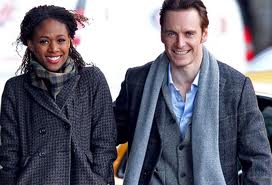
Nicole Beharie and Michael Fassbender

Noirish shots of Brandon prowling New York streets at night reveal the energy he expends to shroud his life in secrecy and keep his emotions at bay.

There are many graphically raw scenes that earned the film a NC-17 rating and many are harrowing to watch. Harrowing, to be sure, but also moving – Mulligan and Fassbender are marvelously compelling in these roles that let them express uncommon depth and a mighty struggle. Beharie and Dale strike us as real people as opposed to stock types, yet they neatly suggest the general pattern of Brandon and Sissy’s superficial relationships.

To some extent, “Shame” follows in the tradition of “The Lost Weekend” and “The Man with the Golden Arm,” as well as “Last Tango in Paris,” but McQueen’s work seems broader, more resonant in our instant-gratification, must-have-it-now culture. Says Fassbender, “It speaks to this constant drive we have for satisfaction and highs, one that is followed by feelings of shame and self-loathing.”

“Shame” also speaks, in tough language, to vulnerability, damage, connection and love.
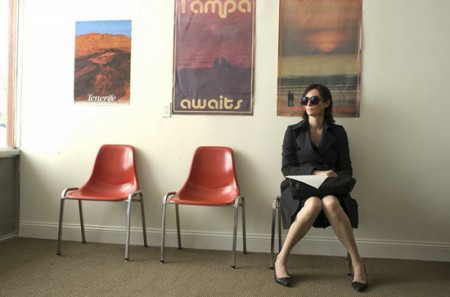
Tilda Swinton plays a beaten-down mother.

Also opening today (in a limited release) and very highly recommended: “We Need to Talk About Kevin” by Lynne Ramsay, a thriller in which neo noir meets New Age parenting. We witness, in jagged pieces that jump back and forth in time, the unthinkably brutal rupture of a dysfunctional but not entirely unhappy family.

Tilda Swinton plays a mother struggling to love her son Kevin (Ezra Miller) who comes into the world seething with anger. John C. Reilly plays her denial-prone husband. Though the script isn’t fully there and I just couldn’t buy Swinton and Reilly as a couple, this is nonetheless tour de force direction from Ramsay. I hope her vision and style are recognized during awards season.

Rich with visual metaphor, bold use of color and captivating performances, this is destined to be a neo-noir classic.
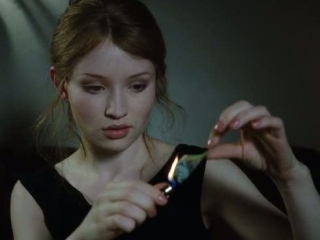
Emily Browning

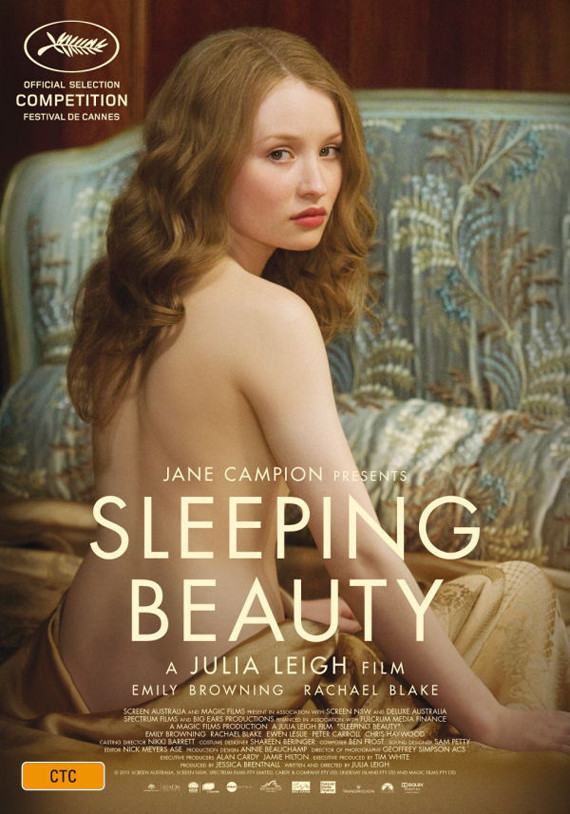
In writer/director Julia Leigh’s erotic reworking of the fairy tale “Sleeping Beauty” we meet Lucy (Emily Browning), a perverse college student using her stunning looks to make a living in the sex industry.

Though I admired Browning’s performance, the movie was disappointingly sluggish and dull.

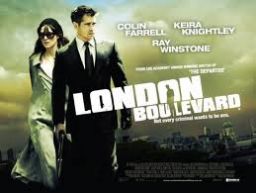
Film noir with Farrell and Knightley is a little bit of all right

London Boulevard/2010/GK Films, et al/103 min.

“She’s not wearing that dress, the dress is wearing her,” the fashion police might grumble before making an arrest. “London Boulevard” commits a similar crime – it’s a movie that ultimately overpowers its director.

That said, there is much to admire in this work from William Monahan, who directed and wrote the script from a novel by Ken Bruen. Monahan, having won the Oscar for “The Departed,” is completely in his element with noir scripts, setting up compelling narrative threads and knocking out smart, fast, sometimes-funny lines.

Colin Farrell plays Mitchel, an ex-con determined not to return to jail. But, in need of quick cash, he hooks up with simple-minded Billy (Ben Chaplin) and helps him make his rounds collecting money in South London for flashy gangster boss Rob Gant (Ray Winstone). At a pub gathering to celebrate Mitchel’s release, a pretty girl (Ophelia Lovibond) tells him he could approach a “retired” friend of hers for a job as a handyman.

The friend turns out to be anxious and vulnerable Charlotte (Keira Knightley), a famous actress who can’t leave her Holland Park home without being bombarded by the snapping and flashing of verminlike paparazzi. He catches her eye (Colin Farrell just has a way of doing that), then earns her trust as well as that of her manager, Jordan (David Thewlis), a former actor and fluent drug-taker. At the same time, Mitchel tends to his unstable sister (Anna Friel) and seeks retribution for the murder of a damaged old criminal (Alan Williams).

Still, the ties with the underworld are tough to break. After Mitchel endures a beating from rival thugs (Billy flees), the boss offers him a promotion. “No thanks, got a new job” does not go over well and Mitchel has to find a way to extricate himself from Rob.

“London Boulevard” has many of the elements of a first-rate neo noir. It starts with high energy (the music helps) and an exciting pace – Monahan seems in command of his material. Chock full of dodgy characters, the movie is nicely cast and all the actors are interesting to watch. Farrell and Knightley have a spindly spark of chemistry, which is about all you could expect from this ships-in-the-night liaison.

But, about two thirds of the way though, the movie’s rhythm goes haywire, lingering too long on one storyline, then rushing abruptly to another. It’s hard not to notice the drafty holes in the story as it shunts to its slightly surprising, yet far from inevitable, conclusion.

Flaws aside, however, “London Boulevard” is an entertaining yarn with a considerable amount of visual flair (Chris Menges shot it) and intelligence. So the movie police might complain – film noir with Farrell and Knightley is still a little bit of all right.

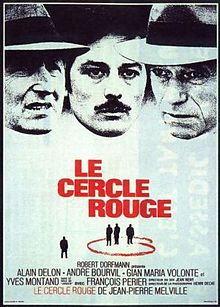
‘Le Cercle Rouge’ is an icy thriller by an immaculate artist

“Le Cercle Rouge” plays Saturday, Nov. 6, at 4 p.m. at the Egyptian Theatre in Hollywood as part of AFI FEST 2011.

Le Cercle Rouge/1970/EIA, et al/140 min./in French with English subtitles

By Michael Wilmington

Jean-Pierre Melville (1917-1973) was, in some ways, the Vermeer of the heist movie. A master of classic noir and neo noir, Melville was a cool, sure-fingered expert and an immaculate artist. Like Vermeer, his pictures were deceptively simple and utterly haunting, punctilious and mysterious. And, like Vermeer, he didn’t leave many behind him.

One of the greatest of all Melville’s films, with one of his most spectacular heists, is “Le Cercle Rouge,” a neo-noir which has, as its centerpiece, a spine-chilling depiction of a jewel robbery at the Place Vendome in Paris.

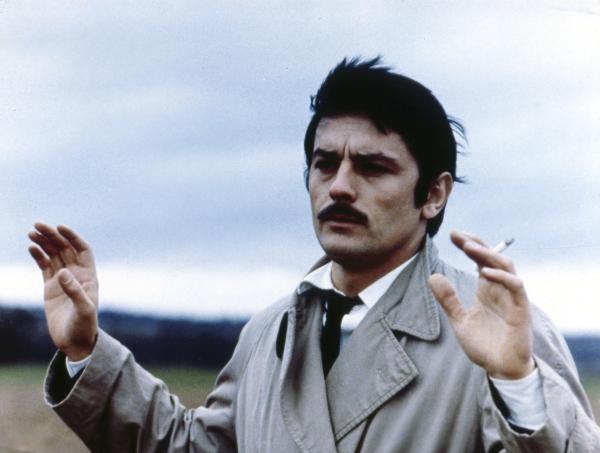
The job is pulled off with rare skill by three strangely honorable thieves, played by three international film stars: ex-convict Corey (played by Alain Delon), escaped prisoner Vogel (Gian Maria Volonté) and ex-cop Jansen (Yves Montand).

Alain Delon

The movie is about how these three come together, how they execute the robbery, and how they’re finally driven apart – largely through the quiet skill and determination of their relentless police antagonist. Deceptively lumpish, bourgeois-looking Inspector Mattei is played by comedy star André Bourvil.

Mattei is keeping watch over his prisoner, Vogel, on a train journey. But Vogel slips out of his handcuffs and escapes from the sleeper car of the speeding train. Mattei is humiliated, then obsessed with finding Vogel. The broken handcuffs become a psychological link.

Mattei has an invaluable source in Santi (François Périer), a double-dealer and underworld mole, who looks like a ferret in a suit. Santi owns a nightclub that seems to specialize in crooked assignations and ersatz ’50s American movie musical numbers, set to a cool jazzy score by Éric Demarsan. (The chorus girls in those numbers are almost the only women we see in the movie, except for one faithless lover and one cigarette girl.)

The title “Le Cercle Rouge” refers to a story of Buddha, who supposedly draws a red chalk circle and explains to his students that those who are destined to cross paths will do so within the circle, no matter what.

Melville made and released Le Cercle Rouge in 1970, one year after making his World War Two French Resistance masterpiece, “Army of Shadows” (1969) and two years before making his last film (with his last heist), the flawed “Un Flic” (Dirty Money), starring Delon, Catherine Deneuve and Richard Crenna. “Le Cercle Rouge” was his last masterpiece.

Back to Vermeer for a moment. There is one vital quality of Vermeer’s that Melville misses completely, probably never tries for: warmth. Melville’s films noirs are cold, especially when cinematographer Henri Decaë (of Melville’s “Le Samourai”) shoots them. His crooks are cool. They speak little, wear raincoats and fedoras, and smoke cigarettes, like Bogie. His cops are icy. His world is dark: noir to the brim.

Why was Melville so obsessed with criminals, with heists and with heist movies? Maybe because this underworld reminded him of the world that was the French Resistance, in which he had fought during the war.

And maybe it’s because of the one that got away. In the ’50s, Melville was hired to direct the movie that became one of the greatest of all heist movies (François Truffaut’s choice as the greatest of all film noirs), 1955’s “Rififi.” Melville was later fired and replaced by Jules Dassin, who chivalrously refused to take the job without Melville’s consent (which Melville gave). [Read more…]

The Marilyn Chronicles at Chicago film fest

Chicago saw the installation this summer of a 26-foot-tall tacky statue of Marilyn Monroe by J. Seward Johnson, so maybe it’s fitting that the city’s film fest hosted two Marilyn flicks, both much more elegant than the gargantuan “Seven Year Itch” tribute.
v
Simon Curtis’ “My Week with Marilyn” (UK) offers a glimpse into a brief period in the troubled actress’ life: her 1956 trip to London to shoot “The Prince and the Show Girl” in which she co-starred with Sir Laurence Olivier.
v
x
The source material is “The Prince, the Showgirl and Me,” a memoir by Colin Clark, an assistant director on the film and son of art historian Sir Kenneth Clark (of “Civilisation” fame). Curtis brings the memoir to life with sumptuous cinematography and spellbinding, Oscar-worthy performances from Michelle Williams as Marilyn, Kenneth Branagh as Olivier and Eddie Redmayne as Colin Clark.
v
“MWWM” also explores profound changes in the world of film acting as the Stanislavski/Method school took hold of Hollywood and clashed with British style, still deeply rooted in stage tradition.

"Nobody Else But You"

Darkly funny, quirky and delightful to watch was the story of a modern-day Marilyn, “Nobody Else But You,” by Gérald Hustache-Mathieu. Sophie Quinton plays Candice Lecoeur, a luscious weathergirl in a remote French village whose life oddly parallels Marilyn’s and in a “Laura”-like way becomes the focus of a murder mystery.

Hustache-Mathieu’s most brilliant achievement is the unlikely mix of disparate mood and tone – farce, black humor, drama – fluidly, splendidly coming together. The audience loved it and high-energy Hustache-Mathieu was humbly charming at the post-screening Q&A.
x
In writer/director Julia Leigh’s erotic reworking of the fairy tale “Sleeping Beauty” (Australia) we meet another stunning blonde: Emily Browning as Lucy, a desperate college student using her looks to make a living in the sex industry. Though I admired Browning’s performance, the movie was disappointingly sluggish and dull.
v
Tomorrow: More highlights from the fest

Dark dramas shine at Chicago International Film Festival

Dark domestic dramas led the fine slate of high-style movies at the 47th Chicago International Film Festival, which boasted a lineup of nearly 200 titles.

In “We Need to Talk About Kevin” (UK) by Lynne Ramsay, neo noir meets New Age parenting in a haunting thriller. We witness, in jagged pieces that jump back and forth in time, the unthinkably brutal rupture of a dysfunctional but not entirely unhappy family.

Creating buzz at many fests, Tilda Swinton will doubtless continue to earn acclaim for her wrenching portrait of a mother struggling to love her son Kevin (Ezra Miller) who comes into the world seething with anger. Chicago-born John C. Reilly plays her denial-prone husband. Rich with visual metaphor and captivating performances (though the script is not fully there), this is destined to be a neo-noir classic. (“We Need to Talk About Kevin” does not release in the US until February.)

Samuli Niittymaki

I doubt Finnish director Zaida Bergroth had “Mildred Pierce” in mind when she made “The Good Son,” which won the top prize in the new directors competition. But I kept thinking of Michael Curtiz’s 1945 classic starring Joan Crawford as a flawed single mother of two daughters, the elder of whom is a bit of a snake, as I watched Elina Knihtila portray Leila, a flawed single mother of two sons, the elder of whom (Samuli Niittymaki as Illmari), is a bit of a psycho.

Eero Aho plays Leila’s new love interest, a kindly writer named Aimo. Anna Paavilainen is excellent as Illmari’s girlfriend as is Eetu Julin as Unto, the younger brother. Arresting images, subtle acting, nicely paced.

Arguably, “A Dangerous Method” (Germany/Canada) by David Cronenberg could be classified as a domestic drama, dealing as it does with the long-term adulterous relationship between renowned Swiss psychiatrist Carl Jung (Michael Fassbender) and a patient-turned-student-of-psychoanalysis Sabina Spielrein (Keira Knightley). Viggo Mortensen is Sigmund Freud; Sarah Gadon is Jung’s wife. This finely crafted film is already generating Oscar buzz.

“Martha Marcy May Marlene” (US) is the kind of film that leaves you reeling, then lodges in your mind for days. Elizabeth Olsen (sister of Ashley and Mary Kate) stars as a young woman who escapes from an evil cult and struggles to reconnect with her estranged sister (Sarah Paulson) and her new brother-in-law (Hugh Dancy). Writer/director Sean Durkin’s fragmented narrative swerves from past to present; the tension mounts masterfully to a claustrophobic level. Thoroughly mesmerizing, but as much as I admired Olsen’s presence and vulnerability (she may be an Oscar contender), I felt no sympathy for her character. John Hawkes (of “Winter’s Bone”) is unforgettable as the warped cult leader.

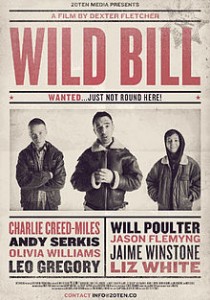
English actor Dexter Fletcher makes an impressive directorial debut with “Wild Bill.” Though the story is essentially rooted in cliché, the fresh writing and powerful acting inject vitality into this tale of an ex-con (Charlie Creed-Miles) reconnecting with his young sons (Will Poulter and Sammy Williams) in London’s East End.

A desire for a father-daughter reunion drives the ex-con (Mark Pellegrino) in “Joint Body” by Brian Jun. But he gets sidetracked when he meets a stripper (Alicia Witt) in a seedy residential motel in downstate Illinois and the two end up on the run. (The term joint body refers to a convict who works out and walks the walk with confidence.)

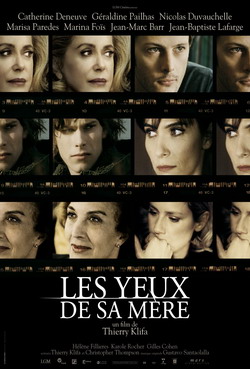
Too melodramatic to be a real thriller, Thierry Klifa’s “His Mother’s Eyes/Les Yeux de Sa Mère,” (France) about a writer’s plan to ingratiate himself into a fractured family, is still intelligent, engrossing and features an easy-on-the-eyes cast, which includes ever-lovely Catherine Deneuve, Nicolas Duvauchelle, Géraldine Pailhas and Jean-Baptiste Lafarge.

And though definitely not a noir, the festival’s grand-prize winner, “Le Havre” (Finland/France) by Aki Kaurismaki, recounts the forming of a temporary, makeshift family. A working class French man (André Wilms) befriends and protects an African boy (Blondin Miguel) who lands illegally in Le Havre on the way to reuniting with his mother in London. Lit and composed like an Old Master painting, Kaurismaki’s film brims with humanity and humor.

Tomorrow: More about movies at the festival

‘The Last Rites of Joe May’ kicks off CIFF

The Chicago International Film Festival, the oldest competitive film festival in North America, starts tonight at the Harris Theater in Millennium Park with “The Last Rites of Joe May,” a neo noir.  The fest, now in its 47th year, runs through Oct. 20.

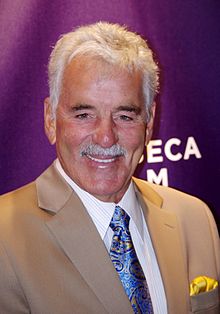
Writer/director Joe Maggio’s film stars Chicagoan Dennis Farina (“Get Shorty,” “Snatch,” “Midnight Run,” “Law & Order”), Jamie Anne Allman, Meredith Droeger, Ian Barford, Chelcie Ross and Gary Cole.

Farina was a Chicago cop before becoming an actor.

In “The Last Rites of Joe May,” Farina, who was a Chicago cop for 18 years before becoming an actor, plays a sixtysomething short-money hustler looking to make a comeback after a battle with pneumonia. The film is “steeped in colorful characters and the neighborhood flavor of the city,” said Mimi Plauché, CIFF’s head of programming.

This year’s fest features 143 feature-length films (narrative and documentary), representing 55 countries, and 52 short films. There are also panels, parties, discussions and tributes.

I’m most interested in the After Dark competition, described by the fest as follows: “From H.P. Lovecraft to high-voltage chases in the streets of Seoul, South Korea, not to mention psycho killers using unconventional methods to inflict mayhem, these films will keep you on the edge of your seat.”

I will be posting more about the fest next week!

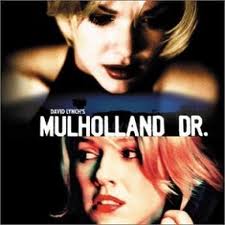
‘Mulholland Dr.’ takes us through shiny dreams and devastating nightmares

Mulholland Dr./2001/Universal, Studio Canal/145 min.

Let’s face it, reality sucks. So, on second thought, let’s not face it.

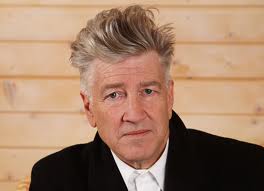
David Lynch

Instead, pluck an image from your fantasy du jour, then jump into your limousine, Lamborghini roadster or sedan chair and head to “Mulholland Dr.” for poolside cocktails with your dear chum writer/director David Lynch.

Or just put your feet up and watch the movie. This terrific neo-noir mystery is a story within a story within a story within a story about Hollywood, its shimmering promise and dark secrets, its cut-throat power and caustic pain, and its huge cast of heroes, hopefuls, heavies and hangers-on. The film is also a visual poem and Lynch’s highly personal, surrealistic imagery resonates long after you see it.

Lynch’s Tinseltown reminds me of F. Scott Fitzgerald’s valley of ashes in “The Great Gatsby,” the famous Hollywood sign, like the eyes of Doctor T. J. Eckleburg, set amid wild delight and staggering decadence.

Lynch’s detractors complain that his motifs – portals and shadowy rooms, lurking danger beneath an innocent exterior, secret languages, nightclub singers and stages, for example – are shallow gimmicks that Lynch leans on from film to film. (His other work includes: “Eraserhead” 1977, “Blue Velvet” 1986, “Wild at Heart” 1990, the TV series “Twin Peaks” 1990-91, “Lost Highway” 1997, “Inland Empire” 2006).

Nevertheless, in each film, Lynch creates a unique cinematic world that takes your breath away with its striking beauty, sly humor, intense characters and uncommon depth. In “Mulholland Dr.” Lynch invites us into a shiny dream as well as a devastating nightmare. Though it’s a contemporary setting, there are so many retro references that the story almost feels like a period piece.

In part one, we meet golden girl Betty Elms (Naomi Watts), a young actress who’s just arrived in Hollywood. Sweet, perky and hopeful, Betty has a retro-chic apartment to live in and an audition set up for a role in a major movie. Just in case she needs to borrow a cup of sugar, her charming landlady Coco (Ann Miller, in her last movie role) is ready and waiting to help.

Laura Elena Harring

Ann Miller

Nothing throws this girl, not even finding a stranger using her shower. This particular mystery woman calls herself Rita (Laura Elena Harring) because she can’t remember her own name or anything else about her life. Arrestingly beautiful, with raven hair and ravishing features, Rita appears to be on the run from some nefarious mobsters but she doesn’t know why, natch.

Nor does she have any idea why she has a key and $50,000 in her handbag, which the girls hide in a hatbox. (Well done! If you’ve picked the right frock and got your lipstick on straight, why bother to carry cash?)

Betty decides that Rita needs to retrace her steps in order to regain her identity. But first Betty must prepare for her audition. Rita helps her rehearse and the next day Betty wows everyone in the room, including her debonair co-star Jimmy Katz (Chad Everett). Afterward, Betty is whisked away to meet edgy young director Adam Kesher (Justin Theroux), who’s casting a flick called “The Sylvia North Story.”

Later, over coffee at a diner (Lynch always loves a diner), Rita remembers the name Diane Selwyn; this leads them to an apartment where they make an unsettling discovery. That night, Rita has a few tricks up her sleeve for Betty – first a seduction, then a visit to a strange, nearly empty dive bar called Club Silencio, where Rebekah Del Rio, playing herself, performs a stunning a capella rendition of Roy Orbison‘s “Crying.” When they return home, Rita uses her key to open a box and Betty disappears.

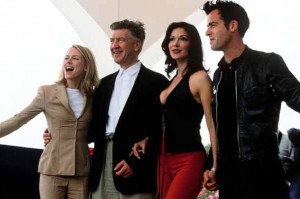
Watts, Lynch, Harring and Theroux

There are several subplots involving a fantasy creature in a diner parking lot; a hitman (Mark Pellegrino) who steals an address book, then casually kills three people; and slick-suited heavies (including Dan Hedaya as Vincenzo Castigliane) pressuring Kesher to cast unknown blonde actress Camilla Rhodes (Melissa George) in his movie. Oh, and Kesher’s wife (Lori Heuring) is sleeping with the pool guy (Billy Ray Cyrus).

In part two, Lynch rejiggers this world. The glossy, fun-filled days and Betty’s wholesome aspirations are gone, replaced by pitch-black, sinister nights, acts of betrayal and quests for revenge.

“Mulholland Dr.” – whose abbreviated title may be a tribute to Billy Wilder’s “Sunset Blvd.” – deserves high praise, for its look, its performances, its humor, its risks, its weirdness. Angelo Badalamenti (he has a cameo as gangster Luigi Castigliane, a man who takes espresso extremely seriously) contributes a stellar soundtrack and Peter Deming’s cinematography, with bright light and saturated color, is a treat.

Most of all, though, Lynch’s direction is superb. So is the acting. Watts easily shifts from fluffy and fierce, graceful to gritty. Similarly, Harring makes a fluid transition from lost soul to lady in charge. Though the plot is sometimes thorny, the actors are breezy and believable.

To think that Renée Zellweger received a Best Actress Oscar nom for “Bridget Jones’s Diary” and Watts didn’t make the list is baffling. (Halle Berry won that year for “Monster’s Ball.” The other contenders were Sissy Spacek for “In the Bedroom,” Nicole Kidman for “Moulin Rouge” and Judi Dench for “Iris.”)

Lynch was nominated for a Best Director Oscar. Ron Howard won for “A Beautiful Mind,” which also won Best Picture. At Cannes, however, “Mulholland Dr.” received the Palme d’Or for best direction. (Lynch shared the honor with Joel Coen for “The Man Who Wasn’t There.”)

Don't want to keep Clive waiting ...

Of all that’s been written about “Mulholland Dr.” critic Stephanie Zacharek sums it up best: “‘Mulholland Dr.’ is the most womanly of David Lynch’s movies. … It’s wily and sophisticated, stylized like an art deco nude, and suffused with so much feline glamour and beauty and naked eroticism that its chief aim seems not to be to dazzle us with its typically Lynchian plot twists, but to seduce us into its sway and keep us there. This is a movie with hips.”

Speaking of seducing, I must dash back to my fantasyland. I’m meeting with my agent so I can sign that $3 million book deal. Then, I’m off to dinner and dancing with Clive Owen at the Stork Club. Ta ta!

‘Mulholland Dr.’ quick hit

Mulholland Dr./2001/Universal, Studio Canal/145 min.

Two parallel stories and a bizarre tangle of story threads – by turns sumptuous and sinister – courtesy of visual poet David Lynch. A bright young actress (Naomi Watts) comes to Hollywood to pursue her dreams.

With talent, perseverance and a bit of luck, she’ll soon be the toast of the town, right? Think again, doll. Exciting work from an excellent cast, particularly from Watts and co-star Laura Elena Harring.

‘Drive’ is full of killingly well-executed action scenes, sharp acting, ironic dialogue and ultra-snazzy visuals

Drive/2011/100 min.

By Michael Wilmington

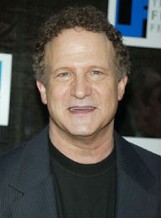
“Drive” is a gut-twisting LA action movie, stripped to the bone, but also drenched with visual style. It’s about a driver played by Ryan Gosling who falls in love with the woman down the hall in his building, nervous Irene (Carey Mulligan), whose husband Standard (Oscar Isaac) just got out of jail and is being forced into another heist by shady moneymen Nino (Ron Perlman) and Bernie (Albert Brooks).

Albert Brooks

The show is full of killingly well-executed action scenes, sharp acting, ironic dialogue and ultra-snazzy visuals – all of which won Nicolas Winding Refn the Best Director prize at the last Cannes Film Festival. Hossein Amini wrote the script based on James Sallis’ novel.

It’s a movie built largely out of our memories of other movies, but that’s not necessarily bad. We know where this movie is coming from as soon as we know Gosling’s character has no name but The Driver – just like Ryan O’Neal in Walter Hill’s 1978 “The Driver.”

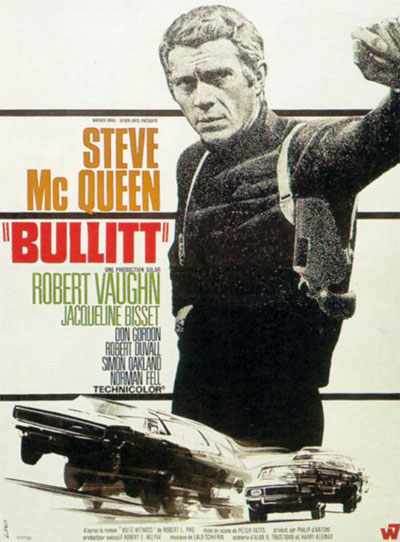
Neo-noir is this picture’s middle name, and its forebears include “The Driver” (of course); John Boorman’s 1968 “Point Blank” with Lee Marvin; Peter Yates’ 1968 “Bullitt” with Steve McQueen; and Michael Mann’s outlaw movies “Thief” (1980) and “Heat” (1995). As you’d expect from a movie with that kind of lineage, “Drive” begins with a great chase and gives us a little dip under Gosling’s opaque exterior by letting us know that he’s a movie stunt driver by day and a getaway driver at night. (He allows his robber/clients only five minutes to get back to his car).

He’s also a prospective race car driver, for whom his auto shop owner/patron Shannon (Bryan Cranston) wants to get sponsorship. Shannon turns to the very same criminal financiers, Nino and Bernie, who want Standard to pull a job for them, for which Standard wants The Driver to drive. And The Driver does, mostly because he’s in love with Standard’s wife, Irene, and his little son Benicio (Kaden Leos).

The movie alternates its always-thrilling action scenes with more emotional character stuff – including a brilliant turn, Oscar-worthy really, by Brooks as the falsely good-natured gangster and ex-movie producer Bernie. (In the ’80s, says Bernie, he did action stuff that some critic called “European.”) The classy cast sometimes seems to be getting paid for holding it all back, especially Gosling, whose minimalism here makes vintage Eastwood or McQueen look like John Barrymore.

As the film goes on, it gets more violent. The violent scenes are short but extremely bloody. Since the movie plays some of its carnage with razor-sharp comic timing (especially Brooks’ scenes), it becomes more and more disturbing as well. There’s something sinister and icily detached about that comic violence. “Drive” suggests a world where brutality is rampant, where greed rules, where immorality thrives.

Though Refn may not have really made a classic neo-noir, it’s a very good effort. A little more Albert Brooks maybe. Not too much. Five minutes or less.

Albert Brooks photo by Jim Spellman/WireImage/The New York Times

‘Barracuda’ heroine puts justice in the driver’s seat

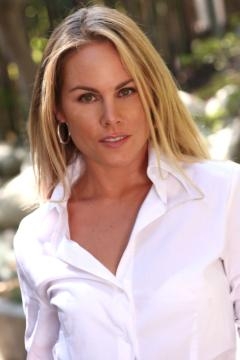
Christy Oldham

When Christy Oldham moved to LA from Louisiana 13 years ago to be an actress, she hadn’t heard of the Screen Actors Guild. “I was very green and naïve,” she says. “But I realized that if I was going to be successful, I would have to write, produce and make my own movies rather than waiting on someone to call me in for an audition.”

Fast-forward to today and she has three movies under her belt. Her latest, “Barracuda,” is a dark comedy about a phone-sex operator’s mission to bring sex offenders to justice, tracking them in her 1966 Plymouth Barracuda. Oldham wrote, produced and stars in the work; Shane Woodson directs.

“My film exposes the secret and often criminal sexual lives of normal, professional men,” Oldham says. According to the National Center for Missing and Exploited Children, there are nearly 740,000 registered sex offenders in the U.S.

“Barracuda” is part of the 2011 Burbank International Film Festival’s women’s night. It screens Thursday, Sept. 15th, at 10:30 p.m. at the AMC 16 movie theater in Burbank. “Barracuda” was nominated for three awards at the Burbank festival including Best Picture and received an Excellence in Filmmaking award at the 2011 Las Vegas International Film Festival.

“Barracuda” taps veteran editor Robert Pergament, cinematographer Marco Naylor and composer Emir Isilay. The film was shot in California, Kentucky, Louisiana and Indiana; the cast includes 200 actors.

Oldham and Woodson previously collaborated on the 2007 screwball comedy “Cain and Abel,” starring rap icon Flavor Flav. Oldham plans to make her directorial debut with a film that she wrote about the victims of a serial killer in southern Louisiana.

The Burbank film fest is open to the public. You can buy tickets to “Barracuda” ($13.41 each, including service fee) here.

“Barracuda” will also screen in New Orleans and Mississippi film festivals in October. For more information on the film and the filmmakers, go to: barracudamovie.tv and mercuryrisingfilms.com.