‘The Night of the Hunter’ a wondrous poem of terror, family, false gods and redemption

Michael Wilmington

The Night of the Hunter/1955/United Artists/93 min.

By Michael Wilmington

Some movies take a while to reach their audiences. Take, for example, Charles Laughton’s great Faulknerian film noir “The Night of the Hunter,” based on Davis Grubb’s Southern Gothic novel.

Beautifully scripted by James Agee, spellbindingly directed by Charles Laughton, evocatively shot by cinematographer Stanley Cortez, and memorably acted by Robert Mitchum (in his best performance), it’s a haunting tale of murder, terror and wild, lyrical flight.

Also unforgettable: the performances by Shelley Winters, Lillian Gish, James Gleason, Evelyn Darden, Don Beddoe, Peter Graves, and two little-known child actors Billy Chapin and Sally Jane Bruce.

In this mesmerizing movie, we see two orphaned West Virginia kids, John and Pearl Harper, desperately fleeing the honey-tongued but murderous preacher Harry Powell (Mitchum), a black-clad, brim-hatted charlatan who has “LOVE” and “HATE” tattooed on his knuckles as props to his sermons. Harry is the Hunter. The children are his prey because they can lead him to the money their father (Graves) stole and managed to hide before he was arrested and executed.

Harry cajoles them, bullies them, then kills their poor, sad, seducible mom Willa (Winters). The heroine of the film is the children’s savior Miss Cooper (Gish). Then close to 60, Gish is eternally enduring, a rustic angel with a hymn on her lips and a rifle in her lap.

John and Pearl escape down the river in an open boat. And for them, the world of the rural South in the Depression becomes a magical twilight of Halloween horrors, a nocturnal landscape of rushing water, moonlit skies, ghostly trees, croaking frogs, watchful owls, pensive rabbits and evil spiders spinning their webs.

As they flee, Preacher Harry follows them on horseback, far-off but omnipresent, a specter etched in silhouette against the evening sky, singing, in Mitchum’s rich, lazy  baritone: “Leaning, leaning…Safe and secure from all alarms. Leaning, leaning…Leaning on the everlasting arms.”   (You’ll recognize the soothing yet eerie tune; it’s the one threaded through the Coen Brothers’ remake of “True Grit” and sung under the credits.)

Are any classic noir images or sounds more scarily poetic than that flight, that drifting boat, those hands tattooed with “LOVE” and “HATE,“ that black-clad maniac preacher, that spider, that river, that song? [Read more…]

Noir City 9 memorial reel honors movie greats

At the recent Noir City 9 in San Francisco, besides the marvelous movies, audiences got to see a memorial reel for talent who died in 2010, created by Richard Hildreth, Noir City showrunner.

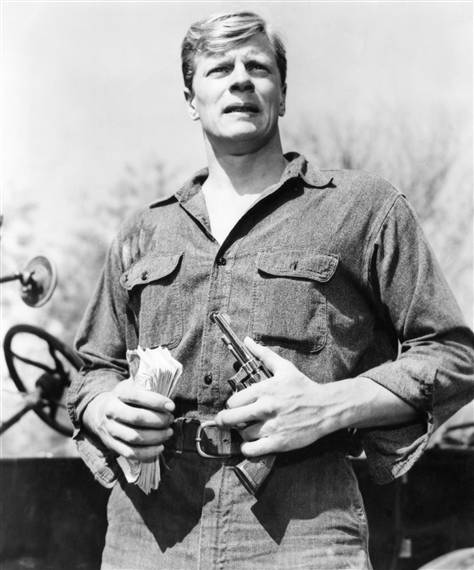
Peter Graves in "The Night of the Hunter"

The reel honored: Blake Edwards (“Experiment in Terror”), Gloria Stuart (“The Old Dark House”), Peter Graves (“The Night of the Hunter”), John Forsythe (“In Cold Blood”), Anne Francis (“Rogue Cop”), Kevin McCarthy (“Invasion of the Body Snatchers”), Patricia Neal (“The Breaking Point”) and Tony Curtis (“Sweet Smell of Success”).

Seeing Graves’ name and the clip from “The Night of the Hunter” (recently re-released by Criterion) reminded me to feature this movie on my site and I’m lucky to have a review to share from critic Michael Wilmington.

MW rightly praises Robert Mitchum’s performance. But for me it is the child actors, Billy Chapin and Sally Jane Bruce, who make the film so moving and resonant.

Peter Graves image from today.msnbc.msn.com
 

Exquisite suspense, anguished obsession and sleek blonde style in ‘Vertigo’

Vertigo/ 1958/Paramount Pictures /127 min.

Since I still have San Francisco on the brain, my next few reviews will highlight Fog City.

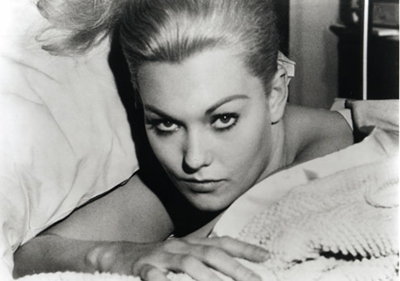
Kim Novak plays two parts, elegant Madeleine and brassy Judy.

On a cold morning several years ago, my colleague Joe bumped into me at Starbucks and said: “You look like Kim Novak in ‘Vertigo’ in that suit,” referring to my fitted gray jacket and skirt. I’d twisted my hair into the best chignon I could manage pre-coffee using the three hairpins I was able to find on my cluttered bathroom shelf.

I was relieved to put off a shampoo for another day, but never thought my impromptu bun had the added effect of contributing to a Hitchcock-blonde vibe.

Alfred Hitchcock was always extremely fastidious about his leading ladies’ wardrobes and for 1958’s “Vertigo” he and costume designer Edith Head agreed that a gray suit would lend a particularly eerie air to Novak’s character, Madeleine Elster. Though stylish, sophisticated and perfectly appointed, Madeleine seems to be struggling to hold onto her sanity.

Her worried husband Gavin Elster (Tom Helmore) taps an old acquaintance and former police detective John “Scottie” Ferguson (James Stewart) to keep an eye on her. Gavin tells Scottie that Madeleine is tormented by family ghosts and that he’s afraid she’ll commit suicide.

Like Madeline, Scottie is a little delicate too, having recently been treated for his fear of heights, brought on by a nasty bout of vertigo. So, he’s taking it easy and hanging out with his upbeat buddy Midge (Barbara Bel Geddes). Reluctant at first, Scottie accepts Gavin’s assignment and, over time, becomes obsessed with saving Madeline, then falls in love with her.

But alas, Scottie can’t provide foolproof protection against her demons because he hasn’t completely conquered his vertigo. After Madeleine takes a fatal tumble, Scottie is inconsolable, until he encounters a shop clerk named Judy Barton (also played by Novak).

Judy bears an uncanny resemblance to his lost love, even if she’s less refined and has the wrong hair color. Scottie decides that’s where hair dye and haute couture come in and he sets his sights on transforming this new object of his affection into the spitting image of Madeleine. “It can’t mean that much to you,” Scottie growls at Judy when she balks at bleaching her hair. But the déjà vu does not go according to plan.

“Vertigo”’s surreal, sometimes unsettling exploration of two troubled minds bears Hitchcock’s distinctive stamps: intense but masked emotion, exquisite suspense, altered identity and disguises, and technical innovation – in this case, the use of forward zoom and reverse tracking to depict Scottie’s vertigo. Intense color and meticulous composition heighten our sense of Scottie’s anguish and frustration. Robert Burks, a longtime Hitchcock collaborator, was director of photography.

Though reviews were mixed upon its initial release (critics complained that the plot was far-fetched), “Vertigo” has since been acknowledged as a crowning cinematic achievement. In 2002, “Vertigo” landed the No. 2 spot on the Sight and Sound critics’ top 10 poll, second only to “Citizen Kane.”  Leonard Maltin calls it: “A genuinely great motion picture that demands multiple viewings.” [Read more…]

‘Vertigo’ quick hit

Vertigo/ 1958/Paramount Pictures /127 min.

James Stewart as Scottie and Kim Novak as Madeleine/Judy are unforgettable in this Hitchcock classic, one of the all-time great noirs. Stewart is an ex-detective with a fear of heights and Novak plays two women – one, a damsel in distress and another who receives the ultimate makeover. Best of all for femmes fatales: Novak’s timeless, elegant wardrobe.

“Vertigo” bears Hitchcock’s distinctive stamps: intense but masked emotion, exquisite suspense, altered identity and disguises, and technical innovation. Intense color and meticulous composition heighten our sense of Scottie’s anguish and frustration. Robert Burks, a longtime Hitchcock collaborator, was director of photography.

Tremendous performances from Stewart, Novak and Barbara Bel Geddes as Scottie’s pal Midge.

‘Don’t Bother to Knock’ a showcase for Monroe’s talent

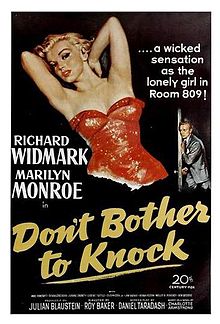
Don’t Bother to Knock”/1952/Twentieth Century Fox/76 min.

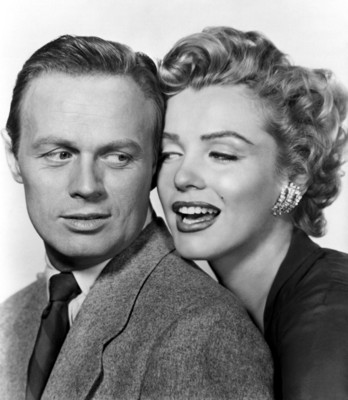
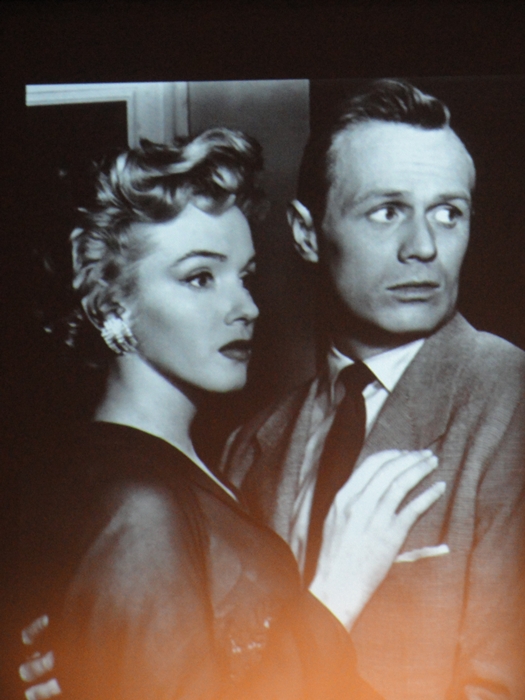
Richard Widmark and Marilyn Monroe

For any fool who still questions Marilyn Monroe’s depth as an actress, “Don’t Bother To Knock” should be required viewing. In this 1952 film directed by Roy Ward Baker and written by Daniel Taradash, Monroe stars with film noir icons Richard Widmark and Elisha Cook, Jr. and entirely holds her own.

She plays Nell Forbes, a vulnerable and mysterious young woman who might be dangerous. Well, if you look at the movie poster, she’s definitely dangerous, though the image (Marilyn wears a shiny bright-red bustier) is a bit misleading — Nell doesn’t wear anything quite that daring. Of course, no matter what she wears, she’s still uber sexy.

Anyway, Nell has recently moved to NYC, from Washington state, to make a fresh start after a long recovery from a broken heart (a pilot who died in World War Two). Her sole contact in the big city is her ever-nervous and slightly creepy uncle (Cook Jr.), an elevator operator at the McKinley Hotel. When a couple staying at the hotel needs a baby-sitter, Uncle Eddie taps Nell for the job. Lurene Tuttle and Jim Backus play the parents; Donna Corcoran is their daughter Bunny.

Once the little girl goes to bed, Nell kills time by trying on Mrs. Jones’ jewelry, perfume and a negligee. She also notices Jed Towers (Widmark) in a room across the courtyard. He’s a pilot in from Chicago trying to patch things up with ex-girlfriend Lyn Lesley (Anne Bancroft), a sultry and svelte singer who performs at the hotel lounge.

Nell and Jed flirt from afar and he eventually joins her in the Jones’ room, bearing a wicked smile and a bottle of rye. It slowly becomes clear that Nell needs more tonic than a handsome cocky stranger with hard liquor can provide. (Rats!) By leading Nell toward help, Jed reveals a side of himself that changes his relationship with Lyn.

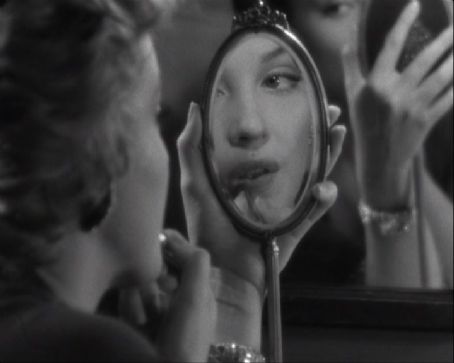
Mirrors (and their suggestion of fractured reality) pop up frequently in film noir.

Though the plot’s quite simple, the film’s strong direction and writing as well as resonant performances from some of the finest actors of the era infuse it with tension that fairly crackles. Luminous, fragile, restless and alluring, Monroe brings an undercurrent of torment and confusion to this memorable role.

Widmark appeals as the insolent yet sympathetic suitor. And the supporting cast is marvelous; in addition to Backus and Tuttle, there’s Verna Felton and Don Beddoe (nosy hotel residents), Willis Bouchey (the hotel bartender), Corcoran as the cute kid, and of course Cook Jr. and Bancroft.

The story is based on the novel “Mischief” by best-selling suspense author Charlotte Armstrong; Taradash wrote the script a year before he won the Oscar for adapting “From Here to Eternity.” “Don’t Bother to Knock” also offers moments of wry humor, such as when Jed asks the bartender if he fights and argues with his wife. The bartender’s deadpan reply: “Some of the time she sleeps.”

If you are a Marilyn fan, you’ll love her even more after seeing this movie and you’ll have definitive proof of her sensitivity and subtlety as an artist from early in career, just in case you ever happen to be chatting with someone who is dismissive of her talent. In 1952, given the way she was marketed and managed, you could forgive an assessment based purely on her physical assets. Nearly 60 years later, however, so much has changed. 😉

Btw, I found a wonderful blog called Blonde & Red. Author Rosanna “loves vintage fashion, red lipstick and Marilyn Monroe” and each week runs Marilyn Mondays. Enjoy!

‘Don’t Bother to Knock’ quick hit

Don’t Bother to Knock/1952/Twentieth Century Fox/76 min.

Great writing and a strong cast (Marilyn Monroe, Richard Widmark, Elisha Cook, Jr., Anne Bancroft) make 1952’s “Don’t Bother To Knock” by Roy Ward Baker a cinematic treasure, but one that is, sadly, often overlooked. Monroe plays a deranged baby-sitter who likes diamonds, perfume and negligees (ok, she’s clearly not completely bonkers) but can’t seem to put her past behind her.

FNB is crazy for Noir City 9

Monroe and Widmark in "Don't Bother to Knock."

Happy Saturday and hello from San Francisco! It’s beautiful weather here and there’s much to see at Noir City 9, the terrific film festival put on by the Film Noir Foundation.

This year’s theme is “Who’s Crazy Now?” described by festival organizers as a lineup of 24 tales of madness, ranging from Oscar-winning performances by Ingrid Bergman (“Gaslight”) and Ronald Colman (“A Double Life”) to obscure rarities, all presented as originally intended, in glorious 35mm. The fest runs through Jan. 30.

Just returned from “Strangers in the Night” by Anthony Mann at the Castro Theatre and will be returning for tonight’s double feature, the little-known “They Won’t Believe Me” and “Don’t Bother to Knock,” the sexy thriller starring Marilyn Monroe.
Between movies, there are so many divine restaurants, I’m afraid I might lose my mind. 😉
#

Murder and martinis with a twist: ‘Laura’ brings us butlers, bodies and banter

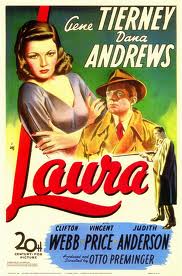
Laura/ 1944/ Twentieth Century Fox/88 min.

“Laura” makes me nostalgic for a life I never led — the adventures of a 1940s career girl living in Manhattan: landing a job on Madison Avenue, buying suits and silk stockings for work, renting a place for $40/month, meeting handsome men, dinner and drinks at the Stork Club, weekend trips to the country.

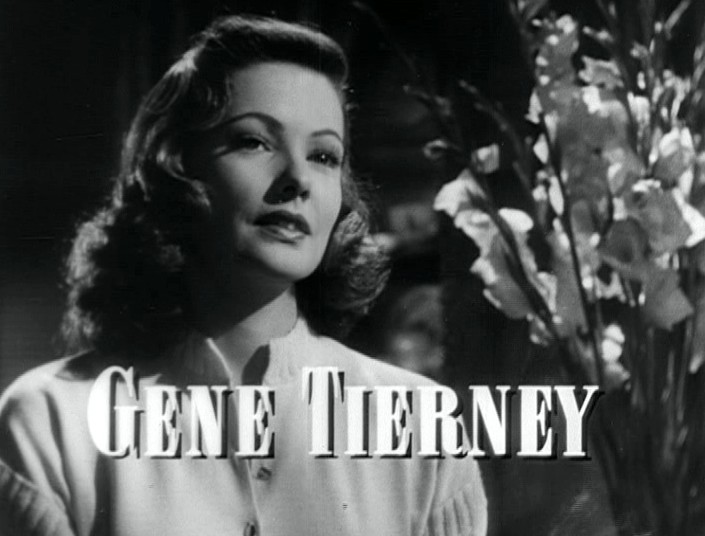
Of course, “Laura” does have a few downsides — murder and mistaken identity, for starters. Seems that turning every head and being the toast of the town, as is the case with the charming and lovely Laura (Gene Tierney), may prove very dangerous. In a series of flashbacks, we learn the details of Laura’s life and it appears that in addition to having many admirers, she attracted an enemy or two as well.

The movie starts with Waldo Lydecker (Clifton Webb) setting the scene. Lydecker, a campy, sybaritic writer, played mentor to Laura as she made a name for herself in advertising and he’s extremely proud of his protegee’s success, especially her popularity with men.

Lydecker is also, quite rightly, very proud of his apartment, with its animal-print chairs and a chunky bathtub equipped with a swiveled tray for his Smith Corona typewriter. I love this Lydecker line: “In my case, self-absorption is completely justified. I have never discovered any other subject quite so worthy of my attention.”

Later, he tells Laura, “For you, a lean, strong body is the measure of a man.” I knew I liked Laura. That doesn’t mean she’s picked the right man, however. She’s engaged to smarmy, sleazy Shelby (Vincent Price) and he clearly doesn’t deserve her.

Once the murder (I’ll keep this a bit vague so I don’t spoil it) is committed, we meet the anti-society, take-no-guff Det. Lt. Mark McPherson (Dana Andrews), who questions the upper-crust types that populate Laura’s world. Mark may lack social graces but he’s definitely a lean, strong body worth rooting for. And Mark definitely falls for Laura.

Amid his investigation, there’s plenty of cocktail conversation, pretentious accents, gorgeous gowns and quirky personalities. And after realizing Murder No. 1 was a bit careless, the killer strikes again.

Beautifully put together and immensely entertaining, “Laura” was nominated for five Academy Awards – art direction, screenplay, director, supporting actor (Webb) and b&w cinematography. Joseph LaShelle won for cinematography.

Based on a popular novel by Vera Caspary, the screenplay by Jay Dratler, Samuel Hoffenstein and Betty Reinhardt, with uncredited help from Ring Lardner Jr., is full of wit and Algonquin-caliber one liners. The wonderfully lush music came from David Raksin.

Otto Preminger served as producer and took over as director after Fox chief Darryl Zanuck pulled Rouben Mamoulian off the job. Preminger replaced the original cinematographer Lucien Ballard with LaShelle.

In 1977, the New Yorker called the movie: “Everybody’s favorite chic murder mystery.” This is no B picture. But that’s not to say it doesn’t have a dark side. With its treatment of sexual obsession, casual betrayal and class structure, “Laura” explores raw themes in a refined setting.

One of noir’s great strengths is that as a genre it very frankly challenged the myth that America was a classless society and pointed out that patrician elegance bred corruption just as much as, if not more than, the streetwise desperation of common criminals. [Read more…]

‘Laura’ quick hit

Laura/ 1944/ Twentieth Century Fox/88 min.

Part polished whodunit, part classic noir, this elegant, urbane thriller stars Gene Tierney in one of her most famous roles. Suspects and surprises abound as do witty one-liners and ’40s high style. Dana Andrews, Clifton Webb and Vincent Price are the men in Laura’s life. Otto Preminger directs.

Rouge tins and compacts and powder, oh my!

Tonight is part two of my Q&A with writer, social historian and author of the Vintage Powder Room, Joan Renner.

Writer Joan Renner

FNB: Where do you find your pieces?
JR: When I first began to collect I could find face powder boxes at flea markets and estate sales, but the Internet has changed that considerably.  I still find items in those places occasionally, but mostly I rely on Internet sites such as eBay and Etsy (and the generosity of friends).
FNB: How were you able to research the original prices and how/where was the makeup typically sold, upon its release?
JR: I’ve used multiple sources to research pieces in my collection.  My favorites are vintage magazines and newspapers.  Via the Los Angeles Public Library I access the Proquest database to view early issues (1880-1980) of the Los Angeles Times online.  Ancestory.com also makes it possible to search vintage newspapers from around the country.
For a peek into the early days of the cosmetics/perfume industry I think that the publication AMERICAN PERFUMER AND ESSENTIAL OIL REVIEW can’t be beat.  I’m fortunate because the Central Branch of the Los Angeles Public Library has a good collection of them.
Then, as now, the pricier brands of makeup would be found at the cosmetics counter of the finer department stores.  Women on a tighter budget could find a wide array of makeup choices at their local drugstore or five and dime.
Many of the early cosmetics companies were regional and either went out of business years ago or they were absorbed by bigger companies.  A few of the largest brands are still in business; for example Coty is over 100 years old and continues to manufacture Airspun face powder in a box designed by Rene Lalique!  The box is festooned with little powder puffs and it is simply gorgeous.  You can purchase it at a drugstore or online for just a few dollars. Amazingly inexpensive for a piece of cosmetics and design history!

Coty Airspun face powder (hard to date this box because the design is virtually unchanged from original)

FNB: Are any still made today/ have you ever worn or used any of your collection?
JR: I’ve used some of the compacts that I’ve collected, but never any of the cosmetics – that would be way too risky.  Over the years cosmetics have contained some toxic, potentially lethal, ingredients.  Early cosmetics contained a wide variety of nasty ingredients such as lead or arsenic.
FNB: How has the merchandising and marketing of makeup and beauty products changed over the last 60 or so years?
JR: Cosmetics companies still advertise in fashion magazines and other magazines geared toward women, but now you have TV and radio advertising, both mediums were in their infancy 60 years ago.  Surprisingly, even in the early days of makeup, there were celebrity endorsements and the celebrity branding of cosmetics.
During the 1910s and 1920s Mary Garden, a Scottish born opera singer, partnered with Rigaud to offer a line of cosmetics and perfumes using her name and image.  Another woman who would leverage her fame into a line of cosmetics was Edna Wallace Hopper.  Hopper was an actress/singer who would never reveal her age.  She said that her birth records had been destroyed in the 1906 San Francisco earthquake!  She was always described as eternally youthful looking, so that was the hook for her brand of cosmetics and skin care.