Quick hit: ‘Strangers on a Train’

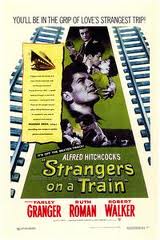
Strangers on a Train/1951/Warner Bros. Pictures/101 min.

Of the noir genre’s many chance meetings on trains, this is tops. Clean-cut tennis star Guy (Farley Granger) and loony playboy Bruno (Robert Walker) get to chatting. Turns out, they both have thorns in their sides, in the form of Guy’s wife and Bruno’s father. Bruno suggests each of them murder the other’s nemesis and shortly after follows through with his end of the bargain. One of Hitchcock’s best.

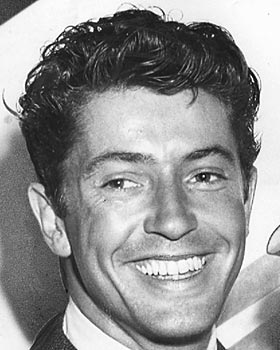
Farley Granger (1925-2011): A face born for film noir and a movie immortal

By Michael Wilmington

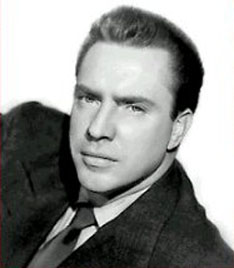
Farley Granger

Farley Granger, who died at 85 on March 27, was the darkly handsome, sensitive-looking lead in four indisputable noir classics: Nicholas Ray’s “They Live by Night” (1949), Anthony Mann’s “Side Street” (1950), and by Alfred Hitchcock: “Rope” (1948) and “Strangers on a Train” (1951).

Blessed (or sometimes cursed) with pretty-boy looks, dark curly hair and an expression that could vary from bruised innocence and outright anguish to wary bemusement and dissolute sadism, Granger became a Hollywood movie star at 18, right out of North Hollywood High, when Samuel Goldwyn decided to sign him and groom him.

The teenager was cast in two Lewis Milestone World War II movies, “North Star” (1943) and “The Purple Heart” (1944). Goldwyn signed him again when Granger returned from WWII service in 1948.

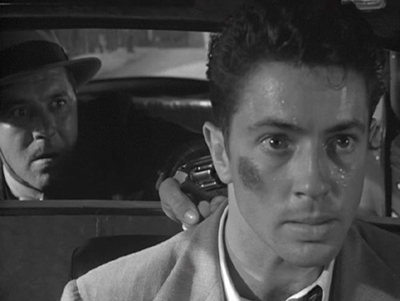
It’s his noirs that make Farley Granger a movie immortal. We remember him best as the murderous but conscience-plagued college boy modeled on thrill-killer Nathan Leopold in “Rope”; as the desperate young husband caught in a web of crime in “Side Street”; as the bank-robbing outlaw, Bowie, part of a Bonnie-and-Clyde team with Cathy O’Donnell’s Keechie in “They Live By Night” (O’Donnell also co-starred with him in “Side Street”); and as socially ambitious tennis star Guy Haines, bedeviled by the persistent “criss-cross” killer, Bruno Anthony (the magnificently deranged Robert Walker), in Hitchcock’s masterpiece “Strangers on a Train.”

After a minor noir “The Naked Street” and a lush period crime drama “The Girl in the Red Velvet Swing” (both 1955), Granger returned far less often to the big screen, though he remained a permanent part of Hollywood’s historical landscape.

And of the international film landscape. One of his finest performances was as the handsome, seductive and amoral Austrian Army officer, Lt. Franz Mahler, the wastrel who ruins Alida Valli’s life, in Luchino Visconti’s great operatic Italian period drama from 1954 “Senso” – a role that Marlon Brando had wanted and read for.

(“Senso” has just been released in a splendid Criterion edition, complete with a documentary, interviews and a bonus disc of the English-language version, “The Wanton Contessa,” with Granger’s voice.)

Farley Granger starred in "Side Street" from 1950 directed by Anthony Mann.

Sensitive or troubled in most of his famous parts, Granger may have suffered in ’50s Hollywood, a time and place where his bisexuality – hinted at in his “Rope” and “Strangers” roles – could be something of a career killer. (Among his lovers: “Rope’s” screenwriter Arthur Laurents, composer-conductor Leonard Bernstein, Shelley Winters and Ava Gardner.) [Read more…]

On the radar: Noir fest hits the Egyptian, get into Cain’s brain on ‘Mildred Pierce’ tour, Bette and Joan on stage

There’s nothing like a bunch of noirs in my back yard to put me in a good mood!

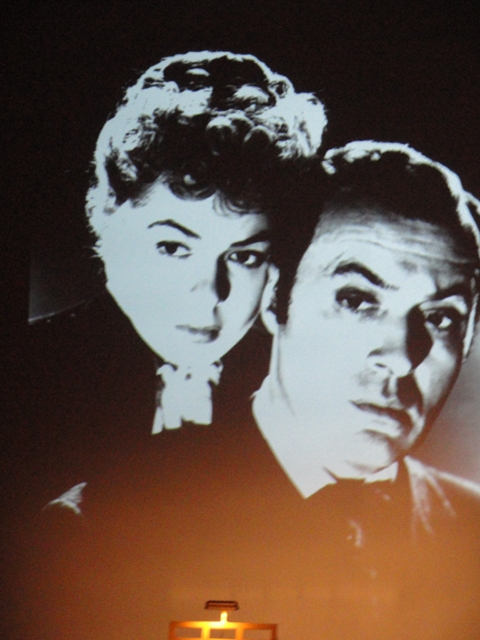
Ingrid Bergman and Charles Boyer star in "Gaslight" from 1944.

So I’m very excited that the NOIR CITY: HOLLYWOOD film festival, presented in collaboration with the Film Noir Foundation, returns to the Egyptian Theatre on April 1.

Now in its 13th year, the program features several new prints preserved by the foundation and the UCLA Film & Television Archive. The series is hosted by the foundation’s Eddie J. Muller and Alan K. Rode. For more info, visit: http://bit.ly/ebV4uM.

There is much to see at this year’s fest (28 films total) and top on my viewing list are:

“High Wall” (1947, Curtis Bernhardt)

“The Hunted” (1948, Jack Bernhard)

“The Two Mrs. Carrolls” (1947, Peter Godfrey) and “The Dark Mirror” (1948, Robert Siodmak)

“Journey into Fear” (1943, Orson Welles)

“Kiss Tomorrow Goodbye” (1950, Gordon Douglas)

“A Woman’s Secret” (1949, Nicholas Ray)

“Caught” (1949, Max Ophuls)

“Framed” (1947, Richard Wallace)

“Gaslight” (1944, George Cukor) and “My Name is Julia Ross” (1945, Joseph H. Lewis)

One way ticket to Noirville: Viewers of HBO’s “Mildred Pierce,” directed by Todd Haynes, may be interested to know about a bus tour of the Los Angeles venues that inspired James M. Cain, author of the novel on which the series and the 1945 film were based. Read Sean Macaulay’s story at: http://bit.ly/enRyfV.

London anyone? According to Playbill: “London’s Arts Theatre has announced details of its summer program, which will include the world premiere of Anton Burg’s Bette & Joan, which will star Greta Scaachi and Anita Dobson in the title roles of Bette Davis and Joan Crawford, respectively.” Read more at: http://bit.ly/f8kghH.

Huston explores ‘Asphalt Jungle’ with an unflinching eye

The Asphalt Jungle/1950/MGM/112 min.

“The Asphalt Jungle” was a departure in that it humanized its villains.

“The Asphalt Jungle” was a departure in that it humanized its villains.

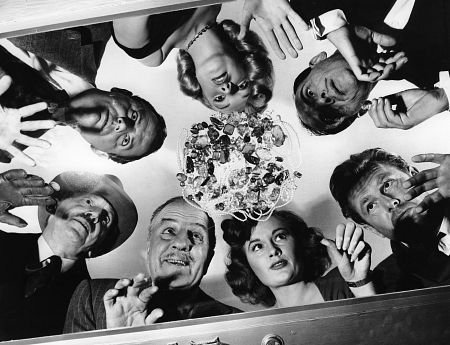
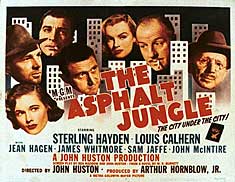
“The Asphalt Jungle” from 1950 by director John Huston is rightly considered a masterpiece. Excellent storytelling and an outstanding cast, including Sterling Hayden, Louis Calhern, Sam Jaffe, Jean Hagen and Marilyn Monroe, have helped it stand the test of time.

But its stark, unwavering realism is not for everyone. Louis B. Mayer, head of MGM, where Huston made the movie, had this to say about the flick: “That ‘Asphalt Pavement’ thing is full of nasty, ugly people doing nasty things. I wouldn’t walk across the room to see a thing like that.”

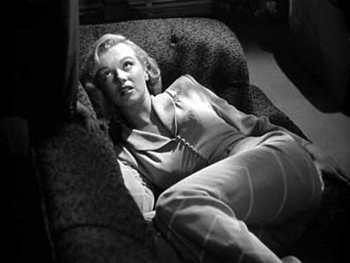
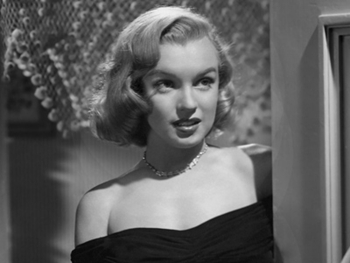
This small but pivotal role helped put Marilyn on the map.

This small but pivotal role helped put Marilyn on the map.

Um, did he not see luminous and fragile Monroe as mistress Angela Phinlay? Huston portrays a gang of thieves as flawed humans trying to make a living. “We all work for our vice,” explains menschlike mastermind Doc Erwin Riedenschneider (Jaffe). Recently released from jail, Doc has planned every detail of a $1 million jewel robbery and seeks to round up the best craftsmen he can find for one last heist.

A fat wallet means Doc can head to Mexico and court all the nubile girls he can handle. Dix Handley (Hayden), a tough guy with swagger to spare, hopes to pay his debts and return to his beloved horses in Kentucky. Getaway driver Gus Minissi (James Whitmore) is sick of running his dingy diner. Bookie ‘Cobby’ Cobb (Marc Lawrence) covets booze. Safecracker Louis Ciavelli (Anthony Caruso) has a wife and kid to support. Alonzo ‘Lon’ Emmerich (Calhern) is a wealthy but overspent lawyer who wants to be solvent again.

“You may not admire these people, but I think they’ll fascinate you,” says Huston in an archive clip included on the DVD. They pull it off, but what heist would be complete without a doublecross and crossing paths with the police?

In this macho, man’s-world movie, there is alas no femme fatale. But rest assured there are flawed women aplenty. Hagen plays the neurotic Doll, a struggling performer, and her vice is Dix. Monroe, as Lon’s barely legal girlfriend, orders mackerel for his breakfast, flips through travel magazines and is fond of saying, “Yipes!” Lon’s bed-ridden wife May (Dorothy Tree) wishes Lon were home more often. Teresa Celli plays dutiful wife Maria Ciavelli.

Said Huston of Marilyn: “She had no techniques. It was all the truth, it was only Marilyn.” (He later directed her in “The Misfits.”)

Said Huston of Marilyn: “She had no techniques. It was all the truth, it was only Marilyn.” (He later directed her in “The Misfits.”)

The actors complement each other deftly. Jaffe, both sage and seedy (when he lusts after pretty young things) is particularly entertaining; he nabbed an Oscar nom for best supporting actor. Helping his rich characterization is the fact that he gets some terrific lines, for instance: “Just when you think you can trust a cop, he goes legit.”

The movie is full of such dry asides. The whip-smart script, by Huston and Ben Maddow, also scored an Oscar nom. W.R. Burnett‘s novel provided the source material, though the book told its story from the police point of view; Huston and Maddow flipped the perspective. Huston was also nominated for best director; Harold Rosson for best B&W cinematography. (None won.)

“Asphalt Jungle” is the only noir I know of that’s set not in NYC, LA, Chicago or London, but in a smaller city in the Midwest, usually seen as the bedrock of integrity, and it’s fun to try to figure out exactly where this is happening.

The dark film was a departure for MGM—known for upbeat, lavish, escapist fare—but the studio’s production chief Dore Schary ushered in a period of social consciousness for the company, notes Drew Casper, film scholar and author of “Post-War Hollywood Cinema 1946-1962,” in his DVD commentary.

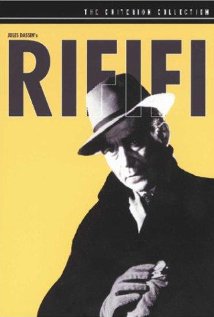
Rififi posterAs for the look of the film, Casper points out that in addition to elements of Expressionism (fractured frames and diagonals or horizontals blunting verticals to create tension), Huston’s experience filming war documentaries as well as the work of Italian Neo-realism (1945’s “Open City” by Roberto Rossellini and Vittorio De Sica’s “The Bicycle Thief” from 1948) also influenced his visuals.

In turn, Huston’s groundbreaking movie clearly had an impact on the great Jules Dassin, director of 1955’s “Rififi,” one of the best of all noirs. “Asphalt Jungle” was remade three times: “Badlanders” (1958), “Cairo” (1962), and “Cool Breeze” (1972). None is considered as good as the original.

Dry but never dull, “Jungle” is a straight-shooting portrait that undermines Hollywood’s often-moralizing and hypocritical gloss. “Crime is only a left-handed form of human endeavor,” as Lon so matter-of-factly puts it. Yipes!

‘The Asphalt Jungle’ quick hit

The Asphalt Jungle/1950/MGM/112 min.

John Huston‘s classic heist movie, which earned four Oscar noms, broke new cinematic ground by humanizing the criminals rather than writing them off as one-dimensional cheats. A suspenseful ride with stellar performers. The top-notch cast includes Sterling Hayden, Louis Calhern, Jean Hagen, James Whitmore, Sam Jaffe and an up-and-coming young starlet named Marilyn Monroe.

‘Mildred Pierce’ by Haynes savors subtext of Cain’s novel

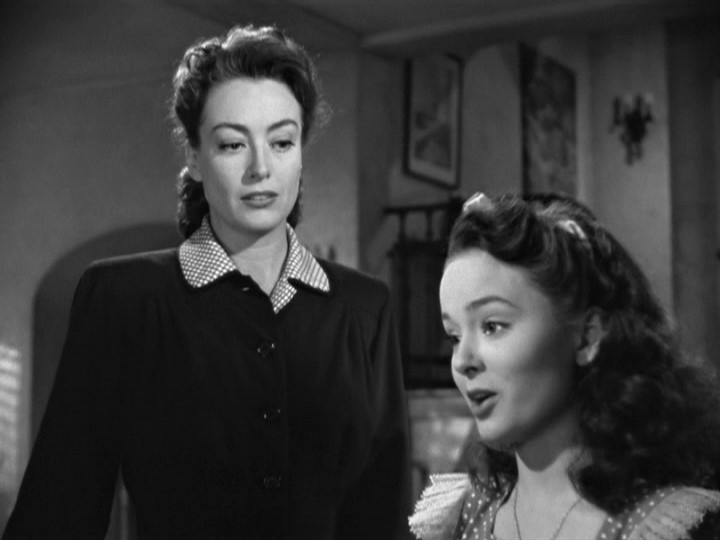
Crawford and Blyth

HBO’s “Mildred Pierce” mini-series, directed by Todd Haynes and based on James M. Cain’s 1941 novel, starts this Sunday.

In director Michael Curtiz’s 1945 movie version of the book, Joan Crawford won the Oscar for her portrayal of the title role in the ultimate story of a self-sacrificing mother and her ungrateful child, Veda (Ann Blyth). Mildred’s hard-earned success as a restaurateur allows her to support not only her family but also her aristocratic and cash-poor love interest Monty Beragon (Zachary Scott).

In Haynes’ mini-series, Kate Winslet stars as Mildred, Guy Pearce plays Monty and two actresses share the Veda role: Morgan Turner as the girl and Evan Rachel Wood as the young woman. Haynes and Jon Raymond wrote the teleplay.

In many ways, the series, which follows the book more faithfully than the 1945 movie and covers nearly 10 ten years in the characters’ lives, is a delight to watch. Depression-era Southern California is beautifully recreated and shot by Edward Lachman. Carter Burwell’s original music is spot-on as is Ann Roth’s costume design. And the acting is excellent, particularly the leads.

Whereas Crawford’s Mildred is stoic and dignified, Winslet’s is sensitive, wistful, often tentative and unsure of herself. Her expressive features suggest her mounting anger, guilt and desperation as her business grows but her relationships deteriorate.

Early on in the series, Winslet’s Mildred identifies in her daughter a “pride or nobility I thought I had” and we glimpse the complexity and closeness of her bond with Veda. The mother-daughter relationship in Haynes’ five-hour version is perhaps more nuanced than in Curtiz’s film.

Pearce easily inhabits the playboy scoundrel Monty and Wood sizzles as the junior miss femme fatale. As the story unfolds, we learn that Mildred and Veda also have very similar taste in men. This year’s supporting actress Oscar winner Melissa Leo and Mare Winningham are quite good as Mildred’s friends.

A disappointment, however, is James LeGros’ insipid performance as Pierce family “friend” Wally Burgan. In Curtiz’s version, the role as played by Jack Carson – conniving and sly, but charming – was one of the movie’s many strengths.

Another downside is the pacing, which is far too slow. It would have benefited from shaving about an hour, especially in the beginning. But then if Haynes’ aim was to be true to every page of the book, he has succeeded.

I prefer Curtiz’s original because it is canonical film noir, in tone, look and story. Granted, Cain’s book was altered because in 1940s Hollywood, immorality was never allowed to triumph. Instead of the evil-doers leaving California to begin a new life in New York, one is fatally shot and the other eventually is punished. The murder sets the story, told via flashback, in motion and lends an edgy suspense.

Still, Haynes did not set out to make a noir; apparently his aim is to explore the subtext and subtleties in Cain’s novel. Cain was, arguably, sympathetic toward his feisty protagonist (what choice does she have but to establish independence and security, given the weak and deceitful men she has to choose from?). But she pays a dreadful price for doing so and the book decries materialism, the class system and social climbing. As for Cain’s ultimate take on Mildred’s power, in Hayne’s work, there is fodder for both sides of the argument.

Warner Bros. image of 1945 “Mildred Pierce”

Film noir’s feline stars: The cat in ‘Femme Fatale’

More on the most famous kitties in film noir

The Cat on the Control Panel in “Femme Fatale” 2002

Name: Funk Soul Furrier

Character Name: Clouzot the Control Room Cat

Funk Soul Furrier has long been famous in the south of France.

Bio: Funk Soul Furrier is a part-time actor and full-time DJ, creating the intense, kit-kat rap that critic Naught DeClawde calls “the edgiest sound yet from the alley.” His album “No Mo’ Kow-Tow to the Bow-Wow” sold 24 million copies worldwide.

With his sultry good looks and haute high-tech, Funk Soul was a natural to play Clouzot the Control Room Cat, a key staffer at the Palais du Cinema, the primary theater of the Cannes Film Festival, and setting for the suspenseful opening of “Femme Fatale.”

While he may be new to American audiences, he has long been famous in the south of France, particularly in Nice, where he owns and runs Le club de Chat et de Souris (The Cat and Mouse Club).

Since playing in “Femme Fatale,” he has landed starring roles in several high-concept cat-food commercials as well as cameos in a handful of Polish art films.

“Femme Fatale” director Brian de Palma said of Funk Soul’s performance: “His honesty and emotion just knocked me out. He did an amazing job with very little input from me.”

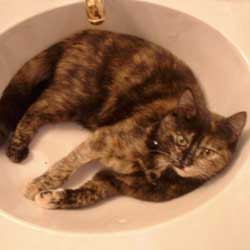
Image from http://catsinsinks.com

Film noir’s feline fatales, tough tom cats: A new feature

Of the many visual symbols in film noir, the cat is one of the most elegant and expressive. Sitting in a doorway, watching and waiting, or sprawled contentedly on a chaise longue, these haughty creatures convey the quintessential femme fatale attitude: “If I deign to take you on, I’ll win.”
x
Cats are smart, nimble and fastidious. They spend hours grooming themselves and, unlike dogs, they have no work ethic. Enough said. In between doting on my cat, I’ve done a little research so I can start a new feature on the most famous kitties in film noir.
x
The Cats in “This Gun for Hire” 1942
x
Names: Fluffy Taylor and Tab Burton
x
Character Names: The Stray, Toughie

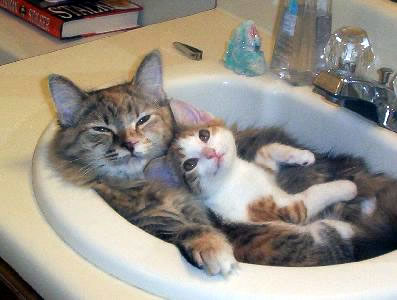
The happy Hollywood couple

Bios: “Cats bring you luck,” says Philip Raven (Alan Ladd) in 1942’s “This Gun for Hire.” Raven’s first good-luck charm is The Stray (Fluffy Taylor), a petite, violet-eyed beauty, who wanders through his window first thing in the morning. Despite being a cold-hearted hitman, Raven gives her milk and protects her from the nasty maid, Anna (Pamela Blake).

The second “charm” is a tomcat named Toughie (Tab Burton). But Toughie doesn’t fare as well as The Stray. Philip Raven happens to be a psychopath and he turns on Toughie in a deadly betrayal. Well, maybe the name Raven didn’t bode too well for feline friendship. (Off screen, however, Burton and Ladd were great chums. It was Ladd’s first major movie role and he welcomed Burton’s advice on acting.)
x
And contrary to some accounts, the feline stars of “This Gun for Hire” never once had a catfight on the set. Just the opposite: While working together on this film, British imports Taylor and Burton fell madly in love. Seven years Burton’s junior, Taylor had been an established star in England since kittenhood.
x
Burton was born in Wales and studied acting at Oxford University. Following their U.S. debut in “This Gun for Hire,” the pair soon became the “it” couple among Hollywood’s feline set, co-starring in “Catopatra,” “The Taming of the Mew” and “Who’s Afraid of Virginia Puss?” They were also known for their lavish, jet-set, cream-and-catnip lifestyle.
x
They married in 1945, divorced in 1955, remarried in 1957 and divorced for a second time in 1962. After they finally parted, Burton’s career faltered and he passed away in 1964. When Burton died, the ever-popular Taylor referred to him as “the love of my life and my very best friend.”
x
As their close friend Morris once said of them: “He gave her class. She gave him sex.” And they gave each other Fancy Feast Salmon.
x
xxx

‘D.O.A.’ reveals the ultimate inspiration to solve a murder: when it’s your own

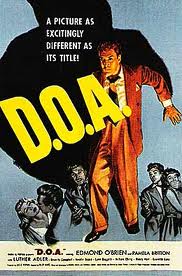
D.O.A./1950/United Artists/83 min.

“I don’t think you fully understand, Bigelow,” says a doctor to his shocked patient, “you’ve been murdered.”

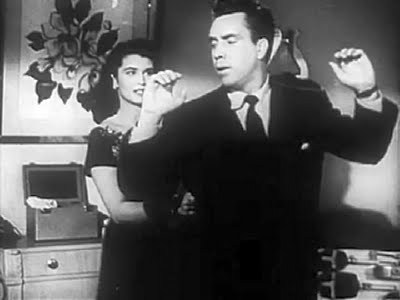
Edmond O’Brien is doomed in “D.O.A.”

This is the premise for 1950’s “D.O.A.,” directed by Rudolph Maté, a classic noir about a standup, solid guy from Banning, Calif., named Frank Bigelow (Edmond O’Brien) who, while on a trip to San Francisco, learns he has been poisoned with a time-released fatal toxin. He has just a few days to find his murderer. And here he thought it was just a hangover.

It’s particularly bad luck because Bigelow hasn’t served time, he doesn’t play the horses, he’s not eyeing easy money. He is a self-employed accountant in a small town near Palm Springs minding his own business. True, he does like hard liquor, is a bit of a skirt chaser and he’s on the fence about committing to doting girlfriend Paula Gibson (Pamela Britton), but those are minor flaws in the noir scheme of things.

D.O.A posterEven though Bigelow is dying, his genetic tough-guy instinct kicks as he abandons his ledger book and adding machine to follow clues, talk tough, tote a gun and chase his prey. Clearly, he missed his calling as a macho gumshoe who could give Phillip Marlowe or Sam Spade a run for their money.

Checking in via phone calls to Paula, who also happens to be his secretary, he learns that a Mr. Phillips, an importer-exporter in Los Angeles, has been urgently trying to contact him. Bigelow returns to LA but, before he can probe for info, Phillips takes a flying leap from a tall building. So, Bigelow taps Phillips’ inner circle: his brother Stanley (Henry Hart), his wife (Lynn Baggett), his secretary Miss Foster (Beverly Garland, credited as Beverly Campbell), and co-worker Halliday (William Ching).

Turns out that Bigelow’s connection to these Angelinos is that six months prior, he notarized a bill of sale for a shipment of iridium. Phillips bought the stuff from a mysterious man named George Reynolds.

Marla (Laurette Luez) gives Frank Bigelow (Edmond O'Brien) trouble in D.O.A.

Marla (Laurette Luez) gives Frank Bigelow (Edmond O’Brien) trouble in D.O.A.

While working to track Reynolds down, Bigelow encounters a sultry and sullen model Marla Rakubian (Laurette Luez), a man known only as Majak (famed stage actor Luther Adler) – clad all in white and with an indeterminate foreign accent, which instantly makes him suspect in Tinseltown terms –  and a trio of heavies led by raging psychopath Chester (Neville Brand, in his first movie). Though Brand might seem like a miscreant plucked from a dingy alley, he was in fact a WW2 vet, who had received numerous awards, including the Purple Heart.

As he narrows down the suspects, Bigelow also realizes that Paula is The One and the scene where he professes his love is touching. He eventually busts the bad guy in an eye-for-an-eye kind of way, but, as we knew from the start, Bigelow is a goner. No plot spoilers here.

Director Maté, who was the cameraman on foreign classics “Vampyr” and “The Passsion of Joan of Arc” as well as “Foreign Correspondent” and “Gilda,” tells a riveting story. Aided by Ernest Laszlo’s cinematography, Maté creates a mood that is both hard-boiled and slightly surreal. The storyline becomes so lusciously serpentine, with perilous curves and hairpin turns, it rivals Howard Hawks’ “The Big Sleep” from 1946 for the most convoluted plot in all of film noir.

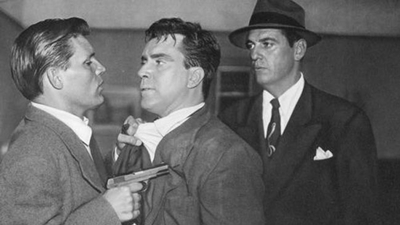
Chester (Neville Brand) gives Edmond O'Brien some more trouble. O'Brien is definitely not having a good day.

Chester (Neville Brand) gives Frank (Edmond O’Brien) some more trouble. Frank is definitely not having a good day.

I especially like the scenes in which Bigelow leaves the comfort of dancing the rhumba and downing a few drinks in the upscale St. Francis Hotel to visit the noisy, smoky Fisherman club, where he watches a bebop jazz band play its all and chats with “jive-crazy, high-society” Jeannie (Virginia Lee), an elegant blonde who turns out to be a mere red herring.

O’Brien, with his good looks and strapping self-confidence, plays the determined Bigelow as every man’s take-charge fantasy. Britton as Paula is the kind of girl next door that bad-ass femmes fatales played by actresses like Barbara Stanwyck and Joan Bennett would eat for breakfast. Her innocence is nicely countered by a rich array of dastardly, devious characters.

Clarence Greene and Russell Rouse wrote the original screenplay, perhaps inspired by a 1931 German film “Der Mann, der seinen Mörder sucht”/ “Looking For His Murderer” directed by master noir creator Robert Siodmak with writing help from the great Billy Wilder. (In “D.O.A.” Rouse’s name, along with Laszlo and assistant director Marty Moss, appears on the guest register of the Allison Hotel in Los Angeles.)

The movie was remade in 1969 as “Color Me Dead” and in 1988 with Dennis Quaid, Meg Ryan and Charlotte Rampling. The original is the best of the lot. Watch it and you’ll see why.

‘D.O.A.’ quick hit

D.O.A./1950/United Artists/83 min.

Edmond O’Brien plays the frantic but determined Frank Bigelow who spearheads the hunt for a killer – his own – in this riveting noir from director Rudolph Maté. You’d be freaked out too if you discovered you’d been poisoned and had to track the culprit before it’s too late. Talk about deadline pressure!