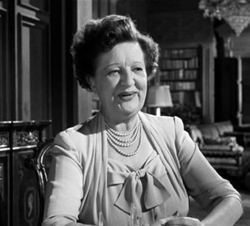
Quick hit: ‘The Damned Don’t Cry’

The Damned Don’t Cry/1950/Warner Bros./103 min.

A quintessential film noir and one of Crawford’s crowning roles. She plays Ethel Whitehead, a housewife stuck with her dreary, damaged hubster (Richard Egan). Ethel leaves him and tries to build a better life for herself in New York City. Short on actual career skills, her path instead leads her to become a streetwise moll who takes on the mob and never once musses her hair. Along the way, she mixes business and pleasure with David Brian, Kent Smith and Steve Cochran. Vincent Sherman directs.

Film noir’s feline stars: The cat in ‘The Third Man’

More on the most famous kitties in film noir

The Cat in “The Third Man” 1949

Name: Klaus W. Kuddelmann

Character Name: Little Harry

Klaus Kuddelmann's music deeply impressed Orson Welles and they became close friends.

Bio: Klaus W. Kuddelmann grew up in a family of musicians. His father Hans was a classically trained violinist and his mother Clara was an operatic soprano of considerable acclaim.

Young Klaus first performed at the age of 6 weeks, playing “Eine Kleine Nacht Musik” to a packed house at the Theater an der Wien in Vienna.

While studying at the Mewlliard School in New York after World War Two, he made the acquaintance of the great actor/director Orson Welles. Upon accepting the part of the nefarious double-dealer Harry Lime in “The Third Man” (1949), Welles insisted that Kuddelmann be cast as his feline sidekick.

Off camera, Welles and Kuddelmann reportedly holed up in Welles’ Vienna hotel room, eating and drinking into the wee hours of the morning. As a musical purist, Kuddelmann abhorred the film’s famous zither music – calling it “excruciatingly middlebrow” – and made a point of hissing and clawing at Anton Karas.

After the “The Third Man,” Kuddelmann returned to music and enjoyed great success on the European concert circuit. He died in 1972; his obituary listed 19 children and 358 grandchildren.

Image from http://catsinsinks.com

Arthur Lyons Film Noir Festival starts tonight!

The 11th annual Arthur Lyons Film Noir Festival starts tonight in Palm Springs.

I am thrilled to be here and, since it’s about 95 degrees, I’m hoping to go for a quick dip before heading to the opening night movie, “Experiment in Terror,” from 1962 by Blake Edwards. Actress Stefanie Powers will attend the screening.

The fest runs through Sunday. I will be posting updates on Facebook and Twitter.

Coen Brothers’ ‘Man’ is darkly moody, handsomely shot

The Man Who Wasn’t There/2001/Good Machine, et al/116 min.

Scarlett Johansson plays a high-school student in this 2001 film.

What would life be without a dark and handsome companion at night? One I highly recommend is “The Man Who Wasn’t There” by master filmmakers Joel and Ethan Coen. This homage to vintage film noir, gorgeously shot in black and white by cinematographer Roger Deakins, conjures a guy you’ll always remember.

Set in 1949, the film introduces us to a choice cast of characters. Top of the list is introspective and blasé Ed Crane (Billy Bob Thornton), who has fallen into a comfortable, if dull, life in Santa Rosa, Calif. He’s fond of his wife Doris (Frances McDormand), both cynical and oddly sweet, but there’s never been any passion between them.

To earn a living, Ed cuts hair with his brother-in-law Frank (Michael Badalucco) at the family barbershop. (“I don’t talk much,” Ed tells us. “I just cut the hair.”) Doris is a bookkeeper at Nirdlinger’s, the town’s big department store, and together they have it “made” – after all, Ed points out dryly, they have a garbage grinder built into the sink.

When he’s not working or tossing scraps down their fancy drain, Ed kills time mainly by smoking and taking care of Doris after she’s had too much to drink, which is quite often. Doris passes the hours of their lives by playing bingo and having an affair with her boss at Nirdlinger’s, Big Dave Brewster (James Gandolfini), a blustery WW2 vet. Dave’s married to Ann Nirdlinger (Katherine Borowitz), whose family owns the store. Ed knows about the affair but, as he does with everything, takes it in stride.

Ed’s life changes forever the day that unctuous big-mouth businessman Creighton Tolliver (Jon Polito) walks into the barbershop as it’s about to close, gets a very quick trim and happens to mention that he’s in town trying to raise money to invest in drycleaning, which he’s convinced is “the biggest business opportunity since Henry Ford.”

Ed decides later that night that he wants in on the putative drycleaning empire and figures he can raise the requisite $10,000 by anonymously blackmailing Dave. No sooner does Ed get the cash than Tolliver takes off with it. And because Tolliver is so quick to bend ears and beg for money, Dave gets to the bottom of the blackmail scheme and intends to get his money back.

What Dave doesn’t count on is that Ed’s mild facade hides nerves of cold steel; when cornered, Ed’s response to him is quick, instinctive and deadly. But, after news breaks of Doris and Dave’s affair, Doris is arrested for Dave’s murder. [Read more…]

Palm Springs hosts 11th annual Arthur Lyons Film Noir Festival

It’s been so hot and sunny this week, I’m in definite need of some cool darkness and poolside lounging. For me, that will come next week in the form of the 11th annual Arthur Lyons Film Noir Festival in Palm Springs. The fest runs May 12-15. I like the fact that when I was calling for info on accommodation, I was told repeatedly, “This is a desert town, of course we have a pool.”

Stefanie Powers will appear at the fest's opening night film, "Experiment in Terror."

Along with “an eclectic mixture of landmark and obscure vintage movies from the classic film noir era,” the festival will host a number of special appearances, such as actress Stefanie Powers, a star (along with Lee Remick, Glenn Ford and Ross Martin) of the opening night film “Experiment in Terror” from 1962, directed by Blake Edwards.

Critic Leonard Maltin gave the movie three stars, calling it “realistic, unsentimental, with convincing performances by Remick and Martin. Great Henry Mancini score, good use of San Francisco locations.”

Other fest guests include actress Julie Adams, actress/dancer Barrie Chase, actress Jeanne Cooper, actress Diane Baker and actor/producer Norman Lloyd.

The rest of the movies are: “The Underworld Story” (1950, directed by Cy Endfield); “Six Bridges to Cross” (1955, Joseph Pevney); “A Kiss Before Dying” (1956, Gerd Oswald); “Cape Fear” (1962, J. Lee Thompson); “99 River Street” (1953, Phil Karlson); “Plunder Road” (1957, Hubert Cornfield); “Loophole” (1954, Harold Schuster); “Mirage” (1965, Edward Dmytryk); “Crashout” (1955, Lewis R. Foster); “Saboteur” (1942, Alfred Hitchcock) and “The Damned Don’t Cry” (1950, Vincent Sherman).

Now I just need to come up with a few ensembles that qualify as desert chic. 😉

Stefanie Powers image from TV Guide.com.

Noir delights abound at TCM Classic Film Festival

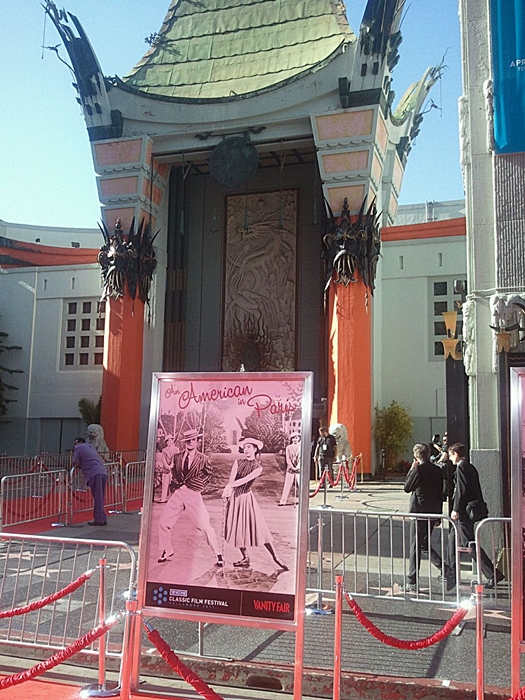
"An American in Paris" opened the festival.

Four days of devouring big-screen classics has left me deliciously sated! At least until my next film fest.

About 25,000 people attended this year’s sold-out TCM Classic Film Festival in Hollywood, which featured more than 70 films and special events. Stars who made appearances included Julie Andrews, Alec Baldwin, Drew Barrymore, Warren Beatty, Leslie Caron, Kirk Douglas, Angela Lansbury, Hayley Mills, Peter O’Toole, Jane Powell, Debbie Reynolds and Mickey Rooney.

Before the screening of 1940’s “Fantasia,” in Grauman’s Chinese Theatre on Sunday night, TCM’s Bob Osborne announced that there will be a third fest in 2012. He also announced a new event: the TCM Classic Cruise, Dec. 8-12, 2011, a five-day/four-night event aboard Celebrity Millennium. The cruise will sail from Miami to Key West and Cozumel.

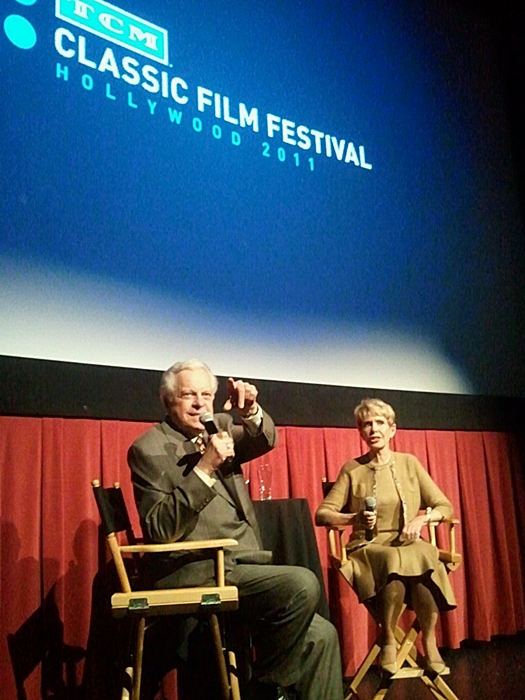
Most important for me was getting my noir fix and, happily, dark delights abounded. For example, there was the chance to see Nicholas Ray’s “Bigger Than Life” with James Mason as a teacher struggling with an addiction to prescription cortisone. As co-star Barbara Rush told Osborne before the screening, this 1956 psychological drama has been programmed in several film noir festivals “because it’s so dark and so scary.”

Bob Osborne talks with Barbara Rush.

As you’d expect from Ray, it’s very well done and the performances are excellent. Despite telling the audience that she was “very old,” Rush is very lively. When Osborne asked her to talk about her leading men, she replied, “I had them all!”

Another noir high point was meeting the charming Marya of Cinema_Fanatic and chatting with renowned author Foster Hirsch at the screening of 1953’s “Niagara,” directed by Henry Hathaway and starring Marilyn Monroe (as a murderous wife), Joseph Cotten (as her off-kilter husband) and Jean Peters (as a plucky, pretty brunette). Hirsch told the audience that film noir can absolutely be in color, describing “Niagara” both as a “minor masterpiece” and a “pulp-fiction paperback come to life.”

He pointed out the contrast in lighting between the bright exteriors and dark interiors, ending with the comment: “If you’ve come for laughs and joyous uplift, you’ve come to the wrong place.”

Also a treat was seeing “The Man with the Golden Arm” from 1955. Adapted from a Nelson Algren novel, it’s a story about drug addiction in a gritty urban setting, by master noir director Otto Preminger. I’d seen it before but, as with “Niagara,” the big screen really intensifies the storytelling. It is definitely Frank Sinatra’s best performance and one of Kim Novak’s finest as well. In attendance were Preminger’s daughter Vicki Preminger and Sinatra’s daughters Nancy Sinatra and Tina Sinatra. Rounding out the noir programming were “The Third Man” (Carol Reed, 1950), “Gaslight” (George Cukor, 1944) and “Taxi Driver” (Martin Scorsese, 1976).

Other films with noir elements included Orson Welles’ masterpiece “Citizen Kane” (1941), “The Tingler” (1959), “The Mummy” (1932), “Went the Day Well (1942) and “Whistle Down the Wind (1961). (I saw all but “Kane,” which I’ve seen several times before.)

Ana Alexander and Anya Monzikova of Cinemax's new series, "Femme Fatales," which starts May 13.

The festival also honored master composer Bernard Herrmann, who scored  “Citizen Kane” and “Taxi Driver” as well as “Psycho,” “Vertigo,” “Cape Fear” and many others.

On the neo-noir front, I’ll be excited to see Cinemax’s upcoming “Femme Fatales” anthology series “about powerful, sexy and dangerous women” starring Ana Alexander and Anya Monzikova, both of whom walked the fest’s red carpet to promote show.

The first of 13 stand-alone episode starts May 13 and I hope to catch up with the actresses sometime soon.

‘The Third Man’ delivers stellar suspense, performances both haunting and dazzling

TCM’s Classic Film Festival starts tomorrow and I’m fretting about packing in all the viewing and events. Definite draws are the classic noirs “The Third Man,” which screens at 9 a.m. Saturday; Henry Hathaway’s “Niagara” from 1953, starring Marilyn Monroe, screening at 6:15 p.m. on Saturday; and “Gaslight” (George Cukor, 1944) showing at 9:30 p.m. Saturday. Other must-sees: Marlene Dietrich in “The Devil is a Woman” (Josef von Sternberg, 1935) at 10:15 p.m. Friday and “Citizen Kane” (Orson Welles, 1941) at 3:30 p.m. Saturday.

The Third Man/1949/(104 min. UK, 93 min. US)

Alida Valli and Joseph Cotten

If a city could be a femme fatale, it might be Vienna in “The Third Man” from 1949. The voiceover at the beginning of the film refers to “old Vienna with its Strauss music, its glamour and easy charm.” But new Vienna, a war-torn metropolis split into four Allied zones after World War Two, is a city living by its wits, host to a thriving black market. Hey, a girl’s gotta make a living somehow.

The voiceover also introduces us to a slightly naïve and completely broke newcomer to the hallowed city: Holly Martins (Joseph Cotten), an American writer of pulpy Western novels, who has come to visit his old friend and fellow Yank Harry Lime (Orson Welles), a sly operator.

Instead of a buddy reunion, though, Martins ends up at his friend’s funeral: Turns out Harry was hit by a car and has died. Also at the burial is the distinguished Major Calloway (Trevor Howard), who suggests they get a drink.

As they sip, Martins starts asking questions about Lime’s death and eventually suspects foul play. So, Martins hunts for more info and, along the way, he meets a handful of vaguely nefarious characters who traveled in Lime’s orbit: his porter (Paul Hoerbiger), “Baron” Kurtz (Ernst Deutsch), the Romanian known as Popescu (Siegfried Breuer), Dr. Winkel (Erich Ponto). One source he particularly likes is Anna Schmidt (Alida Valli), a sultry, cynical Czechoslovakian actress, who was also Lime’s lover.

What troubles Martins is learning that there were three men who carried Harry’s body from the street after he died, but he can only find two. Finding the mysterious third man drives the action, ultimately leading to a chilling chase through the dank sewers of underground Vienna.

Director/producer Carol Reed, working from a Graham Greene novel, draws us into a perfectly rendered world where tension and trouble pulse just beneath the surface, where anxiety and disillusion are tempered with fleeting pleasures and faded love. I love the details of everyday Viennese life: a moonfaced boy, an ancient balloon seller, a haggard landlady, a prowling cat and the forlorn-looking Teddy bears of the children’s hospital. The lecture hall scene reminds me of a similar passage in Hitchcock’s “The 39 Steps” from 1935. [Read more…]

Quick hit: ‘The Third Man’

The Third Man/1949/(104 min. UK, 93 min. US)

American writer Holly Martins (Joseph Cotten) comes to his visit his school friend Harry Lime (Orson Welles) in Vienna after World War Two. But he discovers that his pal is dead and the city is a hub for black-market corruption. Cotten digs for more details with help from various jaded denizens, including Welles’ girlfriend (Alida Valli) and a British major (Trevor Howard). First-rate fare from director Carol Reed working from a Graham Greene novel; brilliant zither music from Anton Karas.

COL•COA welcomes Blier for ‘The Clink of Ice’ premiere

Guests mingle at a COL•COA reception before the film.

The Clink of Ice/2011/87 min.

In film noir, Fate bides its time and waits patiently for opportunity. In acclaimed writer/director Bertrand Blier’s new black comedy, Fate — in the form of cancer — barges in, bosses characters around and jumps into bed with them.

“The Clink of Ice” made its West Coast premiere on Thursday night at the Directors Guild of America in Los Angeles, as part of the COL•COA film festival.

“I have good news for you,” Blier told the audience before the film started. “My film is funny. It is about cancer.”

His deadpan preface was apt for this wry, contemplative movie.

FNB at the pre-film reception.

Dour, binge-drinking writer Charles Faulque (Jean Dujardin) has distanced himself from the people closest to him (his wife and son, for instance) and lives alone with his maid Louisa (Anne Alvaro). Her employer’s cranky demeanor is a draw and she fantasizes about sleeping with him.

Charles’ discontent morphs into full-on angst when a malignant doppelganger (Albert Dupontel) shows up and inserts himself into Charles’ life. Not long after, Louisa finds that she too has cancer that’s represented by a random interloper (Myriam Boyer). Nothing like evil twins to bring two people together, right?

But Blier’s upbeat, good-looking film, with its spare script and arresting mix of music, doesn’t dwell on prognoses or potential farewells. Instead, the disease takes a backseat to the characters’ inner lives and evolving relationships, before Charles and Louisa concoct a brilliant plan to banish it once and for all.

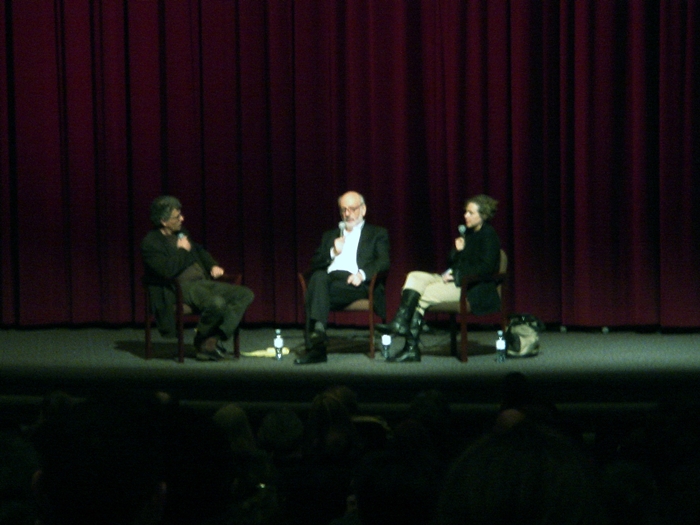
From left: Director Jon Amiel talks with Bertrand Blier and his interpreter Thursday at the DGA.

After the film, Blier was interviewed on stage by another director, Jon Amiel, who described Blier’s film as “a beautiful, profound, funny and ultimately deeply optimistic.” Blier revealed a bit about his process, explaining that there are no rehearsals before shooting in order to heighten spontaneity (he just asks actors to learn their lines). “I like to discover the story at the same time the actors do,” he said, also acknowledging that he wants them to hold precisely to the script.

The son of veteran French character actor Bernard Blier, auteur filmmaker Bertrand Blier has consistently elicited powerful performances from his actors, particularly in his 1974 box-office hit, “Going Places,” which helped launch the careers of Gérard Depardieu and Isabelle Huppert.

Guests sipped St-Germain cocktails.

Blier, who had the idea for “Clink of Ice” 25 years ago, said he still thinks of Depardieu when he’s writing any character, man, woman or animal. Blier also praised American actors, such as Robert DeNiro and Jack Nicholson, adding that Nicholson plays more like an Italian or French actor, with an air of, “I’m Jack Nicholson and you’re still going to believe what I’m telling you.”

Before seeing “Clink of Ice,” I attended a lovely reception in the DGA atrium. Guests sipped St-Germain cocktails and nibbled on delicious savory fare from caterer WCEP (West Coast Event Productions, 323-930-6785) and, for dessert, authentic French macarons, which were all-natural, handmade and gluten-free, from Les Macarons Duverger.

Authentic macarons for dessert.

‘Strangers on a Train’ brings out the bad in the best of us

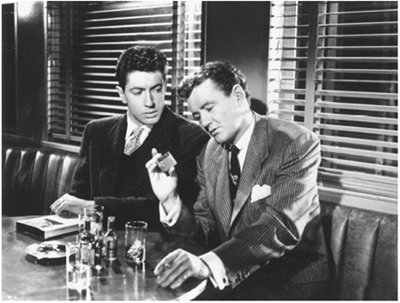
Farley Granger and Robert Walker

Strangers on a Train/1951/Warner Bros. Pictures/101 min.

A friend of mine once went on a second date with a guy who showed up wearing saddle shoes. Let’s just say there wasn’t a third date. If only he’d seen 1951’s “Strangers on a Train.”  Alfred Hitchcock understood the importance of footwear and it shows in this stellar film.

He starts the story by contrasting the shiny, two-toned spats of Bruno Anthony (Robert Walker) with the sensible black dress shoes of Guy Haines (Farley Granger) as each emerges from a Diamond cab. We follow these parallel footsteps as they board the same train, hence the title.

These brief shots contain the crux of the film: Model citizens often hide hard-core badness and the most unsavory renegades and reprobates can surprise you with a virtue or two (especially if we count charm and fashion sense as virtues).

Marion Lorne

Despite their differences, Bruno and Guy both have monkeys on their backs. Bruno is a spiffy playboy with psychopathic tendencies. Besides drinking and gambling, he spends his time hatching schemes for space travel and blowing up the White House. Even though Bruno has his wealthy and wacky mother (Marion Lorne) wrapped around his little finger, his father (Jonathan Hale) isn’t so flexible. In fact, he keeps threatening to have Bruno “taken care of, if necessary, put under restraint.”

Guy is a pro tennis player who wants to marry his dream girl Anne Morton (Ruth Roman), daughter of Senator Morton (Leo G. Carroll). Hitch’s daughter Patricia plays Anne’s little sister, Barbara. Unluckily for Guy, he’s already married to venal and unfaithful Miriam (Kasey Rogers, credited as Laura Elliott).

So, during their train trip, Bruno strikes up a conversation with Guy, telling him: “I certainly admire people who do things.” Over drinks, smokes and a lamb-chop lunch, Bruno proposes a daring, if absurd, solution to both of their glitches: If Bruno murders Miriam, that would leave Guy free to marry Anne. In exchange, Guy would bump off Mr. Anthony. Guy laughs it off, but Bruno takes it as mutual pledge and proceeds to carry out his part of the deal, trailing Miriam to a carnival and murdering her.

When he hears the news, Guy’s shocked, but if he tells the police, Bruno will claim that Guy was an accomplice. Besides, he had motive. As the police investigate, Bruno pressures Guy to fulfill his part of the plan.

Guy resists, but Bruno won’t back down and turns into a bit of a stalker. Bruno also has an ace in the hole: he nabbed Guy’s engraved cigarette lighter when Guy left it behind after their lunch on the train. Guy may lack Bruno’s warped brilliance but he pushes back when cornered and he’s determined to set things right.

If you don’t love “Strangers on the Train,” I’ll be shocked. It’s a gloriously suspenseful story, based on a Patricia Highsmith novel. Raymond Chandler wrote the screenplay, but most of that was trashed and rewritten by Czenzi Ormonde, with uncredited help from Ben Hecht. (Whitfield Cook adapted.) Hitch and Chandler apparently had a hate/hate relationship. [Read more…]