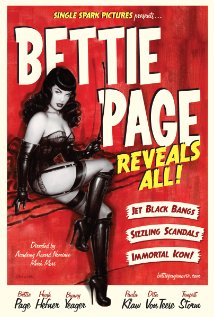
 Now playing at the Nuart Theatre in LA: ‘Bettie Page Reveals All.’ It’s just here for a week so see it while you can.
‘Bettie Page Reveals All’ hits theaters
December 1, 2013 by


The FIlm Noir File: neo-noir master Chabrol scores twice
November 23, 2013 by
By Film Noir Blonde and Mike Wilmington
The Noir File is FNB’s guide to classic film noir, neo-noir and pre-noir from the schedule of Turner Classic Movies (TCM), which broadcasts them uncut and uninterrupted. The times are Eastern Standard and (Pacific Standard).
PICK OF THE WEEK: Two by Claude Chabrol: Les Cousins, Le Beau Serge
“Les Cousins” (France: 1959, Claude Chabrol). Sunday, Nov. 24, 2:30 a.m. (11:30 p.m.)
Le Beau Serge (France: 1958, Claude Chabrol). Sunday, Nov. 24, 4:30 a.m. (1:30 a.m.)

Brialy and Blain in Les Cousins
By the time he died in 2010, at 80, with at least 80 directorial credits behind him, Claude Chabrol had become the most prolific and, in some ways, the most successful of all the great directors/friends of the old French Nouvelle Vague (or “New Wave“) – those arrogant young cinematic firebrands, prodigies and know-it-alls who traded barbs, blurbs and bon mots in Parisian cafes in the ‘50s while they were mounting their assaults on the French film industry from the pages of the legendary film journal Cahiers du Cinema.
Chabrol, by the time of his death, was still making movies and TV and had outstripped, in production and longevity, his famed compatriots Jean-Luc Godard (“Breathless“), Eric Rohmer (“Claire’s Knee”), Jacques Rivette (“La Belle Noiseuse”), and, the most popular New Waver of them all, and the first to die (three decades ago, in 1984), Francois Truffaut (“Jules and Jim“)..
In the ‘50s, before their directorial careers began, these five were called the Holy Family: out of envy perhaps, but perhaps too out of secret high regard. They all became famous and revered French cineastes. As for Chabrol, the first of them to make a feature film — well, he was a specialist. Chabrol primarily made crime dramas, thrillers, film noirs. (“Les Bonnes Femmes,” “Le Boucher,” “Violette Noziere,” “La Ceremonie”). He adapted or was inspired by Patricia Highsmith, Ruth Rendell, Ellery Queen, Stanley Ellin, Georges Simenon — mystery thriller specialists all.
Critics often called him the French Hitchcock, though, as Chabrol liked to point out, his own visual and dramatic style was far closer to that other great crime movie specialist, Fritz Lang. A man who seemed himself a model of high spirits, goodness and humanity, Chabrol understood evil very, very well. He once said that he couldn’t imagine shooting a script that didn’t have a murder in it, and he rarely did.
Chabrol was a funny-looking, fun-loving little man, with glasses, a thick French accent and a frequent smile. He looked playful and professorial, and when I interviewed him once in New York City, he joked and laughed continuously. He seemed to work continuously too. Almost every year, like clockwork, out would come a new Chabrol film (or two). They were (almost) always good, always well and elegantly-crafted, always intelligent, often highly critical of the provincial or Parisian bourgeoisie, the classes in which Chabrol had grown up (the provinces) or later lived (Paris). And almost always, they had a murder (or two).
TCM is showing Chabrol’s first two films Sunday night and Monday morning: both noir gems in black and white: the riveting “Le Beau Serge” (1958) and the masterly “Les Cousins” (1959). They make a complementary double feature: two classic film noirs, with the same co-stars (suave Jean-Claude Brialy, feisty Gerard Blain) in the same kind of dark, chatty, stylish, psychologically complex drama — both about people unwittingly destroying themselves.
In Le Beau Serge, set (and shot) in Chabrol’s home town of Sardent, Brialy, as Francois, plays a young intellectual who left Sardent for Paris, and now has come back, sick, to recuperate and also to revisit his old friend Serge a.k.a. “Le Beau Serge” (Blain), a village beau who is now an alcoholic in an unhappy marriage. They spend much of their time in the local bar, drinking and talking. The two probably love each other, are attracted to the same women — Serge’s wife (Michelle Meritz) and her sister (Bernadette Lafont) — and they seem to push each other to dissolution.
In “Les Cousins,” set (and shot) in Paris, Blain, as shy country cousin Charles, travels to The City of Light to revisit his urbane and hedonistic city cousin Paul (Brialy), and to join him at law school — where Paul spends most of his time drinking and throwing decadent parties for decadent people, including some women (Michelle Meritz and Juliette Mayniel) whom they both like. (Stephane Audran, later Chabrol’s wife and frequent star, is a regular party guest.) Paul rarely studies, yet seems to know everything; Charles studies constantly, yet seems to forget it all. They also seem to love each other, somewhat, and one of them seems to be pushing the other toward dissolution.
The two movies, in other words, almost seem to be inversions of each other, with the Brialy/Blain team returning as different versions of the same characters. Not quite though. One of the main differences between the pictures, is that, though Chabrol wrote both screenplays, the dialogue for The Cousins was written by Paul Gegauff, an urbane and hedonistic, cynical right-wing novelist who writes very good dialogue and who went on writing for Chabrol, and once starring for him (in Une Partie de Plaisir) until Gegauff was stabbed and killed by his second wife in 1983. (Remember that when you watch “Les Cousins,” one of whose protagonists is named “Paul.”)
Though they were the first two features Chabrol made, both show the hand of a master. Both also have beautiful and highly mobile, black and white cinematography by the superb Henri Decae. And, after seeing the pictures again, all I can say is that it makes you wish Chabrol had been able to shoot in black and white always, or at least most of the time, and more often with Decae. Black and white suits him: this New Wave master of film noir et blanc. (In French, with English subtitles.) [Read more…]
Catch ‘Nightmare Alley’ on the big screen in Westwood
November 22, 2013 by
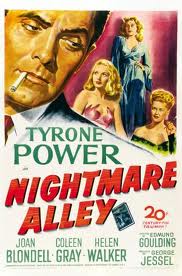 “Nightmare Alley” (1947, Edmund Goulding) plays at 7 p.m. Sunday, Nov. 24, at UCLA’s Billy Wilder Theater in Westwood. You will not be disappointed!
Lest you think classic noir is limited to private-eye offices, police stations and penthouse apartments, director Edmund Goulding’s flick transports us to the seedy world of traveling carnivals. Tyrone Power is Oscar-worthy as Stan Carlisle, a charismatic hustler looking to break into the big time. The excellent cast includes Joan Blondell, Coleen Gray, Helen Walker, Ian Keith and Mike Mazurki. Based on William Lindsay Gresham’s novel.
This is one of my all-time fave film-noir titles!
You can read the full review here.
The Film Noir File: Crawford at her finest, one of Lang’s best
November 16, 2013 by
By Film Noir Blonde and Mike Wilmington
The Noir File is FNB’s guide to classic film noir, neo-noir and pre-noir from the schedule of Turner Classic Movies (TCM), which broadcasts them uncut and uninterrupted. The times are Eastern Standard and (Pacific Standard).
PICK OF THE WEEK
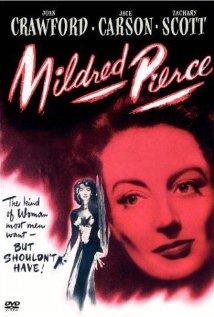 “Mildred Pierce“ (1945, Michael Curtiz). Tuesday, Nov. 19; 10 p.m. (7 p.m.). With Joan Crawford, Jack Carson, Zachary Scott and Ann Blyth.
Sunday, Nov. 17
10:15 a.m. (7:15 a.m.): “The Big Heat” (1953, Fritz Lang). With Glenn Ford, Gloria Grahame and Lee Marvin.
8 p.m. (5 p.m.): “Johnny Eager” (1941, Mervyn LeRoy). With Robert Taylor, Lana Turner and Van Heflin. Reviewed in FNB on August 4, 2012.
10 p.m. (7 p.m.): “Johnny Apollo” (1940, Henry Hathaway). Tyrone Power and Edward Arnold undergo father-and-son traumas and reversals as two wealthy Wall Street family members gone bad. Directed with Hathaway’s usual tough expertise. Co-starring Dorothy Lamour, Lloyd Nolan and Charley Grapewin.
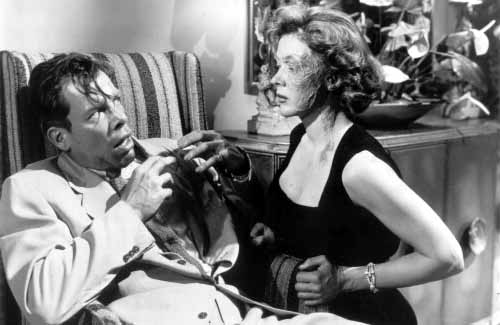
In “The Big Heat” from 1953, Lee Marvin and Gloria Grahame create one of the most iconic scenes in all of film noir. It plays Sunday morning.
Tuesday, Nov. 19
4:30 p.m. (1:30 p.m.): “Man in the Attic” (1953, Hugo Fregonese). With Jack Palance and Constance Smith. Reviewed in FNB on March 5, 2013.
10 p.m. (7 p.m.). See “Pick of the Week.”
8 p.m. (5 p.m.). “The Maltese Falcon” (1941, John Huston). With Humphrey Bogart, Mary Astor, Peter Lorre, Sydney Greenstreet and Elisha Cook, Jr. Reviewed in FNB on November 10, 2012.
Thursday, Nov. 21
3:45 p.m. (12:45 p.m.): “Jeopardy” (1943, John Sturges). With Barbara Stanwyck, Barry Sullivan and Ralph Meeker. Reviewed in FNB on July 21, 2012.
Film noir stalwart Lizabeth Scott highlighted on TCM
November 14, 2013 by
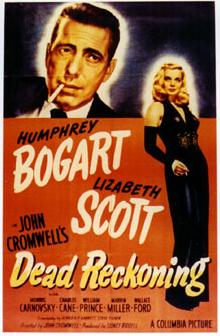 Dead Reckoning/1947/Columbia Pictures/100 min.
It’s good to take fashion risks from time to time. But would I ever wear a polka-dot shower cap with matching bow-tie to take an ex-GI for a ride? Hmm, I think not. Sadly, Coral “Dusty” Chandler (Lizabeth Scott) makes this fashion choice in “Dead Reckoning” (1947). Honey, you’re trying to con Capt. Rip Murdock (Humphrey Bogart), the toughest tough-guy ever. You can’t afford a wardrobe slipup like that.
To put it mildly, Rip is slow to succumb to feminine wiles. As he tells his war buddy, earnest and Yale-educated Sgt. Johnny Drake (William Prince): “All females are the same with their faces washed.”
When Johnny mysteriously disappears on the way to pick up the Congressional Medal of Honor, Rip heads to Gulf City, Fla., to find him. Instead, he meets Johnny’s girlfriend Coral – pretty, poised and concerned for her beau – at the Sanctuary Club, a hangout run by Martinelli (Morris Carnovsky), a lowlife with a fancy vocabulary.
Rip’s next stop is the local morgue, where he learns that Johnny has died in a car crash. Convinced it was no accident, he determines to find out who’s responsible. Then a dead body shows up in Rip’s hotel room. As Rip and Coral join forces to figure out what gives in Gulf City, Rip allows her to get a little closer to his battle-scarred core. She reveals that Johnny didn’t really light her fire. But Rip’s another story, and a bumpy romance ensues.
At one point, Rip shares his ultimate female fantasy, that “women ought to come capsule-sized, about four inches high” and for the most part kept in a man’s pocket except for “that time of the evening when he wants her full-sized and beautiful.” Luckily that’s a no-brainer for lovely Coral. Other than that disastrous hat and bow, she looks impeccable.
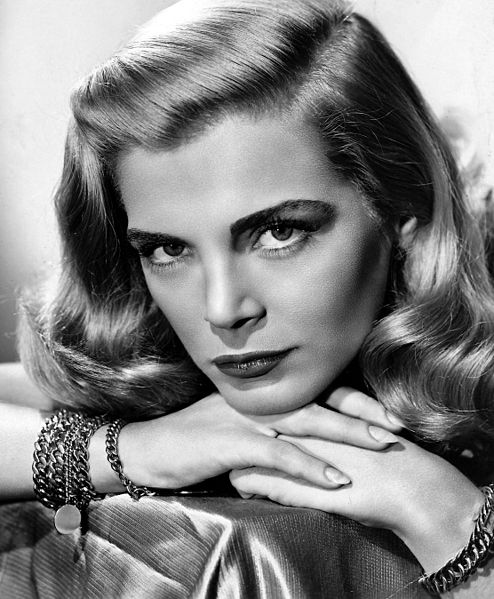
Lizabeth Scott was born Emma Matzo on Sept. 29, 1922, in Scranton, Pa., one of six children. Her parents emigrated from the Ukraine.
“Dead Reckoning” joins top talent to create a solid example of the noir genre. John Cromwell provides fine direction; Steve Fisher’s crisp, funny script has Rip telling his story via flashback to a kindly priest, Father Logan (James Bell). Rip’s still-fresh memories of World War II intertwine with the neatly crafted plot.
Best of all we get to watch Bogart and Scott. Sculpted, slim and statuesque, fair-haired Scott (who looks a lot like Lauren Bacall) was a film noir stalwart and TCM is showing many of her movies Friday, including “Dead Reckoning,” “Pitfall” and “The Strange Love of Martha Ivers,” in which Scott holds her own with fellow cast members Barbara Stanwyck, Van Heflin and Kirk Douglas. Other notable ’40s flicks include: “Desert Fury,” “I Walk Alone” and “The Racket,” co-starring Robert Mitchum and also directed by Cromwell, who was blacklisted from 1951-1958. (“The Racket” is also part of Friday’s lineup.)
(In 1950, Cromwell directed the classic prison flick “Caged” starring Agnes Moorehead and Ellen Corby. Moorehead would later star as Endora on “Bewitched” and Corby would play Grandma on “The Waltons.”)
Scott tended to play tough girls who lived by their wits and worldly charms, having been born on the wrong side of the tracks. Alluring and mysterious, she was sometimes a bit too aloof, a bit stiff in her expression, body language and gesture. In other words, she lacked the sizzle of a full-on femme fatale. The role of Coral Chandler was originally intended for Rita Hayworth, but she was busy making “The Lady from Shanghai.”
Still, Scott was a trooper and accumulated many credits: “Too Late for Tears,” “Easy Living,” “Paid in Full,” “Dark City,” “The Company She Keeps,” “Two of a Kind,” “Red Mountain,” “A Stolen Face,” “Scared Stiff,” “Bad for Each Other” and “Silver Lode.”
Scott never married, rumors circulated about her sexual preferences and the murky publicity was enough to sour her career. A pretty raw deal, I’d say. Scott recently turned 91 and we at FNB would love to take her out for dinner and drinks, say Musso & Frank’s? That’s the least we can do. Well, that and watch her Friday on TCM.
The Noir File: Robert Ryan is the acting champ of film noir
November 10, 2013 by
By Film Noir Blonde and Mike Wilmington
The Noir File is FNB’s guide to classic film noir, neo-noir and pre-noir from the schedule of Turner Classic Movies (TCM), which broadcasts them uncut and uninterrupted. The times are Eastern Standard and (Pacific Standard).
PICK OF THE WEEK
Robert Ryan Day Monday, Nov. 11, 6 a.m. (3 a.m.) to 6 p.m. (3 p.m). His eyes were dark, narrow and penetrating, and they could sometimes take on a bemused crinkle or a murderous squint. His voice sometimes had a menacing rasp or whine. He had a powerful frame, hardened by his years as a college boxing champ and a U. S. Marine. He could portray pathology — the ruthlessness of a villain, the torment of a ordinary man caught in a web of violence or corruption — like few players in the history of film noir. He could break your heart, or make your blood run cold.
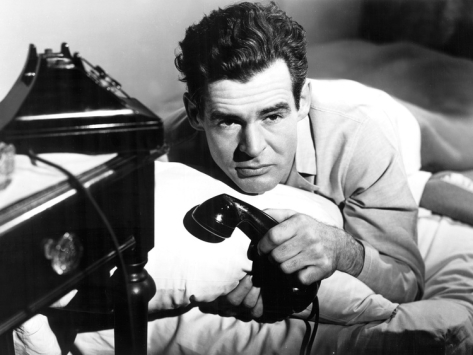
Robert Ryan is a brutal cop in “On Dangerous Ground.”
He was underestimated for much of his career, but we know him now as one of the great actors of film noir, and of American movies. He came from Chicago and his name was Robert Ryan. For most of his career, Ryan was one of Hollywood’s most underrated actors: a reliable villain, yes, and a supporting player who never gave a bad performance, but not, it was mistakenly thought, one of the monarchs of his profession, like Bogart, Tracy, Stewart and Fonda.
Perhaps only at the end of his career, when he was dying — and he played for John Frankenheimer, superbly, the role of Larry Slade in the American Film Theater film of Eugene O’Neill’s “The Iceman Cometh,” did he get something like the full recognition as a master of his craft, that he always deserved.
On Monday, TCM is highlighting the work of this brilliant actor. If you can only catch one or two of the Robert Ryan movies, see “The Set-Up” and “On Dangerous Ground.” And then raise a glass to the guy, one of the greats, who never really got his due until he was almost gone. The champ.
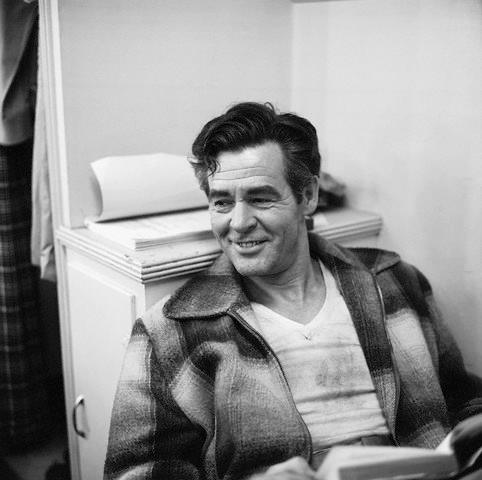
Robert Ryan was underrated for much of career.
Monday, Nov. 11
6 a.m. (3 a.m.): “Berlin Express” (1948, Jacques Tourneur) With Merle Oberon and Paul Lukas. Reviewed in FNB on April 9, 2013.
7:30 a.m. (4:30 a.m.): “Act of Violence” (1949, Fred Zinnemann). With Van Heflin and Janet Leigh. Reviewed in FNB on Aug. 4, 2012.
9 a.m. (6 a.m.): “Crossfire” (1947, Edward Dmytryk). With Robert Mitchum and Robert Young. Reviewed in FNB on Nov. 20, 2012.
10:30 a.m. (7:30 a.m.): “The Set-Up” (1949, Robert Wise). With Audrey Totter. Reviewed in FNB on April 9, 2013, Reviewed in FNB on April 9, 2013.
11:45 a.m. (8:45 a.m.): “Beware, My Lovely” (1952, Harry Horner). Lonely woman Ida Lupino is put through the suspense drama wringer by bent handyman Ryan.
1:15 p.m. (10:15 a.m.): “On Dangerous Ground” (1952, Nicholas Ray). One of the great Robert Ryan roles and Nick Ray movies. Ryan plays a brutal, disillusioned cop, sick of the dark urban world in which he works, and prone to fits of near-murderous violence. He is sent to the country to track down an emotionally damaged young boy/murderer, whose sister is a blind woman (Ida Lupino). With Ward Bond as the vigilante father of the victim and Charles Kemper as Ryan’s sympathetic city cop partner. The excellent script is by A. I. Bezzerides (“Kiss Me Deadly”), and the great, alternately romantic and nerve-jangling, score is by Bernard Herrmann.
2:45 p.m. (11:45 a.m.): “Born to be Bad” (1950, Nicholas Ray). With Joan Fontaine and Mel Ferrer. Reviewed in FNB on April 9, 2013.
4:30 p.m. (1:30 p.m.): “Bad Day at Black Rock” (1955, John Sturges). With Spencer Tracy, Walter Brennan and Lee Marvin. Reviewed in FNB on April 7, 2012.
6 p.m. (3 p.m.): “Billy Budd” (1962, Peter Ustinov). Another of Ryan’s greatest performances. In Ustinov’s film adaptation of Herman Melville’s story of the beautiful, childlike sailor Billy Budd (Terence Stamp), Ryan is the sadistic ship’s officer Claggart, who relentlessly persecutes the boy and triggers a tragedy. With Ustinov as Captain Vere and Melvyn Douglas as The Dansker. [Read more…]
True Hollywood Noir probes legendary Tinseltown mysteries
November 8, 2013 by
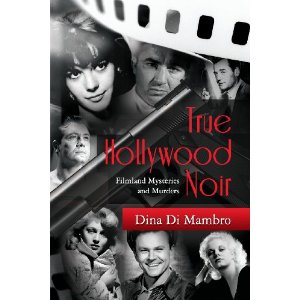 “Lana Turner was the quintessential film noir blonde,” says author Dina Di Mambro in her new book, True Hollywood Noir: Filmland Mysteries and Murders, pointing to Turner’s standout part as Cora in “The Postman Always Rings Twice.”
The actress’s real life was no less fascinating than any of the roles she portrayed on the screen, says Di Mambro, setting up the chapter on Turner and the 1958 fatal stabbing of her boyfriend Johnny Stompanato.
A coroner’s inquest jury found the act (by Turner’s teenage daughter Cheryl Crane) to be justifiable homicide but there has long been speculation that Turner herself did the deed. In probing that theory, film historian and entertainment writer Di Mambro offers “the story you haven’t heard.”

Author Dina Di Mambro
It’s one of 12 stories Di Mambro explores in her book; the others are: William Desmond Taylor, Thomas H. Ince, Jean Harlow, Thelma Todd, Joan Bennett (and the shooting of Jennings Lang), George Reeves, Bob Crane, Gig Young, Natalie Wood, Robert Blake and death of his wife Bonnie Lee Bakley). The finale, as it were, is a lengthy chapter on gangster Mickey Cohen.
Says Di Mambro in the book: “The West Coast mob, city corruption and Hollywood mysteries were often intertwined. This is a common thread through much of this book. … Many of the plots of the noir films were taken from actual happenings in the underworld.”
Di Mambro presents her facts in a straightforward, no-nonsense style, leaving the reader to decide which theory is most likely. Replete with vintage photos, the book clocks in at 230 pages, making it a pretty fast read cover to cover. It’s also a great reference volume if you prefer to dip in one grisly cold case at a time.
We at FNB especially like the fact that Di Mambro includes in her acknowledgements her “muse,” meaning her cat Sunny, who supervised the writing process. Nothing like a regal kitty to tap a true-crime scribe vibe.
The Noir File: Burt Lancaster Wednesdays in November
November 5, 2013 by
By Film Noir Blonde and Mike Wilmington
The Noir File is FNB’s guide to classic film noir, neo-noir and pre-noir from the schedule of Turner Classic Movies (TCM), which broadcasts them uncut and uninterrupted. The times are Eastern Standard and (Pacific Standard).
Note: The Noir File has been on temporary hiatus recently while one of its co-authors, Mike Wilmington, moved from Chicago to Los Angeles. Now, with Mike ensconced in Hollywood, in the neighborhood where Philip Marlowe once roamed (in spirit), we’re happy to welcome the File back to Film Noir Blonde.
 PICK OF THE WEEK
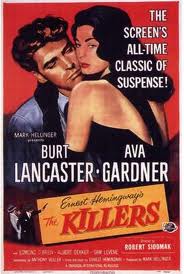
“The Killers”
(1946, Robert Siodmak). With Burt Lancaster, Ava Gardner and Edmond O’Brien. Wednesday, Nov. 6, 8 p.m. (5 p.m.).
Of all film noir’s femmes fatales, Ava Gardner as Kitty Collins in “The Killers” ranks as the most devastatingly efficient. She doesn’t waste time chit-chatting or getting to know a guy. Just a glance gets them hooked and firmly planted in the palm of her hand. “Swede” Andreson (Burt Lancaster) takes all of 10 seconds to fall for her and then get lured into “a double-cross to end all double-crosses.”
Based on the famous Ernest Hemingway short story, this 1946 film is the crowning achievement of one of Hollywood’s most prolific noir directors, Robert Siodmak, earning him an Oscar nomination for best director and leaving us with some of the genre’s most memorable characters.
You can read the full review here.
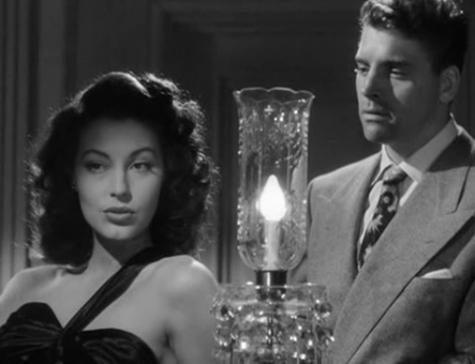
Kitty (Ava Gardner) has Swede (Burt Lancaster) wrapped around her little finger in no time.
Wednesday, Nov. 6
4:15 p.m. (1:15 p.m.): “Colorado Territory” (1949, Raoul Walsh). One of the peaks of Western noir: Raoul Walsh’s Old West version of his 1941 gangster classic, “High Sierra,” with Joel McCrea and Virginia Mayo filling the Bogart and Lupino roles, and Dorothy Malone and Henry Hull (who was also in the original) in support.
8 p.m. (5 p.m.): “The Killers” (1946, Robert Siodmak). See Pick of the Week.
Friday, Nov. 8
6:30 a.m. (3:30 a.m.): “The Front Page” (1931, Lewis Milestone). First of the three stellar movie versions of Ben Hecht and Charles MacArthur’s terrific newspaper comedy “The Front Page.” A wily editor, Walter Burns, (Adolphe Menjou) tries to keep his star reporter Hildy Johnson (Pat O’Brien), from leaving their paper, the Chicago Examiner, on the night before the hanging of hapless radical murderer Earl Williams (George E. Stone). Howard Hawks, who remade “The Front Page” as “His Girl Friday,” said that this play had the best American comedy dialogue ever written and it’s hard to argue.
 Saturday, Nov. 9
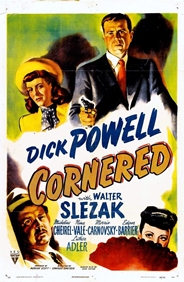
12 a.m. (9 p.m.): “Cornered” (1945, Edward Dmytryk). Star Dick Powell, director Dmytryk, and writer John Paxton, all of the hit Raymond Chandler adaptation “Murder My Sweet,” reunite for a tough international thriller, with ex-WW2 pilot Powell tracking down his French wife’s fascist murderers. The marvelously slimy or ruthless villains include Walter Slezak and Luther Adler.
Sunday, Nov. 10
4 p.m. (1 p.m.): “Casablanca” (1942, Michael Curtiz). With Humphrey Bogart, Ingrid Bergman, Claude Rains and Paul Henreid. Reviewed in FNB on August 25, 2012.
Oddly endearing ‘Moonrise’ a treat on the big screen
November 4, 2013 by
Moonrise/1948/Republic Pictures/89 min.
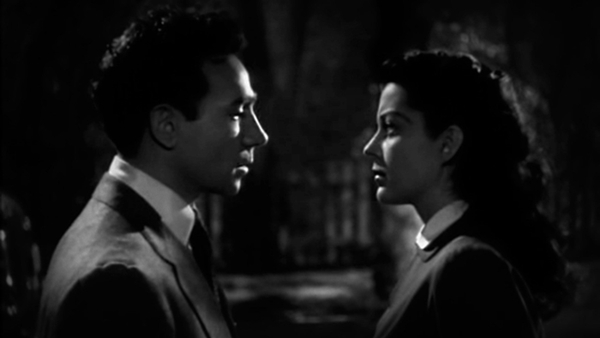
Dane Clark and Gail Russell play small-town lovers.
Last month, I caught Frank Borzage‘s “Moonrise” on the big screen at the Billy Wilder Theater in Westwood. It’s an enchanting and perplexing little flick. Dane Clark and Gail Russell star as small-town Virginia lovers Danny and Gilly who face a rather formidable obstacle: Danny killed Gilly’s ex-boyfriend Jerry (Lloyd Bridges) in a fight and, though Danny seems to be getting away with murder, his guilt and anxiety gnaw away at him endlessly. The anxiety is of the bad-seed variety, stemming from the fact that his father was hanged for murder many years before. Rex Ingram plays Danny’s sage chum Mose; Ethel Barrymore plays Danny’s grandmother.
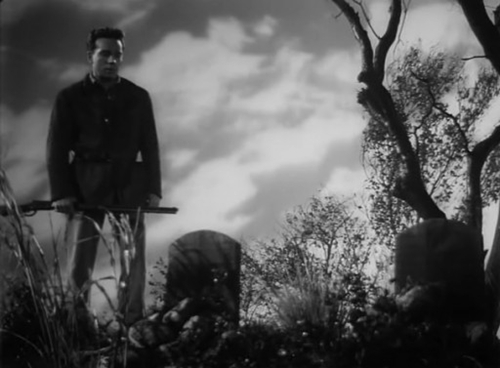
Danny must confront his past.
The script is what you might call quirky and it becomes curiouser and curiouser upon reflection. (Charles Haas based his screenplay on a novel by Theodore Strauss.) Danny and Gilly apparently grew up in the same small town, though she says she has seen him only twice. She’s now a schoolteacher, though, so maybe that refers to sightings since she returned from college. (Get used to cutting slack.) Despite the fact that she was engaged to Jerry, son of a wealthy bigshot, Gilly falls almost instantly for jobless outcast Danny. Even after Danny endangers Gilly’s life with reckless driving and randomly jumps off a Ferris wheel, Gilly remains head-over-heels for the dude.
The sins of the father hang over Danny but not all the time, it seems. While half the townsfolk despise Danny, the other half are madly in love with him, including the wildly kind-hearted and sympathetic sheriff (Allyn Joslyn). This is the kind of lawman any femme fatale would kill to have on her side. (Oops, there I go being all literal again.)
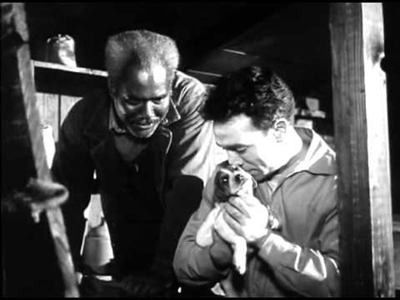
Rex Ingram plays Mose, Danny’s best friend.
And though Jerry has picked on Danny since childhood, it apparently doesn’t cross anyone’s mind that the two men might be enemies and that Danny might have had a heck of a grudge against Jerry. Then there’s the ending – so strangely upbeat and morally triumphant, I wondered if there was some crucial footage missing.
But I don’t want to trash “Moonrise” because it doesn’t deserve it. Despite the uneven script, the actors are all fun to watch. Borzage brings his characteristic romantic sensibility to the work and cinematographer John L. Russell creates uncommon beauty. An oddly endearing film noir, “Moonrise” played on a big screen is among the most luminous of visual poems.
Film noir fashionistas in the spotlight
October 28, 2013 by
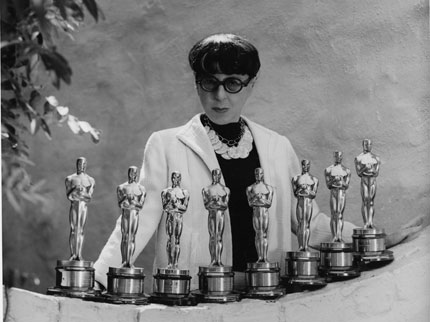
Edith Head worked on film noir titles such as “Double Indemnity,” “Sunset Blvd.,” “Rear Window” and “Vertigo.”
Happy birthday, Edith Head! She was born October 28, in San Bernardino, Calif. In her 60-year career, at Paramount and Universal, she worked on more than 1,131 films, received 35 Academy Award nominations and won eight Oscars, more than any other woman. (Walt Disney, with 22 Oscars, holds the record for a man.)
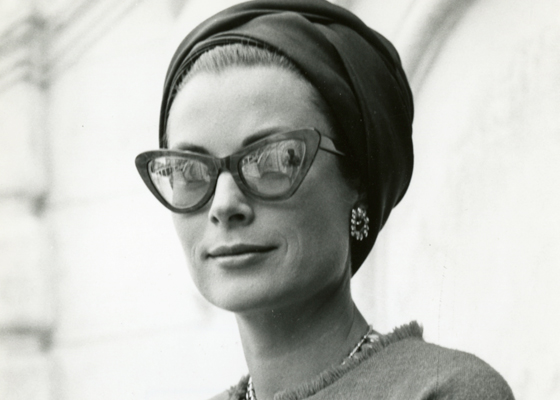
Grace Kelly was born on Nov. 12, 1929 in Philadelphia. She died on Sept. 14, 1982 in Monaco.
The exhibition From Philadelphia to Monaco: Grace Kelly Beyond the Icon opens today at the James A. Michener Art Museum, near Philadelphia.






From my readers