‘The Long Goodbye’ is a highlight of Altman at the Aero

On Friday, March 20, the Aero Theatre in Santa Monica will present “The Long Goodbye” (1973, Robert Altman) as part of a weekend tribute to this stellar director. This event is free to all current American Cinematheque members, with regular pricing for non-members. There will be an introduction by Kathryn Altman, who will sign her book Altman in the lobby at 6:30 p.m. The movie is at 7:30 p.m.

The Long Goodbye/1973/United Artists/112 min.

One of the best films of the ’70s or an ugly, boring travesty of a well respected detective novel?
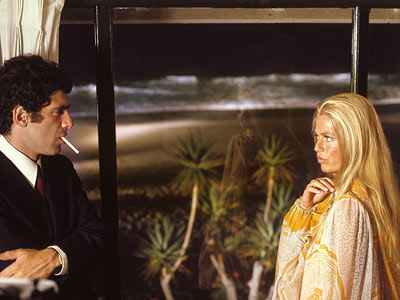
Elliott Gould and Nina Van Pallandt in “The Long Goodbye.”

Decide for yourself as you watch Robert Altman’s 1973 movie of “The Long Goodbye,” by Raymond Chandler. The film, starring Elliott Gould as private investigator Philip Marlowe, divided critics, earning the above-mentioned rave from Time Out and the snooty slam from Leslie Halliwell.

It was primarily Gould’s free-wheeling interpretation of the beloved PI that drew ire. Charles Champlin called him an “untidy, unshaven, semi-literate dimwit slob.”

An entertaining yarn, soaked in ’70s atmosphere, the movie captures the sunny, scruffy, solipsistic mood and look of Malibu, Calif., at the start of the Me Decade. Marlowe’s next door neighbors, for example, are pot-brownie-baking, clothing-optional candlemakers. We only see them from a distance but in a way they are timeless party girls, a ’70s version of “The Girls Next Door.”

And “The Long Goodbye” stretches the vocabulary of film noir. As Foster Hirsch, author of “Detours and Lost Highways: A Map of Neo Noir,” writes: “For all its self-indulgence and contradiction – the film both satirizes and seeks acceptance as a cool, contemporary L.A. mystery story – Altman’s ‘new age’ noir suggested the genre’s elasticity at a time when it was considered passé. Produced before nouveau noir had taken root, ‘The Long Goodbye’ anticipates the full-force genre revival of the 1980s and 1990s.”

We meet Marlowe late one night as he’s trying to round up food for his hungry cat (Morris the Cat in the role that launched him to stardom). The story spices up when Marlowe’s friend Terry Lennox (Jim Bouton) asks him, after a marital spat, to drive him to Tijuana.

Marlowe doesn’t have much else going on (besides cat care, of course) and so they make the trip; Marlowe heads back on his own to find that Lennox’s wife is dead. The police press Marlowe for info on Terry’s whereabouts, hoping that a little jail time will jog his memory (David Carradine plays Marlowe’s cellmate). They ease up after Terry Lennox commits suicide, having first written a letter confessing to the murder.

Marlowe’s not buying the suicide, but turns his attention to a new client. The sun-kissed and sophisticated Eileen Wade (Nina van Pallandt) wants Marlowe to find her missing hubby Roger Wade, a boozy writer, (played by the wonderful Sterling Hayden, a veteran of film noirs like “Asphalt Jungle” and “The Killing”).

Searching for Roger isn’t all that challenging, but Marlowe has his hands full with a visit from psychopathic gangster Marty Augustine (director Mark Rydell) and his hoods (including young Arnold Schwarzenegger). They’re sniffing around for a load of cash that Terry Lennox was supposed to deliver to Mexico. Surprise, surprise, the cash never made it. So the surly, anti-social Marlowe plods on toward the truth, trying not to get any sand on the shag carpets. [Read more…]

Feast your eyes: TCMFF, Noir City and COLCOA

Over the next several weeks, there will be lots to see on the big screen in Los Angeles.

First, the TCM Classic Film Festival runs March 26-29 in Hollywood. This year’s theme is history as portrayed by Hollywood. Noir treats include: “Too Late for Tears,” “Nightmare Alley” and “Psycho.” More info is here.

The festival takes place at various venues in Hollywood.

Ride the Pink Horse posterTickets are now on sale for Noir City Hollywood. The 17th annual edition of the fest runs April 3-19 at the American Cinematheque’s Egyptian Theatre. There’s so much noir goodness – oops, I mean badness – to choose from. I am particularly looking forward to the Humphrey Bogart programming as well as the Dorothy B. Hughes double feature: “Ride the Pink Horse” and “The Fallen Sparrow.” Criterion just released “Ride the Pink Horse” on Blu-ray and DVD, which is great, but I can’t wait to see this at the Egyptian.

The Egyptian Theater is at 6712 Hollywood Blvd., Hollywood, CA 90028.

Mais oui! The always-outstanding City of Angels City of Lights (COLCOA) festival runs April 20-28. “The Soft Skin” restored? I’m in! Check the web site for more info starting March 31. This is a first-rate festival and should not be missed!

The COLCOA festival is held at the Directors Guild of America, 7920 Sunset Blvd., Los Angeles, 90046.

Laura Linney plays Patricia Highsmith, Rendez-Vous with French Cinema opens at the Crest Theater in Westwood

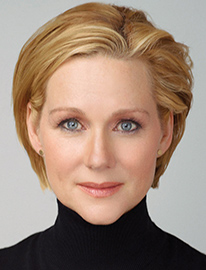
Laura Linney

Laura Linney plays the role of crime writer Patricia Highsmith in the new stage drama “Switzerland,” by Joanna Murray-Smith, at the Geffen Playhouse in Westwood. The play opens Friday and runs through April 19.

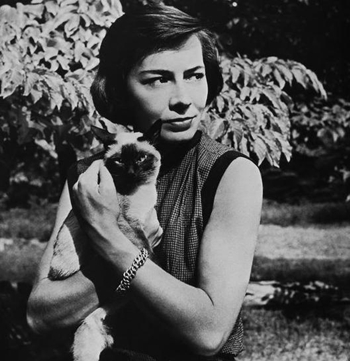
Highsmith (1921-1995), a Texas-born novelist and short-story writer, was much admired in Europe and is considered part of the Existentialist tradition started by Dostoyevsky, Conrad, Kafka and Camus. Alfred Hitchcock’s 1951 film adaptation of her novel, “Strangers on a Train,” which she published in 1950, put her career on the fast track.

In the play, Highsmith is near the end of her life and residing in the Swiss Alps. A visit from a young American man (played by Seth Numrich) sets the drama in motion.

“There’s something sort of exotic about [doing theater in Los Angeles],” Linney told the LA Times.

The Geffen Playhouse is at 10886 Le Conte Ave. in Westwood.

Also starting Friday in Westwood: The Crest Theater, in association with Emerging Pictures, will present the 20th annual Rendez-Vous with French Cinema – a first-time look at some of France’s most exciting modern cinema. Rendez-Vous runs through March 19.

The Crest Theater is 1262 Westwood Blvd.

Celebrate Joan Crawford’s birthday at Laemmle’s NoHo 7

See “Possessed” & “What Ever Happened to Baby Jane?” on the big screen!

Laemmle NoHo7 - 140Laemmle Theatres and Film Noir Blonde are pleased to present a double feature on Monday, March 23, at Laemmle’s NoHo 7, to mark Joan Crawford’s birthday.

A gifted actress and the ultimate movie star, Joan Crawford found that by the mid-1940s, her career had stalled. She restarted it with the help of film noir, namely 1945’s “Mildred Pierce,” by director Michael Curtiz, for which she won the Best Actress Oscar. Whether she played a tough broad or a lady in distress, Crawford was especially well suited for the genre’s expressionistic intensity. She starred in many film-noir titles between 1945 and 1962.

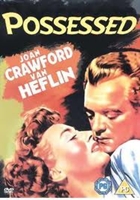
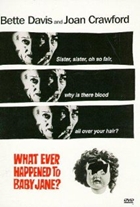
Possessed movie poster -- 140What Ever Happened to Baby Jane poster - SmallerOn Monday, March 23, Laemmle’s NoHo 7 will pay tribute to her legacy with a special double bill from Warner Bros.: “Possessed” (1947, Curtis Bernhardt) and “What Ever Happened to Baby Jane?” (1962, Robert Aldrich).

The program will start at 7:30 p.m., with “Possessed” and “What Ever Happened to Baby Jane?” at 9:55. Tickets are $11 each, $15 for the double feature.

There will be a special birthday cake for Ms. Crawford’s fans and Warner Bros. Archive will provide select prizes. Laemmle’s NoHo 7 is at 5240 Lankershim Blvd., North Hollywood, CA 91601, 818-762-4600. Laemmle’s main number is 310-478-3836.

Film Noir Blonde

Film Noir Blonde

Joining the party will be Jacqueline Fitzgerald, founder and editor of FilmNoirBlonde.com. Fitzgerald will introduce the movies.

In “Possessed” (also starring Van Heflin and Raymond Massey) Crawford gives a memorable performance as a woman who can’t get over a bad relationship. In “What Ever Happened to Baby Jane?” she is Blanche Hudson, a once-glamorous Hollywood actress who lives with her demented sister (Bette Davis), a former child star.

Full reviews are available here:

“Possessed” http://bit.ly/1saxBHV

“Whatever Happened to Baby Jane?” http://bit.ly/1z7ctQ7


Celebrate Women in Film Noir: Saturday at the Durant Library

Patricia Highsmith

Patricia Highsmith

Did you know:

* A woman named Czenzi Ormonde co-wrote the script for “Strangers on a Train” (1951, Alfred Hitchcock). The film was based on Patricia Highsmith’s first novel, published in 1950.

* In the early days of Hollywood, film editors, or cutters as they were known, were mostly women. The job was considered menial labor and on-screen credit was rare.

* In a Lonely Place” (1950, Nicholas Ray) was the third movie based on a novel by Dorothy B. Hughes. The others were: “The Fallen Sparrow,” (1943, Richard Wallace) and “Ride the Pink Horse,” (1947, Robert Montgomery).

Come out and learn more at 1 p.m. on Saturday, March 7, at the Will & Durant Library in Hollywood. I will be talking about women’s contributions to film noir in honor of Women’s History Month. The Durant Library will be showing films on March 9, 16, 23. See my post from Feb. 24 (below) for more details.

The Durant Library is at 7140 W. Sunset Blvd. (one block west of La Brea), Los Angeles, CA 90046, 323-876-2741.

UCLA’s Preservation Fest to screen ‘Too late for Tears’ and ‘The Guilty’ as part of monthlong run of restored films

The LA TimesKenneth Turan recently gave high praise indeed to the UCLA Film & Television Archive’s Festival of Preservation.

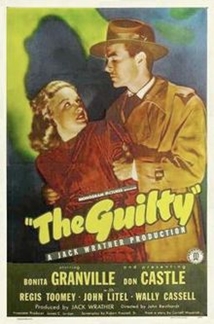
Too Late for Tears posterThe Guilty posterAs he put it: “Forget Cannes, Sundance, even the Oscars: This is the cinematic event I look forward to most of all. That’s because no other movie festival comes close to it in the magnificent breadth of neglected but compelling American film material it puts on display.”

Hmm. Forget Sundance? Sure. Forget the Oscars? Done. But Cannes? Not so much. That said, however, I am also very much looking forward to UCLA’s terrific monthlong lineup, which begins on March 5 with Anthony Mann’s “Men in War.” This year marks the 17th edition of the festival.

For noir fans, the double feature on Saturday, March 7, should not be missed. It starts at 7:30 p.m.

In “Too Late for Tears” (1949, Byron Haskin), noir badness bursts from the screen as Lizabeth Scott plays a housewife who comes across a suitcase stuffed with $60,000 in cash. Scott seizes the chance to say goodbye to cooking meatloaf, washing dishes and doing laundry. Duh! Besides, it turns out that she’s a much better murderess than she was a homemaker. Arthur Kennedy plays her husband and the always-great Dan Duryea shines as a private eye.

Next up is “The Guilty” (1947, John Reinhardt), based on a short story by Cornell Woolrich. Here, Don Castle and Wally Cassell are lured into trouble by Bonita Granville, who plays twin sisters, one good and one bad, natch. When the nice girl is found murdered, both men are under suspicion. “The Guilty” is reminiscent of Robert Siodmak’s “The Dark Mirror” from 1946.

Film historian Alan K. Rode will discuss the films.

Films will be screened at the Hammer Museum’s Billy Wilder Theater in Westwood.

Film Noir Blonde, Durant Library celebrate Women in Film Noir

I am very pleased to announce that I have programmed a series for the Will & Ariel Durant Library in Hollywood called Women in Film Noir. The series runs in March to honor Women’s History Month. We are highlighting women’s contribution to the genre at a time when there were many barriers to working outside the home.

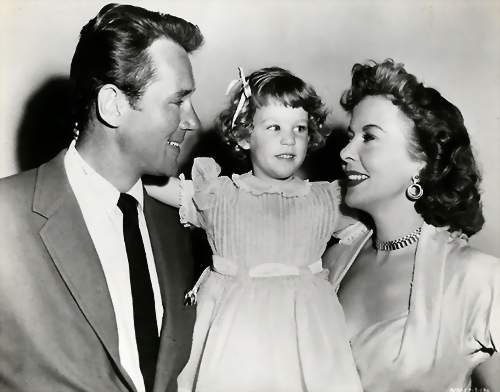
Ida Lupino juggled work and family. Shown: Ida with her husband Howard Duff and daughter Bridget.

Ida Lupino juggled work and family. Shown: Ida with her husband Howard Duff and their daughter, Bridget, who was born in 1952.

The library will screen five films, starting March 2.

I will be giving a talk at the library at 1 p.m.  Saturday, March 7. The opening night double feature is a spotlight on Ida Lupino, actress, director, writer and producer.

5 p.m. March 2: “On Dangerous Ground” (1951, 82 min.): Ida Lupino plays a blind country girl who lives with her brother. She meets a psychologically scarred cop (Robert Ryan) when her brother becomes a suspect in a murder. With a taut script by A. I. Bezzerides (“Kiss Me Deadly”) and moody, poetic direction from Nicholas Ray, “On Dangerous Ground” is an unforgettable film noir.

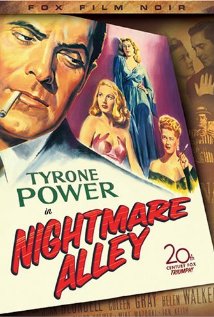
Nightmare Alley poster 214The Hitch-Hiker” (1953, 71 min.): Fate isn’t smiling when two guys on vacation give a lift to a man who turns out to be serial killer. “The Hitch-Hiker,” starring Edmond O’Brien, Frank Lovejoy and William Talman, is the only classic film noir directed by a woman, the great Ida Lupino. Best known as an actress, Lupino was also a director, writer and producer. She co-wrote “The Hitch-Hiker.”

5 p.m. March 9: “Nightmare Alley” (1947, 110 min.) A film noir set in the seedy world of a carnival, “Nightmare Alley” tracks an ambitious performer (Tyrone Power) as he pursues a better life. Crucial to his rise and fall are three women: Joan Blondell, Coleen Gray and Helen Walker. Unusual for time, Walker plays an upper-class working woman who is not a teacher, nurse or secretary.

Based on William Lindsay Gresham’s novel and directed by Edmund Goulding, “Nightmare Alley” is unusually cerebral and rich with subtext. Also unusual for that time: Barbara McLean served as editor – by 1947, many women had been pushed out of film editing jobs, despite the fact that in the early days of the industry they dominated that function.

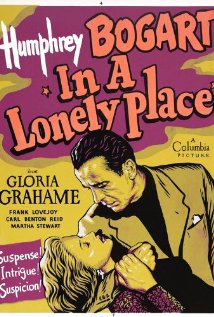
In a Lonely Place poster5 p.m. March 16:  “Strangers on a Train” (1951, 101 min.) With standout performances from Robert Walker and Farley Granger, “Strangers” stands as an excellent example of Alfred Hitchcock’s subversive casting. The film is based on the novel of the same name by master of suspense Patricia Highsmith. Czenzi Ormonde (aka Gladys Lucille Snell) co-wrote the script with Raymond Chandler. Pat Hitchcock plays a small but memorable part.

5 p.m. 23: In a Lonely Place” (1950, 94 min.) Based on a novel by Dorothy B. Hughes, “In a Lonely Place” tells the story of a screenwriter (Humphrey Bogart) and an actress (Gloria Grahame) who live in the same Hollywood apartment building and fall in love. All is not well, however, when it seems the writer might also be a deranged killer. Masterfully directed by Nicholas Ray and edited by Viola Lawrence, sometimes called “Hollywood’s first lady film cutter.”

The Durant Library is at 7140 W. Sunset Blvd. (one block west of La Brea), Los Angeles, CA 90046, 323-876-2741.

Skirball Cultural Center screens ‘Cinema’s Exiles: From Hitler to Hollywood’

The exhibitions close on Sunday, March 1.

The exhibitions close on Sunday, March 1.

Time flies, that’s for sure. The Skirball Cultural Center’s superb exhibitions Light & Noir: Exiles and Émigrés in Hollywood, 1933–1950 and The Noir Effect, which began last October, will close Sunday, March 1.

The closing day (March 1) is an ideal opportunity to head up to the Skirball. That way you can see “Cinema’s Exiles: From Hitler to Hollywood,” a 2009 PBS documentary about members of the German film industry who left Europe and re-created their careers in Los Angeles, forever changing the way American movies were made. More than 800 filmmakers fled the Nazis; some found great success in the U.S., but others were less fortunate. Sigourney Weaver narrates the movie.

Film excerpts include: “The Bride of Frankenstein,” “Fury,” “Ninotchka,” “To Be or Not To Be,” “Casablanca,” “The Wolf Man,” “Double Indemnity,” “Phantom Lady,” “Sunset Blvd.,” “High Noon,” “The Big Heat” and “Some Like It Hot.” Also covered will be classics of early German cinema, including “The Cabinet of Dr. Caligari,” “Metropolis,” “The Blue Angel” and “M.”

Additionally, “Cinema’s Exiles” features behind-the-scenes archival footage of director Fritz Lang in Germany and Marlene Dietrich’s “Blue Angel” screen test as well as home-movie footage and photographs. Eyewitness accounts of this era are provided by screen actress Lupita Kohner, author Peter Viertel and (via archive statements) Lang, Billy Wilder and Fred Zinnemann, among others.

“Cinema’s Exiles: From Hitler to Hollywood” (90 min.) will start at 11 a.m. Sunday. It is free with museum admission. Museum tickets are available at the door.

Favorite film noir Oscar moments

I wasn’t terribly impressed with last night’s Oscar ceremony. Long and not very funny, for the most part. But, I enjoyed Richard Brody’s assessment in The New Yorker and present you with these golden moments from Oscars past.

Generally speaking, film-noir titles were not wildly popular with Academy voters. Certainly, a B picture stood little chance of being honored. Film noir movies with bigger budgets and brighter star power might have earned nominations but ultimately lost the Oscar. That said, one category in which film-noir talent held its own was writing.

The Academy recognized that fact in 2010 with its excellent Oscar Noir screening series, which celebrated film-noir classics from the 1940s, all of which were nominated in the writing categories. You can see clips from the series and learn more about the Oscars’ history at www.oscars.org. It’s a terrific resource. While there, I also found out about a quintessential 1940s woman who had a hand in shaping the ceremony as we know it today: Margaret Herrick. Read more about her here.

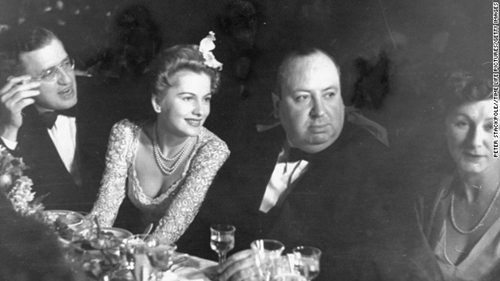
Joan Fontaine, sitting with David O. Selznick, Alfred Hitchcock and Alma Hitchcock at the 1941 ceremony, starred in

Joan Fontaine, sitting with David O. Selznick, Alfred Hitchcock and Alma Hitchcock at the 1941 ceremony, starred in “Rebecca,” though she lost the gold to Ginger Rogers. “Rebecca” won Best Picture and Best Cinematography. Fontaine claimed the Oscar the next year in Hitchcock’s “Suspicion.” In the 1941 show, President Franklin D. Roosevelt gave a six-minute, direct-line radio address from the White House, honoring the work of Hollywood. This was the first time an American president had participated in an Academy Awards evening. Also, for the first time, the names of all the winners were kept secret until they were announced during the ceremony. Hitchcock received an honorary Oscar in 1968.

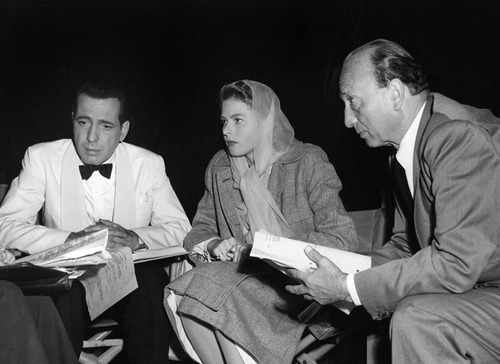
Humphrey Bogart, Ingrid Bergman and Michael Curtiz on the set of "Casablanca," which snared the gold in 1944. The film was released in late 1942 and competed with titles from 1943.

Humphrey Bogart, Ingrid Bergman and Michael Curtiz on the set of “Casablanca,” which snared the gold in 1944. The film was released in late 1942 and competed with titles from 1943.

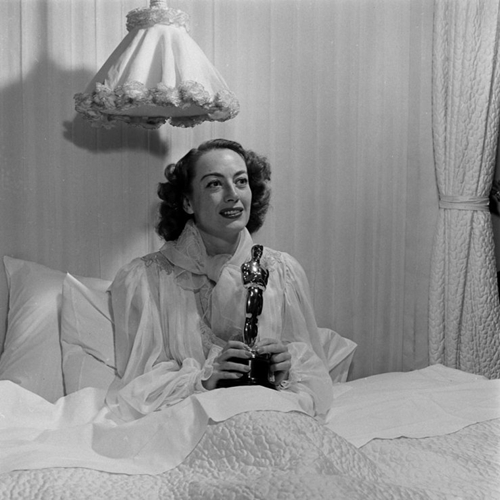
Joan Crawford triumphed playing the title role in 1945's "Mildred Pierce." Director Michael Kurtiz accepted the award at the ceremony because Crawford was ill and confined to bed. Clearly, she perked up when she found out she won.

Joan Crawford triumphed playing the title role in 1945’s “Mildred Pierce.” Director Michael Kurtiz accepted the award at the ceremony because Crawford was ill and confined to bed. Clearly, she perked up when she found out she won.

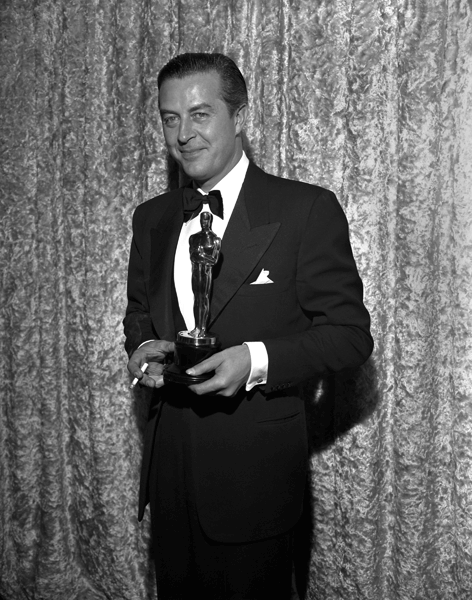
Ray Milland holds his Best Actor Oscar. He won for his portrayal of an alcoholic writer in Billy Wilder's "The Lost Weekend" from 1945. The film also won Best Picture, Best Director and Best Screenplay, a rare feat for such a noirish flick.

Ray Milland holds his Best Actor Oscar. He won for his portrayal of an alcoholic writer in Billy Wilder’s “The Lost Weekend” from 1945. The film also won Best Picture, Best Director and Best Screenplay, a rare feat for such a noirish flick.

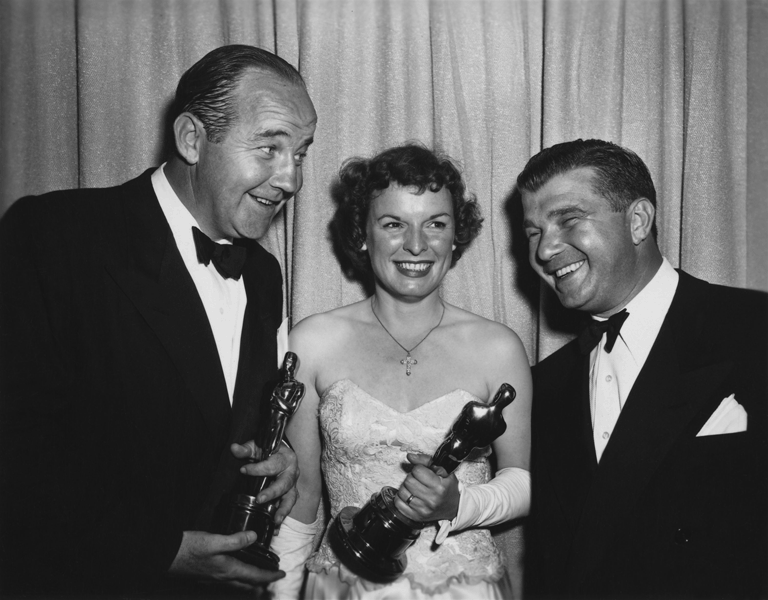
"All the King's Men," a political noir from 1949, garnered Best Picture, Best Actor for Broderick Crawford and Best Supporting Actress for Mercedes McCambridge. The gold winners savor the moment with director Robert Rossen.

“All the King’s Men,” a political noir from 1949, garnered Best Picture, Best Actor for Broderick Crawford and Best Supporting Actress for Mercedes McCambridge. The gold winners savor the moment with director Robert Rossen.

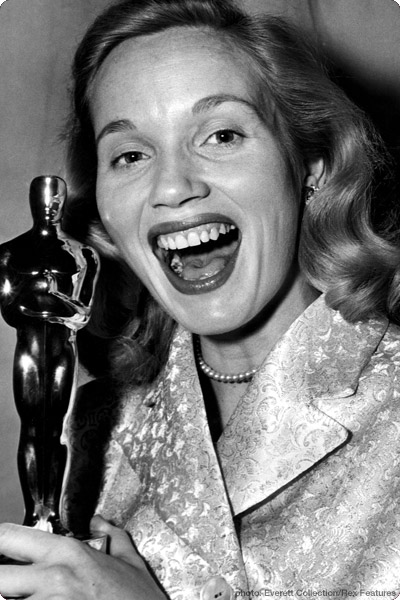
Eva Marie Saint took home the Best Supporting Actress for  "On the Waterfront" from 1954. "On The Waterfront" also won Best Picture, Best Actor (Marlon Brando), Black-and-White Art Direction-Set Decoration, (Richard Day), Black-and-White Cinematography (Boris Kaufman), Directing (Elia Kazan), Film Editing (Gene Milford), and Writing – Story and Screenplay (Budd Schulberg).

Eva Marie Saint took home the Best Supporting Actress Oscar for
“On the Waterfront” from 1954. “On The Waterfront” also won Best Picture, Best Actor (Marlon Brando), Black-and-White Art Direction-Set Decoration, (Richard Day), Black-and-White Cinematography (Boris Kaufman), Directing (Elia Kazan), Film Editing (Gene Milford), and Writing – Story and Screenplay (Budd Schulberg).

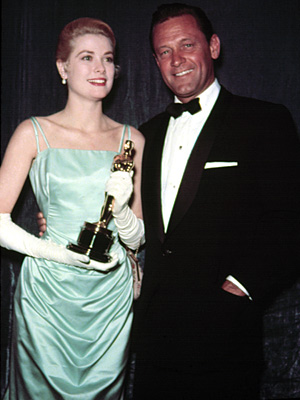
Grace Kelly won the Best Actress gold for 1954's "Country Girl." I know, I know, it's not a noir but Kelly was one of Hitchcock's favorite blondes, she's shown with co-star William Holden (mmm) and I love the dress. Kelly quit acting in 1955 to marry Prince Rainier.

Grace Kelly won the Best Actress gold for 1954’s “Country Girl.” I know, I know, it’s not a noir but Kelly was one of Hitchcock’s favorite blondes, she’s shown with co-star William Holden (mmm) and I love the dress. Kelly quit acting in 1955 to marry Prince Rainier.

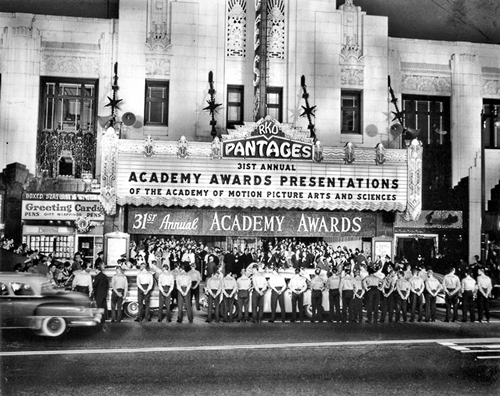
The RKO Pantages Theatre hosted many Oscar ceremonies. The 31st Academy Awards ceremony, held on April 6, 1959, ended 20 minutes early, after producer Jerry Wald cut numbers from the show to make sure it ran on time. Host Jerry Lewis was left to fill up the time.

The RKO Pantages Theatre hosted many Oscar ceremonies. The 31st Academy Awards ceremony, held on April 6, 1959, ended 20 minutes early, after producer Jerry Wald cut numbers from the show to make sure it ran on time. Host Jerry Lewis was left to fill up the time.

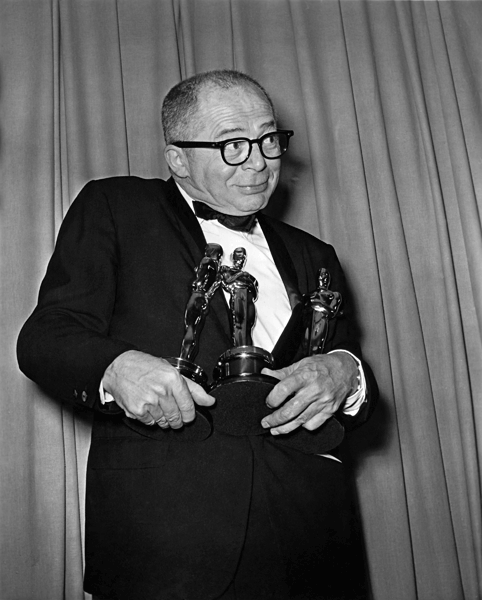
Billy Wilder juggles Oscars snared by his dark comedy "The Apartment," which won Best Picture, Best Black-and-White Art Direction-Set Decoration (Alexander Trauner and Edward G. Boyle), Directing (Billy Wilder), Film Editing (Daniel Mandell), and Writing – Story and Screenplay written directly for the screen (Billy Wilder and I.A.L. Diamond).

Billy Wilder juggles Oscars snared by his dark comedy “The Apartment,” which won Best Picture, Best Black-and-White Art Direction-Set Decoration (Alexander Trauner and Edward G. Boyle), Directing (Billy Wilder), Film Editing (Daniel Mandell), and Writing – Story and Screenplay written directly for the screen (Billy Wilder and I.A.L. Diamond).

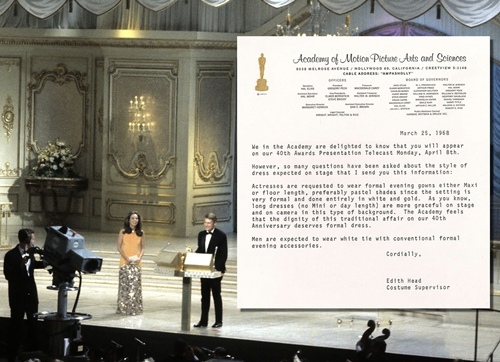
Eight-time Costume Design winner Edith Head was costume supervisor for the 40th (1967) Academy Awards and offered her fashion tips in the letter above. Also seen above are presenter Leslie Caron and Best Director winner Mike Nichols.

Eight-time Costume Design winner Edith Head was costume supervisor for the 40th (1967) Academy Awards and offered her fashion tips in the letter above. Also seen above are presenter Leslie Caron and Best Director winner Mike Nichols.

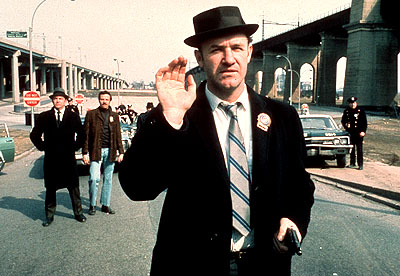
"The French Connection," a neo-noir from1972, won Best Picture. The film also won Academy Awards for Best Actor (Gene Hackman), Directing (William Friedkin), Film Editing (Jerry Greenberg), and Writing – Screenplay based on material from another medium (Ernest Tidyman).

“The French Connection,” a neo-noir from 1971, won Best Picture. The film also won Academy Awards for Best Actor (Gene Hackman), Directing (William Friedkin), Film Editing (Jerry Greenberg), and Writing – Screenplay based on material from another medium (Ernest Tidyman).

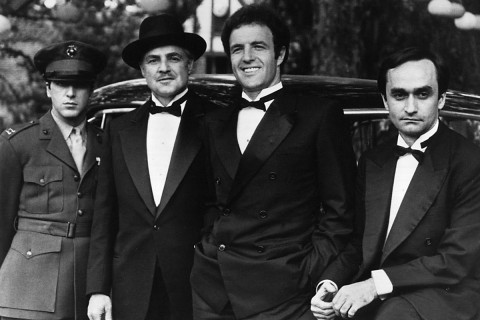
"The Godfather" (1972) cast members: Maron Brando, James Caan, Al Pacino and xx. The classic family-crime saga won Best Picture. The movie also won Best Actor (Marlon Brando) and Writing – Screenplay based on material from another medium (Mario Puzo and Francis Ford Coppola). “The Godfather Part II" (1974) became the first sequel to win the award for Best Picture. Part Two claimed five more Oscars including the directing prize for Coppola.

“The Godfather” (1972) cast members: Al Pacino, Marlon Brando, James Caan, and John Cazale. The classic family-crime saga won Best Picture. The movie also won Best Actor (Marlon Brando) and Writing – Screenplay based on material from another medium (Mario Puzo and Francis Ford Coppola). “The Godfather Part II” (1974) became the first sequel to win the award for Best Picture. Part Two also claimed five more Oscars including the directing prize for Coppola.

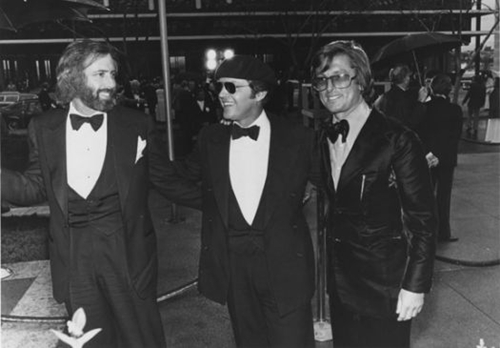
Robert Towne, Jack Nicholson and producer Robert Evans at the 1975 Oscars ceremony. Towne took home the Oscar for writing "Chinatown," perhaps the best neo-noir script ever written.

Robert Towne, Jack Nicholson and producer Robert Evans at the 1975 Oscars. Towne took home the Oscar for writing “Chinatown,” perhaps the best neo-noir script ever written.

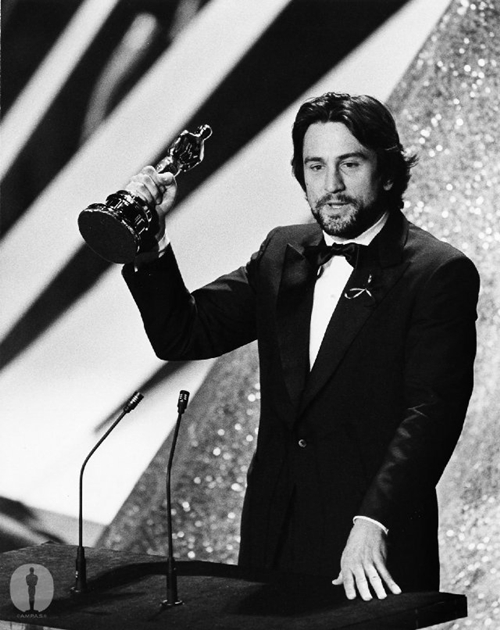
Robert DeNiro gives accepts his Best Actor Oscar for "Raging Bull" (1980) directed by Martin Scorsese, who grew up on classic noir and became a neo-noir master. The oft-subbed Scorsese finally won the directing gold for 2007's "The Departed."

Robert DeNiro accepts his Best Actor Oscar for “Raging Bull” (1980) directed by Martin Scorsese, who grew up on classic noir and became a neo-noir master. The oft-snubbed Scorsese finally won the directing gold for 2006’s “The Departed.” This was DeNiro’s second Oscar, having garnered Best Supporting Actor for “The Godfather Part II.”

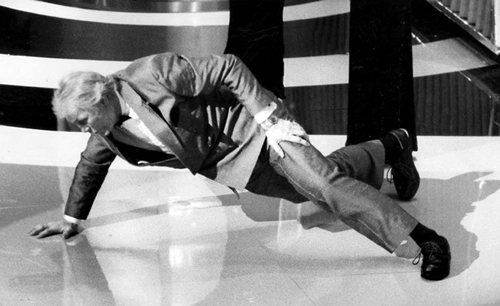
During his fourth decade in the movies, Jack Palance won Supporting Actor for his role as Curly in "City Slickers" (1991). His famous one-handed pushups onstage became a running joke with host Billy Crystal throughout the show. Our favorite Palance film-noir part: "Sudden Fear" (1952, David Miller) in which he co-starred with Joan Crawford and Gloria Grahame.

During his fourth decade in the movies, Jack Palance won Supporting Actor for his role as Curly in “City Slickers” (1991). His famous one-handed pushups onstage became a running joke with host Billy Crystal throughout the show. Our favorite Palance film-noir part: “Sudden Fear” (1952, David Miller) in which he co-starred with Joan Crawford and Gloria Grahame.

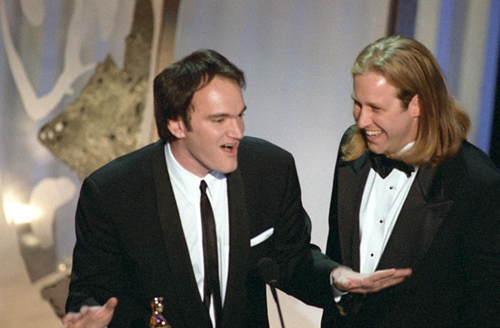
Quentin Tarantino and Roger Avary won the Oscar for writing "Pulp Fiction" (1994). It earned six other noms.

Quentin Tarantino and Roger Avary won the Oscar for writing “Pulp Fiction” (1994). It earned six other noms.

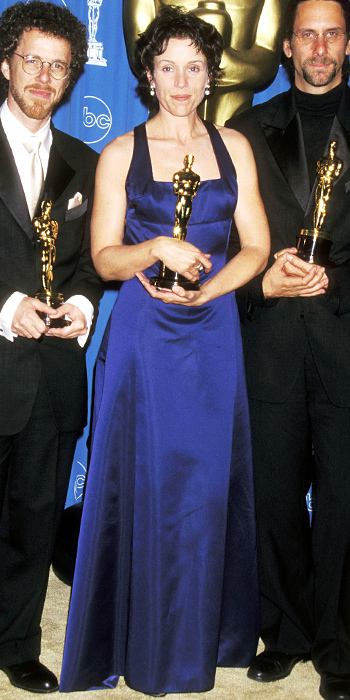
Frances McDormand hold her Best Actress Oscar for her work in 1996's "Fargo." Writer/director team Joel and Ethan Coen won for Best Original Screenplay. They went on to win writing and directing Oscars for 2007's "No Country for Old Men."

Frances McDormand hold her Best Actress Oscar for her work in 1996’s “Fargo.” Writer/director team Joel and Ethan Coen won for Best Original Screenplay. They went on to win writing and directing Oscars for the 2007 neo noir “No Country for Old Men.”

Top reasons we love ‘Double Indemnity’

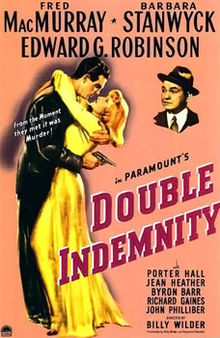
Double Indemnity poster

Yes, we’re still gushing about “Double Indemnity,” the film noir classic from 1944. And why not? It can still draw an audience, after all. ArcLight and the Skirball Cultural Center are showing “Double Indemnity” Monday night in Sherman Oaks.

Billy Wilder‘s great prototype film noir turns 71 this year and yet it never gets old. Starring Barbara Stanwyck, Fred MacMurray and Edward G. Robinson, the movie boasts a screenplay that Wilder co-wrote with Raymond Chandler, based on James M. Cain‘s novel, which was inspired by actual events.

Here’s why we hold the picture dear to our hearts, dearies.

14. As film noir historian and author Foster Hirsch once put it: “It’s the quintessential film noir. This is the mother lode, primary source film noir. It’s the basis for every film noir you’ve ever loved.”

13. Someone with the name Walter Neff turns out to be a tough guy.

12. All Walter has to do to escape punishment is sit tight. Yet, his ego drives him toward a final confrontation with his lover/partner in crime. He’s so damn human.

11. Barbara Stanwyck’s Phyllis Dietrichson is a fashion victim. She’s so damn human.

10. The first time Phyllis shows up at Walter’s apartment, she says she is returning his hat (which he supposedly left at her house) but the previous scene clearly shows him taking his hat as he leaves. Still, there’s so much tension between them, who cares?!

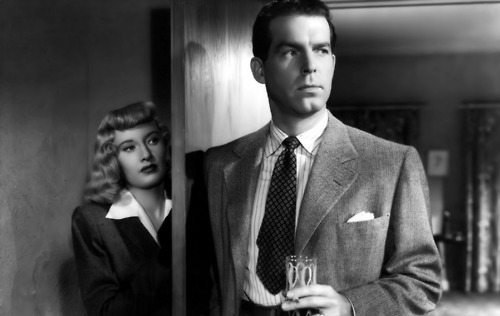
9. The door to Walter’s apartment opens the wrong way (it shields Phyllis on one of her visits) but you’re so caught up in the story you hardly notice.

As Billy Wilder acknowledged, no door in the world would open this way.

As Billy Wilder acknowledged, no door in the world would open this way.

8. You could buy Phyllis Dietrichson’s house for $30,000.

7. You could have a beer at a drive-in restaurant, served by a car-hop, no less.

6. The look of supreme satisfaction on Phyllis’s face at the moment her husband is murdered.

5. Stanwyck and MacMurray both took a risk and played against type.

4. Edward G. Robinson almost steals the show and it’s really a bromance between his character and MacMurray’s Walter Neff.

3. Raymond Chandler makes a cameo appearance, about 16 minutes into the movie, at Walter’s office building.

2. It’s perfectly paced – you can watch it over and over and it moves along lickety split every time, leaving you wanting more.

1. It truly ranks as a classic flick – it’s as fresh, sexy and funny today as it was in 1944. The writing, acting, directing cinematography, lighting, art direction are matchless.

Do you love “Double Indemnity” as much as we do? Then let us know!