‘From the Head’ intrigues, but doesn’t live up to its potential

From the Head/2013 VoD/Breaking Glass Pictures/95 min.
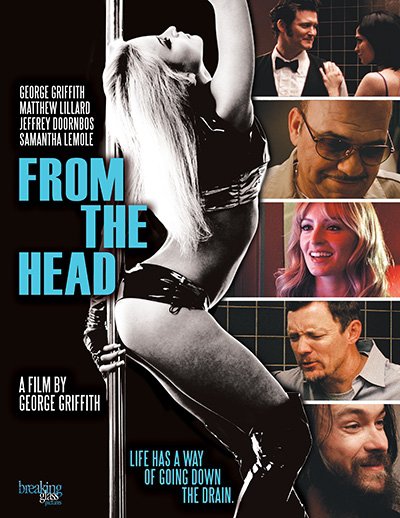
Three years at a job can feel like a milestone or a miracle. Working as a bathroom attendant at a seedy strip club, it’s an eternity.

In “From the Head,” a film made by and starring George Griffith, we spend a day in the life of Shoes, a wry, worldly grifter on his third anniversary of hanging out behind the men’s room door of a Times Square club, drinking, smoking and secretly smirking at patrons as they pause to leave their tips.

We see him interact with customers, joking, advising, observing – even solicitously plucking a stray blonde hair off a man’s suit. Shoes has literary aspirations and all of these moments might be fodder for his work.

The film, impressionistic and candid, snags the harsh look and tawdry feel of the place. Griffith deftly shows the camaraderie among co-workers (shared drinks, a casual display of a brand-new boob job) and seamlessly orchestrates the parade of memorable customers in and out of the men’s room – from the guys who refuse to tip to those who reveal their genuine (mostly unrequited) feelings for the strippers.

Griffith has a gem of an idea here – a sly insider’s view of a “hell hole” fairly bursting with potential for drama. Unfortunately, the film’s drama doesn’t quite get off the ground – despite the tawdry, titillating backdrop, “From the Head” feels oddly flat and sluggish.

Griffith’s main character (Shoes) must distance himself to survive the hostility, sadness and desperation around him, but we don’t get much of a glimpse beyond the wall he has built. The constant cold sneer needs to be tempered by at least a suggestion of vulnerability in order for viewers to feel his depth of pain and connect with his plight.

“From the Head” is available on cable VOD. It releases July 9 on DVD.  

Happy Father’s Day, all!

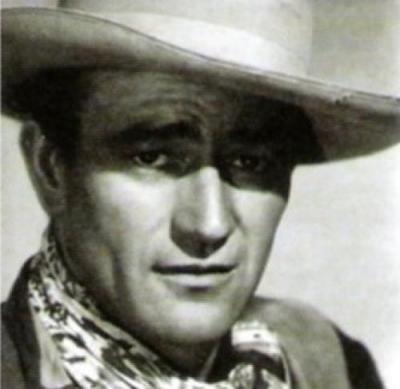
My friends used to say that my Dad reminded them of John Wayne.

The Aero hosts an evening with Sofia Coppola in person

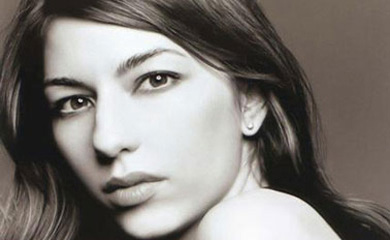
Sofia Coppola

Having just seen “The Bling Ring,” Sofia Coppola’s terrific new neo-noir based on real events, I am especially excited about An Evening with Sofia Coppola, presented by the American Cinematheque.

The night begins with 2003’s “Lost in Translation,” starring Bill Murray and Scarlett Johansson, as two Americans who cross paths one night in a luxury hotel bar in Tokyo and form an unlikely friendship. The film earned Coppola an Oscar for Best Original Screenplay.

Next up is “The Virgin Suicides,” Coppola’s adaption of Jeffrey Eugenides’ novel exploring adolescent repression and rebellion in an upper-class Detroit suburb in the 1970s. The local boys are mesmerized by the mysterious Lisbon sisters, who are kept on a short leash by overprotective parents James Woods and Kathleen Turner. When one of the girls (Kirsten Dunst) strikes up a relationship with one of the guys (Josh Hartnett), it sets in motion a chain of events that ends in tragedy.

There will be a discussion between films with Coppola.

An Evening with Sofia Coppola takes place on Wednesday, June 5 at 7:30 p.m. at the Aero Theater in Santa Monica.

Zúñiga tribute opens and arts·meme marks another year

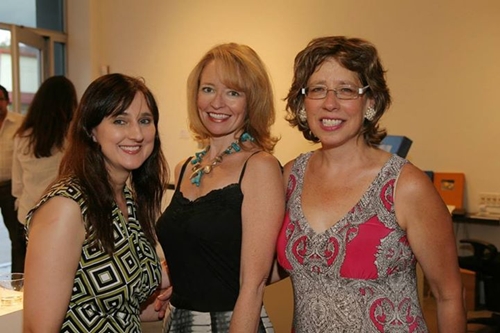
Tonya Plank, Film Noir Blonde and Debra Levine at the event.

On Saturday, I attended an elegant and lively double-bill soiree: the opening of Francisco Zúñiga: A Centennial Tribute at Jack Rutberg Fine Arts in Los Angeles and an anniversary party for the always-inspiring arts·meme blog, founded five years ago by Debra Levine.

Debra is a former dancer whose grace and poise extends to her writing as well to welcoming guests. She has the old-school and thoroughly charming notion that partygoers might enjoy being introduced to one another. Imagine! There were many to greet on Saturday and Debra did the job nimbly, flitting from person to person, smiling brilliantly, flirting sometimes, briefly quizzing, then nodding, pondering and promising to give her considered reply later on.

There is another arrival and, as always, party clocks shoo the minutes into a lovely over-too-fast blur. Meshuga, she often calls herself. Those who know her call her savvy, sharp, insightful and delightful. Thank you, Debra, for a wonderful party and happy anniversary to arts·meme.

Francisco Zúñiga: A Centennial Tribute at Jack Rutberg Fine Arts runs through July 31.

On her birthday, thoughts from and about Marilyn

I put this together last year and liked it so much I decided to run it twice. ; )

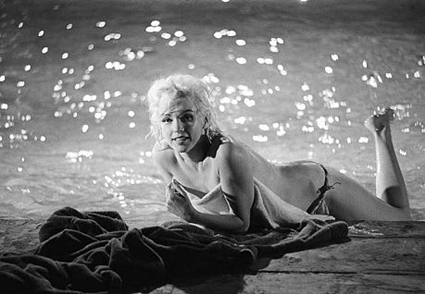
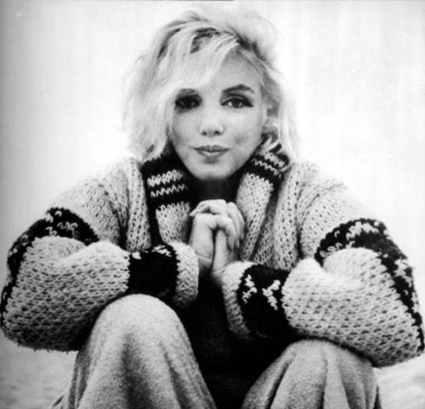
For what would have been Marilyn Monroe’s 86th 87th birthday (she was born on June 1, 1926), I’ve compiled quotations from her and about her. If you have a favorite quotation from or about MM, please send it and I will add it to the list. I have credited the photographers wherever possible; copyright of all photos belongs to the photographers and/or their estates/representatives.

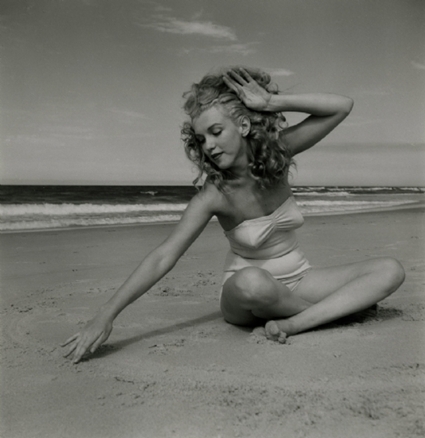
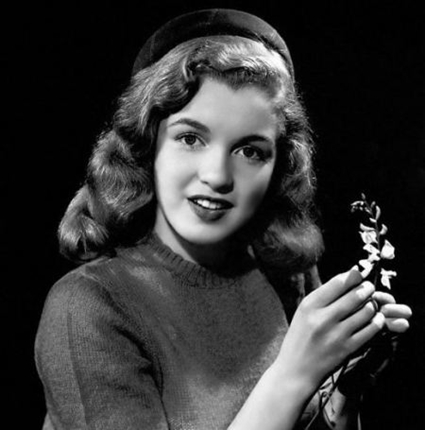
An early shot of Marilyn on the beach; she loved the water.

FROM MARILYN …

“The real lover is the man who can thrill you by touching your head or smiling into your eyes or just staring into space.”

“I love champagne – just give me champagne and good food, and I’m in heaven and love.”

Marilyn started out as a model.

“The body is meant to be seen, not all covered up.”

“Sex is part of nature. I go along with nature.”

“My illusions didn’t have anything to do with being a fine actress, I knew how third rate I was. I could actually feel my lack of talent, as if it were cheap clothes I was wearing inside. But, my God, how I wanted to learn, to change, to improve!”

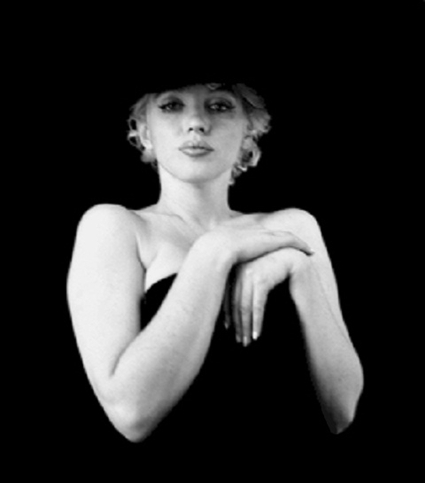
Marilyn shot by Milton Greene

“I don’t mind living in a man’s world as long as I can be a woman in it.”

“Husbands are chiefly good as lovers when they are betraying their wives.”

“People had a habit of looking at me as if I were some kind of mirror instead of a person. They didn’t see me, they saw their own lewd thoughts, then they white-masked themselves by calling me the lewd one.”

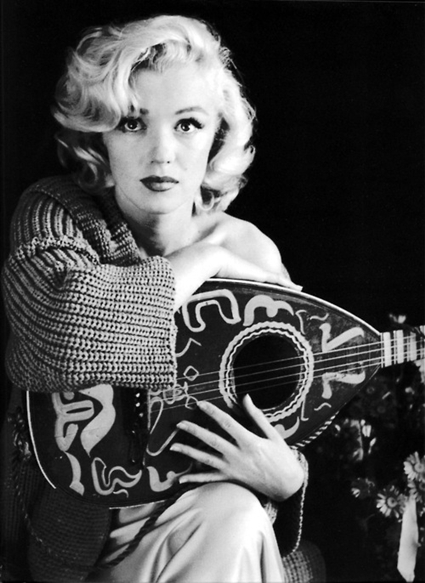
Marilyn shot by Milton Greene

“All the men I know are spending the day with their wives and families, and all the stores in Los Angeles are closed. You can’t wander through looking at all the pretty clothes and pretending to buy something.” – on why she hated Sundays

“Everyone’s just laughing at me. I hate it. Big breasts, big ass, big deal. Can’t I be anything else? Gee, how long can you be sexy?”

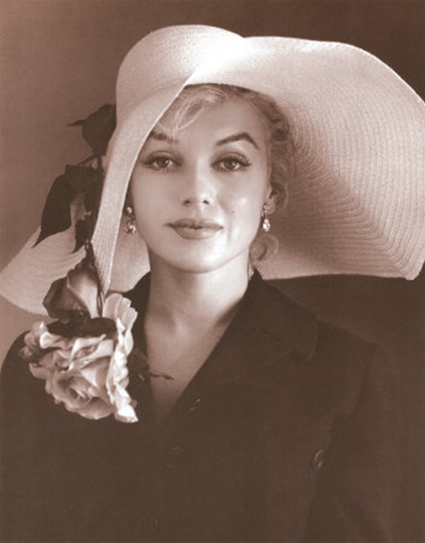
I love this shot and the elegant hat.

“Looking back, I guess I used to play-act all the time [as a child]. For one thing, it meant I could live in a more interesting world than the one around me.”

“No one ever told me I was pretty when I was a little girl. All little girls should be told they’re pretty, even if they aren’t.”

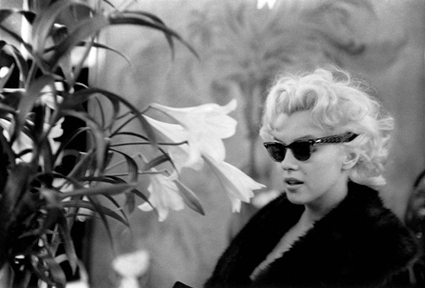
Marilyn in New York, shot by Ed Feingersh

“I’m selfish, impatient and a little insecure. I make mistakes, I am out of control and at times hard to handle. But if you can’t handle me at my worst, then you sure as hell don’t deserve me at my best.”

“My problem is that I drive myself … I’m trying to become an artist, and to be true, and sometimes I feel I’m on the verge of craziness. I’m just trying to get the truest part of myself out, and it’s very hard. There are times when I think, ‘All I have to be is true.’ But sometimes it doesn’t come out so easily. I always have this secret feeling that I’m really a fake or something, a phony.”

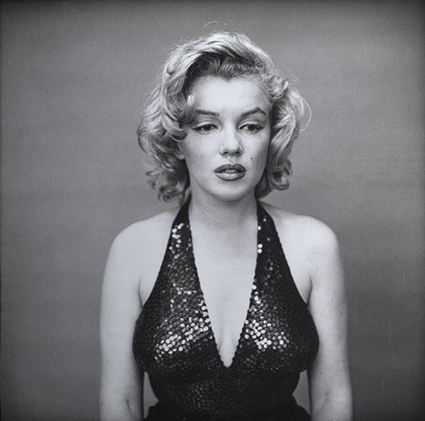
Marilyn shot by Richard Avedon

“Hollywood is a place where they’ll pay you a thousand dollars for a kiss and fifty cents for your soul.”

ABOUT MARILYN …

“Our marriage was a good marriage … it’s seldom a man gets a bride like Marilyn. I wonder if she’s forgotten how much in love we really were.” – Jim Dougherty talking to Photoplay magazine, 1953; they were married from 1942-46.

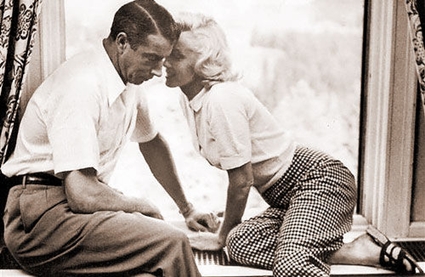
Marilyn and Joe DiMaggio were married less than a year.

“It’s like a good double-play combination. It’s just a matter of two people meeting and something clicks.” – Joe DiMaggio; he was married to Marilyn from Jan. 14, 1954 to Oct. 27, 1954

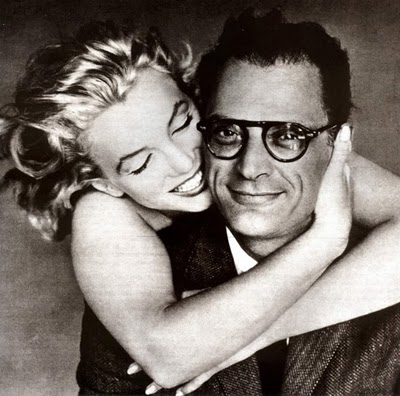
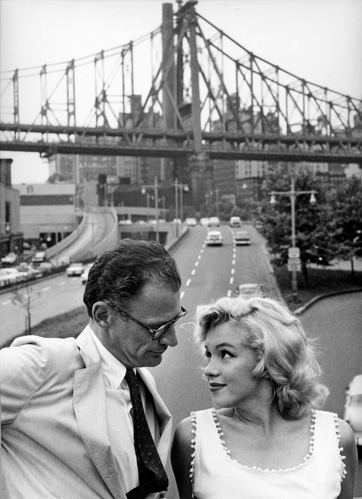
Marilyn and Arthur Miller, her third husband

“She was a whirling light to me then, all paradox and enticing mystery, street-tough one moment, then lifted by a lyrical and poetic sensibility that few retain past early adolescence. …

“She had no common sense, but what she did have was something holier, a long-reaching vision of which she herself was only fitfully aware: humans were all need, all wound. What she wanted most was not to be judged but to win recognition from a sentimentally cruel profession, and from men blinded to her humanity by her perfect beauty. She was part queen, part waif, sometimes on her knees before her own body and sometimes despairing because of it. …

“To have survived, she would have had to be either more cynical or even further from reality than she was. Instead, she was a poet on a street corner trying to recite to a crowd pulling at her clothes.” – Arthur Miller, her husband from 1956-61

Marilyn Monroe and Arthur Miller in front of the Queensboro Bridge, New York, 1957. Sam Shaw/ Shaw Family Archives, Ltd.

“There’s a beautiful blonde name of Marilyn Monroe who makes the most of her footage.” xxxxxLiza Wilson of Photoplay magazine, writing about “The Asphalt Jungle,” 1950

She was, “a female spurt of wit and sensitive energy who could hang like a sloth for days in a muddy-mooded coma; a child girl, yet an actress to loose a riot by dropping her glove at a premiere; a fountain of charm and a dreary bore … she was certainly more than the silver witch of us all.” – Norman Mailer

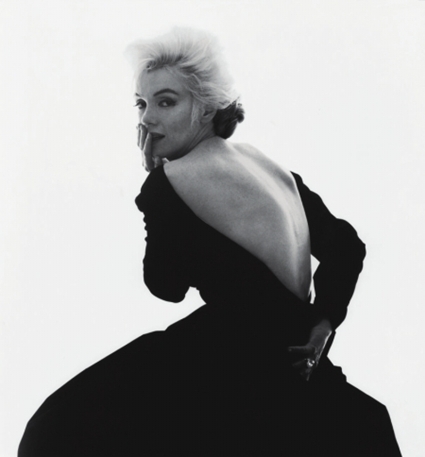
Marilyn shot by Bert Stern, 1962

‘‘From families that owned little but their own good names, she had inherited the fierce pride of the poor. Because she was sometimes forced to give in, to sell herself partially, she was all the more fearful of being bought totally.’’ – Gloria Steinem

“She deeply wanted reassurance of her worth, yet she respected the men who scorned her, because their estimate of her was her own.” – Elia Kazan

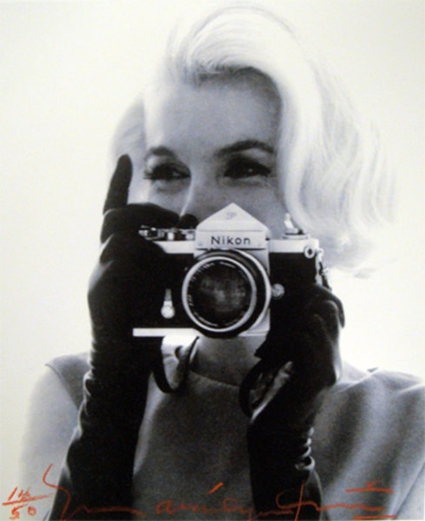
Marilyn shot by Bert Stern, 1962

All the sex symbols were endowed with a large portion of earthy coarseness. Marilyn had the most. … Only an inherent whore could walk like Marilyn and dress like Marilyn. … She had a trick of making all men feel she could be in love with them and I think she could be, a sort of saving each one for a rainy day, for when things would get tough again in her life and she would need help. … I saw the hope and the disappointments. The longing to give what the people wanted and, at the same time, to become a complete person herself. She was also selfish, rude, thoughtless, completely self-centered. She kept people waiting for hours.” – Hollywood columnist Sheilah Graham

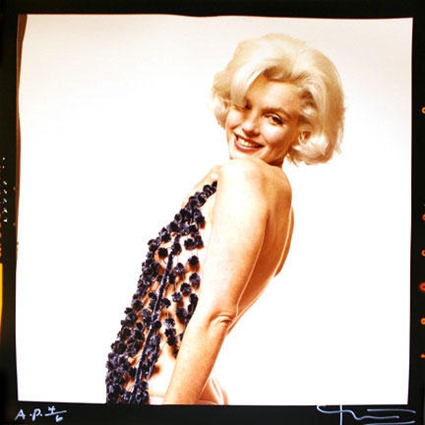
Marilyn shot by Bert Stern, 1962

“The luminosity of that face! There has never been a woman with such voltage on the screen, with the exception of Garbo. … She was an absolute genius as a comic actress, with an extraordinary sense for comic dialogue. … Nobody else is in that orbit; everyone else is earthbound by comparison.” – Billy Wilder

“If she’d been dumber, she’d have been happier.” – Shelley Winters

“Everything Marilyn does is different from any other woman, strange and exciting, from the way she talks to the way she uses that magnificent torso.” – Clark Gable, her co-star of 1961’s “The Misfits,” about which he said: “This is the best picture I have made and it’s the only time I’ve been able to act.

Marilyn shot by Lawrence Schiller on the set of “Something’s Got to Give,” 1962

“Her mixture of wide-eyed wonder and cuddly drugged sexiness seemed to get to just about every male; she turned on even homosexual men. And women couldn’t take her seriously enough to be indignant; she was funny and impulsive in a way that made people feel protective. She was a little knocked out; her face looked as if, when nobody was paying attention to her, it would go utterly slack – as if she died between wolf calls.” – Pauline Kael

“What I particularly liked about Marilyn was that she didn’t act like a movie star. She was down to earth. Although she was 28, she looked and acted like a teenager. … I was most impressed that Marilyn was always polite and friendly to everyone on the set. She was no phony or snob. … Marilyn always seemed determined to talk to me about her childhood. We would be discussing a subject of current interest to her and she would somehow bring up an incident from her bygone days.” – Photographer George Barris

Marilyn shot by George Barris, 1962

“I liked her. She was a good kid. But when you looked into her eyes, there was nothing there. No warmth. No life. It was all illusion. She looked great on film, yeah. But in person … she was a ghost.” – Dean Martin, her co-star in 1962’s (unfinished) “Something’s Got to Give”

“Nobody could be as miserable as she was in such a loving, good-natured way. No matter how sad she may have been, she was never mean, never lashed out at me. Instead she just wanted to hug me and have me hug her and tell her it was all going to work out. That it didn’t, broke my heart.” – George Jacobs, who was Frank Sinatra’s valet

“Marilyn Monroe was a legend. In her lifetime she created a myth of what a poor girl from a deprived background could attain. For the entire world she became a symbol of the eternal feminine.” – Lee Strasberg in his eulogy

Noirish ‘Some Like It Hot’ at Hollywood Forever Cemetery

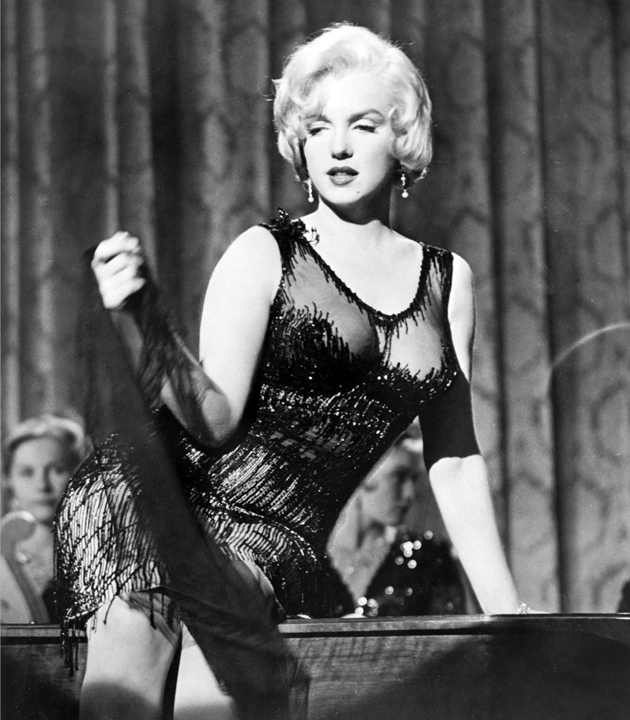
Marilyn Monroe as Sugar Kane in “Some Like It Hot.”

To celebrate Marilyn Monroe’s birthday, on Saturday, June 1, Cinespia.org will present “Some Like It Hot” (1959, Billy Wilder) at Hollywood Forever Cemetery. Though the film is considered one of Tinseltown’s all-time best comedies, Marilyn reportedly objected to the fact that her character, Sugar Kane, actually believed her fellow musicians (Tony Curtis and Jack Lemon dressed in drag) were women. No girl is that dumb, she said. Nevertheless, the movie was a hit and her performance is unforgettable. You can read Mike Wilmington’s review here.

More Burt on the big screen at UCLA’s Billy Wilder Theater

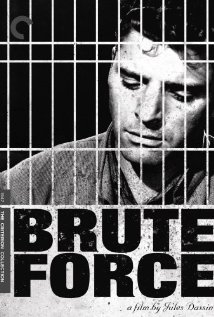
The Billy Wilder Theater at UCLA will present a choice double bill on Sunday, June 2, at 7 p.m.: two film-noir titles starring Burt Lancaster. First is the prison drama “Brute Force” (1947, Jules Dassin), in which Lancaster plays an angry inmate desperate to escape his sadistic captors.

Variety’s review of “Brute Force” noted that “Yvonne De Carlo, Ann Blyth, Ella Raines and Anita Colby are the women on the ‘outside’ whose machinations, wiles or charms accounted for their men being on the ‘inside.’ ” Natch. (Lancaster and De Carlo were paired again in 1949’s “Criss Cross,” directed by Robert Siodmak.)

“Brute Force” will be followed by “Kiss the Blood Off My Hands” (1948, Norman Foster). Lancaster plays a traumatized and violent ex-prisoner of war living in London and trying, unsuccessfully of course, to get his life together. Co-starring Joan Fontaine.

The evening is part of the Lancaster centennial celebration presented by the UCLA Film & Television Archive and the Hugh M. Hefner Classic American Film Program. The celebration of Lancaster’s movies runs through June 30. Author Kate Buford is the special guest on June 2.

Additionally, on Monday, June 3, at 7:30 p.m., the Archive’s look at emerging voices in Czech cinema comes to a close with director David Ondříček in person for his taut neo-noir police thriller, “In the Shadow” (2012), which was the Czech Republic’s official Oscar entry for 2013.

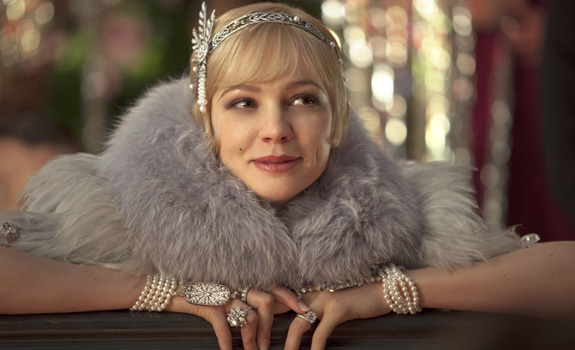
Happy birthday, Carey Mulligan!

Photo by Matt Hart – ©2013 Bazmark Film III Pty Ltd

She is 28. Shown as Daisy Buchanan in “The Great Gatsby” by director Baz Luhrmann and production/costume designer Catherine Martin.

On Memorial Day: Good wishes, gratitude to our veterans

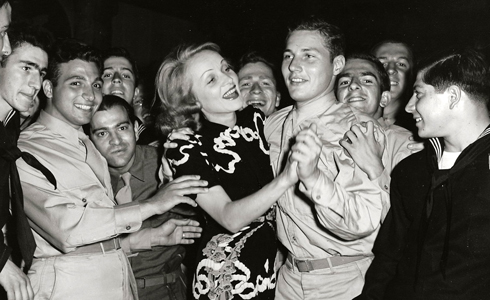
Marlene Dietrich dances with a serviceman at the Hollywood Canteen.

Today I was thinking about the Hollywood Canteen, the club that entertained servicemen during World War II. What a feat of dedication and coordination! More than 3,000 stars as well as industry staff from producers to prop masters volunteered their talent, time and effort. A uniform served as a ticket for admission; food, non-alcoholic drinks, shows and dancing were free of charge.

Housed at 1451 Cahuenga Blvd., the Canteen was typically open six nights a week and was in operation from Oct. 3, 1942 to Nov. 22, 1945. Key to the venue’s formation and success were Bette Davis, John Garfield and Jules Stein (Davis’ agent).

You can read more about the Hollywood Canteen here.

Film noir gets a Hawaiian punch Saturday at the Egyptian

New York, Los Angeles, San Francisco, Chicago … these are the cities we usually associate with the grim, glamorous tales of film noir.

But when you get the rare chance to see a noir with a more exotic setting, it’s all the more memorable. The American Cinematheque is offering just such a viewing opp when it goes tiki on Saturday, June 1.

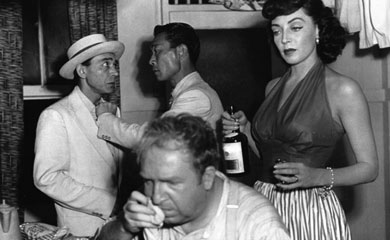
Noir stalwart Marie Windsor stars in this unusual example of the genre.

The Egyptian Theatre in Hollywood is showing “Hell’s Half Acre” (1954, John Auer), which was filmed in filmed in Honolulu. Evelyn Keyes stars as a dancer combing the streets of Honolulu’s red-light district to hunt for her missing G.I. husband (Wendell Corey), who she believes is alive and writing songs in Hawaii.

Turns out, he’s also a gangster vying with Philip Ahn for control of the island’s vice rackets. Toss sultry, statuesque Marie Windsor into the mix, and it’s pulp nirvana, says the Cinematheque.

The party starts at 5 p.m. in the Egyptian’s courtyard, where there will performances from King Kukulele & the Friki Tikis and the Polynesian Paradise Dancers, tiki vendors and a cash bar with Polynesian drinks. A slide show and a 50th anniversary tribute to the Disney’s Enchanted Tiki Room by Bob Baker’s Marionettes will precede the 7:30 p.m. screening.