‘Black Swan’ charts madness, dreamily voluptuous terror

Black Swan/ 2010/ Fox Searchlight Pictures/ 108 min.
Michael Wilmington

With the Oscars this Sunday, I want to highlight a contender with intriguing noir elements: “Black Swan.” Critic Michael Wilmington shares his thoughts on director Darren Aronofsky’s latest foray into tortured psyches and Natalie Portman’s startling performance.

Who makes crazier art movies — agonized characters, trapped in more nightmarish fixes — than Darren Aronofsky? David Lynch, Bong Joon-ho and Roman Polanski, maybe, but few others. A specialist in tales of the brilliantly sick and the sickly brilliant, Aronofsky has spun, with disorienting intensity, barmy movie stories of a crazed math genius going nuts on the stock market (in “Pi”), of a family of lower- depths junkies and pill-poppers flipping out together (“Requiem for a Dream”), and of a  battered, over-the-hill wrestler putting himself through hell for one last fight (“The Wrestler.”) In “The Fountain,” Aronofsky’s whole universe went bonkers, in segments.

And in his latest movie, the justly hailed but occasionally (understandably) ridiculed dance melodrama “Black Swan,” this chronicler of mad lives charts the psychological disintegration of a young, ambitious New York ballerina named Nina Sayers (played by Natalie Portman with ferocious dedication), who’s been given the dream role of the swan princess of Tchaikovsky’s “Swan Lake” at Lincoln Center and promptly goes over the edge into some kind of madness, as well as, apparently, self-mutilation, paranoid fantasies and sexual hysteria.

As we watch, Nina whirls and leaps and goes delusional. And the camera seems to whirl and leap and go delusional along with her, executing wild leaps and dizzying spins, peeking over her shoulder, Polanski-like, wherever she goes. When the ballet company’s seductive bully of a master choreographer, Thomas Leroy (played by French star Vincent Cassel, as a kind of sexy, sadistic puppet-master) casts Nina as the lead in Tchaikovsky’s classic ballet, replacing his former prima ballerina, Beth Macintyre (Winona Ryder, who plays Beth like a mad, self-destructive witch), he’s simultaneously anointing her and hurling her into hell.

When he tells Nina she’s ideal casting  for half the part (the role of the pure white swan) but not the other half (the wicked black swan), he’s dropping her into an inferno of nightmares, hurling a dart at the splintering psyche we glimpse beneath Nina’s “Persona”-like, beautiful, introverted face.      

Aronofsky bombards us with Nina’s fears and desires, in scenes of dreamily voluptuous terror. The ballet studio and stage become arenas of paranoia. So does her home, an art-cluttered Manhattan apartment she shares with her painter mother Erica (Barbara Hershey).

Stricken with fear, Nina tears and rips at her own flesh, on her shoulder blades, her hands, near her cuticles, and then the cuts are mysteriously healed.  She’s flung into predatory sexual escapades or fantasies, involving Thomas, and her main rival, Lily (Mila Kunis), whom Thomas says is the perfect Black Swan, and who (seemingly) dives between Nina’s legs one night, a fling that Lilly then denies. (“You fantasized about me? Was I good?” she asks delightedly.)

As the fantasies (?) rage, Nina becomes ill, is berated by Thomas, attacked by Beth, played for a fool (maybe) by her rival Lilly, bossed by her devoted yet domineering mother. Nina works herself into near-collapse, her mind unhinges, her body is ripped open. Lilly plays the part of seductress/rival/friend, the earthy black swan against Nina’s ethereal white. Amid this accelerating chaos, the beauty and classicism and first night of “Swan Lake” looms.

But how much of this is really happening? Is there really a theater, really a company, even really a white and black swan? We know some it is real, some of it a dream. We can never be too sure which is which. That’s what makes the movie so interesting. It hovers on camp, of course. More than hovers: it swoops and circles and dives right in. [Read more…]

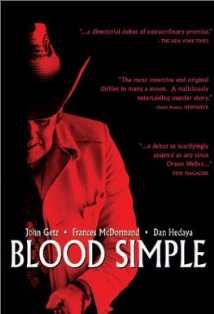
‘Blood Simple’ launches Coen brothers’ brilliant careers

Blood Simple/1984/River Road, Foxton Entertainment/97 min.

T.S. Eliot wrote that the world ends not with a bang but with a whimper.

In “Blood Simple” banging precedes death, but one life ends spitting dirt; another with a belly laugh. Perhaps that’s not surprising given that “Blood Simple” was the writing and directing debut of first-rate storytellers and masters of neo noir Joel and Ethan Coen. For anyone who saw this movie, now nearly 30 years old, in its initial release in 1984, it must have been exciting to witness the talent of the then almost unknown Coens (Joel was 26, Ethan was 25).

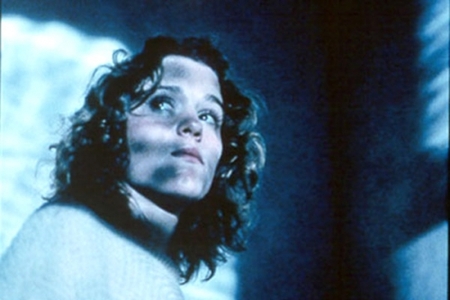
"Blood Simple" was Frances McDormand's first big movie.

The young brothers made a knowing homage to classic noir, updated for ’80s audiences and heavily injected with dark, often perverse, humor. Not only do the Coens honor the traditions and touchpoints of their ’40s predecessors, they also subvert convention and reinvent visual language to serve the story.

Their original tale of adultery, revenge and murder takes place not in the big city, but in Texas, and they nail the mood of a dusty, sweaty small town where lax morals, lust and lawlessness are the only markers on the vast landscape. The title comes from a Dashiell Hammett reference to a dulled mental state (blood simple) that results from repeated exposure to violence.

In her first major screen role, Frances McDormand plays Abby, an appealing country girl – no makeup and all healthy glow – whom some might call a hick. She’s cheating on her husband, tavern owner Julian Marty (Dan Hedaya), with one of his employees, Ray (John Getz). It’s hard to imagine that Abby would even go on a second date with greasy, seething, sleazy Marty, let alone marry him, but hey, that’s why she bedded kinder, gentler Ray. That and his washboard abs.

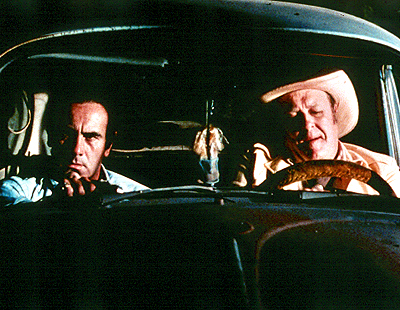
Dan Hedaya and M. Emmet Walsh

When Marty learns that he’s been cuckolded, he hires venal but philosophical butterball P.I. Loren Visser (M. Emmet Walsh) to knock the lovers off. The movie opens with this narration from Visser: “The world is full of complainers. And the fact is, nothin’ comes with a guarantee. Now I don’t care if you’re the pope of Rome, president of the United States or man of the year; something can all go wrong. … What I know about is Texas and, down here, you’re on your own.”
#
It seems that Visser has done his duty, but he double-crosses Marty. After that comes a slew of misunderstandings, mistaken identities and messy cleanups, which is pretty impressive, given that there’re only four main characters in the story.
#
One plot detail in particular to watch for: Though money stolen from Marty’s safe is repeatedly referred to, we never know conclusively who took it. Since three people know the combination, your guess is as good as mine. Part of the fun of this movie is anticipating what comes next so I don’t want to reveal any more twists – it’s unpredictable but not convoluted. In fact, the tight plot and spare dialogue lend the movie an earthy sort of elegance.
#
#
Cinematographer Barry Sonnenfeld’s arresting visual style – stark camera angles and repetition of certain images, such as the overhead fan – heightens the suspense. Sonnenfeld was the cameraman on several other Coen Bros. movies and later became a stylish and successful director on his own, best known for the “Men in Black” series. Carter Burwell wrote the “Blood Simple” score and has worked on every Coen brothers movie since.
#
The characters might be a bit cartoonish, rendered as they are in broad, sweeping strokes. But that approach works in a movie like this and for these characters who are archetypes of noir love triangles. Life is short and they live it hard. Who has time for psychological complexity and multiple layers of personality? “Blood Simple” is taut, suspenseful, slyly funny and very entertaining. And it holds up well. “Blood Simple” was remade as “A Woman, A Gun, and A Noodle Shop” in 2009 by Zhang Yimou.

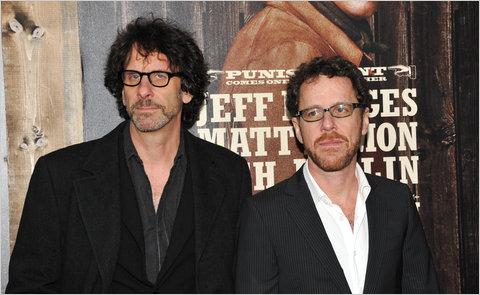
Joel, left, and Ethan Coen at the New York premiere of 2010's “True Grit,” their most recent movie.

Additionally, the Coens get excellent performances from their actors. With little to say, McDormand instead conveys feeling, especially fear, through nervous gesture and subtle facial expressions. Walsh’s gross gumshoe effortlessly glides from mutton-headed and dawdling to powerful and menacing.

Hedaya’s Marty fights to the bitter end and has since made a reputation in films as a snarling villain (I also loved his tough-love Dad in “Clueless.”) Getz makes the most of his part as well, the neo-noir version of a knight in slightly tarnished armor, though in his case, the armor is more muddy and dusty than tarnished.
#
The Coen brothers, who later made Oscar winners “Fargo” and “No Country for Old Men,” rank with the world’s finest filmmakers and they are the undisputed champions of American neo noir.
#
Coen brothers photo by Evan Agostini/Associated Press/New York Times

‘Blood Simple’ quick hit

Blood Simple/1984/River Road, Foxton Entertainment/97 min.

How FNB would love to meet those darling Coen brothers and probe their diabolical little minds. And of course I’d gush about “Blood Simple,” their first baby, a fast-paced, taut thriller that will keep you guessing till the end. When a husband (Dan Hedaya) confirms that his wife (Frances McDormand) is cheating on him, he decides to have the lovers killed. But simple? Not so much, especially not in Texas.

Exquisite suspense, anguished obsession and sleek blonde style in ‘Vertigo’

Vertigo/ 1958/Paramount Pictures /127 min.

Since I still have San Francisco on the brain, my next few reviews will highlight Fog City.

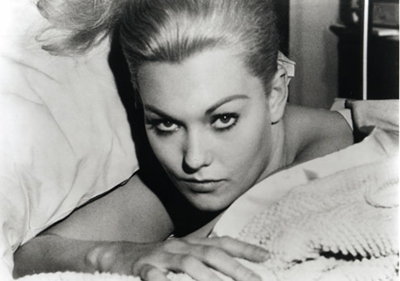
Kim Novak plays two parts, elegant Madeleine and brassy Judy.

On a cold morning several years ago, my colleague Joe bumped into me at Starbucks and said: “You look like Kim Novak in ‘Vertigo’ in that suit,” referring to my fitted gray jacket and skirt. I’d twisted my hair into the best chignon I could manage pre-coffee using the three hairpins I was able to find on my cluttered bathroom shelf.

I was relieved to put off a shampoo for another day, but never thought my impromptu bun had the added effect of contributing to a Hitchcock-blonde vibe.

Alfred Hitchcock was always extremely fastidious about his leading ladies’ wardrobes and for 1958’s “Vertigo” he and costume designer Edith Head agreed that a gray suit would lend a particularly eerie air to Novak’s character, Madeleine Elster. Though stylish, sophisticated and perfectly appointed, Madeleine seems to be struggling to hold onto her sanity.

Her worried husband Gavin Elster (Tom Helmore) taps an old acquaintance and former police detective John “Scottie” Ferguson (James Stewart) to keep an eye on her. Gavin tells Scottie that Madeleine is tormented by family ghosts and that he’s afraid she’ll commit suicide.

Like Madeline, Scottie is a little delicate too, having recently been treated for his fear of heights, brought on by a nasty bout of vertigo. So, he’s taking it easy and hanging out with his upbeat buddy Midge (Barbara Bel Geddes). Reluctant at first, Scottie accepts Gavin’s assignment and, over time, becomes obsessed with saving Madeline, then falls in love with her.

But alas, Scottie can’t provide foolproof protection against her demons because he hasn’t completely conquered his vertigo. After Madeleine takes a fatal tumble, Scottie is inconsolable, until he encounters a shop clerk named Judy Barton (also played by Novak).

Judy bears an uncanny resemblance to his lost love, even if she’s less refined and has the wrong hair color. Scottie decides that’s where hair dye and haute couture come in and he sets his sights on transforming this new object of his affection into the spitting image of Madeleine. “It can’t mean that much to you,” Scottie growls at Judy when she balks at bleaching her hair. But the déjà vu does not go according to plan.

“Vertigo”’s surreal, sometimes unsettling exploration of two troubled minds bears Hitchcock’s distinctive stamps: intense but masked emotion, exquisite suspense, altered identity and disguises, and technical innovation – in this case, the use of forward zoom and reverse tracking to depict Scottie’s vertigo. Intense color and meticulous composition heighten our sense of Scottie’s anguish and frustration. Robert Burks, a longtime Hitchcock collaborator, was director of photography.

Though reviews were mixed upon its initial release (critics complained that the plot was far-fetched), “Vertigo” has since been acknowledged as a crowning cinematic achievement. In 2002, “Vertigo” landed the No. 2 spot on the Sight and Sound critics’ top 10 poll, second only to “Citizen Kane.”  Leonard Maltin calls it: “A genuinely great motion picture that demands multiple viewings.” [Read more…]

‘Vertigo’ quick hit

Vertigo/ 1958/Paramount Pictures /127 min.

James Stewart as Scottie and Kim Novak as Madeleine/Judy are unforgettable in this Hitchcock classic, one of the all-time great noirs. Stewart is an ex-detective with a fear of heights and Novak plays two women – one, a damsel in distress and another who receives the ultimate makeover. Best of all for femmes fatales: Novak’s timeless, elegant wardrobe.

“Vertigo” bears Hitchcock’s distinctive stamps: intense but masked emotion, exquisite suspense, altered identity and disguises, and technical innovation. Intense color and meticulous composition heighten our sense of Scottie’s anguish and frustration. Robert Burks, a longtime Hitchcock collaborator, was director of photography.

Tremendous performances from Stewart, Novak and Barbara Bel Geddes as Scottie’s pal Midge.

Christian Bale dazzles in the mesmerizing, surreal world of ‘The Machinist’

The Machinist/ 2004/ Paramount Classics, Filmax Entertainment/102 min.

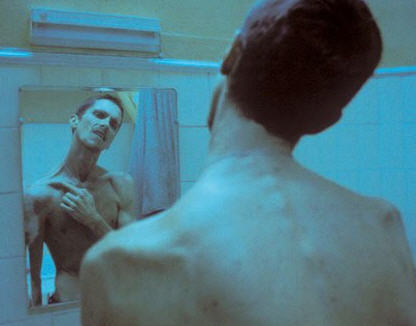
Bale dropped 60 pounds for this part.

In honor of Christian Bale’s Golden Globe award for best supporting actor in “The Fighter” I thought it would be fun to run a review of a neo noir he starred in several years ago: Brad Anderson’s “The Machinist” (“El Maquinista”) from 2004.

I first saw this film at the Chicago Film Festival. When my date left to grab some popcorn, an earnest, chatty guy sat on the empty chair on my left, and cheerfully announced: “I was just in the lobby and it was hotter than Hades in there.”

Hades? Really? Before I had a chance to answer he continued, “Would you like anything from the concession stand?” So basically he was asking me if I wanted anything from hell. Hmmm, very tempting. There were bound to be people I’d want him to say hello to. I thanked him but declined. Just then my date returned, the lights went dim and, as the chatty guy craned forward, his popcorn flew to the floor. “I’ll be right back,” he mumbled, the cheer drained from his voice. Guess he was destined to make that second trip to Hades.

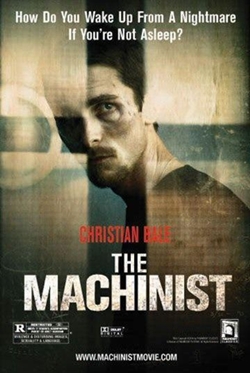
The exchange was an apt intro to “The Machinist,” which is essentially a waking dream set in hell. As the movie’s tagline asks: “How do you wake up from a nightmare if you’re not asleep?”

Bale gives an amazing performance as machinist Trevor Reznik whose life is mysteriously falling apart. He lives in a spare, gloomy apartment, he hasn’t slept in a year, he rarely eats and, distracted and disoriented, can barely stumble through his daily routine.

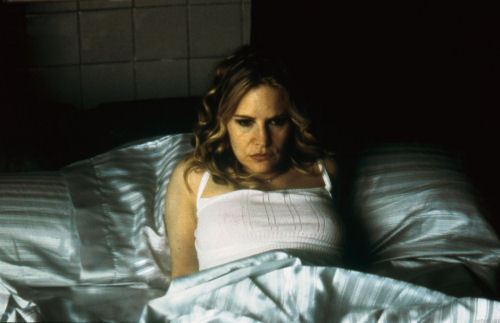
Jennifer Jason Leigh

Trevor alienates his co-workers and has few friends, other than Stevie (Jennifer Jason Leigh), an earthy, matter-of fact prostitute. Stevie would like to toss her other clients and have a real relationship with Trevor but it’s easier said than done, given his delicate mental state.

Not sleeping means he has plenty of time on his hands and, to pass the nighttime hours, he often hangs out at an airport diner. When strange and skeletal Trevor breaks down and eats a slice of pie, it’s served to him by Maria (Aitana Sánchez-Gijón), a pretty waitress with a warm laugh who seems to enjoy chatting with him as he noshes. “If you were any thinner, you wouldn’t exist,” says Maria. Stevie told him the exact same thing.

Then there’s an accident at the plant. A co-worker named Miller (Michael Ironside) loses his arm in a machine and the rest of the guys rightly blame Trevor for the mishap — he failed to keep his eyes on the machine’s controls. Trevor claims his attention was diverted by a stranger at the factory, a malevolently jolly giant named Ivan (John Sharian). Trevor assumes Ivan is a new worker; no one else saw him or knows anything about him.

But Ivan likes Trevor and continues to make special appearances just for him. As memories of his former normal life mingle with twisted visions of reality, other things in Trevor’s life also go awry. He finds a photo that proves one of his co-workers knew Ivan. Sticky notes with partially completed games of Hangman appear on Trevor’s refrigerator. On a date with Maria and her son Nicholas, the boy suffers from a seizure after Trevor takes him on a funhouse ride.

Trevor eventually loses his job, which leaves him even more time to figure out what started his spiral into confusion and fear, perhaps madness. He’s sure someone, ie Ivan, has hatched an evil plot to drive him over the edge. Desperately trying to catch Ivan and get to the bottom of the weirdness, Trevor jumps in front of a car; when he later finds out that the car is actually his own, it pushes him into a full-on state of paranoia, which leads him to turn on Stevie.

It is Ivan whom Trevor must confront, however, and his relentless pursuit ultimately leads him to a dark chapter of his own past that he has unsuccessfully tried to banish. By confronting Ivan, he is in fact confronting himself. Turns out, Trevor did something very bad that got the ball rolling. [Read more…]

‘The Machinist’ quick hit

The Machinist/ 2004/ Paramount Classics, Filmax Entertainment/102 min.

The first thing you might notice about Christian Bale in this movie is that he’s a tad skinny. Well, more than a tad. That’s just the beginning of the weirdness by director Brad Anderson, but it’s brilliant weirdness in a story of a factory worker who seems to be terrorized by hellish nightmares, except that he’s an insomniac. Jennifer Jason Leigh, Aitana Sánchez-Gijón and John Sharian keep him company through the long, creepy nights.

Robert Mitchum is just one of many terrific performers in ‘Farewell, My Lovely’ from 1975

Farewell, My Lovely/1975/Embassy Pictures/97 min.

If you get a chuckle out of Patty and Selma Bouvier of “The Simpsons,” the Laramie-puffing, big-haired sisters with terrible taste in men, you’ll enjoy the raspy-voiced alcoholic widow Jessie Florian of 1975’s “Farewell, My Lovely.” Actress Sylvia Miles earned an Oscar nomination for her portrayal of this sad and seedy lady.

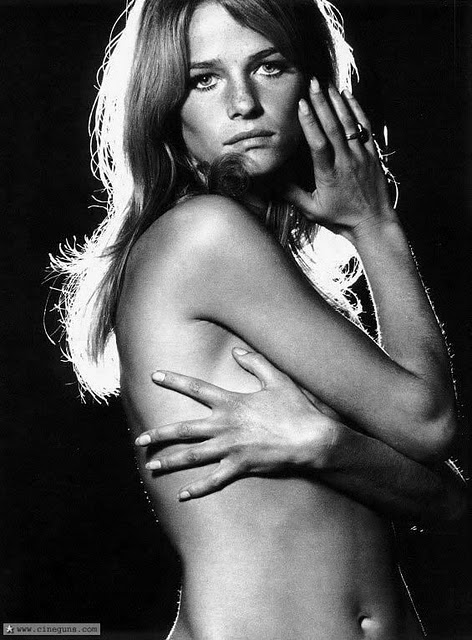
Charlotte Rampling

Miles is just one of many superb performers in this movie, notably Robert Mitchum as private investigator Philip Marlowe and Charlotte Rampling, a judge’s wife, bored to tears in their May/December relationship.

Having starred in many stand-out noirs as a younger actor (“Out of the Past,” “Angel Face” are two of the finest noirs ever made), Mitchum once again lends his sexy, sleepy indolence to the part of a burned-out and baleful detective at the end of his career.

Directed by Dick Richards and written by David Zelag Goodman, “Farewell” is based on Raymond Chandler’s novel of the same name, published in 1940. Director Edward Dmytryk brought the book to the screen in 1944 as “Murder, My Sweet,” a seminal noir starring Dick Powell and Claire Trevor. (The title was changed because Powell, a song and dance man, was playing off-type and studio execs didn’t want audiences to think it was a musical.  It was also filmed in 1942 as “The Falcon Takes Over.”)

“Murder My Sweet,” with its sordid criminals and Expressionist sensibility, was a triumph for Dmytryk and his team. Even so, the film only skimmed the surface of Chandler’s darkness; by 1975, topics like prostitution and racism, in addition to garden-variety crime, could be addressed on the big screen.

The movie opens with David Shire’s luscious score and shots of 1940s Los Angeles at night, bathed in neon light. There we see Mitchum in a dumpy hotel room (you were expecting the Four Seasons?) reflecting over the past few months — rotten weather and rubbing elbows with lowlifes and deadbeats.  Weary of “ducking police” and apparently needing to confess, he calls Det. Lt. Nulty (John Ireland), who agrees to come to the hotel. While waiting for Nulty to arrive, Marlowe begins a second flashback, in which Nulty is a participant, and we get to the meat of the story.

On a boring bread-and-butter case, Marlowe bumps into Moose Malloy (Jack O’Halloran), long on brawn, short on brains and just out of jail.  Moose wants Marlowe to find his girlfriend, a one-time showgirl named Velma, whom he describes as “cute as lace pants.”

The pair head to Florian’s nightclub in search of clues. Nothing turns up, though, and the frustrated Malloy kills a guy with his bare hands. Back to the slammer for the ungentle giant? Well, since the victim is black, the cops aren’t going to do much about it. Next stop for Marlowe: A visit to Jessie Florian’s, with a big bottle of cheap booze in hand. Upon seeing Marlowe, Jessie dons her best bathrobe and turns on the charm.

Meanwhile, a very different client, the posh and effeminate Lindsay Marriott (John O’Leary) hires Marlowe to be a bodyguard during an attempt to retrieve a stolen jade necklace. You’d think the fact that Marriott shows up in a disco suit much like John Travolta’s in “Saturday Night Fever” might put Marlowe off.  Instead, the job opens the door to a circle of unsavory mover/shaker types.

There’s elderly and insipid Judge Baxter Wilson Grayle (a cameo role for Jim Thompson, a famed noir writer of the ’50s); his much younger wife Helen (Charlotte Rampling), ravishing, shrewd, brash and, like Jesse Florian, very fond of strong cocktails; the mannish madame of a high-class whorehouse Frances Amthor (Kate Murtagh); and the suave but slippery Laird Brunette (Anthony Zerbe). As Brunette puts it: “All I do is run towns, elect judges and mayors, corrupt police, peddle dope, ice old ladies with pearls.” [Read more…]

‘Farewell, My Lovely’ quick hit

Farewell, My Lovely/1975/Embassy Pictures/97 min.

Raymond Chandler once described a noir hero as a knight in tarnished armor. Robert Mitchum, playing Philip Marlowe, illustrates the point in “Farewell, My Lovely” from 1975. Sylvia Miles and Charlotte Rampling also deliver excellent performances.

‘L.A. Confidential’ a first-rate depiction of sun-baked sleaze

L.A. Confidential/1997/Warner Bros./138 min.

Life is good (and glitzy) in 1953 Los Angeles, if you don’t mind smoke and mirrors, hidden crime, rampant racism and more than a few dodgy cops. Corruption in the police force, long an undercurrent in classic noir, takes center stage in “L.A. Confidential,” a wry, stylish and devastating police drama directed by Curtis Hanson.

Hanson sets the tone of glib optimism masking darker secrets by opening the movie with shots of bright and cheerful ’50s postcards, the song “Accentuate the Positive (Eliminate the Negative)” and a Danny DeVito voiceover filling us in on some of the trouble that lurks in paradise.

The sophisticated script, by Hanson and Brian Helgeland, is based on the 1990 novel by James Ellroy, which cleverly weaves in actual Hollywood history while telling the see-speak-and-hear-all-evil story of three cops:

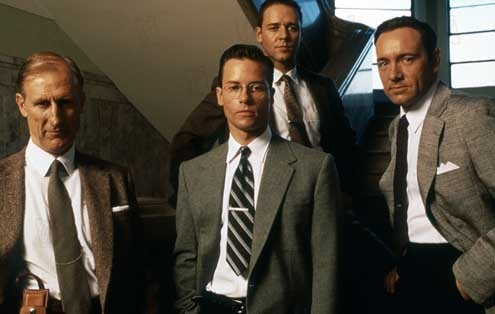
From left: James Cromwell, Guy Pearce, Russell Crowe and Kevin Spacey

*The jaded and jazzy Det. Sgt. Jack Vincennes (played by Kevin Spacey with a nod to Dean Martin) who pads his bank account by consulting for a TV police show (“Badge of Honor”) and feeding juicy info to “Hush Hush” tabloid columnist Sid Hudgeons (Danny DeVito). Sid meets looming deadlines with set-ups, celebrity exposés and the odd blackmail scheme. (“Hush Hush” magazine is based on the ’50s scandal mag “Confidential” and “Badge of Honor” is based on TV’s “Dragnet.”)

*Det. Lt. Edmund Jennings ‘Ed’ Exley (Guy Pearce), an ambitious newbie with a gift for finessing police politics. Exley wants to make his Dad proud, follows a strict moral code and doesn’t care about being one of the guys. And he won’t be, given that he testifies against his fellow cops and their part in “Bloody Christmas,” a true incident of LA cops beating up Mexican prisoners.

*Officer Wendell ‘Bud’ White (Russell Crowe), a thuggish beefcake who likes to take justice into his own hands, especially when it comes to violence against women. “His blood’s always up,” Exley says of White.

Presiding over the entire force and clashing with Exley in particular is Capt. Dudley Smith (James Cromwell), arrogant but understated until his latent psychopath rears his head.

“Bloody Christmas” is a mere prelude to a detailed catalog of vice and sin, as the story deepens and stretches to accommodate layer after layer of lies, double-dealing, betrayal and cover-up. Funny what can happen when mob leader and “honest haberdasher” Mickey Cohen (Paul Guilfoyle) — a real-life criminal — is getting a time-out in jail.

Central to the tangle is the Nite Owl case, involving kidnapping, rape, robbery and murder, which of course is not what it looks like. White’s ex-partner Dick Stensland (Graham Beckel) was among the bodies found in a dumpy diner, and, in pretty short order, three African-American guys with records end up taking the fall.

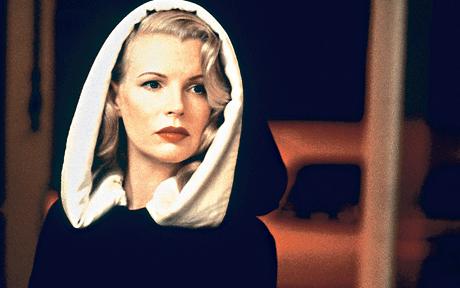
Kim Basinger won the Oscar for best supporting actress.

Additionally, the three cops find out about an upscale call-girl service, run by the suave, slick and urbane Pierce Patchett (David Strathairn). Patchett’s gimmick: All the girls resemble popular actresses — or they do after a few trips to a plastic surgeon. For instance, there’s a Veronica Lake look-alike named Lynn Bracken (Kim Basinger). Sure enough, such a business did apparently exist in ’50s Tinseltown, as recounted in Garson Kanin’s memoir “Hollywood.”

Bud White proves to be both smart and strong as he asks the tough questions and finds their well-guarded answers, one in the form of a rotten, rat-infested corpse who turns out to be a fellow cop. Shocker!

More storylines surface, such as the romance between Bud and good-hearted golden-girl Lynn, not to be confused with Veronica Lake. (Btw, the Lana Turner mixup scene is a hoot!) And as is the case in noir, it’s not long before Exley meets Lynn and creates a triangle of treachery. As the threads of the story unravel, and we see more darkness and deceit, deadly shoot-outs and bloody dust-ups, it’s clear that all strands lead back to a central source of evil. Hanson and Helgeland, courtesy of Ellroy, tell a tense, crisply paced, funny and chilling story nestled in a near-perfectly rendered world of sun-drenched, sleazy LA.

A hit at the Cannes Film Festival, “L.A. Confidential” also ranked on most major critics Top Ten lists for 1997. The film received Oscar noms for best movie, director, editing, art direction, cinematography, adapted screenplay, supporting actress, sound and music/original dramatic score. Composer Jerry Goldsmith also scored “Chinatown” from 1974 and 1992’s “Basic Instinct.”  “L.A. Confidential” won two: Basinger for supporting actress; Hanson and Helgeland for the screenplay.

Hanson’s film stands up beautifully and certainly holds its own among the great neo-noir movies, in the tradition of “Chinatown” and “Body Heat.” Kenneth Turan of the Los Angeles Times sums up the appeal this way: “Its intricate plot is so nihilistic and cold around the heart, its nominal heroes so amoral, so willing to sell out anyone and everyone, that the film is as initially unnerving as it is finally irresistible.”

That said, there are several snags on the accuracy front. [Read more…]