Paris, ‘Pulp Fiction,’ the proper way to approach Tarantino

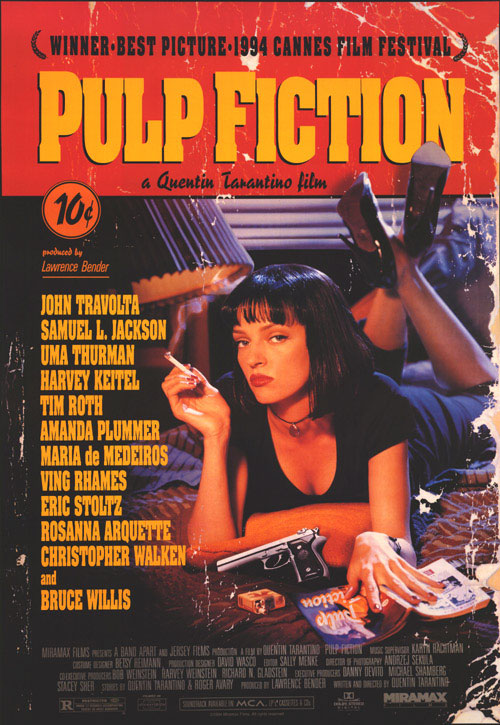
Pulp Fiction/1994/Miramax Films/154 min.

My upcoming trip to Paris (I leave tomorrow) triggered the memory of that great scene in “Pulp Fiction” where two hit men chat about a quarter-pounder with cheese (Royale with cheese) in Paris so I decided to run this review in honor of my trip. For the next two weeks, my posts will slow down a bit as I spend time with a lovely friend and soak in the atmosphere of this ravishingly beautiful city.

Quentin Tarantino at the Cannes film fest in 2008.

Several years ago, at the Cannes Film Fest, I saw Quentin Tarantino rushing down the Croisette but I froze and didn’t approach him to say how much I liked his work. (He was helming the jury that year.) As I stood there, regretting that I’d missed the chance, two English guys walked up and asked me if I was lost. I filled them in; they said I was quite right to have refrained.

But then two Italian men joined us and told me I was crazy not to have said hello. “Maybe he’ll show up at the Ritz,” one of them said, gesturing toward the hotel. “Why don’t we have a glass of champagne there and see if perhaps he arrives?”

As tempting as that sounded, I’d already agreed to meet people at the cheap and cheerful Le Petite Carlton, where the casual, sometimes-raucous crowd spreads out into the street, people bum Marlboros and Gitanes, beer is served in tacky plastic cups and a little kitchen churns out thin-crust pizza well into the early morning hours. Another missed opportunity! 😉

So if by some odd chance, on this trip, I happen to see Tarantino on the Champs Elysee or some charming Italian men invite me to cocktails at the Ritz, I’ll know what to do!
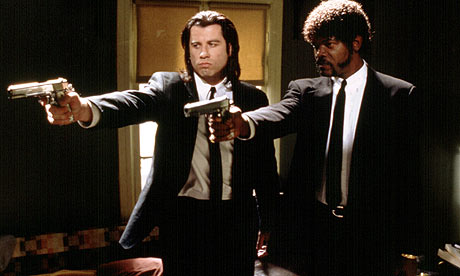
John Travolta and Samuel L. Jackson in "Pulp Fiction."

“Pulp Fiction” is a neo noir of audacious originality, comic brilliance and exquisite craftsmanship. It was one of the most important films of the 1990s. Like his previous film, 1992’s “Reservoir Dogs,” it’s a crime movie that deals with bad guys doing bad stuff – in “Dogs” it’s a robbery gone wrong. In “Pulp Fiction” we’re immersed in three separate but interwoven stories about two chatty hit men, a corrupt boxer who defies a mob boss, and a grunge version of Bonnie and Clyde.

Tarantino tells us the stories out of order, bookended by the scruffy lover bandits (Tim Roth as Pumpkin and Amanda Plummer as Honey Bunny) who hold up an LA coffee shop. Bruce Willis plays Butch the boxer who pulls a double-cross. John Travolta made a stunning comeback as sexy smart-ass Vincent Vega and Samuel L. Jackson dazzles as Jules Winnfield, an armchair philosopher packing heat.

As Vincent and Jules discuss fast food, foot massages and Fate, Vincent is assigned an extra job from brawny bossman Marsellus Wallace (Ving Rhames): to take Mrs. Wallace (Uma Thurman) aka Mia out on the town. A headturner with jet-black hair, Louise Brooks bangs, wide blue eyes and long legs, Mia gets what Mia wants. Topping the list are milkshakes, drugs and dancing. Make that dancing with Travolta, mmm.

There is much to love about this film, particularly the highly original characters and crackling dialogue, which includes one-liners, retro slang, debates over points of logic and lengthy tangents of trivia. The dialogue seems to emerge organically from the characters and random chitchat punctuates major dramatic moments.

Actors talk with their back to the camera and sometimes put the imminent action on hold so they can wind up their conversation. Even though Pumpkin and Honey Bunny probably get the least amount of screen time, through their dialogue, we see several layers of their partnership, both tough and tender. [Read more…]

Quick hit: ‘Pulp Fiction’

Pulp Fiction/1994/Miramax Films/154 min.

One of the great loves of my life is Quentin Tarantino’s imagination and the bizarre people dwelling there. In “Pulp Fiction,” we meet a pair of hit men with a gift for gab, a boxer who refuses to throw a fight, and two adorable armed robbers named Pumpkin and Honey Bunny. John Travolta, Samuel L. Jackson, Uma Thurman and Bruce Willis star. Tarantino and partner Roger Avary won the Oscar for best original screenplay.

Brian De Palma’s ‘Blow Out’ sometimes makes us roll our eyes and sometimes holds us spellbound

Having received good feedback from the winner of April’s giveaway – the prize was Criterion’s rerelease of “Blow Out” – I realized it was high time to run the review. 😉

Brian De Palma/1981/ Filmways Pictures/107 min.

Michael Wilmington

By Michael Wilmington

“Blow Out,” Brian De Palma’s 1981 neo noir about a movie sound man (played by John Travolta), who stumbles into a political conspiracy and a string of murders, is a movie for connoisseurs of trash and movie art. One of this movie’s strongest critical admirers (and one of De Palma’s) was Pauline Kael, and one of Kael’s most famous critical essays is called “Trash, Art and the Movies.” We get all three of them here, in a film that sometimes makes us roll our eyes and sometimes holds us spellbound.

“Blow Out” probably took its title partly from Michelangelo Antonioni’s “Blowup,” which is about a swinging ’60s London photographer who stumbles on what may be murder. And it centers around one of Travolta’s sexiest performances, as Jack Terry the lone-wolf Philadelphia sound-effects man, who is working on a sleazy slasher horror movie.

The director is dissatisfied with the scream Jack has supplied for one of the victims. The movie within the movie is a terrible, inept picture, which De Palma stages as a send-up of “Halloween” and other teen slasher pics. But Jack is a pro. He takes his equipment out that night to get more ambient night-sound on a suburban bridge.

Nancy Allen

That bridge is an unusually well-populated one, considering the lateness of the hour. There are crickets and an owl, who stares at us disturbingly, and there’s another filmmaker named Manny Karp (Dennis Franz), who’s got his camera set up somewhere near Jack (but whom Jack doesn’t know and doesn’t see), and finally there’s a speeding car, carrying, amazingly, the current front-running candidate for president of the United States, Governor McRyan, (John Hoffmeister) together with a hot blonde named Sally (Nancy Allen).

Jack hears a couple of bangs (and catches them on his recorder) and the governor’s car plunges through a fence and into the river where it quickly sinks. Jack dives in and is able to rescue Sally, but not the possible next president.

Soon we’re at the hospital, where Sally is groggily coming to. The police, reporters and some political people, visions of Chappaquiddick perhaps dancing in their heads, seem to want Jack and Nancy to just clam up and go away. He won’t. She wants to, at first, but decides she likes Jack.

Then Manny and his Zapruderish film turns up, and ex-Philadelphian De Palma turns the city into a house of horrors more violent than anything in ex-Philadephian David Lynch’s neighborhood, craning and swooping and whirling his camera all around a world gone seemingly mad. There’s a deadly plot of some kind afoot, and its bloodiest agent is a phony telephone company worker named Burke (played with a truly evil stare and icily smug expression by John Lithgow), a cold-blooded killer who seems willing to depopulate half the town to keep all the guilty secrets safe.

If that sounds like a pretty absurd plot, it often plays pretty silly too, though just as often it’s imaginatively over-the-top and hellishly exciting. I‘ve always thought De Palma should avoid solo-writing jobs on his own movie scripts. And “Blow Out” as well as “Raising Cain” and “Femme Fatale” (and 1968’s “Murder a la Mod,” which is included in this Criterion package) are good demonstrations why. “Blow Out” is never boring. But a lot of the time it doesn’t make any bloody sense.

So why did Kael call it a great movie? Mostly, maybe, because she very much liked De Palma’s work, because this movie is made with such great feverish style, and also maybe because she had a crush of sorts on Travolta, as she had on Marlon Brando, Paul Newman and Warren Beatty.

The style is what we remember about “Blow Out” – not the ideas, which are mostly shallow or obvious, or the story, which is both predictable and illogical, or the characters who are mostly overdrawn and somewhat stereotypical (or archetypal, if you prefer), or the movie itself, which is basically a set of ingeniously orchestrated suspense set-pieces, strung together in clever, artful ways that defy plausibility with an almost cheerful impudence. [Read more…]

Coen Brothers’ ‘Man’ is darkly moody, handsomely shot

The Man Who Wasn’t There/2001/Good Machine, et al/116 min.

Scarlett Johansson plays a high-school student in this 2001 film.

What would life be without a dark and handsome companion at night? One I highly recommend is “The Man Who Wasn’t There” by master filmmakers Joel and Ethan Coen. This homage to vintage film noir, gorgeously shot in black and white by cinematographer Roger Deakins, conjures a guy you’ll always remember.

Set in 1949, the film introduces us to a choice cast of characters. Top of the list is introspective and blasé Ed Crane (Billy Bob Thornton), who has fallen into a comfortable, if dull, life in Santa Rosa, Calif. He’s fond of his wife Doris (Frances McDormand), both cynical and oddly sweet, but there’s never been any passion between them.

To earn a living, Ed cuts hair with his brother-in-law Frank (Michael Badalucco) at the family barbershop. (“I don’t talk much,” Ed tells us. “I just cut the hair.”) Doris is a bookkeeper at Nirdlinger’s, the town’s big department store, and together they have it “made” – after all, Ed points out dryly, they have a garbage grinder built into the sink.

When he’s not working or tossing scraps down their fancy drain, Ed kills time mainly by smoking and taking care of Doris after she’s had too much to drink, which is quite often. Doris passes the hours of their lives by playing bingo and having an affair with her boss at Nirdlinger’s, Big Dave Brewster (James Gandolfini), a blustery WW2 vet. Dave’s married to Ann Nirdlinger (Katherine Borowitz), whose family owns the store. Ed knows about the affair but, as he does with everything, takes it in stride.

Ed’s life changes forever the day that unctuous big-mouth businessman Creighton Tolliver (Jon Polito) walks into the barbershop as it’s about to close, gets a very quick trim and happens to mention that he’s in town trying to raise money to invest in drycleaning, which he’s convinced is “the biggest business opportunity since Henry Ford.”

Ed decides later that night that he wants in on the putative drycleaning empire and figures he can raise the requisite $10,000 by anonymously blackmailing Dave. No sooner does Ed get the cash than Tolliver takes off with it. And because Tolliver is so quick to bend ears and beg for money, Dave gets to the bottom of the blackmail scheme and intends to get his money back.

What Dave doesn’t count on is that Ed’s mild facade hides nerves of cold steel; when cornered, Ed’s response to him is quick, instinctive and deadly. But, after news breaks of Doris and Dave’s affair, Doris is arrested for Dave’s murder. [Read more…]

Quick hit: ‘The Man Who Wasn’t There’

The Man Who Wasn’t There/2001/Good Machine, et al/116 min.

What would life be without a dark and handsome companion at night? One I highly recommend is “The Man Who Wasn’t There” by master filmmakers Joel and Ethan Coen. This homage to vintage film noir, gorgeously shot in black and white by cinematographer Roger Deakins, conjures a guy you’ll always remember.

Starring: Billy Bob Thornton, Frances McDormand and James Gandolfini, and a peerless supporting cast.

‘Taxi Driver,’ the ultimate big-city bad dream, screens Sunday at TCM Classic Film Festival

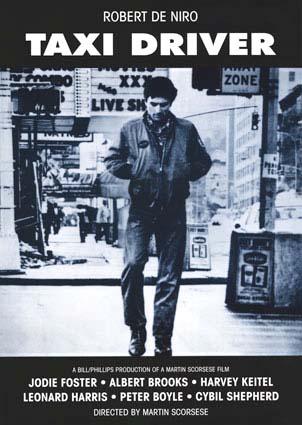
Taxi Driver/1976/Columbia Pictures/113 min.

One of the many highlights of the TCM Classic Film Festival is Sunday’s showing of “Taxi Driver” by Martin Scorsese, which this year turns 35. One of the most sordid urban nightmares ever, “Taxi Driver” stands as the ultimate big-city bad dream.

And where else could it be set but New York City? In the mid-1970s, the mighty metropolis seemed to be falling apart: the economy had stalled, people were deserting the troubled island in droves, and crime was rampant. (Other cinematic portraits of the dismal period are “The French Connection” 1971 by William Friedkin and John Schlesinger’s “Midnight Cowboy” 1969.)

Jodie Foster in "Taxi Driver"

In the middle of this urban mess is anti-hero Travis Bickle (Robert DeNiro) – a Vietnam vet and taxi driver, whose desperate loneliness and disgust with NYC’s squalor and decay slowly pushes him over the edge of sanity. Long hours of driving jerks and freaks around isn’t good for anyone’s mental health, let alone an introverted downer like Travis.

Early on, there seems to be a shimmer of hope when Travis encounters a woman named Betsy (Cybill Shepherd), lovely and stylish, ambitious and free-spirited (kudos to costume designer Ruth Morley). Betsy is a campaign worker for Senator Charles Palantine (Leonard Harris), who is making a bid for the presidential nomination. Rather surprisingly, Betsy agrees to meet Travis for coffee. Rather astonishingly, Betsy agrees to go on a date with him, which thoroughly annoys her co-worker Tom (Albert Brooks).

Instead of candlelight and roses, or even strip lighting and sandwiches, Travis takes Betsy to a porn movie. She storms out, quashing any hope of romance, though Travis keeps angling for another chance by sending her flowers and showing up at Palantine’s campaign HQ.

After that, Travis tries to keep busy – you know, the usual breakup stuff – writing in his journal, shaving his head, talking to himself in the mirror, buying guns and pointing them at Palatine. When Travis spies a child prostitute as she walks the streets (Jodie Foster), he makes it his mission to rescue her from the degradation of working for sicko pimp ‘Sport’ Harvey Keitel. His quest, fueled by his worsening mental illness, culminates in out-of-control violence.

Once you see “Taxi Driver,” you’ll never forget it. Coming on the heels of Vietnam and Watergate, the film tapped the overall dark mood of the nation and did well at the box-office. Additionally, it catapulted Scorsese and writer Paul Schrader into the big league, making its mark with the Hollywood tastemakers and earning four Oscar noms: best picture (it lost to “Rocky”); best actor (De Niro); best supporting actress (Foster); best original score (Herrmann). It also won the Palme d’Or at Cannes.

Though he didn’t win the Oscar, DeNiro turned in one of the best and most iconic performances of his career, spanning the emotional gamut from hardened cynicism to earnest and utter sadness. The most moving scene for me is when he sends a corny anniversary card to his parents and jots down some details of a life he pretends to live. Foster’s performance is raw and gutsy. Keitel’s brief but searing scenes are repulsive, disturbing, stomach churning; even for crime-movie aficionados, they are hard to watch.

Scorsese’s virtuoso filmmaking taps the sensibilities of the finest American and European filmmakers. He draws thematic inspiration from classic Western director John Ford (specifically 1956’s “The Searchers”) and from his beloved ’30s and ’40s crime movies as well as the visual aesthetic of French New Wave auteurs. [Read more…]

Quick hit: ‘Taxi Driver’

Taxi Driver/1976/Columbia Pictures/ 113 min.

In this Martin Scorsese neo-noir, Robert DeNiro won an Oscar nomination for his portrayal of angry loner Travis Bickle, who’s on the brink of insanity in sad and seedy ’70s New York. Says Travis: “Someday a real rain will come and wash this scum off the streets.” While waiting for the rain, he makes it his mission to save a child prostitute. Co-star Jodie Foster, then 12, earned an Oscar nom of her own. Harvey Keitel, Cybill Shepherd and Albert Brooks round out the cast.

‘Long Falling’ a strangely intense neo noir with superb acting

Friday night was the noir series at the 15th annual City of Lights, City of Angels (COL•COA) film festival in Los Angeles. My favorite: director Martin Provost’s “The Long Falling,” based on a Keith Ridgway novel, which follows a guilty woman in her fleeting days of freedom.

Actress Yolande Moreau had her work cut out for her in playing the woman, Rose, who has murdered her alcoholic and abusive husband of 30 years. That’s because what’s left of Rose is just a shell of a person.

"The Long Falling" poster

Nonetheless, Moreau deftly inhabits Rose. Her worn-down, resigned expression when she runs him over with her car is not much different than when she takes her nightly bath, immersing her perpetually bruised skin in the hot water and glancing warily over her shoulder, listening for his footsteps.

It is Moreau’s authenticity as an actress and Provost’s skillful direction that make this movie so compelling. The somber story starts with a mighty jolt, then takes its time unfolding. Agnes Godard’s atmospheric cinematography and Hugues Tabar-Nouval’s original score also draw you into this strangely intense neo noir.

After Rose commits the crime, she leaves her isolated farm town, telling no one, and heads to Brussels to be with her son (Pierre Moure). But their relationship is strained — he has also been abused by the same monstrous man and feels an undercurrent of resentment toward his mother for her inability to protect him as a child. Meanwhile, the police are investigating and there’s little chance that they won’t apprehend her.

Eventually, she leaves her son’s place, rents a room and then attempts to flee the country with the help of a woman who is essentially a stranger (a bit too wildly implausible). Once more, Rose does not or cannot challenge her fate.

We have sympathy and feel sadness for Rose, yet Provost (who also directed Moreau in 2008’s “Séraphine,” a winner of many prestigious awards) does not whitewash the moral choices Rose has made in her life. The film also reminds us that we never exist alone in the world, no matter how desperate or dire our circumstances.

“The Long Falling” image from uniFrance

A literate, exciting action movie that’s drop-dead gorgeous

Hanna/2011/Focus Features/111 min.

Michael Wilmington

By Michael Wilmington

“Hanna” is “Kick-Ass” and “The Bourne Identity” filtered through “Pride and Prejudice” and “Atonement.” And I don’t mean that as a knock.

Director Joe Wright, who made the 2005 Keira Knightley version of Jane Austen’s best-loved novel and the lauded film of Ian McEwan’s grim tale “Atonement,” is a director with a style both flashy and sumptuous.

And in “Hanna,” he’s demonstrating something we might not have expected from him: burn-down-the-house action-movie skills. The movie — starring Saoirse Ronan (the jealous little girl from “Atonement”) as the kick-ass title heroine Hanna, Eric Bana as her action-mentor dad Erik, and Cate Blanchett as Marissa, the vicious C.I.A. agent villainess — is such a departure from what Wright has done before that it’s hard not to be impressed.

Saoirse Ronan

Wright starts the film with a snowy deer hunt and kill in the wilds of Finland, where the gifted 16-year-old Hanna, trained in all manner of martial arts and assassin skills, brings down a stag and muses philosophically. The story moves with dizzying speed to the Moroccan desert, Hamburg and Berlin, escalating into spectacular brawls, subway battles and bloody showdowns.

It’s quite a ride. The whole movie is a long three-sided chase: Hanna is captured early on by Marissa when Erik leaves her on her own, after arranging to rendezvous with her later in Berlin. Then Hanna escapes and Marissa pursues both her and Erik. The fights are all set-pieces and Wright shoots one of them in a virtuosic unbroken Steadicam take, which reminds you of the spectacular tracking shot on Dunkirk Beach in “Atonement.”

The three lead actors — along with Tom Hollander as the perverse villain Isaacs, Olivia Williams, Jason Flemyng and Jessica Barden as the British family Hanna meets in the desert — have the kind of acting chops you don’t usually see in movies like this, and they display them as much as Seth Lochhead and David Farr’s script lets them.

All the characters, in fact, have more fullness and surprises than the action-movie norm. They’re reminiscent at times of the psychologically detailed or richly eccentric characters in an old-style British thriller by Alfred Hitchcock.

We haven’t had many really literate thrillers lately (The “Bourne” movies excepted), and it’s a pleasure to see one here, to see filmmakers who are trying to please us on a multitude of levels and not just trying to blow us out of our seats.

The results are drop-dead gorgeous and exciting, but not completely satisfying. What we’d expect from Wright — memorable characters and high-style high drama — are here, but not emphasized as much as the story sometimes needs in order to make total sense.

The action scenes are scorchers, and they’re shot beautifully by cinematographer Alwin Kuchler on stunning sites and sets by designer Sarah Greenwood. (Her interrogation chamber below the Moroccan desert is an homage to Ken Adam’s great War Room set in “Dr. Strangelove.”) But I thought they became a little too set-piecey at times, took over the show a little too much.

Ronan has a talent for bewitching the camera and for suggesting levels of thought, memory and passion beneath the surface. Ronan is kind of strong and silent here, which deepens the film’s mysteries, including any nagging questions we might have about the relationship among Hanna, Marissa and Erik. [Read more…]

‘Mildred Pierce’ by Haynes savors subtext of Cain’s novel

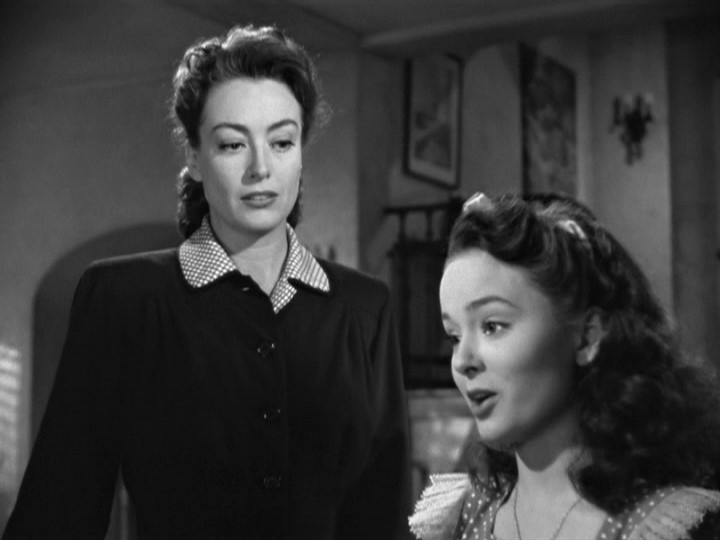
Crawford and Blyth

HBO’s “Mildred Pierce” mini-series, directed by Todd Haynes and based on James M. Cain’s 1941 novel, starts this Sunday.

In director Michael Curtiz’s 1945 movie version of the book, Joan Crawford won the Oscar for her portrayal of the title role in the ultimate story of a self-sacrificing mother and her ungrateful child, Veda (Ann Blyth). Mildred’s hard-earned success as a restaurateur allows her to support not only her family but also her aristocratic and cash-poor love interest Monty Beragon (Zachary Scott).

In Haynes’ mini-series, Kate Winslet stars as Mildred, Guy Pearce plays Monty and two actresses share the Veda role: Morgan Turner as the girl and Evan Rachel Wood as the young woman. Haynes and Jon Raymond wrote the teleplay.

In many ways, the series, which follows the book more faithfully than the 1945 movie and covers nearly 10 ten years in the characters’ lives, is a delight to watch. Depression-era Southern California is beautifully recreated and shot by Edward Lachman. Carter Burwell’s original music is spot-on as is Ann Roth’s costume design. And the acting is excellent, particularly the leads.

Whereas Crawford’s Mildred is stoic and dignified, Winslet’s is sensitive, wistful, often tentative and unsure of herself. Her expressive features suggest her mounting anger, guilt and desperation as her business grows but her relationships deteriorate.

Early on in the series, Winslet’s Mildred identifies in her daughter a “pride or nobility I thought I had” and we glimpse the complexity and closeness of her bond with Veda. The mother-daughter relationship in Haynes’ five-hour version is perhaps more nuanced than in Curtiz’s film.

Pearce easily inhabits the playboy scoundrel Monty and Wood sizzles as the junior miss femme fatale. As the story unfolds, we learn that Mildred and Veda also have very similar taste in men. This year’s supporting actress Oscar winner Melissa Leo and Mare Winningham are quite good as Mildred’s friends.

A disappointment, however, is James LeGros’ insipid performance as Pierce family “friend” Wally Burgan. In Curtiz’s version, the role as played by Jack Carson – conniving and sly, but charming – was one of the movie’s many strengths.

Another downside is the pacing, which is far too slow. It would have benefited from shaving about an hour, especially in the beginning. But then if Haynes’ aim was to be true to every page of the book, he has succeeded.

I prefer Curtiz’s original because it is canonical film noir, in tone, look and story. Granted, Cain’s book was altered because in 1940s Hollywood, immorality was never allowed to triumph. Instead of the evil-doers leaving California to begin a new life in New York, one is fatally shot and the other eventually is punished. The murder sets the story, told via flashback, in motion and lends an edgy suspense.

Still, Haynes did not set out to make a noir; apparently his aim is to explore the subtext and subtleties in Cain’s novel. Cain was, arguably, sympathetic toward his feisty protagonist (what choice does she have but to establish independence and security, given the weak and deceitful men she has to choose from?). But she pays a dreadful price for doing so and the book decries materialism, the class system and social climbing. As for Cain’s ultimate take on Mildred’s power, in Hayne’s work, there is fodder for both sides of the argument.

Warner Bros. image of 1945 “Mildred Pierce”