‘L.A. Confidential’ quick hit

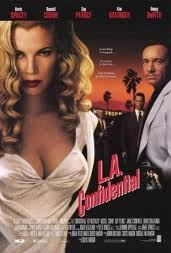
L.A. Confidential/1997/Warner Bros./138 min.

Kim Basinger won the Oscar for her portrayal of call-girl Lynn Bracken in this police corruption drama, set in vintage Hollywood. The script, co-written by director Curtis Hanson and Brian Helgeland from a James Ellroy novel, also snared the gold statuette. Co-starring with Basinger are: Kevin Spacey, Russell Crowe, Guy Pearce, David Strathairn and Danny DeVito.

‘Chinatown’ mixes classic intrigue with ’70s cynicism

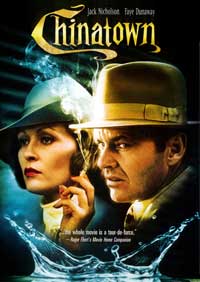
Chinatown/1974/Paramount Pictures/131 min

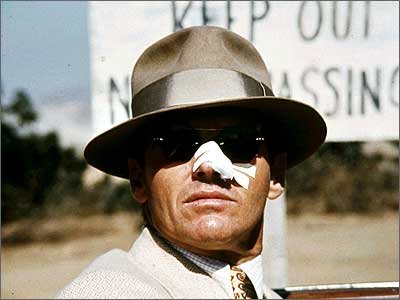
A nervous femme fatale with a slight stutter. A stocky PI with a hot temper and a bandage plastered on his face.

Perhaps not the most promising characters at first glance; in fact they are among noir’s finest. Faye Dunaway and Jack Nicholson deliver knockout performances in 1974’s “Chinatown,” a neo-noir that ranks as one of the greatest films ever made. Certainly, it’s among the top 10 movies of the 1970s.

With an Oscar-winning screenplay by Robert Towne, directed by Roman Polanski, and produced by Robert Evans, “Chinatown” clearly has roots in classic noir, but also reinvents and subverts the tradition. The movie’s intelligence, artistry and uniquely dark vision elevate it beyond a simple homage.

Set in 1937 Los Angeles, “Chinatown” tells a story of corruption both personal and public. Nicholson stars as J.J. ‘Jake’ Gittes, a cynical ex-cop turned private investigator with a penchant for shiny, cream-colored suits, matching hats and spats, and a tendency to fly off the handle. One day, Gittes gets a visit from a black-clad blonde (Diane Ladd) who claims that her husband Hollis Mulwray (Darrell Zwerling) of the water and power company is cheating. She wants Gittes to provide proof, despite his urging that she let sleeping dogs lie.

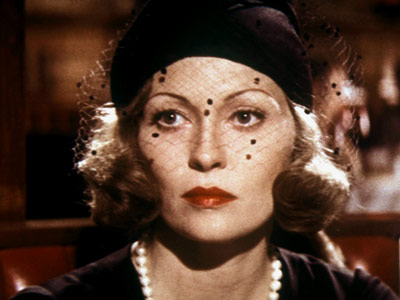
Roman Polanski called on memories of his mother when creating Faye Dunaway's stunning look in "Chinatown."

But it comes to light that the real Mrs. Evelyn Cross Mulwray (Dunaway) is the daughter of multimillionaire Noah Cross (John Huston). And she wants Gittes off the case – or she’ll sue. But when Mulwray’s body is found in an empty water reservoir, Evelyn wants Gittes back on her side. Once there, Gittes uncovers lots of facts that don’t add up – for instance, in the middle of a drought, water is being dumped. At the core of the mystery is a struggle for control of LA’s water supply.

There’s lots of money to be made and power to be gained if you can dry out vast patches of land, then buy them on the cheap. (The California water wars, a fight that started in 1898 over water rights between LA and other areas, including the Owens Valley, influenced Towne’s story.)

Gittes has his work cut out for him. The cops, led by Lieutenant Escobar (Perry Lopez), give him grief. Russ Yelburton (John Hillerman) and Claude Mulvihill (Roy Jenson) of the LA Water and Power Company don’t like him. A menacing man with knife (a cameo by Polanski) warns him not to be so nosy – and just to drive home the point, he slices off a bit of Gittes’ schnoz.

Once he’s cracked the case, though, Gittes can’t play the hero to the dishonesty, greed and perversion that surround him. The evil continues, unchecked. “As savior and restorer of a moral order, [Gittes is] a complete washout, a genre first,” writes Foster Hirsch in “Detours and Lost Highways: A Map of Neo-Noir.”

So why is this a great work of art? First, it looks so striking—vintage LA, poised to become a big city—and Polanski’s voyeuristic camerawork (from the viewpoint of a standing onlooker) lends dark sophistication. The bleak themes of betrayal and corruption give the film enormous power.

Then there’s Jerry Goldsmith’s score and of course Towne’s smart, sexy and funny dialogue. In an interview for the 1999 DVD re-release, Towne explains that he wrote the part with Nicholson in mind and was inspired by the actor’s temperament, manner and the way he uses language.

And despite the fact that Gittes’ character has roots in earlier screen detectives, such as Philip Marlowe, Towne says, “I tried to draw characters from life, not from film.”

Private investigator Jack Gittes is one of the best performances of Jack Nicholson's lengthy and prestigious acting career.

Some of my favorite Gittes’ lines:

“I goddamn near lost my nose. And I like it. I like breathing through it.”

“He passed away two weeks ago and one week ago he bought the land. That’s unusual.”

“You’re dumber than you think I think you are.”

Huston, avuncular and charming, and Dunaway, delicate, otherworldly and aloof, turn in resonant, affecting performances. (Ali MacGraw and Jane Fonda were also considered for the part of Evelyn.) Polanski recalls on the DVD interview that between every take Dunaway touched up her makeup. Her thin eyebrows and Cupid’s bow mouth was a ’30s look he helped Dunaway create; it was inspired by memories of his mother.

Though alluring, glamorous and dressed to a T, Evelyn Cross Mulwray is not a femme fatale. As Towne says in the interview, Evelyn sets up the expectation of being a black widow, but she is the heroine of the movie, the one person in the film who is operating out of decent and selfless motives. [Read more…]

‘Chinatown’ quick hit

Chinatown/1974/Paramount Pictures/131 min

Few films rank as one of the best of their decade but that’s the case with “Chinatown,” a neo noir, set in 1937 California. Of the many things there are to admire, No.1 on my list is Jack Nicholson’s portrayal of private eye Jack Gittes. Secrecy and sex, profit and power, specifically control of the LA area’s water supply, are pieces of a potentially deadly puzzle that lands in his lap.

Also on the admiration list: performances from Faye Dunaway and John Huston, razor-sharp writing from Robert Towne, the mood of cool menace, and Roman Polanski’s directorial flair.