The Noir File: ‘The Third Man’ ranks as one of Britain’s best

By Michael Wilmington and Film Noir Blonde

The Noir File is FNB’s weekly guide to classic film noir and neo noir on cable TV. All the movies below are from the current schedule of Turner Classic Movies (TCM), which broadcasts them uncut and uninterrupted. The times are Eastern Standard and (Pacific Standard).

PICK OF THE WEEK

The Third Man” (1949, Carol Reed) Saturday, Oct. 13, at 8 p.m. (5 p.m.)
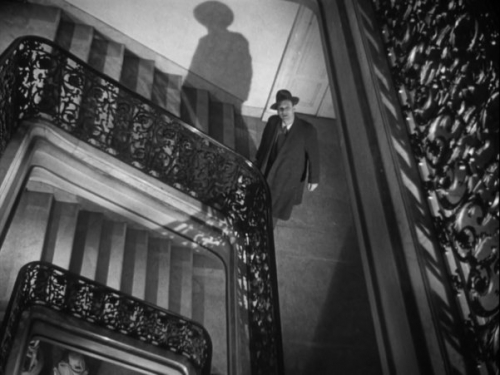
“The Third Man” is a noir masterpiece with a perfect cast and Oscar-winning cinematography.

Graham Greene and Carol Reed’s “The Third Man” is one of the all-time film noir masterpieces. Greene’s script – about political corruption in post-World War II Vienna, a naïve American novelist named Holly Martins (Joseph Cotten) and his search for the mysterious “third man” who may have witnessed the murder of his best friend, suave Harry Lime (Orson Welles) – is one of the best film scenarios ever written. Reed never directed better, had better material or tilted the camera more often.

“The Third Man” also has one of the all-time perfect casts: Cotten, Welles (especially in his memorable “cuckoo clock” speech, which he wrote), Trevor Howard (as the cynical police detective), Alida Valli (as Lime’s distressed ladylove), and Jack Hawkins and Bernard Lee (as tough cops). Oscar-winner Robert Krasker does a nonpareil job of film noir cinematography – especially in the film’s climactic chase through the shadowy Vienna sewers. And nobody plays a zither like composer/performer Anton Karas.

Sunday, Oct. 14

6:30 a.m. (3:30 a.m.): “Deadline at Dawn” (1945, Harold Clurman). Bill Williams is a sailor on leave who has just one New York City night to prove his innocence of murder. Susan Hayward and Paul Lukas are the shrewd dancer and philosophical cabbie trying to help him. Clifford Odets’ script is from a Cornell Woolrich novel; directed by Group Theater guru Harold Clurman (his only movie).
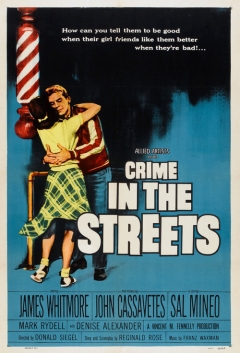
8 a.m. (5 a.m.): “Crime in the Streets” (1956, Don Siegel). This streetwise drama of New York juvenile delinquents (John Cassavetes, Sal Mineo and Mark Rydell) and a frustrated social worker (James Whitmore) is an above-average example of the ’50s youth crime cycle that also included “Rebel Without a Cause” and “The Blackboard Jungle.” Reginald Rose (“12 Angry Men”) wrote the script based on his TV play. Punchy direction by Siegel and a lead performance of feral intensity by Cassavetes.

1:30 a.m. (10:30 p.m.): “The Unknown” (1927, Tod Browning). One of Lon Chaney’s most sinister roles: as a traveling carnival’s no-armed wonder (really an escaped con). With the young Joan Crawford.

2:30 a.m. (11:30 p.m.): “The Testament of Dr. Mabuse” (1933, Fritz Lang). Fritz Lang and writer Thea von Harbou (Lang’s wife) bring back their famous silent-movie crime czar, Mabuse (Rudolf Klein-Rogge). This time, he’s a seeming lunatic, running his empire from an insane asylum. According to some, it’s an analogue of the Nazis’ rise to power.

Monday, Oct. 15

11:30 p.m. (8:30 p.m.): “Bad Day at Black Rock” (1955, John Sturges).

Tuesday, Oct. 16

8 p.m. (5 p.m.): “Eyes in the Night” (1942, Fred Zinnemann). A good B-movie mystery with Edward Arnold as blind detective Duncan Maclain, co-starring Donna Reed, Ann Harding and Stephen McNally.

3:30 a.m. (12:30 a.m.) “Wait Until Dark” (1967, Terence Young).

The Noir File: Tracy is tops in Lang’s anti-lynching classic ‘Fury’

By Michael Wilmington and Film Noir Blonde

A guide to classic film noir and neo-noir on cable TV. All the movies are from the current schedule of Turner Classic Movies (TCM), which broadcasts them uncut and uninterrupted. The times are Eastern Standard and (Pacific Standard).

PICK OF THE WEEK

Fury” (1936, Fritz Lang). Monday, Oct. 8, 8 p.m. (5 p.m.)

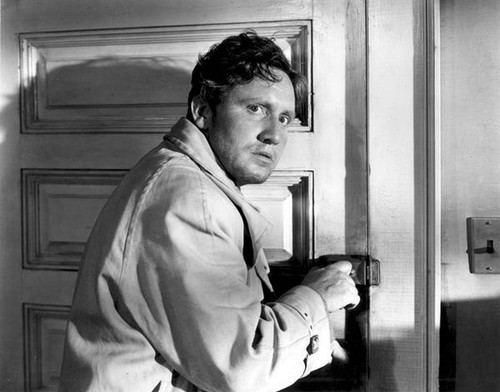
Spencer Tracy stars in “Fury,” one of the most Germanic of Fritz Lang’s American movies.

The two great American anti-lynching movies are Fritz Lang’s 1936 classic “Fury,” and William Wellman’s great 1943 Western “The Ox-Bow Incident.” “Fury” is the more powerful of the two, the more effective, the more memorable. Lang’s film, which he also co-wrote, is an explosive saga of a Depression-era small city descending into lynch hysteria. Spencer Tracy, at his youthful naturalistic best, is Joe Wilson, a decent, ordinary, working-class guy who stops his car in the town and is mistaken for a kidnapper. Locked in jail despite his desperate protestations of innocence, Joe is then subject to a terrifying nocturnal assault by the maddened townspeople, who drive away the craven police guards and burn the jail down, killing Joe – they think.

But Joe is alive, having fled back to the big city and his family and fiancée (Sylvia Sidney). And he is now consumed with obsessive dreams of fiery revenge and awful retribution. What happens in the course of that revenge may be unlikely, but “Fury” is still gripping, frightening and hypnotic. It’s one of the most Germanic of Lang’s American movies, one of the strongest social message dramas of the ’30s, and as obvious a precursor of ’40s film noir as Lang’s1931 masterpiece “M.” With Walter Brennan, Bruce Cabot, Walter Abel and Frank Albertson. Screenplay by Lang and Bartlett Cormack, from a story by Norman Krasna.

Saturday, Oct. 6

“Party Girl” is pure Nick Ray: romantic, moody and violent. Shown: John Ireland, Cyd Charisse.

6 a.m. (3 a.m.): “Party Girl” (1958, Nicholas Ray). In Nick Ray’s lusciously colorful and nervy gangland tale, Robert Taylor is a handsome mob attorney who milks sympathy from juries by walking on his crutches. Cyd Charisse is the leggy nightclub dancer/party girl he loves and Lee J. Cobb is Cyd’s other lover: Rico, the Chicago mob boss who carries a little vile of acid for anyone who double-crosses him. Set in 1930s Chicago, this is pure Ray: romantic, moody and violent. With John Ireland and Kent Smith.

Sunday, Oct. 7

4 a.m. (1 a.m.): “No Orchids for Miss Blandish” (1948, St. John Legh Clowes). A real oddity: British novelist James Hadley Chase’s bizarre take on American crime fiction, complete with a twisted gang boss, a kidnapped heiress, a cynical newsman, gunsels galore and pink gin. (Later remade quite well by Robert Aldrich in 1971 as “The Grissom Gang.”) With Jack LaRue and Linden Travers.

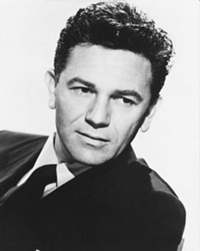
John Garfield

Tuesday, Oct. 9

1:30 p.m. (10:30 a.m.): “The John Garfield Story” (2003, David Heeley). Documentary-bio of the great, sensitive tough guy and New York City-born film noir star.

Wednesday. Oct. 10

8 p.m. (5 p.m.): “The Haunting” (1963, Robert Wise). From Shirley Jackson’s shivery, intellectual, supernatural novel “The Haunting of Hill House” – about a group of mostly amateur spook watchers (Richard Johnson, Claire Bloom, Russ Tamblyn and movie-stealer Julie Harris) in an “old dark house” – noir and horror master Robert Wise (“The Body Snatcher,” “Born to Kill”) and screenwriter Nelson Gidding weave a classic ghost movie, seemingly without ghosts. (Or is it?)

Thursday, Oct. 11 (Robert Aldrich Night)

(Robert Aldrich Night begins at 8 p.m. (5 p.m.) with a great adventure movie: Jimmy Stewart, Richard Attenborough and Peter Finch in 1965’s “The Flight of the Phoenix.”)

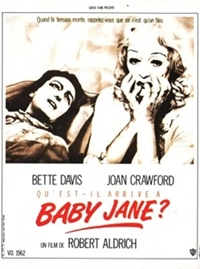
10:30 p.m. (7:30 p.m.): “Whatever Happened to Baby Jane?” (1962, Robert Aldrich).

1 a.m. (10 p.m.): “The Legend of Lylah Clare” (1968, Robert Aldrich). Perverse backstage thriller about an obsessive Hollywood movie director (Peter Finch) trying to recreate the image of his dead wife, film legend Lylah Clare, in the body of a new blonde bombshell actress (Kim Novak). Echoes of “Vertigo” and “Baby Jane” abound. With Ernest Borgnine.

3:15 a.m. (12:15 a.m.): “Kiss Me Deadly” (1955, Robert Aldrich).

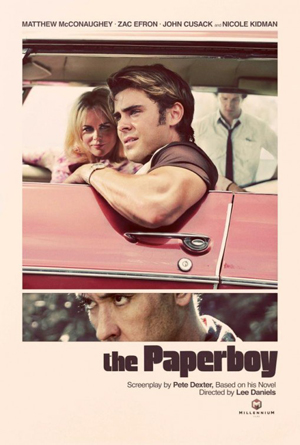
‘The Paperboy’ delivers pulpy trash but proves a dull read

The Paperboy/2012/Millennium Films/107 min.

Were you to meet some unenlightened soul who was unfamiliar with the concept of pulpy trash, you needn’t blather on about lurid images, sordid secrets and sweaty flesh. You’d simply need to steer this person to a showing of “The Paperboy.” One big problem: despite being an over-the-top, often shocking, tangle of murder mystery, neo noir, lust triangle and family/race relations drama, the movie is oddly dull.

Writer/director Lee Daniels, who earned a directorial Oscar nom for 2009’s groundbreaking “Precious,” takes us on a murky, hazy, lazy journey to South Florida in 1969 and does a nice job evoking that time and place. “The Paperboy” refers to the youngest member of a newspaper family, Jack Jansen (Zac Efron), who gets wrapped up in a mystery and wracked by obsession. Narrating the story is the family’s longtime maid Anita (Macy Gray), introduced as if she were being interviewed.

Jack’s older brother Ward (Matthew McConaughey) is a smart, smooth Miami Times reporter. Ward returns to his hometown (Lately, Fla.), to follow a controversial story with his writing partner, Yardley Acheman (David Oyelowo), a disdainful outsider with an English accent. They’re convinced that slimy Hillary Van Wetter (John Cusack) – a former swamp-dweller who now sits on death row – has been wrongfully imprisoned for the murder of a corrupt sheriff.

Helping their efforts is Hillary’s fiancée, flirty, feisty Charlotte Bless (Nicole Kidman). Charlotte has a penchant for frosted pink lipstick, teased blonde hair and tight, tacky clothes. Oh, and for providing boxes of paperwork that she says supports Hillary’s innocence. When Jack begins driving the three of them around, he finds himself increasing drawn to Charlotte and dogged by darker and darker violence.

What starts as an engaging story ultimately proves flimsy and unsatisfying. (The depiction of “investigative journalism” is laughable.) The fact that we don’t know why Anita is narrating the story or to whom is one of many whys left unaddressed, the worst of which is why do we care? Apparently, that’s not a concern for Daniels who seems more into injecting the script with what?! just happened? This includes simulated sex, Kidman urinating on Efron in order to disinfect jellyfish stings and a scene in which McConaughey is brutally beaten and permanently disfigured. And we still don’t care. At least I didn’t.

On the plus side, “The Paperboy” seethes with period atmosphere; the grainy look and jittery editing add to the non-stop but misguided intensity. There are a few outstanding performances – Kidman mesmerizes as the trashy, troubled blonde and Efron holds his own as her devoted young suitor. Also effective are the scenes with Efron and Gray. McConaughey overdoes it as the slick, scar-faced Southerner. Cusack seems one-note as the puffy, greasy, low-down villain.

Though it might seem to have the makings of a tabloid masterpiece, “The Paperboy” isn’t much more than an eye-grabbing headline.

“The Paperboy” opens today in New York and LA.

The Noir File: Hitchcock, Grant, Fontaine fill us with ‘Suspicion’

By Michael Wilmington and Film Noir Blonde

A guide to classic film noir and neo-noir on cable TV. All the movies are from the current schedule of Turner Classic Movies (TCM), which broadcasts them uncut and uninterrupted. The times are Eastern Standard and (Pacific Standard).

PICK OF THE WEEK

Suspicion” (1941, Alfred Hitchcock). Thursday, Sept. 27, 8 a.m. (5 a.m.):

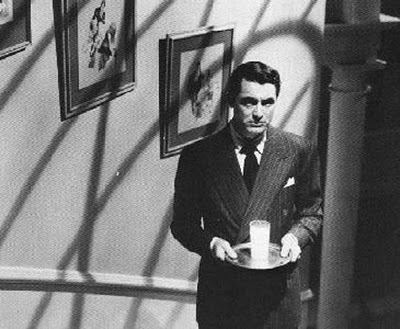
Cary Grant bringing the glass of milk is an unforgettable moment.

In Alfred Hitchcock’s glossy, shivery 1941 domestic thriller, British provincial wallflower Joan Fontaine marries the gorgeous but irresponsible Cary Grant and begins to suspect, more and more strongly, that he intends to murder her. Hitchcock builds the suspicion, and the suspense, beautifully.

And the lovely might-be victim Fontaine, whom Hitch had made a first-rank star the year before by casting her as the shy, nameless heroine of his Best Picture Oscar winner “Rebecca,” this time won the Best Actress Oscar herself.

“Suspicion” is one of Hitchcock’s most polished and well-executed thrillers, and there are scenes and shots in the film – such as the sinister, glowing glass of milk Grant carries upstairs to his sick wife – that have become famous. But the movie has one big flaw, dictated by the culture of the time and by the Production Code. You’ll know what it is by the end of the film.

The classy British émigré cast includes Sir Cedric Hardwicke, Dame May Whitty, Nigel Bruce and Leo G. Carroll. The screenwriting team – Samson Raphaelson, Joan Harrison and Hitchcock’s wife, Alma Reville – adapted “Suspicion” from Francis Iles’ classic suspense novel “Before the Fact,” and they should have kept Iles’ shocking original ending.

Friday, Sept. 21

5:15 p.m. (2:15 p.m.): “Lolita” (1962, Stanley Kubrick).

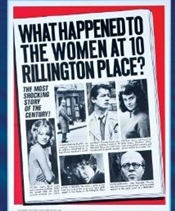
4 a.m. (1 a.m.): “10 Rillington Place” (1971, Richard Fleischer). Noir expert Richard Fleischer specialized in true-crime movies (“Compulsion,” “The Boston Strangler”) and this is one of his best: a chilling realistic thriller modeled on the famous case of British serial killer Dr. John Christie (brilliantly underplayed by Richard Attenborough), and the hapless man he frames for one of his murders, (a brilliant job by John Hurt). Also with Judy Geeson, Andre Morell and Bernard Lee.

Saturday, Sept. 22

8 p.m. (5 p.m.): “Gilda” (1946, Charles Vidor).

Tuesday, Sept. 25

1 p.m. (10 a.m.): “Nightfall” (1956, Jacques Tourneur).

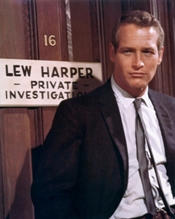
Paul Newman as Lew Harper

Wednesday, Sept. 26

12 a.m. (9 p.m.): “Harper” (1966, Jack Smight). Paul Newman, at his most attractively laid-back, plays one of detective literature’s most celebrated private eyes, Ross MacDonald’s Lew Archer, in this brainy thriller based on MacDonald’s novel “The Moving Target.”

One catch: Archer has been renamed “Lew Harper,” so Newman could have (he hoped) another hit movie with an “H” title, like “The Hustler” and “Hud.” He got one. The stellar cast includes Lauren Bacall, Janet Leigh, Julie Harris, Shelley Winters, Robert Wagner, Arthur Hill, Robert Webber and Strother Martin. Scripted by William Goldman.

Thurs., Sept. 27

9:45 a.m. (6:45 a.m.): “Murder, My Sweet” (1944, Edward Dmytryk).

The Noir File: Non-stop tension from pulp-fiction king Woolrich

By Mike Wilmington and Film Noir Blonde

This is a guide to classic film noir on cable TV. All the movies are from the current schedule of Turner Classic Movies (TCM), which broadcasts them uncut and uninterrupted. The times are Eastern Standard and (Pacific Standard).

Pick of the Week

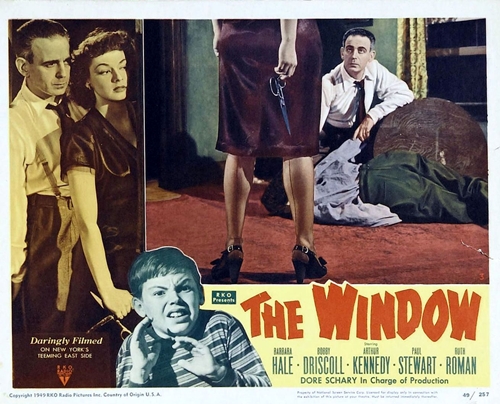
The Window” (1949, Ted Tetzlaff). Monday, Sept. 17, 2012, 1:45 a.m. (10:45 p.m.)

On a sweltering New York City night, a 9-year-old named Tommy (Bobby Driscoll) witnesses a murder committed by neighbors (Paul Stewart and Ruth Roman).

Unfortunately Tommy is known for crying wolf and his parents (Barbara Hale and Arthur Kennedy) don’t believe him. As he keeps trying to tell his story, the killers become more and more aware of the threat he poses and more determined to shut him up.

Of all the great noir writers – Hammett, Chandler, Cain, Goodis, Thompson – no one could generate sheer screaming suspense like pulp-fiction king Cornell Woolrich. And this picture, along with Hitchcock’s 1954 “Rear Window,” are the most tension-packed, unnerving movies made from Woolrich’s stories.

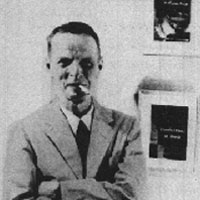
Cornell Woolrich (1903-1968)

“The Window,” shot largely on location, has grittily evocative street scenery and the cast is letter-perfect. (Driscoll won a special Juvenile Oscar for his performance.) The director was Ted Tetzlaff, an ace cinematographer who shot Hitchcock’s “Notorious,” and he does a wonderful job here.

This movie seethes with atmosphere and character, crackles with fear and dread. There are some classic film noirs that are underrated, and – perhaps because the protagonist here is, atypically, a child – this is one of them.

Saturday, Sept. 15

10 p.m. (7 p.m.) “Strangers on a Train” (1951, Alfred Hitchcock)

12 a.m. (9 p.m.) “Dial M for Murder” (1954, Alfred Hitchcock)

2 a.m. (11 p.m.) “Niagara” (1953, Henry Hathaway)

3:45 a.m. (12:45 a.m.): “The Postman Always Rings Twice” (1946, Tay Garnett). See Noir File, 6/29/12

Sunday, Sept. 16

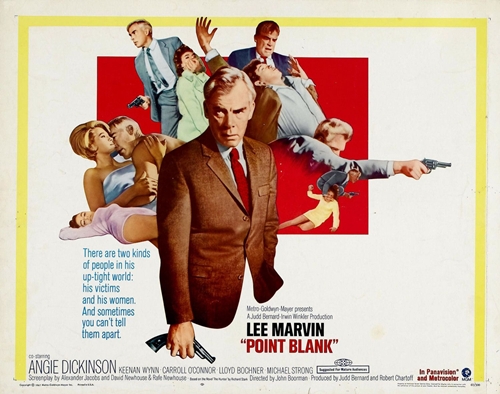
3:30 p.m. (12:30 p.m.): “Point Blank” (1967, John Boorman). “Point Blank” is one of the quintessential neo noirs. Lee Marvin is a thief betrayed and left for dead in Alcatraz. When he takes off after his treacherous associates and their bosses (Carroll O’Connor and Lloyd Bochner), with the help of a mysterious guide (Keenan Wynn) and a glamorous pal (Angie Dickinson), it’s a magnetic, terrifying sight.

Based on a novel by “Richard Stark” (aka Donald Westlake), the movie is steeped in its Los Angeles locale: a deadly city of noir that’s also a surprisingly beautiful sunlit-vision of LA circa 1967. With Boorman going all out, this classic movie plays like a grand collaboration among Don Siegel, Alain Resnais, Phil Karlson and Jean-Pierre Melville. As for Lee Marvin, he’s at the top of his game. So is Angie.

Wednesday, Sept. 19

6:15 p.m. (3:15 p.m.): “The Breaking Point” (1950, Michael Curtiz). Based on Hemingway’s “To Have and Have Not,” and starring John Garfield in the Bogie part, this is a more faithful adaptation than the 1944 Howard Hawks picture, but not quite as good a movie. (Then again, some buffs prefer it.) Curtiz gives it speed, atmosphere and a dark overview. The rest of the cast includes Patricia Neal, Phyllis Thaxter and, in the Walter Brennan part, the matchless Juano Hernandez.

Perfect, posh fodder for a Hitchcock mind game

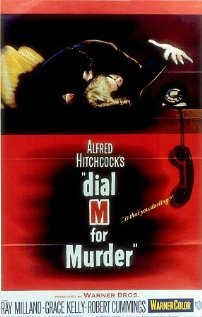
Dial M for Murder/1954/Warner Bros. Pictures/105 min.

A streetwise femme fatale she’s not. Grace Kelly is too refined, too ladylike, too exquisitely beautiful. But in “Dial M for Murder,” her first movie with Alfred Hitchcock, she proves herself to be a smart and capable heroine in this film that’s nearly as ravishing to look at as she is.

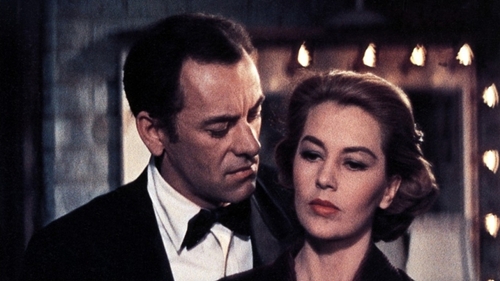
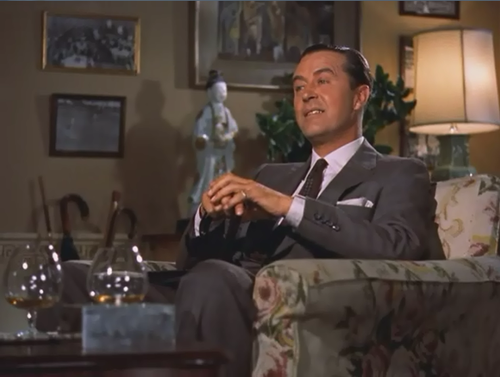
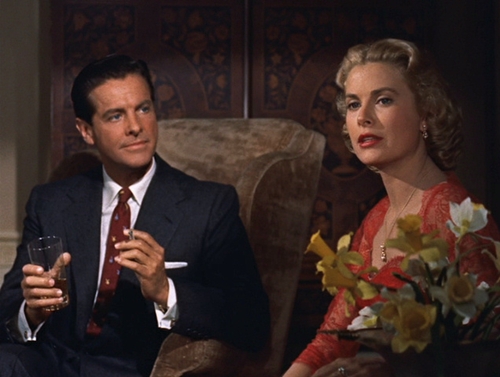
Ray Milland as Tony Wendice brims with confidence and charm.

We first see her character Margot Wendice, in a demure white dress, as she reads the London Times over breakfast with her debonair husband Tony (Ray Milland). Tony’s a former tennis champ who now sells sports equipment. But it’s Margot’s family money that pays for their posh lifestyle and elegant flat in Maida Vale.

Minutes after her breakfast, we see Margot with her lover, a mystery writer named Mark Halliday (Robert Cummings), this time in a bright red dress that signals where her real passion lies. Margot is fretting a bit because she’s received letters from an anonymous blackmailer who knows about her affair and threatens to tell Tony.

Turns out, though, the “blackmailer” is suave old Tony himself. He’s known for quite a while that Margot and Mark are an item and he’s hatched a plan to do away with his wife, get her money and use her lover as his alibi. It’s a very clever plan and Tony has worked out every detail. But as I mentioned Margot is no slouch. She proves quite skilled at surviving and improvising with weapons. A little trick she picked up at boarding school, I expect. Still, Tony sees a chance to achieve his goal using a new ploy.

Mark (Robert Cummings) is the writer with whom Margot (Grace Kelly) begins an affair.

Like most Hitchcock noirs, the story takes place in a world in which manners and titles and accents count for a great deal – in which fate is determined over champagne cocktails and glasses of brandy by a roaring fire. This chi-chi, upper-crust milieu is far removed from the gritty, urban, angst-ridden territory of much of the film noir canon. But a common thread of film noir, regardless of setting, is that its writers and directors were intensely aware of class differences and divisions, of society’s inequalities and injustices.

With a screenplay by Frederick Knott (based on his Broadway and West End hit), “Dial M for Murder” boasts a very civilized, very English, very cozy atmosphere, at least on the surface. Whereas Hitchcock often tended to use novels and short stories as gestalts for his own uniquely original narratives, when he chose to film a play, he left them virtually unaltered. In fact, he considered “Dial M” a minor work, something to do while he recharged his creative batteries.

That said, he shot the movie in 3-D, in vibrant color with extreme camera angles to keep us from getting too claustrophobic (the action takes places almost entirely in the Wendices’ well appointed flat). The lush look, upbeat mood, romantic music by Dimitri Tiomkin and charming characters all belie the darkness at the core of the story.

Milland is magnetic, confident, perfectly composed with just a shimmer of vulnerability. Kelly, the flawless incarnation of ’50s femininity, seems the perfect wife for him. (The supporting cast is splendid as well. Anthony Dawson plays the college acquaintance whom Tony ropes into his scheme. John Williams is urbane as ever as Chief Inspector Hubbard.) But, as sumptuous as these appearances are, they are nevertheless deceiving.

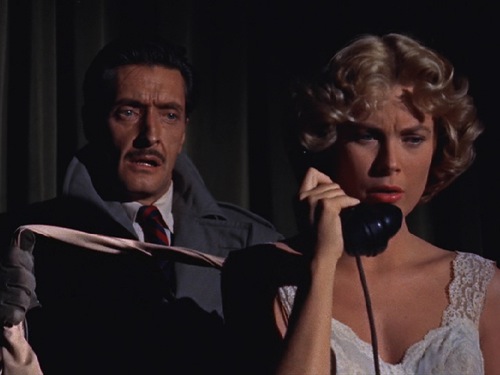
A pawn in the game: Anthony Dawson tries to strangle Margot (Grace Kelly).

“Dial M for Murder” is an excellent example of one of Hitch’s favorite mind games – inviting us to get swept up in this picture-perfect world and then upending our expectations and revealing his (and perhaps our) mistrust of the upper classes, particularly through the use of subversive casting.

For instance, Margot and Mark’s fling is surely one of the most tasteful and thoroughly dull affairs in movie history (despite the red dress). I reckon any woman would take sexy, athletic Tony over sweet but insipid Mark. Of course, Hitchcock knows this. He uses Milland’s humor and appeal to build the audience’s sympathy for the wrong person, to get us to identify with a would-be killer, to subtly underscore the moral ambiguities and deep flaws that make us human.

Hitch liked to play cat and mouse with the audience, to entice us with wit, gloss and visual flair, then slyly expose our delusions and hypocrisies. Or as Francois Truffaut put it: “Hitchcock loves to be misunderstood, because he has based his whole life around misunderstandings.”

‘Dial M for Murder’ quick hit

Dial M for Murder/1954/Warner Bros. Pictures/105 min.

Alfred Hitchcock’s “Dial M for Murder” boasts a very civilized, very English, very cozy atmosphere, at least on the surface. But under the elegant façade, a spurned husband (Ray Milland) crafts an intricate plan to murder his rich wife (Grace Kelly) and use her lover (Robert Cummings) as his alibi. Based on a play by Frederick Knott, this gorgeous-looking film is an excellent example of a classic Hitchcockian trope – subversive casting.

Will ‘Compliance’ have you screaming at the screen?

Compliance/2012/Magnolia Pictures/90 min.

“Compliance” – a disturbing psychological thriller – will more than likely draw extreme reactions from its audiences. One response it probably won’t trigger is boredom. Taut and intense as well as unhurried and detached, it’s a film that, for every one of its 90 minutes, grips, fascinates and frightens.

The story starts on preposterous note and from there it gets even more absurd. The manager of a fast-food restaurant in suburban Ohio (Ann Dowd) receives a call from a man (Pat Healy) who identifies himself as a cop. He tells her that a customer has accused one of the restaurant’s employees, a cartoonishly pretty 19-year-old named Becky (Dreama Walker), of stealing money.

The officer then asks the manager to help with the investigation and to strip-search Becky. Both she and Becky put up little resistance to the caller’s requests (“I’m just trying to do my job,” they both say at different times). After they acquiesce to the initial requests, the caller’s demands become more outrageous and bizarre. At one point, Becky agrees to do jumping jacks, naked.

What’s most unnerving is that “Compliance” is based on real events that took place in a suburb of Louisville, Kentucky, in 2004. And that was not an isolated incident: about 70 similar calls (in which a police officer was impersonated) were made throughout the country in a 10-year period.

But the film is not a documentary. “The reason to make the movie is to fill in the gaps in reality,” said director Craig Zobel at a recent roundtable. “I was very scared to make this movie. If we were going to do it right, we were going to have to ask some hard questions. And the movie doesn’t work for everyone.”

A colleague and friend of mine found the movie exploitative. “The only legitimate reaction is to walk out,” he said and in fact a few people did at the screening we attended.

Watching the humiliation unfold, the kneejerk reaction is to ask: “What is wrong with these people? Why are they going along this?” Yet not only did a version of these events actually happen, repeated psychological studies have shown that, more often than not, most people will obey authority and follow instructions, even if they are asked to do something they know is wrong.

And of course the next question is: “What would I do in that situation?” Your answer to that is perhaps the best way to judge the film’s merits. If you find yourself feeling superior (“I’d never do that”), the film has missed its mark. If, however, you feel sympathy for the characters, the film succeeds.

As Walker put it at the roundtable: “Who knows what any of us would do in that situation? It’s a very primal question.”

“Compliance” opens today in Los Angeles. Filmmaker Craig Zobel and actor Pat Healy will attend shows this weekend at the Nuart Theatre.

‘Nuit #1’ is a daring, if flawed, study of a one-night stand

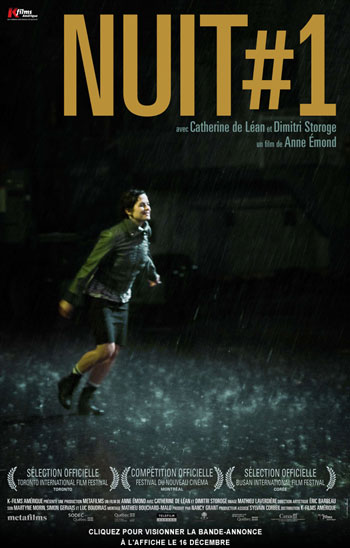
Nuit #1/2011/Adopt Films/91 min.

“Nuit #1” – a fly-on-the-wall treatment of a one-night stand – doesn’t hold much back. It begins with the eerily glum intensity of the rave where Clara (Catherine de Léan) and Nikolai (Dimitri Storoge) meet, moves to clinical coverage of them having sex at Nikolai’s dumpy apartment, then lingers on their scathingly honest exchanges about the reality of their lives – the frustration, pain and desperation that exist just beneath the surface.

They are strangers who share a random spark of chemistry, then take turns sharing their angst in a series of monologues. He’s broke, angry and can’t hold a job; modern love makes him sick, he declares. She’s a school teacher who relieves her unhappiness through partying and nights with other strangers.

Playlike in its structure, “Nuit #1” sometimes feels too talky, the unhappy characters border on clichéd. Still, Canadian writer/director Anne Émond, 29, shows confidence as a director, eliciting raw, spontaneous and resonant performances from her actors. She takes intelligent risks and is at times thoughtfully provocative.

It seems safe to say that Émond had “La maman et la putain”/“The Mother and the Whore” (1973, Jean Eustache) on her radar as she made this film. Wonder if David Lean/Noel Coward’s “Brief Encounter” (1945), one of my favorite ill-fated romances, also made her viewing list? ; )

“Nuit #1” opens today at Landmark’s Nuart Theatre in Los Angeles.

‘Killer Joe’ borders on bipolar, despite a riveting performance from Matthew McConaughey

Killer Joe/2011/LD Entertainment/103 min.

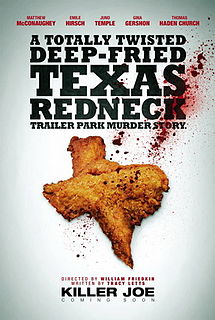
The words “TEXAS REDNECK” jump off the poster for “Killer Joe,” William Friedkin’s neo noir/Southern Gothic black comedy written by playwright Tracy Letts and starring Matthew McConaughey as a hitman who’s also a cop.

The rednecks are the Smiths, a Southern family for whom sleaze and greed have long replaced Sunday grace. In the opening scene, Sharla (Gina Gershon) gets out of bed and answers the door; her stepson Chris (Emile Hirsch) is outside, rain drenched, having been kicked out of his place by his girlfriend. Does Sharla bother to throw on clothes before opening the door? Hell, no. This ain’t no Ritz Hotel after all.

Turns out, Chris is a drug dealer with a debt and needs cash fast. His solution is to murder his mother (mostly unseen in the movie) and cash in on her insurance policy. No one’s really that fond of the mother so the rest of the family – stepmom Sharla, Chris’ remarried father Ansel (Thomas Haden Church) and his sister Dottie (Juno Temple) – are all on board with his plan. They’re not the sharpest tools in the shed, but they know a job like this has to be done right so they hire a pro named Killer Joe (McConaughey). Need I say, things don’t go to plan?

On the plus side, “Killer Joe” is well shot, well directed and well acted – McConaughey is especially magnetic, outlining the character’s chilling darkness and letting us fill in the blanks. On the minus side, though, “Killer Joe” never feels like much of a noir or much of a comedy. The mood shifts border on the bipolar, culminating in a resolution that may have worked on stage but seems laughable (in a bad way) on film, not to mention ridiculously violent. By that time, though, we are nothing if not primed for blood to be shed.

This marks the second collaboration for Friedkin and Letts – their first was 2006’s “Bug” based on Letts’ play. The Chicago-based playwright’s other work includes the Pulitzer-prize winning “August: Osage County” (the movie version is set to start filming in September) as well as “Superior Donuts” and “Three Sisters.”

Given the talent that came together for “Killer Joe,” was I wrong to hope for meatier fare? Though tempting on the outside, this ain’t the blood-red burger I wanted on my plate.

“Killer Joe” opens today in LA.