Noir images dominate Los Angeles photo show

“I Love L.A.,” featuring 50 works from 42 photographers, opened Saturday at the Duncan Miller Gallery, 10959 Venice Blvd., in Los Angeles. Not surprisingly, there were many captivating noir images. The show runs through Sept. 17. To see more photos online, visit the “I Love L.A.” Photography Exhibition Facebook page.
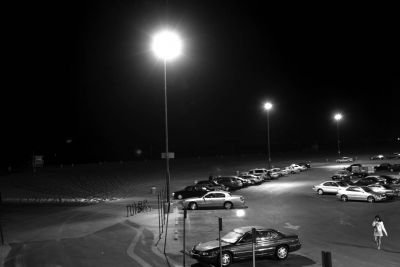
Santa Monica Pier Parking Lot, 2004, Patricia Williams
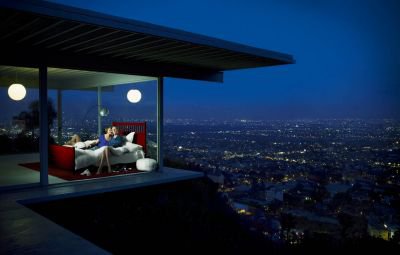
 

Polyamorous Love, 2008, by Michael Grecco

 

Gallery owner Daniel Miller (far right) mingles on Saturday night.

 

Guests voted for their top three photos.

x

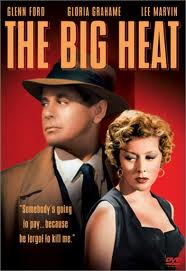
One of Fritz Lang’s finest films, ‘The Big Heat’ is a lean, gripping suspense story

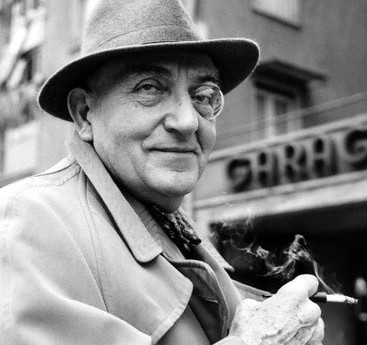
Fritz Lang

The Big Heat/1953/Columbia Pictures/89 min.

“When a barfly gets killed, it could be for any one of a dozen crummy reasons,” says Police Lt. Ted Wilks (Willis Bouchey) in “The Big Heat.” Fritz Lang’s grim but gratifying crime drama from 1953 is laced with violence that’s still a bit shocking even by today’s standards.

Barflys don’t get much sympathy in the fictional city of Kenport, an upstanding community full of white-picket fences and happy homemakers that also harbors a flourishing criminal empire and rampant police corruption.

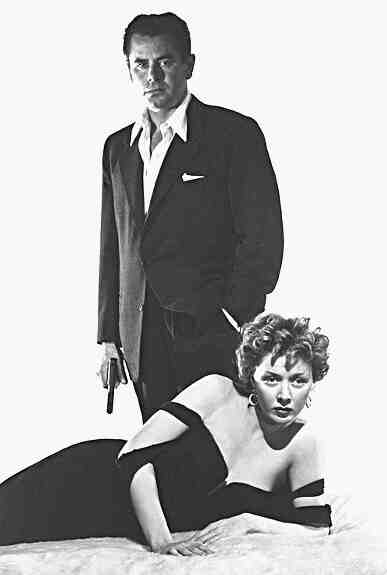
Gloria Grahame and Glenn Ford star in “The Big Heat.”

Wilks is talking to an upright cop, Det. Sgt. Dave Bannion (easy on the eyes Glenn Ford), about the torture and murder of Lucy Chapman (Dorothy Green). Lucy was the girlfriend of police sergeant Tom Duncan, also dead; his suicide is the film’s opening scene.

Tom’s widow Bertha (Jeanette Nolan) is not what you’d call crushed at her husband’s demise and she’s martini-dry as she answers questions from Bannion. Bertha claims her husband was ill, hence the suicide. Bannion got a rather different story from Lucy Chapman.

Unlike Tom Duncan, Bannion seems to have a perfect wife, the golden-haired Katie (Jocelyn Brando, Marlon’s sister), and a cute little daughter, named Joyce. As Mr. and Mrs. Bannion share smokes, sips of drinks and steaks, they banter easily and make each other laugh.

In addition to questioning barflies and ungrieving widows, Bannion noses into the business of an oily mobster named Mike Lagana (Alexander Scourby), a vicious operator whose right-hand man is the lithe and snarling Vince Stone (Lee Marvin).

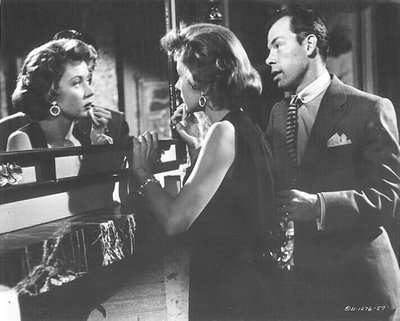
The incomparable Gloria Grahame plays Debby Marsh, Stone’s inamorata. Debby spends most of her time shopping, drinking and looking at herself in the mirror. What’s not to like? As she tells Bannion: “I’ve had it rich and I’ve had it poor. Believe me, rich is better.”

(In, 1954, Ford and Grahame starred in another Lang noir, “Human Desire,” a film version of Émile Zola’s novel “La Bête Humaine”/“The Human Beast.”)

Grahame and Ford have sizzling chemistry.

Shortly after the exchange in Lagana’s living room, a car bomb meant for Bannion kills the lovely Katie. Bannion doesn’t take much time to mourn; instead, with eyes glazed, he’s hellbent on proving the link between the police and Lagana’s mob. Suspended from the force, he seeks vengeance on his own, setting the pace for ’70s vigilante cops such as Clint Eastwood‘s Dirty Harry. As Bannion obsesses over hate and revenge, in a chilling transformation of character, he becomes the moral equivalent of the gangsters he despises.

Known for stark, intense visuals, here director Lang contrasts gloomy, barlike shadows that bind the characters to their destiny with shocks of scouring white light suggesting revelation. Lang was also known for being difficult with cast and crew, but Ford for one never saw Lang’s tyrannical side.

In “Glenn Ford: A Life” by Peter Ford, the famed actor describes his experience: “Fritz Lang came out of the old German studio system, where the director was like a dictator, barking commands and making people jump. He had a pretty nasty reputation in some quarters. There were people in Hollywood who had worked with him who hated his guts, especially some of the crew guys down the line. I mean, there were stories of people throwing lights at him and threatening to kill him for the way he treated them.

“So I head into this picture wondering how bad it’s going to be. And then Fritz and I met and had a couple of cocktails, and he couldn’t have been sweeter. He treated me with great respect. A wonderful friend, and I learned so much from him. We’re talking about one of the real geniuses of the movie business.”

Gloria Grahame and Lee Marvin: a couple with, um, a problem or two.

“The Big Heat” drew inspiration from real-life events a few years before the film was made. When the U.S. Senate set up the Kefauver Committee to probe organized crime, televised hearings brought the Mafia into the consciousness of the American public. Sydney Boehm wrote the script from a serial by William P. McGivern in the Saturday Evening Post.

And of course, any time crime’s on the rise, you know loose women are involved, which brings me to the pièce de résistance: Grahame as Debby. Though she doesn’t get a huge amount of screentime, she’s funny and fresh, and brims over with sexpot charm – striking the perfect balance between waifish, wide-eyed vulnerability and pleasure-seeking sophistication.

Once Debby realizes the depth of Vince’s depravity – burning a young woman’s hand with his cigarette is small potatoes to this guy – she switches her loyalty to the righteous but rigid Bannion. And when Vince learns of her betrayal, she gets burned, literally, with a pot of boiling coffee. We hear, but don’t see, Debby’s wounded reaction in one of the most famous moments in the movies.

With her looks gone, Debby tells Bannion everything she knows and commits the murder that will bring down the syndicate. Oh, and throwing coffee? Two can play at that game. I’d like to see a Starbucks barrista do better.

‘The Big Heat’ quick hit

The Big Heat/1953/Columbia Pictures/89 min.

Fritz Lang’s expose of a crooked police force reveals the painful price of corruption. Glenn Ford is the clean cop bucking the system; Lee Marvin scores as a sadistic villain and Gloria Grahame shines as a vamp who slowly wakes up to the badness all around her. Well since when is there a law against sleeping till noon?

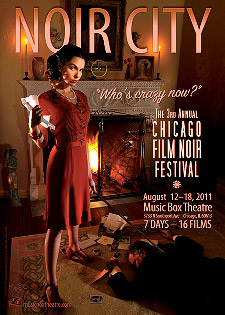
Noir City: Chicago starts Friday at the Music Box

Chicago’s Music Box Theatre will host the third annual Noir City: Chicago starting Friday and running through Aug. 18. Presented by the Film Noir Foundation, the fest features 16 noirs, all in 35 mm.

Opening night is a double feature: 1947’s “High Wall” by director Curtis Bernhardt, starring Robert Taylor and Audrey Totter, and “The Dark Mirror” (1946, Robert Siodmak) in which Olivia de Havilland plays twin sisters, one of whom is deranged. Shocker!

Other highlights include: “Sorry Wrong Number” (1948, Anatole Litvak) and “The Glass Key” (1942, Stuart Heisler) as well as lesser-known films like “Loophole” (1954, Harold D. Schuster) and “The Hunted” (1948, Jack Bernhard), recently saved from extinction by the foundation.

Authors Alan K. Rode and Foster Hirsch will be on hand to discuss these classic noirs.

Having worked at the Chicago Tribune for many years before heading to the West Coast, I always remember this sage editing adage: “If your mother says she loves you, you’d better doublecheck.”

Speaking of checking, you can see the full Noir City: Chicago 3 lineup here.

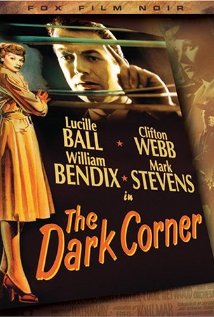
Lucille Ball turns her talents to crimestopping in ‘Dark Corner’

The Dark Corner/1946/Twentieth Century Fox/99 min.

Lucille Ball

If you know Lucille Ball from “I Love Lucy” and other TV shows, she may seem an unlikely noir actress. But before she played the zany wife of Cuban bandleader Ricky Ricardo, Ball was the Queen of B Movies. In “Dark Corner,” she stars as Kathleen, a perky secretary with a crush on her boss, NYC private eye Bradford Galt (Mark Stevens). It’s a solid noir with spot-on direction from Henry Hathaway and superb cinematography from Joseph MacDonald, both of whom were A-list talent.

Brad, equal parts Marlowe and Milquetoast, is appealingly human because we see chinks of weakness under his tough-guy exterior. Like many noir heroes, his past comes back to haunt him. Fittingly, his “ghost” is a heavy in a white suit named Stauffer (William Bendix) who seems to be on the payroll of Brad’s ex-partner, lusciously Nordic-looking Tony Jardine (Kurt Kreuger).

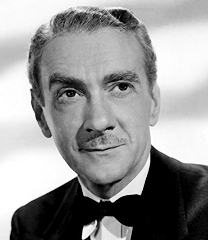
Clifton Webb

There’s bad blood with Tony because he framed Brad for a crime he didn’t commit, which led to jail time. But Tony, now more gigolo than gumshoe, is merely a puppet; pulling the strings is an effete, silver-haired art dealer named Hardy Cathcart (Clifton Webb). The lovely Mrs. Cathcart (Cathy Downs) is a patron of many arts, including a dalliance with Tony.

As Brad’s life becomes more of a nightmare, chipper and ever-loyal Kathleen is there to help him get to the bottom of the mess. What’s in it for her? If she’s lucky, maybe some nylons and a trip to the altar at the end assuming Brad can get out from under his fate.

Destiny, darkness, persecution, paranoia, surface vs. reality, existential angst, the depravity of high society, ie rich, folk – all these classic noir concerns are nicely woven into “The Dark Corner.” Much of the unease and tension is conveyed by Hathaway’s crisp direction and MacDonald’s moody visuals, especially the intense shadows and high contrast MacDonald creates with one dominant light source, such as a lamp on a desk.

This master lensman also worked on “Call Northside 777” from 1948 and 1953’s “Niagara” (both directed by Hathaway) as well as “Panic in the Streets” (Elia Kazan, 1950), “Pickup on South Street (Sam Fuller, 1953) and John Ford’s 1946 Western masterpiece “My Darling Clementine.”

Jay Dratler and Bernard Schoenfeld wrote “The Dark Corner” script based on a story by Leo Rosten. As film noir writers James Ursini and Alain Silver point out in their fine DVD commentary, Dratler also worked on Fox’s 1944 noir hit “Laura” by director Otto Preminger. Webb acted in both films, in “Dark Corner” essentially reprising his earlier role, a wonderfully decadent uppercrust character obsessed with Gene Tierney as Laura.

These writers give us some classic noir lines, such as “I could be framed easier than Whistler’s mother” and “I feel all dead inside, backed up in a dark corner and I don’t know who’s hitting me.” [Read more…]

‘The Dark Corner’ quick hit

The Dark Corner/1946/Twentieth Century Fox/99 min.

Before Lucille Ball starred in the mega-hit TV show “I Love Lucy” she dabbled in noir. Alas, she doesn’t get to be a femme fatale here, nor does she have any “splainin” to do. Instead, she’s a plucky secretary with a thing for her boss, private eye Bradford Galt (Mark Stevens). Her pep talks and problem solving help him figure out who’s after him and why. Also starring William Bendix, Kurt Kreuger and the inimitable Clifton Webb. Directed by Henry Hathaway.

Honey, your August horoscope is here …

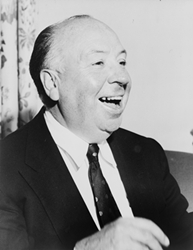
Alfred Hitchcock

Alfred Hitchcock

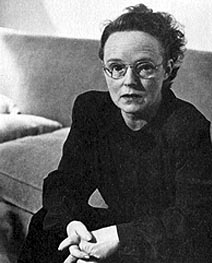
Alma Hitchcock

Fate reigns supreme in film noir, but that doesn’t mean we don’t love us some zodiac fun. Hope your August is full of spicy mystery and sultry sideways glances. And happy birthday, Leo and Virgo! A special shout-out and remembrances to legendary Leos John Huston (Aug. 5), Lucille Ball and Robert Mitchum (both Aug. 6), Alfred Hitchcock (Aug. 13), Alma Hitchcock (Aug. 14), Ann Blyth (Aug. 16), Robert DeNiro and Sean Penn (Aug. 17), Coco Chanel Aug. 19, and one-of-a-kind Virgos Elliott Gould and Ingrid Bergman (both Aug. 29).

Leo (July 24-August 23): You have so much going on this birthday month, on every front, you’ll feel like a kid in a candy shop or a celeb at a swagfest. Opportunities abound to express your creativity and, without even trying, ideas for expansion and innovation pop into your lioness brain. Meanwhile, a flurry of swank invitations lands on your doorstep. Pace yourself and remember to take a breather so as not to be overwhelmed. A friend may need you to serve as a stylist around the 18th.

Virgo (August 24-September 23): You may feel that you’re butting your head against the wall on the career front as a project drags on or a job-search seems to stall. “Why isn’t Easy Street showing up on my GPS?” you ask. Here’s why: Things usually come to you so effortlessly that it’s a bit of a shock to realize you may need to hunker down and persevere to attain your goal. Horrid-sounding, I know. Don’t fret, though, it won’t come to the point of actually getting your hands dirty and chipping your nail polish. Just go with the flow, have faith, and you’ll be fine. And, as a happy distraction, your love life heats up, especially midmonth. [Read more…]

New noirs: ‘The Guard,’ ‘Good Neighbors’

The Guard/2011/Sony Pictures Classics/96 min.

In “The Guard,” Brendan Gleeson is a small-town Irish cop and Don Cheadle a by-the-book FBI agent who comes to the Emerald Isle to bust an international drug-smuggling gang. The two clash at first, then become unlikely allies, then friends, as they get closer to core of the criminal operation.

On the plus side, this black comedy, with a healthy dose of murder, blackmail and corruption, is good for some dark dry laughs, especially from the formidable and funny Gleeson. He knocks back the lines as easily as his character downs a pint. Writer/director John Michael McDonagh is the brother of Martin McDonagh (writer/director of 2008’s “In Bruges”) and, like his brother, he relishes irreverent sarcasm. On the minus side, though, “The Guard” is superficial and derivative; you have seen this movie before.

But if it’s a bit of entertainment you’re after, “The Guard” is your man.

“The Guard” opens July 29.

x

Good Neighbors/2010/Magnolia Pictures/96 min.

According to writer/director Jacob Tierney, “Good Neighbors,” based on a novel by Chrystine Brouillet, isn’t so much a whodunit as it is a satirical movie about people uncovering information and then having to decide what to do with it.

The people in this case are residents of a Montreal apartment building in 1995, three young tenants who become friends: charming, sly Spencer (Scott Speedman), brusque and to-the-point cat lover Louise (Emily Hampshire) and cute but geeky Victor (Jay Baruchel). The above-mentioned information relates to the rape and murder of several young women around the city. Safe at home in a cozy apartment? Not so much, especially since the members of the friendly trio turn out to be capable of shocking, searing violence.

There are more holes than surprises in this movie, the compositions are a little dull looking and it’s not particularly suspenseful until the last reel. That said, the last reel delivers some full-on tension, the actors are interesting to watch, especially Hampshire, and the writing’s not bad. Also, cats figure prominently in the plot – reason enough to see it in my book. 😉

“Good Neighbors” opens July 29.

Totally exciting, wildly preposterous: French police thriller ‘Point Blank’ knocks us out, then keeps right on going

Point Blank/2010/Magnolia Pictures/90 min.

French police thrillers, especially the classics by Clouzot, Chabrol and Melville, used to be a bit more plausible and psychologically acute than their American counterparts – explosive action shoot-’em-ups that have mostly tried to knock us on our asses. Not so these days. The French cops-and-robbers hit movie “Point Blank” out-Yanks the Yanks by knocking us on our derrieres in the first few minutes — and then keeps it up, racing like hell on wheels for the next 80.

That’s the good news: It’s an exciting movie. The bad news is that, like many of its U.S. counterparts, it doesn’t make a hell of a lot of sense. The other good news is that writer/director Fred Cavayé’s movie is so well-gunned and goes by so damned fast, you barely notice the holes as you bounce over them.

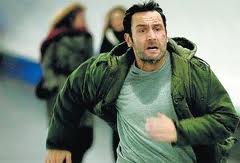
Gilles Lellouche as Samuel is caught between the crooks and the cops.

The plot, jam-packed into the movie’s screamingly fast running time, has to do with a hit man named Hugo Sartet (Roschdy Zem, the somberly magnetic actor of “Days of Glory”) who’s been betrayed and nearly killed. He winds up in the hospital in the custody of the police and the care of a low-key male nurse, Samuel Pierret (the amiable and wonderfully nervous Gilles Lellouche).

Samuel saves Hugo from more would-be assassins and then, to his horror, finds himself trapped between the crooks and the cops – and the crooks who are cops (quite a lot of them, as it turns out). Under the evil command of the Teutonic-looking Commandant Patrick Werner (Gerard Lanvin), who’s actually conducting the investigation of his own crimes, those rogue police start chasing Hugo and Samuel all around Paris.

And, for insurance, they kidnap Samuel‘s beautiful wife Nadia (Elena Anaya), who’s eight months pregnant — threatening her death unless Samuel helps them. Soon Samuel and Hugo have become friends, of a sort, and a large section of Paris has become a bloody battleground.

I told you it didn’t make much sense. And, as I said, it doesn’t really matter. Cavayé, an ex-fashion photographer with a good eye and a blistering sense of pace, also made the big French neo-noir hit “Pour Elle,” which was translated and Americanized into the savagely improbable Russell Crowe thriller “The Next Three Days.” (Hollywood copied it so fast that Cavayé’s French original wasn’t imported and may still pop up here.)

Like Luc Besson and his disciples, Cavayé can do certain high-tech American tricks better than a lot of Americans. How does he get any suspension of disbelief, besides pure speed and kinetic rush? The leads, Zem, Lellouche and Anaya, are all excellent actors (Zem has a great glare) and they bring emotional conviction to a story you can barely believe for a minute.

The title “Point Blank,” by the way, has nothing to do with Cavayé’s original title “A Bout Portant” and nothing to do with the 1967 Lee MarvinJohn Boorman noir classic “Point Blank,” which in turn was adapted from the 1962 Richard Stark-Donald Westlake novel “The Hunter,” which has nothing to do with the 1980 Steve McQueen crime thriller of the same name.

But whether you call it “Point Blank” or “A Bout Portant” or “The French Reconnection” or “Paris Goes Kaboom,” this is still one totally exciting if often wildly preposterous movie.

— Michael Wilmington

“Point Blank” opens July 29. (In French with English subtitles.)

With its engrossing story, gorgeous cinematography and riveting performances, ‘The Conformist’ still compels

The Conformist/1970/115 min.

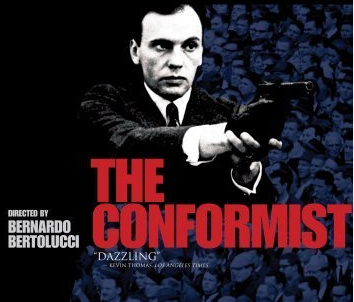
Is Bernardo Bertolucci’s “The Conformist” – an art film classic regarded by many cinematographers as the most beautifully photographed movie of its era – also a neo-noir?

Well, it’s a movie, set in the 1930s, about those old noir standbys: romance, sex, murder, betrayal, guilt and political/police corruption. Adapted from the famous novel by Alberto Moravia, it has a psychologically divided and tormented central character, Marcello Clerici (played by Jean-Louis Trintignant of “Z” and “A Man and a Woman”), who is racked by Freudian desires and guilty secrets. The opaque-faced Marcello has homosexual leanings, which he tries to wipe out by marrying and becoming a good reliable government man. In 1930s Italy, this means being a good fascist.

Marcello is also involved in a messy triangle with his lovely, naive wife Giulia (Stefania Sandrelli) and with the incredibly beautiful bisexual Anna Quadri (Dominique Sanda). In 1970, because of this movie, the ravishing blonde Sanda was often described as the most beautiful actress in movies. Sanda was also Bertolucci’s first choice to be Marlon Brando’s co-star in “Last Tango in Paris.” (She chose motherhood instead.)

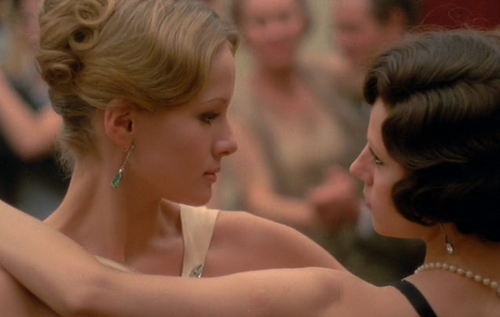
Dominique Sanda and Stefania Sandrelli

“The Conformist,” though, made her a movie immortal. Sanda’s feverish onscreen tango with Sandrelli against an iridescent, gorgeously colored background, while Marcello watches, is one of the most justly famous erotic/musical set-pieces in all of cinema.

Bertolucci later went on to make celebrated and even notorious classics like “The Last Emperor” and “Last Tango,” but many aficionados still prefer “The Conformist” for its engrossing story, the savvy political background, the absolutely gorgeous Storaro cinematography (the color equivalent of a great noir black-and-white), and for the riveting performances by Sanda, Trintignant, Sandrelli, Pierre Clementi, Yvonne Sanson and the others. [Read more…]