Literary confection, noir reflection from Simon Doonan

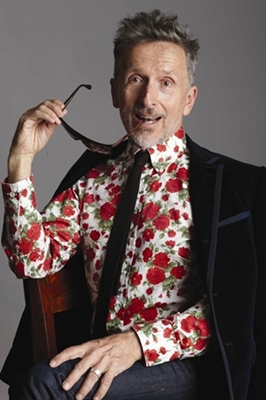
"I am invariably stuffed into a flowery shirt of some description," says Doonan. "It's my signature flourish."

Was “ratchet up your fabulosity factor” one of your New Year’s resolutions? Does that resolve now seem a dim and fuzzy memory? Then thank heaven for Simon Doonan and his new book, “Gay Men Don’t Get Fat” (Blue Rider Press; $24.95).

Style setter, best-selling author and creative director for Barneys New York, Doonan riffs on our tendency to defer to French women regarding matters of living well, dressing with panache and eating dessert. Really though, who knows more about good times and looking great than gay men? As Doonan puts it: “Gay men are French women … with penises.”

This self-described “Gucci-wearing Margaret Mead at heart” shows why gays know how to work, play and dress better than anyone else, and offers advice for getting with the program.

Most gratifying to me was that in his Top 10-ish (actually 13) life-enhancingly fabulous films, Doonan includes “Double Indemnity,” “Mildred Pierce,” “Some Like It Hot” and “All About Eve.” Oh, and “Mommie Dearest” – duh! (The others are: “Paris is Burning,” “The Boys in the Band,” “X, Y and Zee,” “Faster, Pussycat! Kill! Kill!” “Female Trouble,” “Showgirls,” Rosemary’s Baby,” and “Midnight Cowboy.”)
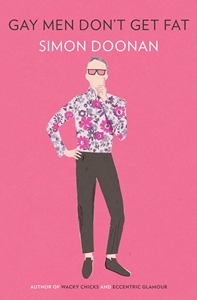
"GMDGF" is Doonan's fifth book.

At a recent book signing at Barneys in Beverly Hills, Doonan graciously shared his thoughts on the glory of black and white. “Film noir has been important to me since I first saw ‘Double Indemnity’ at age 6 [on TV]. It’s mysterious and sad and sexy. I’ve always loved it. I can’t imagine living without knowing about film noir. I feel sorry for kids who grew up on rom-coms and don’t have this beauty in their lives. J’adore!”

The book is the literary equivalent of the champagne and macaroons that circulated at the Barneys event. In chapters such as “Macaroons Are So Gay!” “Jamie Oliver is a Lesbian,” “The Bitter Tears of Jackie O” and “Go Tuck Yourself,” Doonan merrily gushes about the surprisingly straight origins of chi-chi gay-friendly food, lesbian trend-setting, ignorant interns and scary plastic surgery. In “The Fag Hagony and the Ecstasy,” he offers tips for ditching the shackles of ridonculous societal expectations and cultivating a gay entourage.

His hilarious observations are laced with fondness and compassion for his target market. “I dedicate this book to the straight women of the world, whose lives seem insanely more complicated than my own and whose shoes must surely hurt like hell. I feel your pain, girls!”

Author photo by Albert Sanchez

Jean Gillie in ‘Decoy’ is classic noir’s hardest, greediest and most daring femme fatale

Decoy/1946/Monogram Pictures/76 min.

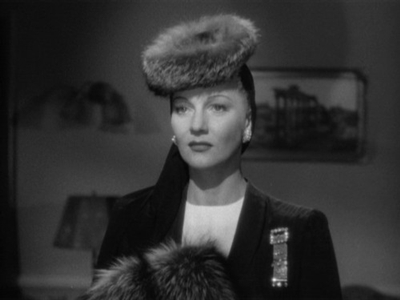
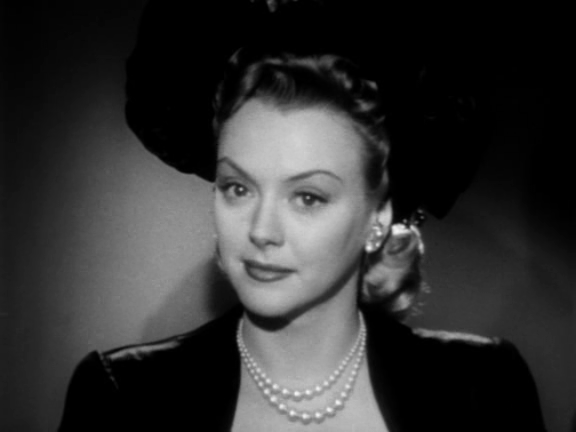
Jean Gillie as Margot is tougher than any American femme fatale of the era.

Talk about raw deals. The hardest, greediest, most daring femme fatale in all of classic film noir – England’s Jean Gillie in “Decoy” – is not widely known today, beyond a fervent cult following.

But rest easy, fatale fans, I am joining the charge to get the word out on Ms. Gillie. I may even become motivated to get off my famously comfy sofa and take to the streets to spread the word. Though that seems a tad drastic, especially since I’ve just achieved the perfect arrangement for my pillows …

Well, let me start by telling you about it. Made in 1946 by director Jack Bernhard, who also directed “Blonde Ice,” this is another hard-core noir story with a totally heartless seductress, a wildly improbable plot and a grimly pessimistic take on human nature.

First, the dame: Dainty, devious and always dressed to a T, Margot Shelby (Gillie) wants the $400,000 that her jailed boyfriend, an old codger named Frank (Robert Armstrong of “King Kong”), has hidden in a buried suitcase. But Frank is awaiting execution and he’s squirreled away the map to the treasure.

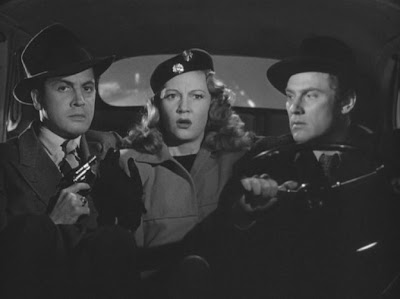
Gangster Jim (Edward Norris), Margot and prison doctor Lloyd (Herbert Rudley) band together to find the $400,000 in cash that Frank has buried.

Hmm, that’s a drag. What to do? Margot figures, after he gets the lethal gas, my pals and I will just bring him back to life. Then, he can lead us to the cash. Margot’s helpers are gangster Jim Vincent (Edward Norris) and prison doctor Lloyd Craig (Herbert Rudley), both of whom are crazy about her. So is nosy police sergeant Joe Portugal (Sheldon Leonard) or Jo-Jo as Margot calls him when she’s flirting with him.

Like any good ringleader, Margot keeps abreast of all kinds of news, and she learns about a chemical called methylene blue, which can be used as an antidote to gas poisoning. So, all they have to do is grab Frank after the execution, pop another body in the hearse and hightail it to the doctor.

Selling Jim, a fully oozing sleaze-atron, on her absurd plan is easy. Earnest and upright Dr. Lloyd is a bit trickier. “I had to smash that shield of ideals,” says Margot. Helping people, healing the sick and making the world a better place? Puhleeze. As she points out, how could they possibly be happy on Lloyd’s paltry $75/week salary when one bottle of Margot’s fave perfume costs $75?

By the time Margot is digging for dollars under the moonlight, her motley gang has dwindled to one, ie Margot. Nothing makes Margot laugh more than bumping somebody off. Her gleeful chortling punctuates the action throughout, but it’s most memorable as a defiant final gesture toward Jo-Jo the cop. She may get what’s coming to her but she also gets the last laugh. Sorry? Penitent? Remorseful? Not a chance!

As the take-no-prisoners Margot, Jean Gillie is amazing to watch – tougher than Barbara Stanwyck, Jane Greer, Joan Bennett or even snarling Ann Savage in “Detour.” In neo noir, her closest equivalent is diabolical Linda Fiorentino in “The Last Seduction.”

“There are very few femmes fatales who don’t have a little time for love and seduction, and she really doesn’t,” says critic Molly Haskell in the Warner Bros. DVD featurette. “Not to any man who comes across her path is she loyal. The only thing she wants is the money.”

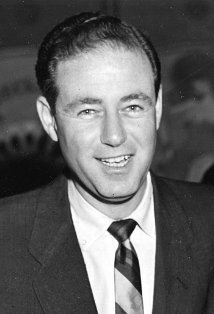
Writer/producer Stanley Rubin

In the DVD commentary, historian Glenn Erickson and writer Stanley Rubin note that as an English actress, Gillie was new to Hollywood and didn’t have to worry that by being a total bitch she would lose favor with her fan base. So, she’s a total bitch and then some. (Rubin conceived the “Decoy” story; Ned Young wrote the script.)

Gillie’s is the standout performance, but the guys certainly hold their own, especially Sheldon Leonard as the conflicted cop. (Leonard also played Nick the bartender in “It’s a Wonderful Life.”) I love the part in “Decoy” when Leonard’s Jo-Jo sits on a bar stool munching a snack – not a burger or fries, but a hard-boiled egg. Mmm, what could be better than a beer and a yolk? Another great moment is when he bums a “stay-awake” pill  from Dr. Lloyd.

Like most B-movies, “Decoy” was cheap and churned out quickly, yet director and co-producer Jack Bernhard’s artistic style distinguishes this film from run-of-the-mill, mediocre B-fare. “Decoy” was out of commission for several decades after its release; a screening at the American Cinematheque about 10 years ago earned fresh appreciation for the film and director.

Bernhard discovered Gillie in England while he was serving in World War Two. They married, made this film and split up. Sadly, Gillie died of pneumonia in 1949, at age 33. Bernhard disappeared from the Hollywood scene shortly after and little is known about the rest of his life.

So, have I convinced you – are you going to give Jean Gillie a chance? If I haven’t, guess I’ll have to pry myself off the sofa and hit the pavement. Just as soon as I finish my nap and book my massage.

‘Decoy’ quick hit

Decoy/1946/Monogram Pictures/76 min.

She’s hard-boiled and thoroughly heartless. But did I mention that she looks good and gets all the money for herself? English actress Jean Gillie as Margot Shelby in “Decoy” shows American femmes fatales a thing or two about seduction, scheming and betrayal. She’s tougher than any Yank and more creative – tapping science fiction to come up with her brilliant plan to steal her boyfriend’s hidden cash. Discovered and directed by husband Jack Bernhard, Gillie delivers a knock-out performance.

Santa Monica shows its dark side at NoirFest

Farewell, My Lovely” screens Wednesday, Jan. 25, as part of NoirFest Santa Monica.

The newly launched festival includes art, film, photography, literature, music and spoken-word events. NoirFest runs through March 28.

Other films to be screened include: “The Brasher Doubloon,” “Murder, My Sweet,” “Double Indemnity,” “The Big Sleep,” “Strangers on a Train,” “The Lady in the Lake” and “The Long Goodbye.”

The fest is the brainchild of longtime Santa Monica resident and artist Helen K. Garber, whose solo show “Encaustic Noir” runs through Feb. 25 at Bergamot Station Arts Center, 2525 Michigan Ave. Also on display is vintage night photography by famed Parisian photographer Brassaï and several of his contemporaries.

“Farewell My Lovely” screens at 7:30 p.m. Wednesday at Vidiots Annex, 302 Pico Blvd., Santa Monica 90405. There is a pre-screening reception at 7:00 p.m. Seating is limited to 35; rsvp essential: vidiots@labridge.com.

Weegee works on display in New York and Los Angeles

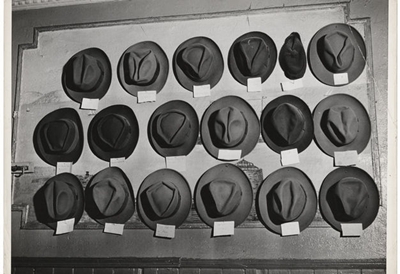
Weegee's Hats in pool room, Mulberry Street, New York, circa 1943. Copyright Weegee/ICP

Opening today at the International Center of Photography (ICP) in New York is “Weegee: Murder Is My Business.”

The famous photographer was born Usher Fellig in 1899 in what is now the Ukraine; his family moved to New York in 1909. He later acquired the nickname Weegee from the Ouija board game because of his knack for arriving at crime scenes just minutes after the crimes were reported.

Says the ICP: Between 1935 and 1946, Weegee was one of the most relentlessly inventive figures in American photography. His graphically dramatic and often lurid photographs of New York crimes and news events set the standard for what has become known as tabloid journalism.

Weegee also wrote extensively (including his autobiographical “Naked City,” published in 1945) and organized his own exhibitions. He died in 1968. This show includes environmental recreations of Weegee’s apartment and exhibitions. It runs through Sept. 2.

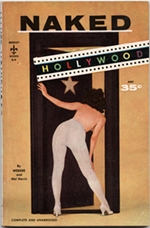
And running through Feb. 27 at MOCA is “Naked Hollywood: Weegee in Los Angeles.” More than 200 works from ICP’s Weegee archive are on display.

This Sunday, Jan. 22, at 3 p.m., Richard Meyer, guest curator of “Naked Hollywood,” Brian Wallis, chief curator at the ICP, and art historian Colin Westerbeck will discuss Weegee’s work, tabloid photography, celebrity culture and the lure of the lowbrow.

MOCA is at 250 S. Grand Ave. in Los Angeles.

Noir City X film fest starts Friday in San Francisco

The Film Noir Foundation celebrates 10 years of deliciously dark programming with NOIR CITY X: The Stuff Bad Dreams Are Made Of. The 10-day festival features a Dashiell Hammett marathon, freshly preserved 35mm rarities, by-popular-demand encore screenings, and special guest star Angie Dickinson. The fest runs Jan. 20-29 at the Castro Theatre in San Francisco.

Among the rarities NOIR CITY is presenting this year is a new 35mm print from Universal Pictures of 1949’s “The Great Gatsby,” starring Alan Ladd as F. Scott Fitzgerald’s legendary hero. Universal is also providing a new 35mm print of 1954’s “Naked Alibi,” starring noir’s favorite bad girl, Gloria Grahame. Also on the bill are preservations of the 1946 classic “Three Strangers” and 1950’s “The Breaking Point,” directed by Michael Curtiz and starring John Garfield.

After San Francisco, the fest will travel to other cities with variations on the programming.

‘Naked Kiss’ crowns queen of beautiful bald leading ladies

The Naked Kiss/1964/F & F Productions/90 min.

What better way to celebrate hump day than with a Sam Fuller double feature?

As part of the UCLA Wednesdays Classic Film Series, the Million Dollar Theater in downtown Los Angeles will show “Shock Corridor” (1963) and “The Naked Kiss” (1964) at 7:30 p.m. this Wednesday, Jan. 18. The Million Dollar Theater is at 307 S. Broadway Ave., Los Angeles, 90013; tickets are $10.

By Michael Wilmington

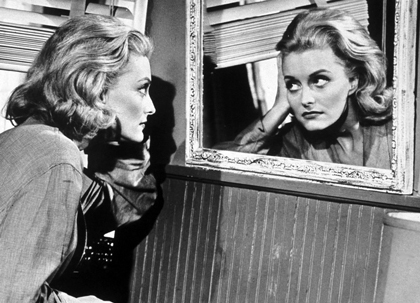
This Sam Fuller movie begins with one of the great shocker low-budget opening scenes: Kelly, a beautiful bald prostitute (played by Constance Towers) beating the crap out of her procurer, losing her wig, pulling out the cash he owes her, and dumping the rest on his whimpering chest. Fuller, freed of any strictures of big studio propriety, has Kelly aiming her purse at the camera and battering us movie voyeurs right along with her ex-pimp.

But “The Naked Kiss” is also a romance (of sorts) and a woman’s picture (of a particularly dark kind). And soon we see Kelly in a typical ’50s-early ’60s American small town, called Grantville, trying to escape her violent past by becoming a nurse’s aide: a care-giver specializing in adorable children, who sing sentimental songs. Kelly also happens to love Beethoven, especially “Moonlight Sonata.” Can she escape the past? Maybe not. The only movie playing in Grantville’s cinema is Fuller’s own previous Constance Towers picture, 1963’s “Shock Corridor.”

Kelly’s nemesis seems to be a salty cop named Griff (played growlingly by Anthony Eisley, of TV’s “Hawaiian Eye”). He beds her right off the incoming bus, pays $20, and then directs her to the nearest brothel (a bordello run by film-noir regular Virginia Grey).

Her salvation seems to be the strangely gentle playboy/philanthropist/Lothario (and Griff’s Korean War buddy) Grant (Michael Dante). Like Kelly, he loves Beethoven and Lord Byron. And something else. In the end, the appearances of her apparent nemesis and salvation prove to be deceiving. As it turns out, the naked kiss is the kiss of a pervert.

Like Fuller’s “Shock Corridor” the year before, “The Naked Kiss” was cheaply but strikingly art-directed by Eugène Lourié (Renoir’s “The Rules of the Game”) and gorgeously shot in black and white by Stanley Cortez (“The Night of the Hunter”).

“The Naked Kiss” is a fine showcase for Constance Towers.

Full of sock and sensation, “The Naked Kiss” has qualities we don’t see as much in “Shock Corridor” – a bizarre tenderness, a tough romanticism, and something part way between schmaltz and weltschmerz. “The Naked Kiss” is also Fuller’s most stylishly soap-operatic work in the Douglas Sirk tradition, just as 1949’s “Shockproof” (co-written by Fuller) was Sirk’s most Fullerian movie.

“The Naked Kiss” is also a fine showcase for Constance Towers, an underrated leading lady who worked for John Ford (in “The Horse Soldiers” and “Sergeant Rutledge”), but whom Alfred Hitchcock unfortunately missed. She’ll never be forgotten for that opening scene, though. Among bald prostitute pimp-battering leading ladies, Constance Towers is the queen.

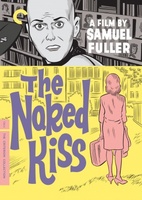
The movie is also available from Criterion and includes these extras: New interview with Constance Towers; 1967 and 1987 French television interviews with Sam Fuller; trailer. Booklet with Robert Polito essay, excerpt on “The Naked Kiss” from Fuller’s autobiography “A Third Face,” and illustrations by the great cartoonist and comic artist Daniel Clowes.

Perfect winter viewing: ‘Blonde Criminal. Ice in her veins. Icicles in her heart.’

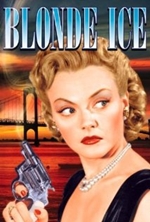
Blonde Ice/1948/Martin Mooney Productions/73 min.

Leslie Brooks stars as newspaper woman and gold digger Claire Cummings in "Blonde Ice."

If you asked angelic-looking Claire Cummings (Leslie Brooks) of “Blonde Ice” the secret to a happy marriage, her answer would be “Money, duh!” And if you happen to be a reasonably successful dude or perhaps just own a wallet, she’d probably hand you a cigarette case reading “All my love, Claire.”

This cookie-cutter approach has served her well with ex-boyfriends obnoxious Al Herrick (James Griffith) and regular-guy Les Burns (Robert Paige), both of whom were colleagues at the San Francisco Tribune, where she covered (what else?) society news. She’s still friendly with Al and Les, and they attend her wedding to wealthy businessman Carl Hanneman (John Holland).

But Claire doesn’t let little things like marriage vows get in the way of having it all. At her wedding, she’d much rather kiss Les than Carl. So, she does. Then it’s off to married life and a bit of a bumpy road with Carl when he objects to her blowing his money at a racetrack. Being a stick in the mud does not go over well with Claire, especially since she’d rather be with Les.

Nothing if not efficient, Claire comes up with a clever alibi before shooting Carl and making it look like suicide. The police find this hard to swallow, but there’s no evidence to contradict her story. Now she’s got wads of cash, a nice house and a new wardrobe for her dates with Les.

It’s while they’re awaiting their chicken-salad dinners at a posh restaurant that she gets a look at attorney and aspiring politician Stanley Mason (Michael Whalen). Les is a sweetheart, of course, but this Congressman-to-be could offer her so much more. Besides wads of cash, a nice house and a new wardrobe, she really needs status, influence and power. Naturally, Mason is smitten within minutes of meeting her, and she easily juggles him and Les.

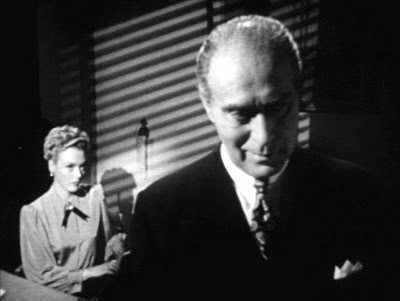
Unfortunately for Claire, Mason’s network of supporters includes psychiatrist Dr. Geoffrey Kippinger (David Leonard) who’s apparently the first man on Earth to suss her out and resist her charm. Even so, he’s not much of a match for her ever-devious mind and, by the end, three more people are dead at her hands. She’s exposed as the treacherous, conniving killer and, just for good measure, receives this wounding assessment, “She wasn’t even a good newspaper woman.” Hilarious!

David Leonard plays a psychiatrist named Dr. Kippinger, one man who sees through Claire and doesn't fall for her.

“Blonde Ice” is a great B movie that makes the most of its limited budget. Veteran lensman George Robinson lends visual flourish (strong composition, lots of ominous, claustrophobic shadow) and Kenneth Gamet’s screenplay crackles along with lines like: “Darling, let’s not quarrel. We can do that after we’re married.” And “I hated you because you were the first man who ever saw inside my mind. And I’m going to kill you.” Gamet wrote the screenplay from Whitman Chambers’ novel “Once Too Often.”

Brooks offers wide-eyed looks, innocent smiles and arched eyebrows aplenty. But it’s easy to overlook her restraint, considering that she’s playing a preposterous role. Griffith as Al exudes the right amount of sleaze; Paige as Les is human and likeable; Holland and Whalen as Claire’s husband and husband-to-be are, fittingly, a bit stiff. Emory Parnell does a nice turn as Police Capt. Bill Murdock and Russ Vincent is convincingly slimy as blackmailer Blackie Talon. Great name, no?

Unlike the shrink, Al (James Griffith) and Les (Robert Paige) are putty in Claire's pretty hands.

The most noirish element of “Blonde Ice” is the mystery of its director Jack Bernhard, also a writer and producer. Once on-staff at Universal, he worked steadily through the 1940s and made 12 B-movies (including “Decoy,” 1946; “Appointment for Murder” and “Search for Danger,” both from 1948; and 1949’s “Alaska Patrol”) before dropping out of sight.

Though perhaps not an accomplished stylist, Bernhard’s movies nonetheless have a distinctive stamp, particularly in “Decoy” and “Blonde Ice,” that reveals Bernhard’s uncommon ability to wrap outlandish material around a sordid core and keep a completely straight face. He draws solid performances and he’s a deft, never draggy, storyteller. “Blonde Ice” and “Decoy” are marvelously entertaining and make an excellent double bill.

Bernhard was briefly married to England’s Jean Gillie, who starred in “Decoy” as the hard-as-nails (one of the hardest in all film noir) femme fatale. Maybe without a bad girl at his side, Bernhard felt he wasn’t a bad enough boy, noirwise.

Note: You can watch the full movie at imdb.

‘Blonde Ice’ quick hit

Blonde Ice/1948/Martin Mooney Productions/73 min.

Claire Cummings (Leslie Brooks) in “Blonde Ice” would like to rethink that whole “marriage means saying goodbye to ex-boyfriends” thing. Or at least give it a new spin – how about saying bye-for-now with a passionate kiss, securing a nest egg, then staging hubs’ murder so it looks like suicide?

True, it’s a more complicated spin but nothing that any competent multi-tasker couldn’t master. The fact that Claire is nuts doesn’t hinder – in fact it enhances – her ability to juggle men and plan murders. Batty, outrageous B-movie fun from director Jack Bernhard.

Frank DeCaro dishes up heaping helpings of camp in ‘The Dead Celebrity Cookbook’

“Highly offensive and exceedingly faggy.” It's all good for retro cookbook author Frank DeCaro.

“There’s a name for someone who says, ‘I can’t watch a movie in black and white.’ Stupid!”

So said Frank DeCaro, author of “The Dead Celebrity Cookbook,” last night at a book signing in West Hollywood. A writer, critic and performer, DeCaro hosts a morning call-in program on Sirius XM satellite radio and writes the Icons column for CBS’ Watch! magazine.

He also likes to cook and throw parties. When the celebs were kind enough to die, as he puts it, the book seemed a natural. Highlights from noiristas include: Otto Preminger’s Deviled Eggs, Joan Crawford’s Poached Salmon, Bette Davis’ Red Flannel Hash, Lucille Ball’s Sunday Night Goulash, Fred MacMurray’s Flemish Pot Roast, Truman Capote’s Fettuccine, Anthony Perkins’ Tuna Salad, Alfred Hitchcock’s Quiche Lorraine, Janet Leigh’s Gâteau Doré, Agnes Moorehead’s Lobster Mousse, William Holden’s Hamburgers à la Hong Kong and Gregory Peck’s Ratatouille.

DeCaro’s favorite: Liberace’s Sticky Buns. “If Liberace didn’t know how funny that was, then the whole world crumbles,” said DeCaro. He is up front that he did not test every recipe, particularly Don Ho’s pigs’ feet soup. DeCaro suggests not picking Crawford’s salmon as a first effort. “Don’t start with Joan Crawford; that’s always good advice.”

And be warned: because many of the recipes are retro, they might call for fat-gram disasters like canned cream of mushroom soup. “You have to remember that frozen and canned food was not considered tacky,” he said. “It was considered modern, instant, groovy!”

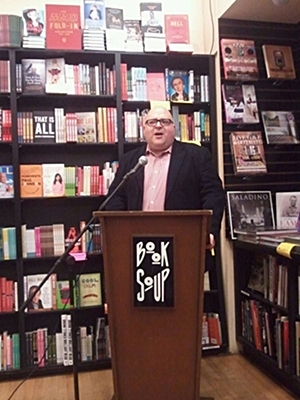
Frank DeCaro and FNB at Book Soup in West Hollywood

Having spent 15 years collecting recipes, DeCaro also has plenty of noshing trivia. Did you know that per capita Hawaii eats the most SPAM and Utah eats the most JELL-O?

Granted, the book might cause some to wince or groan (he includes a pie recipe from Karen Carpenter). One detractor told DeCaro she thought his book was “highly offensive and exceedingly faggy,” which pleases DeCaro to no end. He is now working on a Christmas edition.

Speaking of maximizing opportunity, DeCaro’s domestic advice was not limited to the kitchen. He’s fond of telling his husband Jim Colucci: “You cannot sleep with anyone but me. Unless it’s good for your career.”

“The Dead Celebrity Cookbook: A Resurrection of Recipes from More Than 145 Stars of Stage and Screen” (HCI Books, $19.95)