Free stuff from FNB: Win ‘Criss Cross’ and a TCM mug!

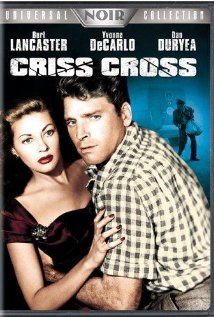
This month, I am giving away a copy of Robert Siodmak’s “Criss Cross” from 1949. Quintessential noir viewing, the film stars Burt Lancaster, Yvonne De Carlo and Dan Duryea. “Criss Cross” plays on the big screen next Thursday in Hollywood at the TCM Classic Movies Festival, kicking off a fine slate of noir films.

So, in addition to the movie, I am adding a souvenir TCM coffee mug as part of the prize. (More on the TCM fest’s noir lineup and a review of “Criss Cross” in upcoming posts.)

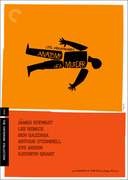
(Marya is the winner of the March reader giveaway, a Criterion DVD set of “Anatomy of a Murder.” Congrats to Marya and thanks to all who entered!)

To enter the April giveaway, just leave a comment on any FNB post from April 1-30. Or, if you are on twitter, retweet one of my giveaway posts. We welcome comments and RTs, but please remember that, for the purposes of the giveaway, there is one entry per person, not per comment/RT.

The winner will be randomly selected at the end of the month and announced in early May. Include your email address in your comment so that I can notify you if you win. Your email will not be shared. Good luck!

Honey, your April noir horoscope is here …

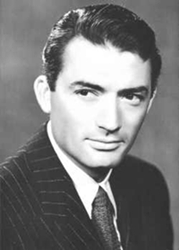
Peck: April 5, 1916-June 12, 2003

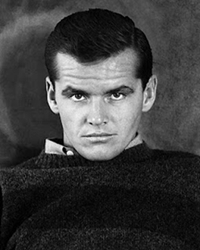
Nicholson was born April 22, 1937.

Fate reigns supreme in film noir, but that doesn’t mean we don’t love us some zodiac fun. Hope your April is full of sunny days, sparkling jewelry and sensual delights. And happy birthday, Aries and Taurus! A special shout-out to amazing Ariens Bette Davis, Spencer Tracy and Gregory Peck (April 5), Francis Ford Coppola and Russell Crowe (April 7), Julie Christie (April 14), Maria Bello (April 18) and Taurus mega stars Jack Nicholson (April 22), Al Pacino (April 25) and Penelope Cruz (April 28).

Aries (March 21-April 20): Let nothing stand in your way this month! Yes, there may be setbacks but that will make your ultimate success so much sweeter. If in doubt, consider this quotation from Aries legend Bette Davis (April 5, 1908-Oct. 6, 1989): “Acting should be bigger than life. Scripts should be bigger than life. It should ALL be bigger than life.” Jump in and make it happen. As for your love life, forget the past and focus on fun. If single, channel your femme fatale to turn on the allure. If attached, allow your man to indulge you – any Aries worth her salt enjoys a little (OK, a lot of) worship.

Taurean Bettie Page is the subject of a new documentary.

Taurus (April 21-May 21): Embrace your unique insight and abilities this month, and avoid any tendency to compare yourself to others. As iconic pinup model Bettie Page (April 22, 1923 – Dec. 11, 2008) reflected: “I was not trying to be shocking, or to be a pioneer. I wasn’t trying to change society, or to be ahead of my time. I didn’t think of myself as liberated, and I don’t believe that I did anything important. I was just myself. I didn’t know any other way to be, or any other way to live.” (A documentary called “Bettie Page Reveals All” releases this month in Vegas.) Around the 19th, your success on a project calls for a stylish celebration, in addition to any b’day festivities in the works.

Gemini (May 22-June 21): If something irks you midmonth, go on, get riled up. Anger in small doses is not a bad thing. Remember though, anger is a secondary emotion – it stems from hurt or fear. So be sure to examine and assess the root of your feeling. With a new work project, you may feel that you are cast against type, but don’t let that drain your confidence. You can rock any role that comes your way and get rave reviews. On the romantic front, let instinct and intuition guide you, especially on the 21st.

Cancer (June 22-July 23): You’ve been a supportive friend and a good listener for someone who keeps falling into the same futile pattern. To put it bluntly, this story is worn out. Time to speak your mind, choosing your words carefully, of course. Don’t overthink things with your Man du Jour – after all, what’s sexier than a relaxed, confident vibe? If you sense that a rival is attempting to undermine you around the 12th realize that she/he is likely threatened by your prowess and verve.

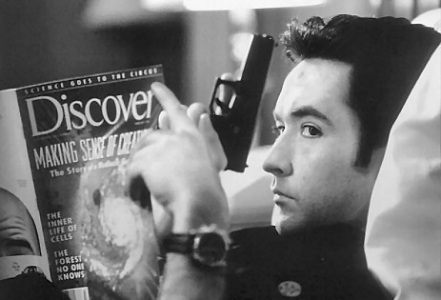
John Cusack was born in Evanston, Ill., on June 28, 1966.

Leo (July 24-August 23): Being in the right place at the right time is key to productive communication this month and you’ll find that, without too much effort, you are making valuable connections. You know, like when that sweet security guard at the bank gave you his access code. A chance to collaborate on a creative venture means that you may have to surrender some control to another’s vision. This requires trust, humility and flexibility. Are you game? You’ll be admired (yes, yet again) on the 7th, 19th and 29th.

Virgo (August 24-September 23): Dreamers and dandies and their pie-in-the-sky plans leave you feeling exasperated. Grounded, practical Virgo wants details, fleshed out facts and a thought-out gameplan. Better to divert your energy to projects that are attuned to your bottom-line way of working. Meanwhile, extra, uh, demands in your love life spur you to look your best – one more yoga class, skipping dessert, a facial and massage. One thing leads to another in more ways than one. Flirt like crazy on the 6th. And any other day you feel like it.

Libra (September 24-October 23): Enough! If you’re up to your eyeballs in someone else’s drama, it’s time to save yourself. Instead of commiserating, put the problem back on the drama king or queen. Besides, you’ll have your hands full with your own noir narrative – midmonth, you may have a seduction to engineer or a clever plot to weave. Let logic take a backseat to imagination and you’ll be surprised at what you accomplish. A day of full-on frivolity is in order on the 21st.

Scorpio (October 24-November 22): Every once in a while, Scorpio’s intensity gets a tad over-the-top. So, this month, make a point of living in the moment and living that moment up! Be spontaneous and don’t waste time on guilt. On the romantic front, if single, throw out your checklist – you might see sparks fly with someone who seems incompatible on the surface. If attached, throw out expectations. As usual, relish your talent for making the first move. Magic awaits you around the 14th.

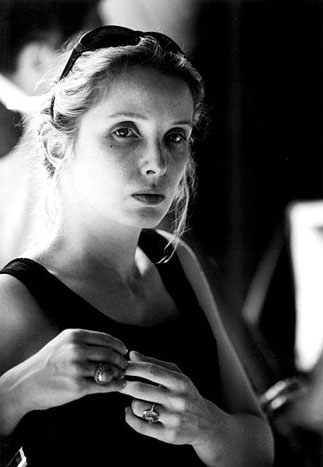
Actress, director and writer Julie Delpy exemplifies Sag charm. She was born in Paris on Dec. 21, 1969.

Sagittarius (November 23-December 22): Recently, you may have noticed that your love life seems off-balance – for example, the guy you have fun with isn’t the one you want to kiss. Or, if you’re in a LTR, scheduling conflicts may be prevailing over romance of late. Relish your power, take charge and be the aggressor. Oh, again? Fret not, you’ll be glad you did. In other realms, resist any temptation to take a cheap shot with an ex or former associate who frankly is just not worthy of your time or energy. You’re better off doing something meaningful like getting your hair blown out.

Capricorn (December 23-January 20): Remember that while generosity is gorgeous, giving too much to an ingrate can be disastrous. As a bad girl, you’re supposed to be the taker, right? Boundaries, though sometimes hard to set, can be mighty important in terms of improving relationships. Your amazing ability to make the most of every day, even in the face of a disappointment, inspires those around you. You may uncover an extra source of income; the 16th is a good day to take a little chance.

Aquarius (January 21-February 19): “Flowers, candy, and current books … are the classic gifts which a woman may accept from a man without hesitation,” explains Vogue’s Book of Etiquette, 1948. But honestly what self-respecting seductress would turn down a big old sparkly rock? Never stand on ceremony if there’s more than half a carat involved. And be sure to celebrate spring with fresh, fun color – Chanel’s Coco Blue nail polish, perhaps? By the end of the month, an old contact may be in touch with an interesting proposition.

Pisces (February 20-March 20): It might be high time for a spring shopping spree. But before you whip out your wallet, consider the singular beauty of a big fat bank balance; it is a sight to behold. Perhaps you could get by on last year’s haul or restrict yourself to one frugal purchase. A change of scene midmonth gives you much-needed perspective and may help you make a major decision. Be bold with your man the week of the 18th. Come to think of it, why wait till then?

COL•COA French film fest in Los Angeles announces lineup

François Truffart announces the COL•COA program.

With five Oscar wins by “The Artist” still fresh in people’s minds, Los Angeles is gearing up to welcome more French film talent to the city. The City of Lights, City of Angels (COL•COA) festival, a week of French film premieres in Hollywood, runs April 16-23.

Last night, at the French Consulate in Beverly Hills, the Franco-American Cultural Fund announced the program for the fest, now in its 16th year.

“The historic triumph of ‘The Artist’ reflects a remarkable year for French cinema and we are glad to introduce a broad spectrum of new films to Hollywood that reveal both the quality and diversity of recent French productions,” said François Truffart, COL•COA executive director and artistic director.

COL•COA will feature 34 features and 21 shorts. It opens on Monday, April 16, with the North American premiere of “My Way” (“CloClo”), a biopic about French pop star Claude François, directed and co-written by Florent-Emilio Siri. The film, already a critical and commercial success in France, stars Jérémie Renier (“The Kid with a Bike”).

Closing the fest on Sunday, April 22, is a hit comedy called “The Intouchables” by writing/directing team Olivier Nakache and Eric Toledano. François Cluzet and Omar Sy star.

Of course I am most looking forward to the film noir series on Friday, April 20, which will include “Paris By Night” (“Une nuit”) by Philippe Lefebvre; Olivier Marchal’s “A Gang Story” (“Les Lyonnais”) and “Early One Morning” (“De bon matin”) from Jean-Marc Moutout.

More on the fest later; meanwhile be sure to check the COL•COA site and snag your tickets – they will sell quickly!

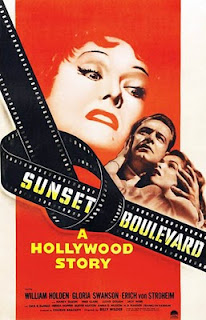
Billy Wilder superbly skewers Tinseltown in ‘Sunset Blvd.’

Sunset Blvd./1950/Paramount Pictures/110 min.

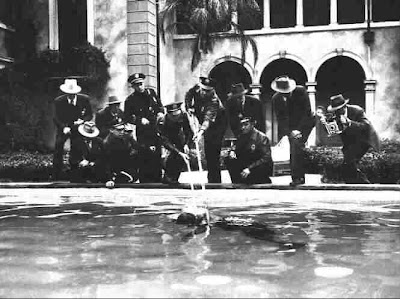
Joe Gillis (William Holden) is found dead in Norma Desmond’s pool.

Without a doubt, Billy Wilder’s “Sunset Blvd.” is one of the greatest movies ever made about Hollywood, perhaps one of the greatest movies ever made.

Aging Hollywood star Norma Desmond (Gloria Swanson) is admittedly a little cut off from reality. She fawns over her pet monkey, has rats in her pool, autographs pile after pile of 8 x 10 glossies for her fans, even though she hasn’t made a picture in years. But, like so many women of film noir, the “Sunset Blvd.” heroine was ahead of her time. She was a veteran movie star who wanted to create her own roles, look her best and date a younger, sexy man. Anything wrong with that?

Unfortunately, though, she spins out of control and winds up shooting this boy toy in a jealous pique. There’s always a downside to being a visionary, I guess. By mentioning the murder, I’m not spoiling anything because the movie opens with Joe Gillis (William Holden) floating lifelessly in Norma’s pool, having stumbled in after she plugged him. He then narrates the movie via flashback, a favorite film-noir technique, but Wilder was the first to let the voice belong to a dead guy. In fact, there are two (perfectly merged) narratives – dead Joe reflecting on the past and in-the-moment Joe, unaware of his fate.

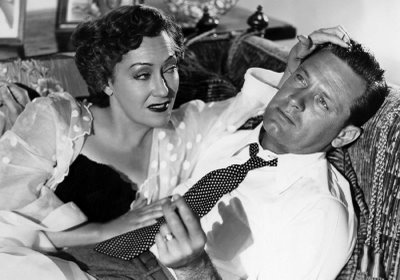
Norma (Gloria Swanson) tries to keep Joe entertained.

An Ohio newspaperman, Joe has come to LA to be a screenwriter but his career has stalled and he’s short on money. Looking for a place to stash his car so that the finance company won’t repossess it, he spots an old mansion on Sunset Boulevard.

It’s an old home, but it’s not deserted – Norma lives there with her butler and former director, Max von Mayerling (real-life director Erich von Stroheim). Once she learns Joe is a writer – a tall, buff, gorgeous writer – she asks him to collaborate on a screenplay that she hopes will relaunch her career. They seal the deal over a glass of champagne and Norma decides he should move in with her. Joe agrees but occasionally sneaks away to slum it with his young, aspiring movie-maker friends, including earnest, ambitious and fresh-faced Betty Schaefer (Wisconsin-native Nancy Olson).

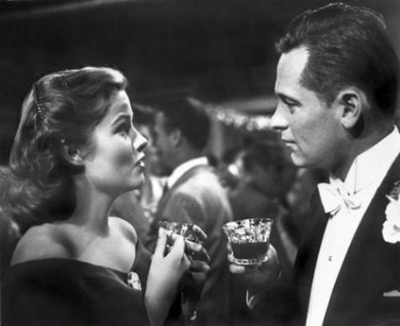
Aspiring writer Betty (Nancy Olson) connects with Joe at a party.

Betty and Joe decide to co-write a script in their free time, but Norma isn’t one to share her man. In her final dramatic encounter with Joe, Norma ironically achieves her long-held dream of hearing “Lights, camera, action!” once more.

“Sunset Blvd.” is rich with irony. Von Stroheim is just one of many Hollywood greats playing parts that were very close to their own lives. (Von Stroheim, a major silent-film director most renowned for “Greed” from 1924, directed Swanson in 1929’s “Queen Kelly,” a few frames of which are shown in “Sunset Blvd.”) Famed director Cecil B. DeMille and gossip columnist Hedda Hopper play themselves as do actors Buster Keaton, H. B. Warner and Anna Q. Nilsson as Norma’s friends from her glory days.

I’ve lost count of how many times I’ve watched “Sunset Blvd.” but each time I view, it seems fresh, funny and contemporary, which is the mark of a truly classic film. From the rich, shadow-laden visuals (I love the first time we see Norma – coiled like a viper, clutching her antique cigarette holder, peeking out from behind Venetian blinds) to the perfect, snappy pacing to the outstanding score by Franz Waxman, Wilder left not one detail to chance.

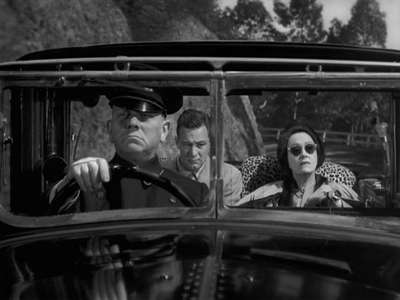
Butler and driver Max (Erich Von Stroheim) takes Norma and Joe to a meeting at Paramount with legendary director Cecil B. DeMille.

Most importantly, Wilder elicited tremendous performances from his actors – Swanson is not only deluded and desperate and vain, she’s funny (especially when she impersonates Charlie Chaplin) and determined and strangely endearing. Holden wins us over, even though there’s very little to like about his character. Of course, a big part of great acting is precise casting and Wilder was lucky on that front.

There was of course no way he could have foreseen how indelibly Swanson and Holden would stamp their parts on the pop-culture landscape. Mae West, Mary Pickford and Pola Negri reportedly turned down the Norma role. Montgomery Clift and Fred MacMurray passed on the chance to add Joe Gillis to their list of credits. (Marlon Brando and Gene Kelly were also considered.)

Wilder and his longtime creative partner Charles Brackett wrote the first-rate script with help from D.M. Marshman, Jr. Relentlessly cynical and unforgiving of Hollywood’s callous, cruel and exploitative side, the story ruffled studio- exec feathers but resonated with critics and audiences.

“Sunset Blvd.” received Oscar noms for best picture, director, actor (Holden), actress (Swanson), supporting actor (Von Stroheim) and supporting actress (Olson) as well as for editing and cinematography (John F. Seitz). It won three – for story/screenplay, art direction and score.

Though perhaps not quintessential film noir, Gloria Swanson as Norma Desmond is nonetheless an unforgettable femme fatale, whose life might’ve unfolded very differently had she but Botox enough and time.

“Sunset Blvd.” plays tonight at 7:30 p.m. (in a double bill with David Lynch’s “Mulholland Dr.”) at the Aero Theatre in Santa Monica.

‘Sunset Blvd.’ quick hit

Sunset Blvd./1950/Paramount Pictures/110 min.

“You have disgraced the industry that made and fed you. You should be tarred and feathered and run out of Hollywood,” said MGM’s Louis B. Mayer to writer/director Billy Wilder after a screening of “Sunset Blvd.”

In this magnificent skewering of Tinseltown, Gloria Swanson, a real-life silent film star, plays Norma Desmond, a fictional silent film star whom time has forgotten. William Holden is her sometime boyfriend and screenwriter of her comeback script; Erich von Stroheim is her ex-husband and ex-director, now a live-in butler.

Personally, I adore the idea of putting an ex-hubby on the payroll to do all my household chores, in a starched gray uniform, no less! “Sunset Blvd.” is a classic to be watched again and again.

Top 10 lines from Billy Wilder’s classic ‘Sunset Blvd.’

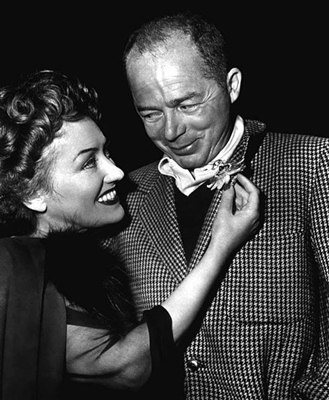
Gloria Swanson and Billy Wilder

“Sunset Blvd,” Billy Wilder’s scathing portrait of Hollywood, stars Gloria Swanson as silent film star Norma Desmond seeking a return to the screen, William Holden as her younger boyfriend, a writer named Joe Gillis, and Erich von Stroheim as her faithful servant and eyeshadow adjuster. Wisconsin-born Nancy Olson plays the smart, fresh-faced girl who wants to be a screenwriter and who falls in love with Joe.

Here are my favorite lines from this terrific film, widely considered to be one of the greatest American movies ever made. It was written by Wilder, Charles Brackett and D.M. Marshman Jr.

1. Norma Desmond: “I am big. It’s the pictures that got small.”

2. Joe Gillis: “Audiences don’t know somebody sits down and writes a picture; they think the actors make it up as they go along.”

3. Salesman at a men’s clothing store, to Joe: “As long as the lady is paying for it, why not take the Vicuna?”

4. Norma Desmond: “No-one ever leaves a star. That’s what makes one a star.”

5. Joe Gillis referring to Norma’s script: “Sometimes it’s interesting to see just how bad bad writing can be. This promised to go the limit.”

6. Cecil B. DeMille (playing himself): “You know, a dozen press agents working overtime can do terrible things to the human spirit.”

7. Norma Desmond: “Without me, there wouldn’t be any Paramount studio.”

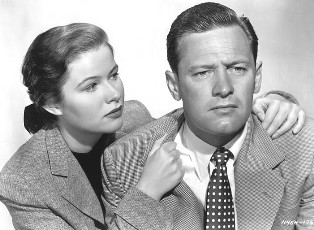
Nancy Olson and William Holden

8. Nancy Olson as Joe’s friend Betty: “Where have you been keeping yourself? I’ve got the most wonderful news for you.”
Joe: “I haven’t been keeping myself at all, lately.”

9. Joe Gillis talking about his car: “I kept it across the street in a parking lot behind Rudy’s shoeshine parlor. Rudy never asked any questions about your finances – he’d just look at your heels and know the score.

10. Norma Desmond: “All right Mr. DeMille, I’m ready for my close-up.”

‘Anatomy of a Murder:’ Preminger’s crowning achievement

Anatomy of a Murder/1959/Columbia Pictures/160 min.

Criterion’s DVD rerelease of “Anatomy of a Murder” is this month’s giveaway prize. To be entered in the draw to win, just make a comment on any post this month.

By Michael Wilmington

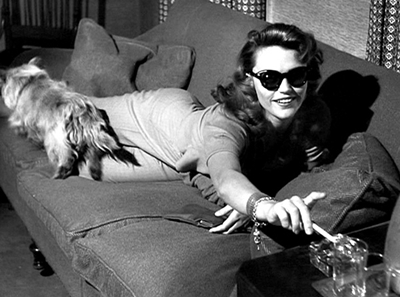
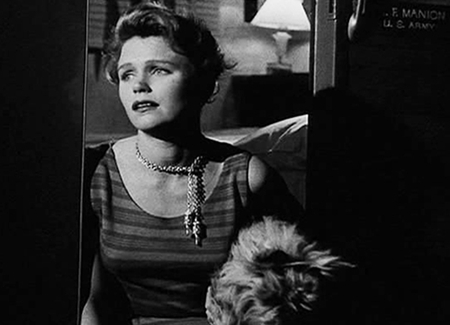
Lee Remick is sexy and flirtatious Laura Manion, a part originally intended for Lana Turner. Laura's dog Muff is frequently at her side.

One of the best and most true-to-life of all courtroom dramas, “Anatomy of a Murder” is also the best film producer-director Otto Preminger ever made. And he was a master – of film noir (“Laura,” “Fallen Angel,” “Whirlpool,” “Where the Sidewalk Ends,” “Angel Face”), of urban drama (“The Man with the Golden Arm”), of romance (“Bonjour Tristesse,” “Daisy Kenyon”), of historical epics (“Exodus”), of spy dramas (“The Human Factor”), of musicals (“Carmen Jones”) and, most characteristically, of dramas that examine big, complex institutions: “Advise and Consent,” “The Cardinal,” “In Harm’s Way.”

“Anatomy” is a great, realistic film on a great subject, with writing that cuts to the bone. It also has one of the most famous title sequences (by Saul Bass) in movie history. And one of the most influential scores, original jazz, composed and played by Duke Ellington.

The film’s source material was a best-selling book by John D. Voelker, a Michigan State Supreme Court Justice, using the pen name Robert Traver. He based the book on an actual murder case in which he’d been the prosecuting attorney. In that trial, an Army man shot and killed a popular small-town bar-owner who, he said, had raped his wife.

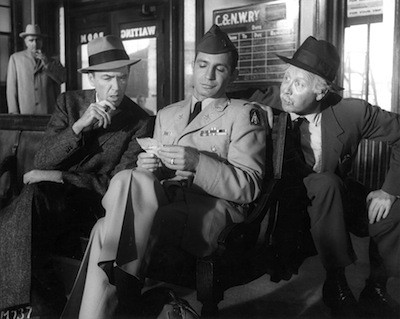
From left: James Stewart plays a lawyer defending an Army lieutenant (Ben Gazzara) with help from his old friend and fellow lawyer (Arthur O'Connell).

Voelker/Traver and Wendell Mayes adapted the book and a phenomenal cast brought the story to the screen. We see Jimmy Stewart at his best as the wily and ingenious old-school defense lawyer Paul Biegler, Ben Gazzara as his cocky murder-trial defendant/client Army Lieutenant Frederick Manion, Lee Remick as Manion’s sexy wife Laura, George C. Scott as the icily astute prosecutor Claude Dancer, Eve Arden and Arthur O’Connell as Paul’s sharp-tongued secretary Maida Rutledge and Paul’s amiably soused fellow counsel Parnell McCarthy. The trial’s owlish, chatty but punctiliously fair Judge Weaver is played unforgettably by famed attorney Joseph Welch. Kathryn Grant is also memorable as the sweet but mysterious Mary Pilant.

If Paul is going to get Manion off, the only defense that is likely to work is Not Guilty by Reason of Insanity – an “irresistible impulse” that drove Manion to kill his wife’s rapist. The movie makes clear that Paul is not necessarily seeking the truth, but a victory for his client. So the trial becomes, in some sense, a piece of theater. Paul is creating a dramatic scenario that we know is a slanted one. Judge Weaver is there to mediate, but also to be a kind of commentator and chorus.

At the same time, Preminger (the son of a Viennese trial lawyer and a law school graduate who never practiced law himself) gives us a course in what happens during a trial and why the American legal system, for all its seeming flaws, is a model of both legal science and human compassion.

We want Paul Biegler to win, but mostly because he’s played by Jimmy Stewart – who brilliantly manipulates his movie persona as the stammering, sincere, dryly funny hero, while also showing us a somewhat devious side beneath the mask. It’s an incredibly adroit performance, as good as Stewart’s signature roles as George Bailey in “It’s a Wonderful Life,” Scottie Ferguson in “Vertigo,” and Jeff Smith in “Mr. Smith Goes to Washington.”

And Stewart anchors an eminently satisfying cast. Remick is wonderful as Manion’s flirtatious, cheerfully brazen and narcissistic wife Laura, a part originally intended for Lana Turner. The prosecution’s arrogant head lawyer Claude Dancer is played with nerveless intensity by Scott. Stewart, O’Connell and Scott got Oscar noms for their work.

Preminger shot the movie in Michigan’s Upper Peninsula (Marquette, Ishpeming, Big Bay and Michigamme). The streets, the bar and the courthouse are real. And the scenes in Paul’s home (with its books, fishing gear and record collection) were shot in Voelker’s own house. “Anatomy” has the flavor of a semi-documentary, or of one of those Henry Hathaway crime dramas/noirs of the ’40s: “The House on 92nd Street,” “Call Northside 777” (with Stewart as a crusading Chicago reporter) and “Kiss of Death.”

Laura (Lee Remick) and her husband share pathology as well as passion.

Preminger’s filmmaking style is often called “objective.” He doesn’t try to force reactions on us, instead leaving us free to observe and judge. “Anatomy of a Murder” is especially ripe for such analysis, since the audience is essentially the jury.

But there’s a catch. Does anyone really watch a Preminger movie without knowing who the good guys and bad guys are? Even in “Anatomy of a Murder” we sense Paul might be defending a guilty client, but we also know he’s upholding the law, and his vision of it: the depth, mercy and grandeur of the law in which he deeply believes.

The fact is that Preminger is never completely objective. A lawyer as well as a man of the theater, he is always arguing a viewpoint, letting us know whom he likes and whom he doesn’t. He just does it in a subtler, more stylish, less forced manner than most other directors.

What’s special about Preminger’s cinematic style is his propensity for long takes and single shots with an unobtrusively moving camera. Preminger once said that, ideally, every scene should be done in a single shot. And that’s often what he often tries to do, for the sake of the actors (who don’t get their performances chopped up) and to preserve the feel of realism.

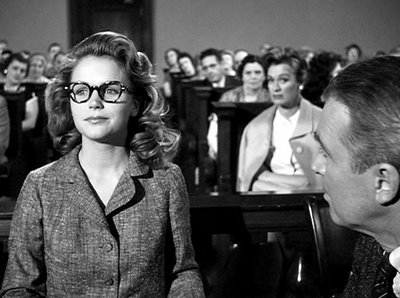
Lee Remick, Eve Arden and James Stewart appear in a courtroom scene.

To some in 1959, “Anatomy” looked like an opportunistic and deliberately sensational shocker, with a script that contained words such as “rape,” “bitch” and panties.” The film was even banned temporarily in Chicago. But Preminger played anti-censorship battles with such shrewd facility that it sometimes seemed he had gulled the censors into being his unofficial P.R. team.

“Anatomy of a Murder” may have raised hackles in its day, but it’s survived as a movie treasure and is one of the top films from 1959 – a year that also saw the release of classics like Billy Wilder’s “Some Like It Hot,” Alfred Hitchcock’s “North by Northwest,” William Wyler’s “Ben-Hur,” Howard Hawks’ “Rio Bravo,” George Stevens’ “The Diary of Anne Frank” and Vincente Minnelli’s “Some Came Running.”

Preminger’s trial drama can stand with any of them.

“Anatomy” will play Friday and Saturday at the New Beverly in LA.

In ‘The Lady Vanishes,’ Hitch pushes form to near perfection

The Lady Vanishes/1938/GB Pictures/96 min.

By Michael Wilmington

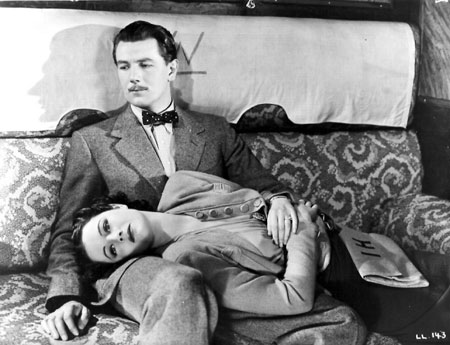
Michael Redgrave and Margaret Lockwood are an utterly beguiling English couple.

In “The Lady Vanishes,” his marvelous 1938 mystery classic set aboard a train racing though the Balkans, Alfred Hitchcock pushes the romantic-comedy-thriller form to near perfection. It’s one of the most purely entertaining movies he ever made, and it can be watched over and over again with no diminution of pleasure.

Arguably funnier than Hitchcock’s other train classics – “The 39 Steps” (1935), “Strangers on a Train” (1951) and “North By Northwest” (1959) – “The Lady Vanishes” offers one of Hitchcock’s greatest assemblies of characters and actors: Michael Redgrave, Margaret Lockwood, Paul Lukas, Dame May Whitty, Cecil Parker, Linden Travers, Catherine Lacey, Naunton Wayne and Basil Radford.

Hitchcock loved trains, in life as well as in his movies. In “The Lady Vanishes” we can see why. Though shot mostly on a sound stage, this locomotive is somehow supremely convincing – with its cozy yet menacing cars, jiggling tables, rushing train-sounds, compartments full of strangely cool or deceptively amiable passengers and that wonderful dining car, where so much tea is sipped, so much suspense generated and where the final crackerjack gun battle takes place.

Sidney Gilliat and Frank Launder (“The Rake’s Progress,” “Night Train to Munich,” “Green for Danger”) wrote the script from a novel called “The Wheel Spins,” by Ethel Lina White. But the Gilliat-Launder stamp, a special brand of breezy and irreverent class-puncturing humor, is all over this film, almost as much as Hitchcock’s flair for tension, perverse romance, dark humor and similar irreverence toward class.

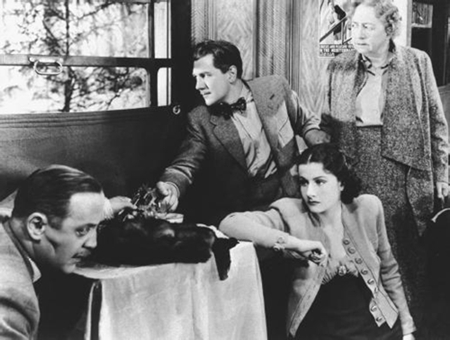
“The Lady Vanishes” offers one of Hitchcock’s greatest assemblies of actors.

The ingenious story is in line with brainy mysteries by writers like Agatha Christie, Ellery Queen and John Dickson Carr. What happens? A congenial old lady named Miss Froy (played by the irresistible Dame May Whitty) disappears from the train and, when her pretty and saucy fellow passenger Iris (Margaret Lockwood) tries to find her, everyone who saw Miss Froy denies she existed.

Only Michael Redgrave as Gilbert, an amorous young musicologist, believes her. As Iris and Gilbert put their nimble wits together, love and melody and mystery bloom, even as the vanished lady remains peculiarly elusive. The train’s odd-lot passengers – including a suave doctor (Paul Lukas), a philandering politico and his inamorata (Cecil Parker and Linden Travers), a nun in high heels (Catherine Lacey) and those ineffable cricket fans Caldicott and Charters (played by the immortal Naunton Wayne and Basil Radford) – keep denying Miss Froy was ever there. Things get progressively stranger, faster, funnier and more dangerous.

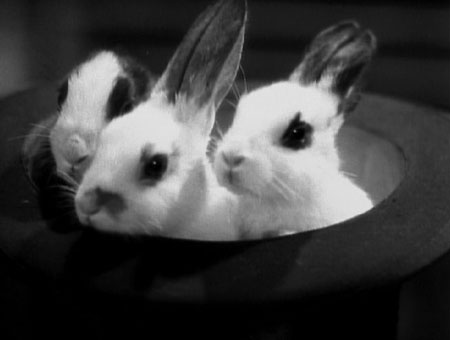
Besides human passengers, a magician’s bunnies are aboard this mystery-filled train.

If Hitchcock loved trains, he makes us fall in love with this one, too – and with many of the people aboard, including some of the villains. And non-villains like Caldicott and Charters, who became so popular that they began making appearances, as the same characters, in other films (“Night Train to Munich” and “Crook’s Tour”). And Miss Froy, who looks a bit like Agatha Christie, or the way we envision Miss Marple to look. And of course Gilbert and Iris, an intrepid, utterly beguiling, English couple if ever there was one.

As I said, “The Lady Vanishes” is one movie classic that most audiences are sure to enjoy. If you don’t enjoy it, I’m afraid I can’t help you. Maybe what you need is a long train ride in the Balkans.

“The Lady Vanishes” plays on the big screen this Wednesday, March 14, at 7:30 p.m. at the Aero Theatre, 1328 Montana Ave. in Santa Monica.

Free stuff from FNB: Win ‘Anatomy of a Murder’

Lee Remick plays Laura Manion. Remick’s co-stars (Stewart, Scott and O’Connell) earned Oscars noms for their performances.

This month, I am giving away a copy of Criterion’s rerelease of the Otto Preminger classic “Anatomy of a Murder” from 1959. Nominated for seven Oscars, including best picture, the film features a Duke Ellington score and an all-star cast: James Stewart, Lee Remick, Ben Gazzara, Arthur O’Connell, Eve Arden and George C. Scott.

In what is arguably the best role of his career, Stewart plays a small-town Michigan lawyer defending an army lieutenant (Gazzara) accused of murdering a tavern owner, who he believes raped his wife (Remick).

As Criterion puts it: “This gripping envelope-pusher, the most popular film by Hollywood provocateur Otto Preminger, was groundbreaking for the frankness of its discussion of sex – but more than anything else it is a striking depiction of the power of words.” This two-DVD special edition is packed with special features.

(Syd is the winner of the February reader giveaway, a DVD copy of “Notorious.” Congrats to Syd and thanks to all who entered!)

To enter the March giveaway, just leave a comment on any FNB post from March 1-31. We welcome comments, but please remember that, for the purposes of the giveaway, there is one entry per person, not per comment.

The winner will be randomly selected at the end of the month and announced in early April. Include your email address in your comment so that I can notify you if you win. Your email will not be shared. Good luck!

On the radar: Revel in noir at the Aero, Egyptian and Lacma

There’s so much to see on the big screen this month in Los Angeles. See you at the movies!
#
AT THE AERO THEATRE
1328 Montana Ave., Santa Monica; shows start at 7:30 p.m.
#
Saturday, March 3: A sneak preview of the thriller/horror flick “Silent House” starring Elizabeth Olsen followed by 2003’s “Open Water,” a nerve-wracking story about a couple left stranded in the Caribbean after a day of scuba diving. There will be a discussion between films with co-directors Chris Kentis and Laura Lau.

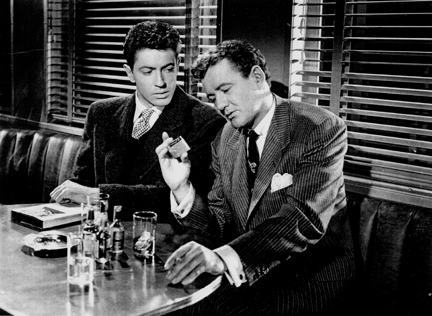
Farley Granger and Robert Walker in "Strangers on a Train"

Wednesday, March 7: One of my all-time favorite Alfred Hitchcock films, “Strangers on a Train” (1951) stars Robert Walker as a psycho playboy intent on committing a double murder with tennis champ Farley Granger. As Hitch shows us in the opening shot, never underestimate the importance of footwear.
#
Wednesday, March 14: Another Hitchcock work that draws on his lifelong love of trains, “The Lady Vanishes” from 1938 takes place on a train en route from the fictional country of Bandrika to Western Europe. Passengers Margaret Lockwood and Michael Redgrave attempt to find a mysterious Miss Froy.
#
Thursday, March 15: In “The Night of the Hunter” (1955, Charles Laughton) the great Robert Mitchum gives an unforgettable performance as a warped preacher with a knack for seducing trusting souls. Also starring Shelley Winters and Lillian Gish. At 6:30 p.m., author Preston Neal Jones will sign his book “Heaven and Hell to Play With: The Filming of The Night of the Hunter.”
#

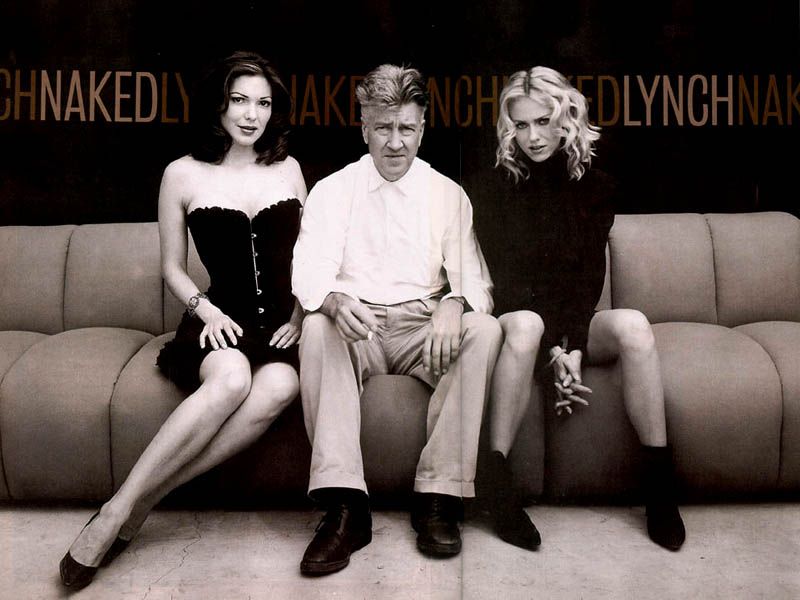
Laura Harring, director David Lynch and Naomi Watts of "Mulholland Dr."

Saturday, March 24: A top-notch double feature, starting with Billy Wilder’s masterpiece noir and scathing look at Hollywood, “Sunset Boulevard” (1950). William Holden, Gloria Swanson and Erich von Stroheim star in this must-see flick. Next up: Naomi Watts and Laura Harring lead the cast of David Lynch’s mesmerizing and surreal portrait of Tinseltown’s latent evil, “Mulholland Dr.” (2001).

Wednesday, March 28: Yet more Hitchcock! Joel McCrea plays reporter Johnny Jones, who encounters intrigue and danger in “Foreign Correspondent” from 1940.

#
Thursday March 29: “The Manchurian Candidate,” starring Frank Sinatra, Laurence Harvey and Angela Lansbury, celebrates its 50th anniversary. Superb direction from John Frankenheimer.
#
AT THE EGYPTIAN THEATRE
6712 Hollywood Blvd., Hollywood; shows start at 7:30 p.m. with multiple showings and one matinee for “The Snowtown Murders”

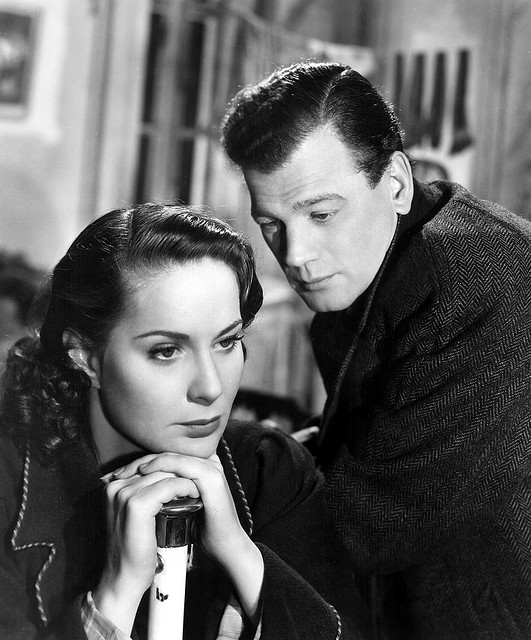
Alida Valli and Joseph Cotten in "The Third Man."

Wednesday, March 7: Carol Reed directs Joseph Cotten, Alida Valli and Orson Welles in 1949’s “The Third Man,” one of the finest thrillers ever made. Don’t miss it!
#
Wednesday, March 14: Orson Welles as auteur and actor. In “The Lady from Shanghai” (1948), an outstanding noir, he co-stars with Rita Hayworth and Everett Sloane. In “Confidential Report” (1955), Welles plays a dad in deep denial about his murky past.
#
Thursday, March 15-Sunday, March 18: Justin Kurzel makes his directorial debut with “The Snowtown Murders,” the story of Australia’s most infamous serial killer. Plays at 7:30 p.m. and 9:30 p.m. Thursday-Saturday and 4 p.m. Sunday.
#
Wednesday, March 28: More brilliance from Orson Welles in this knock-out double feature. “Touch of Evil,” a tale of corruption, is widely considered the last great work of classic film noir. Its unbeatable cast: Welles, Charlton Heston, Janet Leigh and Mercedes McCambridge. “The Trial” (based on Franz Kafka’s novel about paranoia and conspiracy) also boasts amazing talent: Welles, Anthony Perkins, Jeanne Moreau, Romy Schneider and Akim Tamiroff.
#
AT LACMA
5905 Wilshire Blvd.
At 7:30 p.m. Thursday, March 8: As a tribute to Wim Wenders, “The American Friend,” a stand-out neo noir from 1977 is paired with 1982’s “Chambre 666,” a doc with A-list directors about the future of filmmaking.
#
At 7:30 p.m. Friday, March 9: Film noir is partly rooted in French Poetic Realism and these two examples of the genre make an excellent night at the movies. To start: Cinematic genius and master of poetic realism Jean Renoir’s “The Rules of the Game” (1939) followed by Jacques Becker’s “Casque D’Or” (1952). Becker assisted Renoir on “Rules” and “Grand Illusion” (1937).
#

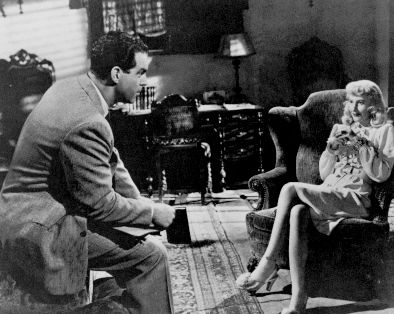
Fred MacMurray and Barbara Stanwyck star in Billy Wilder's "Double Indemnity" from 1944.

At 1 p.m. Tuesday, March 13: Billy Wilder’s “Double Indemnity” (1944) is one of the defining films of the noir genre. Femme fatale Barbara Stanwyck lures insurance agent Fred MacMurray into committing murder for a big payoff. Edward G. Robinson shines as MacMurray’s boss and friend.
#
At noon Saturday, March 24: Christian Marclay’s “The Clock,” winner of the Golden Lion at last year’s Venice Biennale, is a 24-hour single-channel montage constructed from thousands of moments of cinema and television history depicting the passage of time. Begins at noon Saturday and ends at noon on Sunday, March 25.
#
At 1 p.m. Tuesday, March 27: Another prime example of classic film noir, Robert Siodmak’s “The Killers” put Ava Gardner and Burt Lancaster on the track to super-stardom.
#