FNB free stuff: ‘Body Heat,’ ‘L.A. Confidential,’ ‘The Player’

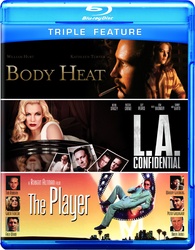
This month, I am giving away a must-have neo-noir triple feature from Warner Bros. on Blu-ray: “Body Heat” (1981, Lawrence Kasdan), “L.A. Confidential” (1997, Curtis Hanson) and “The Player” (1992, Robert Altman). I will post reviews of “Body Heat” and “The Player” later this month.

(Paul is the winner of the April reader giveaway, a Criterion DVD set of “Criss Cross” and a TCM mug. Congrats to Paul and thanks to all who entered!)

To enter the May giveaway, just leave a comment on any FNB post from May 1-31. We welcome comments, but please remember that, for the purposes of the giveaway, there is one entry per person, not per comment.

The winner will be randomly selected at the end of the month and announced in early June. Include your email address in your comment so that I can notify you if you win. Your email will not be shared. Good luck!

A pre-noir from Fritz Lang: ‘The Spiders’ is out on DVD

The Spiders/1919-20/Decla-Bioscop AG, Kino Lorber DVD/173 min.

By Michael Wilmington

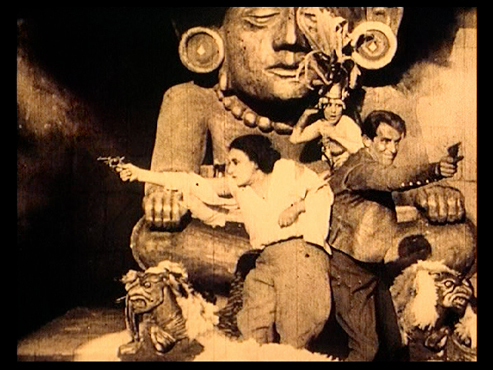
Fritz Lang (“M,” “Metropolis,” “Die Nibelungen”) was a master of horror, crime and adventure, and he combines them all – along with a dark touch of romance and a smidgen of humor – in this epic movie, recently released on DVD by Kino Lorber.

It’s a tale of lost treasure, exotic Peruvian climes, a daring adventurer (Carl de Vogt as the almost insanely courageous explorer from San Francisco, Kay Hoog), a band of ruthless criminals who tunnel under Chinatown and make up the international gang The Spiders, the priceless and elusive Buddha’s Head Diamond, the beauteous sun priestess Naela (Lil Dagover) and one of the more murderous of all femme fatales, the perfidious Lio Sha (Ressel Orla).

This spectacular black and white silent movie was released in two episodes (both in this DVD) – Part One: “The Golden Sea” (1919) and Part Two: “The Diamond Ship” (1920). It was quite obviously influenced by Louis Feuillade’s French crime serials (“Judex,” “Fantomas” and “Les Vampires”), which are better, but not by much. Serial followers with campier tastes might prefer the jovial, high-spirited nonsense of American cliff-hangers like “The Perils of Pauline,” but even considering The Spiders’ lack of humor, it’s easy to see that both Lang and Feuillade are superior artists, and that Lang would grow into an even more important one.

Only Hitler and the Nazis, worse monsters and more evil criminals than The Spiders, could drive out Lang and the other German and Austrian film noir greats to Hollywood, stopping his rise in his own country. But these remnants of high adventure remain.

(Silent movie with intertitles and music score by Ben Model.)

Blogathon to bring ‘The White Shadow’ to your computer

I am re-running my most recent Hitchcock review to support For the Love of Film: The Film Preservation Blogathon III, hosted by Ferdy on Films, the Self-Styled Siren and This Island Rod.

Working with National Film Preservation Foundation (NFPF), this blogathon aims to bring “The White Shadow,” a 1923 melodrama, to a wider audience. Directed by Graham Cutts, it was also the first film Alfred Hitchcock had a major role in creating (assistant director, screenwriter, film editor, production designer, art director, set decorator). The film was restored in New Zealand and repremiered by the Academy of Motion Picture Arts and Sciences last September at the Samuel Goldwyn Theater in Los Angeles.

To make “The White Shadow” available for free on its web site, the NFPF needs to raise $15,000. This money will allow the foundation to host and stream the film for four months and to record Michael Mortilla’s marvelous new score. It is the mission of this year’s For the Love of Film Blogathon to raise the money so that anyone with access to a computer can watch this amazing early film.

I hope you’ll read the great posts from fellow scribes and that you’ll make a donation.

‘Notorious’ is the film noir equivalent of an icy flute of Veuve Clicquot

1946/RKO, Vanguard Films/101 min.

“Notorious” ranks as one of Alfred Hitchcock’s best films and Ingrid Bergman as Alicia Huberman is one of the most contemporary of all ’40s noir heroines. In this splendid 1946 suspense thriller, Bergman’s Alicia is a U.S. secret agent assigned to infiltrate a group of Nazis who have resurfaced in South America after WW2. Alicia risks her life to root out the Nazis’ source of uranium, an ingredient in atomic bombs. She also likes to throw parties, expose her midriff (love the sequin zebra-print top) and pursue her man, fellow secret agent T.R. Devlin (Cary Grant). Dev’s easy on the eyes, but he’s suspicious, uptight and seemingly unfeeling.

The Production Code stipulated that a kiss could not last more than three seconds.

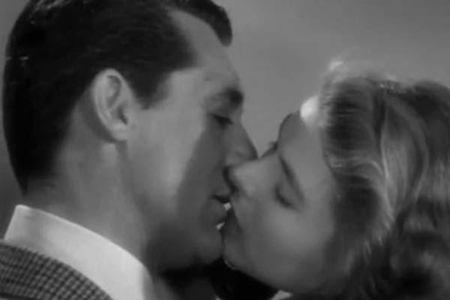
Their “strange love affair” as she calls it, tinged with cynicism and mistrust, is decades ahead of its time. And their record-breakingly long kisses, which look tame now, were considered extremely racy in 1946.

The Production Code (ie, censors) stipulated that a kiss could not last more than three seconds. Hitchcock obeyed, but followed Bergman and Grant’s first swift kiss with another and another and another. Most importantly, she kisses him, noting that he hasn’t said, “I love you.”

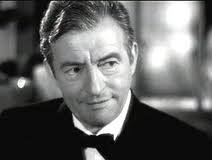
The demands of their work (spying and info gathering) create pressure. Alicia must charm Alexander Sebastian (Claude Rains), a wealthy, suave and impeccably dressed Nazi. Even though Alex is a high-ranking fascist, we never see him hatching his evil plans, so it’s a bit easier for the audience to put his heinousness on the back burner. Alex dotes on Alicia and is far more emotionally available than the shut-down Dev.

Claude Rains

Leopoldine Konstantin

Before long, Alex proposes to Alicia and gives her quite the rock to seal the deal. Alicia accepts after getting the OK from her unsympathetic and cold boss, Captain Paul Prescott (Louis Calhern).

Living with Alex will let Alicia poke around his stately home, where Prescott reckons trouble is literally brewing, and bring her into frequent contact with baddies like ringleader Eric Mathis (Ivan Triesault), scientific mastermind “Dr. Anderson” (Reinhold Schünzel) and weak link, Emil Hupka (Eberhard Krumschmidt).

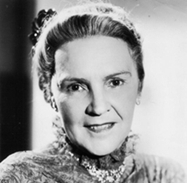
Living with Alex also means dealing with the other Mrs. Sebastian, Alex’s mother. Czech-born actress Leopoldine Konstantin, in her only American film, plays the hard and imperious Mrs. Anna Sebastian. When Alex asks Anna to be friendly to Alicia, the battle-ax tartly replies: “Wouldn’t it be a bit much for both of us to be grinning at her like idiots?”

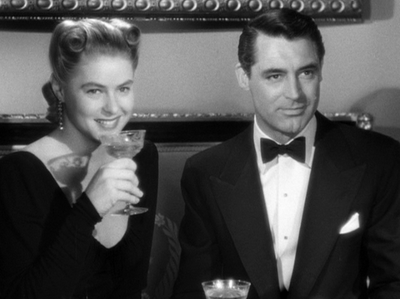
Alicia (Ingrid Bergman) and Dev (Cary Grant) are secret agents assigned to infiltrate a group of Nazis in South America after WW2.

Declaring a shortage of closet space (that’s our girl!), Alicia explores the nooks and crannies of the Sebastian mansion, but finds the wine cellar is off-limits. So, she decides to throw a champagne reception and steal the cellar key from her husband.

She invites Devlin, natch, and the two discover that wine is not the only thing stored in the cellar. (Hitchcock makes his cameo at the shindig, swigging some bubbly.)

Alex realizes the key has been stolen and that his secret is no longer safe, at which point he seeks maternal support. Anna’s fresh out of that, telling him: “We are protected by the enormity of your stupidity, for a time.”

The uranium angle is merely a MacGuffin, Hitchcock argot for a narrative device to advance the plot. The real story is whether Devlin and Alicia can work through their issues, such as his hypocrisy and lack of emotion, her drinking and their mutual game playing, which gets downright cruel. “Our all-too-human capacity for inhumanity is the dark mystery at the heart of ‘Notorious,’ ” writes film scholar William Rothman in his liner notes for the Criterion DVD edition. “And yet, in ‘Notorious,’ the possibility remains alive that the miracle of love can save us from our own perversity.”

This is one of the most beautiful films Hitch ever made, from his gorgeous leads to ravishing cinematography from Ted Tetzlaff – the closeups of Dev and Alicia at the racetrack and the famous crane shot at the mansion before Alicia’s champagne reception are standouts. I also like the imposing silhouettes of Alex and his mother after Alicia susses that they’ve been spiking her coffee. The lighting is magnificent throughout. Using rear-projection, Hitchcock combined footage of the principals filmed on a set with background shots taken in Rio.

The movie clocks in at 102 minutes but it glides by so gracefully that it feels half an hour. Ben Hecht’s sparkling script went through revisions and rewrites with input from Clifford Odets and Hitchcock. (David O. Selznick, on board as producer until he sold his rights to RKO in order to raise cash for another flick, likely tossed ideas around as well. Selznick had eyed Vivien Leigh for the Alicia role.) A few elements of “Notorious” came from a short story by John Taintor Foote called “The Song of the Dragon.”

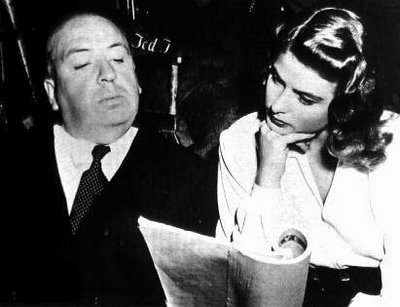
“Ingrid was very fond of my parents,” recalls Pat Hitchcock O’Connell in her book “Alma Hitchcock: The Woman Behind the Man.”

The entire cast dazzles and delights; the subtlety of the performances rewards multiple viewings. Hitch even accepted an idea from Bergman on shooting the dinner party scene.

In her book “Alma Hitchcock: The Woman Behind the Man,” the daughter of Alma and Alfred, Pat Hitchcock O’Connell, recalls that: “Ingrid was very fond of my parents. I remember, she’d finish one film with Daddy and she’d come over, sit on the couch, and say, ‘When do we start the next one?’ ” (Hitchcock O’Connell’s tribute to her mother makes a fun, chatty read and includes some of Alma’s favorite recipes and menus for home entertaining.)

In 1945, Bergman and Hitchcock made “Spellbound” co-starring Gregory Peck and in 1949 Hitch directed her in “Under Capricorn” opposite Joseph Cotten. Also in ’49, Bergman went to Italy to film “Stromboli” with Italian director Roberto Rossellini. Director and star fell in love, and Bergman left her husband Petter Lindstrom for Rossellini. Because of the scandal, Bergman’s reputation in the U.S. suffered, then rebounded; over the course of her career, she earned three Oscars (two for best actress and one for best supporting actress).

One of the most enjoyable and sophisticated films of the black and white era, “Notorious” strikes me as the film noir equivalent of an icy flute of Veuve Clicquot. Cheers!

MGM recently released “Notorious” along with “Rebecca” (1940) and “Spellbound” (1945) on Blu-ray.

‘Dark Shadows’ fam is all dressed up with nowhere to go

Dark Shadows/2012/Warner Bros. Pictures, Tim Burton Productions/113 min.

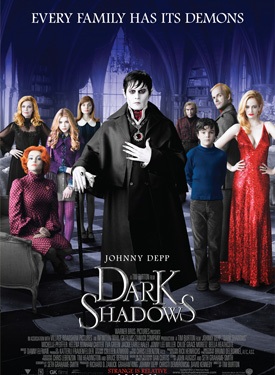
A vampire may be able to live on blood alone, but few movies can exist on camp alone. As much as I was hoping to enjoy Tim Burton’s much hyped and highly anticipated “Dark Shadows,” I found it disappointing.

On the plus side, Dark Shadows” looks slick and gorgeous – the art direction, cinematography, set decoration and special effects are spot on. As always, charismatic Johnny Depp is fun to watch. The character he inhabits here is Barnabas Collins, born in Liverpool in the mid 1700s. The Collins family acquires wealth and power not to mention an imposing mansion in their namesake city of Collinsport, Maine.

When Barnabas grows up, he crosses the wrong woman. Angelique Bouchard (Eva Green) is a witch, who turns Barnabas into a vampire and buries him alive. Two centuries later, Barnabas is freed from his tomb and walks into a world of hippies, macramé and mini-skirts. This is 1972. It’s hard to be lord of the manor, though, when the manor is falling apart and Angelique wants to reignite their dangerous romance.

The rest of the ragtag Collins clan includes Elizabeth Collins Stoddard (Michelle Pfeiffer), Carolyn Stoddard (Chloë Grace Moretz), Roger Collins (Jonny Lee Miller), David Collins (Gulliver McGrath), live-in psychiatrist Dr. Julia Hoffman (Helena Bonham Carter) and groundskeeper/butler Willie Loomis (Jackie Earle Haley). Bella Heathcote plays the newly recruited governess, Victoria Winters, and Barnabas’ true love from the past Josette DuPres.

But somehow these characters never really get off the ground nor do they jell as a “strange family.” This random crew, despite their fetching costumes and makeup, seems purely the result of stunt-casting. They aren’t given much to do besides exchange arch looks (Moretz does some good lip curls) and roll their eyes at Barnabas.

There’s minimal effort to develop these characters; for example, the attempt to delve into Victoria’s past (she was institutionalized as a child) feels supremely clumsy. And there’s little attention paid to why any of this is happening other than you know that the movie itself is a remake of “Dark Shadows,” a popular daytime TV soap opera that ran from 1966-71.

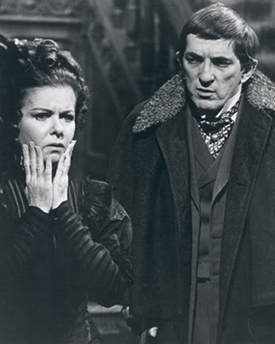
Joan Bennett and Jonathan Frid starred in the daytime TV soap opera, which ran from 1966-71.

The bland and feeble script from Seth Grahame-Smith creaks along with Barnabas remarking on child-birthing hips and unshaven young people, ie hippies. To liven things up, the Collinses throw a ball and hire Alice Cooper to perform. Barnabas declares that Alice is the most unattractive woman he’s ever seen. Were these jokes layered into an actual story, they would be fun but, by the time Cooper appears, the anachronistic humor is wearing pretty thin.

There is supposed to be a love triangle between Barnabas, Angelique, the icy-blonde bad girl and wide-eyed good girl Victoria. Green does an excellent turn as the powerful, alluring femme fatale. But there’s no tension – Barnabas seems strangely detached from both of them – and Angelique’s hell-hath-no-fury antics grow as tedious as the ’70s jokes.

I wasn’t familiar with the TV series (created by Dan Curtis, it starred Jonathan Frid as Barnabas and film-noir great Joan Bennett as Elizabeth), but one of its strengths was fusing low-key campiness and spooky-goth atmosphere. Burton’s anemic version sorely lacks on the eerie/creepy/scary front.

Though Depp is at his best here, to watch and truly enjoy him for almost two hours would require that he not be completely covered up in top coat and breeches.

“Dark Shadows” opens today nationwide.

Robert Bresson retrospective starts tonight at the Aero

The Poetry of Precision: A Robert Bresson Retrospective starts tonight at the Aero Theatre in Santa Monica. Starting the series is a new 35 mm print of a superb prison drama based on actual events: “A Man Escaped” (1956). François Truffaut called Bresson’s work, upon its release, “the most important film of the last 10 years.”

Though Bresson, known for his spare, unflinching vision and for addressing religious and spiritual themes, is not a film noir director, several of his movies deal with crime, fate, entrapment and damnation. These include: “Les anges du péché” (1943), “Les dames du Bois de Boulogne” (1945), “Pickpocket” (1959), “Une femme douce”/“A Gentle Woman” (1969), “Le diable probablement”/“The Devil, Probably” (1977) and “L’Argent” (1983) – all of which are showing at the Aero. Bresson died on Dec. 18, 1999; he was 98.

The series runs through May 20. It is presented by the American Cinematheque in collaboration with the French Embassy, the Institut Français, and the French Film and TV Office of the French Consulate in Los Angeles. All films are in French with English subtitles.

The Aero Theatre is at 1328 Montana Ave., Santa Monica, 90403.

WWJD? Taking a leaf, or not, from Joan Crawford’s book

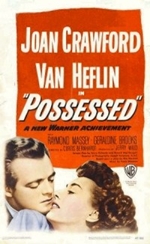
‘Possessed’ will play at the Arthur Lyons Film Noir Festival in Palm Springs, which starts on Thursday, May 10, and runs through the weekend.

Possessed/ 1947/Warner Bros. Pictures/108 min.

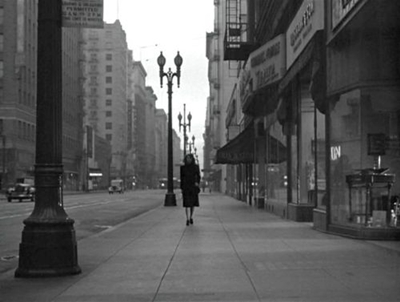
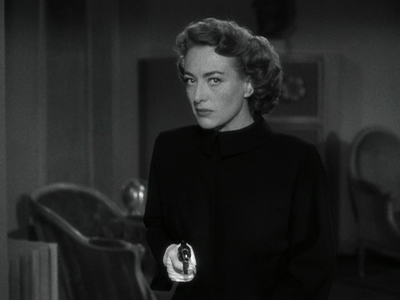
A dazed and confused Louise (Joan Crawford) wanders the streets of LA.

WWJD? What Would Joan Do is an acronym I use to remind myself that in times of trial, or just dreary old doubt, I can always conjure some outrageous guidance in the spirit of the indomitable Miss Joan Crawford.

“You see?” Joan would purr in her low, silky voice, were she still alive. “It sounds severe, but it’s really rather effective.”

Work woes? If you’ve patiently kept your nose to the grindstone and still haven’t received a promotion, it might be time to march into the boardroom and shout: “Don’t mess with me, fellas!”

Slovenly roommate? Never underestimate the effect of throwing a few hangers around to drive home the point that the apartment is not likely to start cleaning itself.

Man trouble? A quick jab with your stiletto to his foot or chin every 10 minutes or so should ensure that the rapscallion not only listens but also hangs on your every word over dinner.

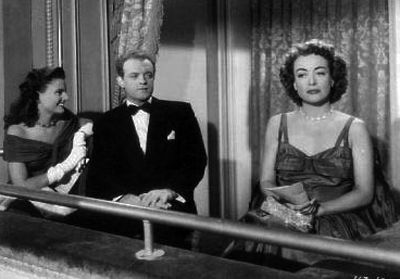
When Carol (Geraldine Brooks) and David (Van Heflin) start a romance, Louise is less than pleased.

Admittedly, actually doing any of the above or generally taking cues from the Queen of the Ankle-Strap Shoe would likely lead to disastrous results. But the point is that imagining WWJD is nearly as entertaining as watching the many movies in which she played tough strong women who made up their minds to go after what they wanted. And. Didn’t. Stop. Until. They. Got. It.

Getting what she wants is certainly central to her character in director Curtis Bernhardt’s “Possessed” from 1947. Joan plays Louise Howell Graham, a determined gal who doesn’t take it very well when her boyfriend David Sutton (Van Heflin) dumps her. Louise is convinced that if she tries hard enough, David will come to his senses and realize that he does love her, after all.

She even marries wealthy widower Dean Graham (Raymond Massey) as a ploy to win David back. (Need I say the ploy doesn’t work?) When Louise’s stepdaughter Carol (Geraldine Brooks) also falls for David, things get sticky. Or perhaps shaky is a better word because Louise goes off the deep end into a full-fledged psychotic state, though when she eventually pulls the trigger of a gun, her hand is rock steady.

You realize in the opening scene that Louise is in La La Land, literally and figuratively, as she wanders the streets of LA calling David’s name. In a drab dress, hideous shoes, no lipstick and her hair a mess? She needs new medication or an emergency shopping trip to Rodeo Drive. Someone help this woman, please! And mercifully someone does. Louise’s story comes to us in flashback as she tells her doctors in the hospital psycho ward.

The movie is director Bernhardt’s exploration of an unhinged mind. A German Jew well-schooled in the tenets of Expressionism, his visual techniques to show us Louise’s inner torment include high-contrast light and shadow as well as stunningly extreme camera angles to create a sense of emotional chaos.

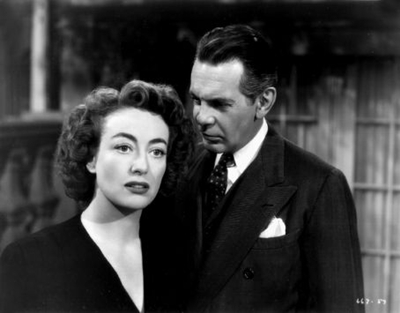
Steady and wealthy husband Dean Graham (Raymond Massey) adores Louise and, more importantly, believes her lies.

Crowded, asymmetric compositions reveal her sense of entrapment and imbalance. Particularly famous, and beautifully lit, is Louise’s disaster-fantasy scene where she confronts Carol near a flight of stairs – essentially a distorted dream sequence that reflects Louise’s anguish. Joseph Valentine and Sidney Hickox (uncredited) were the cinematographers.

A sweeping score by Franz Waxman highlights Louise’s subjective point of view, particularly her splintered personality. (On the DVD release, film historian Drew Casper offers an informative, if gushy, commentary that details Bernhardt’s methods.)

The intense script came from Ranald MacDougall, Silvia Richards and Lawrence Menkin; it was based on a Rita Weiman story. MacDougall was a favorite of Joan’s. He was the lead writer of “Mildred Pierce” (1945, Michael Curtiz) based on James M. Cain’s novel. MacDougall also adapted and directed 1955’s “Queen Bee.”

It’s Joan’s movie, to be sure, but there’s a terrific chemistry among these well cast players. Heflin plays a douche bag like no other, Massey fairly radiates standup sincerity and goodness, and Brooks shines as his sweet and sexy daughter.

Crazy or not, Louise is still a straight shooter.

By today’s standards, Joan’s acting is a little over the top, but it’s hard to think of another actress who could’ve pulled off this part (it’s a crazy lady, after all) any better. As James Agee sagely noted, “Miss Crawford performs with the passion and intelligence of an actress who is not content with just one Oscar.”

Her performance in “Possessed” was nominated for a best-actress Oscar but, having won for “Mildred Pierce,” her chances were slim; she lost to Loretta Young in “The Farmer’s Daughter.” (She was also nominated for “Sudden Fear,” from 1952, but the award went to Shirley Booth in “Come Back, Little Sheba.”)

The genius of Joan is that she while she might’ve overplayed it a tad, she always retained a sense of dignity and backbone that made you admire her a little, even if she was nuts. My favorite scene is when hubby Dean asks her why she lied to him. She answers, in a blasé tone, “Because I felt like it. I wanted to lie and I lied. Let me alone.”

This reminds me of a story my mother told me once. She and her best friend, both newly married, attended a bridal shower where the guests were asked to write down a piece of advice for a happy marriage. The two of them suggested the following: “Tell one lie every day.” When it came time to read each item aloud, the other guests were aghast at this exhortation to fib. Still, my mother and her friend got quite a good chuckle out of it.

I think Joan would have too.

‘Possessed’ quick hit

Possessed/1947/Warner Bros. Pictures/108 min.

“I wanted to lie and I lied,” says a detached and matter-of-fact Louise Howell Graham (Joan Crawford) to her rich hubby (Raymond Massey). In addition to lying, Louise is obsessing over an old boyfriend, an engineer named David Sutton (Van Heflin), to the point of going full-on crazy. Too bad David’s eye is on Louise’s stepdaughter (Geraldine Brooks). This choice line is one of many pleasures in this well acted and well crafted film by director Curtis Bernhardt; Ranald MacDougall wrote the script.

Noir City’s final weekend: Pre-code ‘Maltese Falcon,’ Gary Cooper and a special appearance by Marsha Hunt

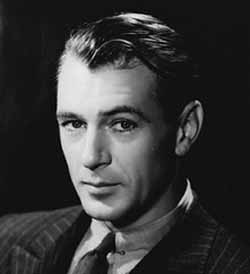
Gary Cooper

FNB shot by Halstan Williams; www.halstan.com

Noir City at the American Cinematheque’s Egyptian Theatre wraps up this weekend with a first-rate slate of films. Tonight is the Dashiell Hammett double feature, starting with the 1931 (pre-code) version of “The Maltese Falcon,” starring Ricardo Cortez and Bebe Daniels, directed by Roy Del Ruth. In “City Streets” (1931, Rouben Mamoulian) a young Gary Cooper goes crooked in order to free his love (Sylvia Sidney) from prison. It should be great looking, given that the cinematographer is Lee Garmes.

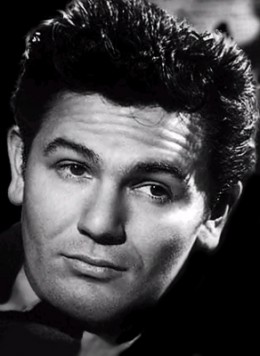
The Saturday matinee is the noir classic “The Postman Always Rings Twice” (1946, Tay Garnett), starring Lana Turner as one of the all-time best femmes fatales opposite a smoldering John Garfield; based on James M. Cain’s novel. Before the film, Denise Hamilton, noir novelist and editor of the Edgar-winning Los Angeles Noir short story anthologies, will discuss the genesis of film noir and the cross-pollination between Hollywood and its noir bards.

John Garfield

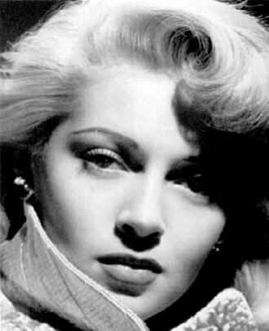
Lana Turner

Saturday night is a terrific pick: two films from the underrated director Jean Negulesco. First, “Three Strangers” (1946) tells the cynical tale of a trio bonded by fate and a winning lottery ticket: Sydney Greenstreet, Peter Lorre and Geraldine Fitzgerald. To read more about this film, I recommend this piece by my friend, writer/producer Barry Grey.

Fitzgerald also stars in 1946’s “Nobody Lives Forever,” scripted by W. R. Burnett. Here, she’s a war widow getting conned by scheming ex-GI John Garfield. There will be a discussion between films with Fitzgerald’s son, Michael Lindsay-Hogg. At 6:30 p.m., in the Egyptian lobby, Lindsay-Hogg will sign his book “Luck and Circumstance: A Coming of Age in Hollywood, New York, and Points Beyond.”

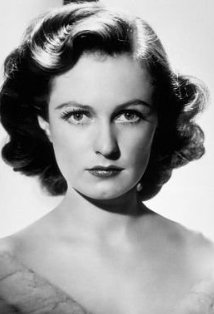
Geraldine Fitzgerald

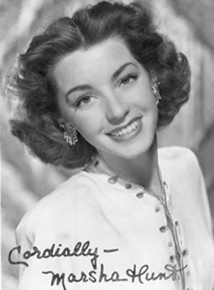
Marsha Hunt

Next up is the Sunday matinee: “Circumstantial Evidence” (1945, John Larkin) a father-son noir starring Lloyd Nolan and Michael O’Shea. This will pair with “Sign of the Ram” (1948, John Sturges).

Says the program: This unusual film was fashioned as a vehicle for star Susan Peters, who plays a sociopathic, paraplegic matriarch bent on destroying her family. Peters, injured the year before in a hunting accident, gives a remarkable performance – all the more haunting for the fact that her paralysis is real. Hitchcock collaborator Charles Bennett wrote the screenplay.

And closing the fest is a special appearance by actress Marsha Hunt. The films shown are an ultra-rare B, “Mary Ryan, Detective” (1949, Abby Berlin), and “Kid Glove Killer” (1942, Fred Zinnemann) in which Hunt plays a police forensics expert juggling a cop (Van Heflin) and a gangster (Lee Bowman). Scripted by John C. Higgins, “Kid Glove Killer” is Zinnemann’s feature film debut. Ava Gardner plays a car hop.

Honey, your May noir horoscope is here …

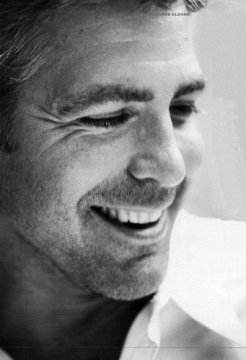
George Clooney

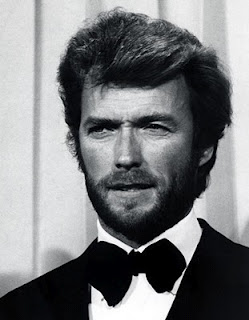
Clint Eastwood

Fate reigns supreme in film noir, but that doesn’t mean we don’t love us some zodiac fun. Hope your May is full of sunny days and sexy nights. And happy birthday, Taurus and Gemini! A special shout-out and remembrances to Taurus icons George Clooney (May 6), David O. Selznick (May 10), Harvey Keitel (May 13), Cate Blanchett (May 14), Joseph Cotten (May 15), Debra Winger and Megan Fox (May 16), and James Stewart (May 20). Gemini charmers we love include Pam Grier (May 26), Annette Bening (May 29) and Clint Eastwood (May 31).

Taurus (April 21-May 21): This spring looks busy so don’t be surprised if you are the toast of the town. Make the most of it! Take forever to get ready and gaze in the mirror with utter fondess. Let others buy you champagne. As you socialize, you may meet the perfect person for your next heist or groundbreaking project. Indeed, flexibility and openmindedness will be key this month. You may also be at the end of a chapter in your life, which is good news all around. Be open to change (it is inevitable after all); your creativity and prosperity will flow. The 12th is a divine time for a little dare, especially in the romantic arena.

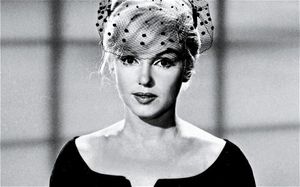
Marilyn Monroe (June 1, 1926 - Aug. 5, 1962)

Gemini (May 22-June 21): Having just completed a transformative peroid in your life, allow time to relish the achievement, hell, wallow in it for weeks, if you can. And with a birthday nearby, you have multiple reasons for celebrations and much to feel grateful for. If, in all the excitement, something slips your mind, don’t be too hard on yourself. It is very probably not the end of the world, unless you forgot to load your gun or fill the getaway car with gas. If you’ve planned a vaca or b’day getaway, do not take work with you. That defeats the whole purpose and you will return feeling drained instead of refreshed. Remember to say what you mean and mean what you say, especially around the 6th and 7th.

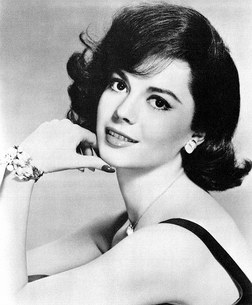
Natalie Wood (July 20, 1938 - Nov. 29, 1981)

Cancer (June 22-July 23): “At the time I wasn’t aware of the things I missed, so why should I think of them in retrospect? Everybody misses something or other,” said Natalie Wood, on being a child actor. Let your easy-breezy, typically philosophical Cancer nature guide you this month as you live in the moment and enjoy simple pleasures. You may be at a romantic impasse; if so, divert your energy and help a friend with a project – perhaps a chum needs assistance in crafting a scheme. With little effort, new and exciting work opportunities seem to fall in your lap. Around the 24th let go of a long-held expectation and make room for fresh joy.

Leo (July 24-August 23): You may be on the fence about attending an event or going to an appointment or interview because it will require a fair amount of energy on your part to make it. While additional effort for a femme fatale is usually best spent on the important things – false-eyelash application, fake tans and finding the perfect cocktail ring – in this case, it’s worth making an exception and going the extra mile. Thinking about a career change? Be practical, of course, but also consider whether the new line of work stirs your soul.

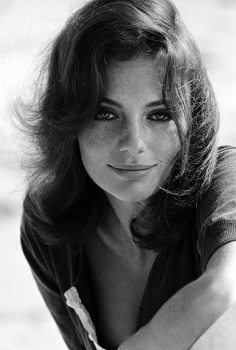
Jacqueline Bisset was born Sept. 13, 1944.

Virgo (August 24-September 23): Consider how you may sharpen your skills of judgment – not simply knee-jerk approvals or quick condemnations – but bringing calmness, clarity and resolve to your assessments. Then trust that you will forge ahead with intelligence, patience and your famous eye for detail. If, on the other hand, a decision about you is likely to be made, trust that the outcome will in some way lead you to the path you need to be on. Meanwhile, go out of your way to be nice to Man du Jour; you’ll both be glad you did. Be spontaneous around the 25th.

Libra (September 24-October 23): A person from your past claims to have made much progress in the areas of emotional maturity and spiritual growth. This is, of course, eminently possible. If you are curious and are still spending a lot of time pondering this person, it may be worth exploring your mutual feelings and examining old issues. (And need I remind you? Bright red lipstick is a must for a meetup.) But speaking of red, proceed with caution and pay attention to red flags. Then, whichever way you move forward, you will be clear and focused, not stuck in the past. An inspired idea of yours pays off at your workplace. Don’t let jealousy cloud your vision on the 16th.

Scorpio (October 24-November 22): It isn’t always easy to live the life of a daring femme fatale/leader of the pack. What with defying convention and bucking trends, and you may find yourself in need of new inspiration this month. Instead of struggling to find it; turn your brain off and rest. Or better yet, enjoy a change a scene with a last-minute trip. Fresh ideas will then find you as long as you relax and don’t try too hard. Just trust in your talent for brilliance, creativity and finding fall guys. As for amour, let your inner vixen be your guide. It’s springtime and, whether you’re in Paris or Peoria, it’s high time for romance. On the 30th, be extra gentle on yourself.

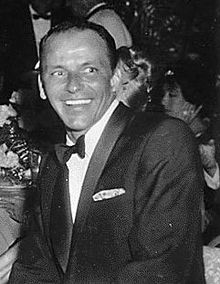
Frank Sinatra (Dec. 12, 1915 - May 14, 1998)

Sagittarius (November 23-December 22): May is the perfect time for a bit of spring cleaning, both literally and figuratively. Your elegant brain thrives in an orderly, clutter-free zone. As for your relationships, if attached, there may be some buried issues that need to be aired. Start on a positive note and avoid citing a comprehensive list of examples. You are trying to communicate, not build a case. If single, it may dawn on you that your slew of male friends may be keeping you single. Of course, you cherish the Marilyn Monroe/Frank Sinatra vibe you have with them, but hanging with them all the time might mean you are less likely to put yourself out there and seek serious romance.

Capricorn (December 23-January 20): While you possess an unusual balance of strength and sensitivity in your character, often the former defines your style of communication. In other words, you are full-on and fiery when it comes to speaking your mind. This is a wonderful trait but this month it may behoove you to try a slightly different approach. Experiment with the power of letting go. Let there be peaceful pauses when you chat with people; don’t feel the need to fill the conversation lulls. Allow your sensitivity to guide you and listen. You may be surprised at the enlightenment you gain. Your sense of humor spurs a friendship on the 25th.

Aquarius (January 21-February 19): “The modern tendency to accept, with no intention of returning, an invitation which sounds amusing, is a form of opportunism which, though practiced, is still very much criticized,” says Vogue’s Book of Etiquette, 1948. Not to worry. You’d be hard-pressed to find an Aquarian gal who isn’t terrific at throwing parties. Your hostess skills (planning, imagination, organization, charm) may be needed in a new context this month; perhaps a red-carpet event that needs to be pulled together at the last minute. Just throw on some teetering ankle straps and a dazzling choker, and you’ll have it under control in no time. Say no to others to say yes to yourself the week of the 14th.

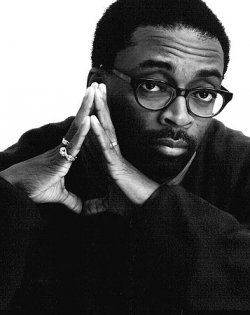
Spike Lee was born March 20, 1957.

Pisces (February 20-March 20): Subtle and skilled communicator that you are, you will find the ideal solution to a sticky problem. Hint: It may be that a more-the-merrier approach trumps exclusivity when it comes to a trip or gathering this month. At work, however, the opposite may hold true and decision-making by committee will impede progress, so step up and call it as you see it. On the romantic front, you have issued a meeting request to the Universe so sit back and relax or better yet get up and go shopping while scheduling details are being finalized. You will just happen to look magnificent this month so don’t forget to flirt. Your way is the best way on the 14th – but isn’t that the case most every day?

Aries (March 21-April 20): Your life will be touched by decadent delight and a few sinful surprises (calories be damned!) this month. Appreciate it and have fun. At the same time, make sure you take a moment to look at the bigger picture and see an opportunity that beckons on the horizon. To be open to it, be in the moment and don’t listen to any fearful or negative internal chatter. Abandon old worries and don’t waste mental energy on second-guessing yourself. Oh and btw, romance awaits you, so make sure you have that smoldering gaze and sexy smile down.

Silver and Ursini reflect on the mighty influence of film noir

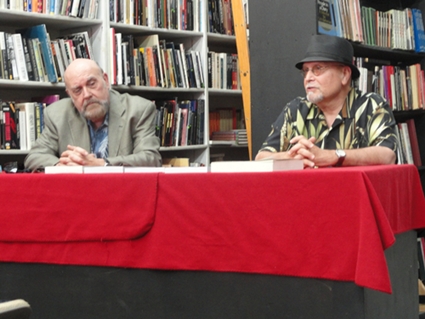
Alain Silver (left) and James Ursini discuss their book, “Film Noir: The Directors.”

Historians/authors/editors Alain Silver and James Ursini discussed and signed their new work, “Film Noir: The Directors” (Limelight Editions, $24.99, multiple contributors) on Saturday afternoon at Larry Edmunds Bookshop in Hollywood.

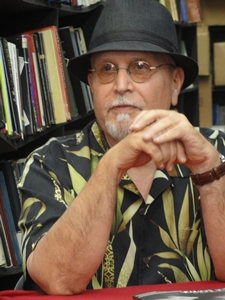
James Ursini

Ursini maintains that film noir is the most important artistic movement Hollywood has produced, and one that’s perfectly capable of jumping genres from Westerns to sci-fi to the traditional women’s picture.

Said Ursini: “Film noir is the overwhelming influence on directors today, in film, TV, comic books … in America and worldwide. Though it went into a sort of remission in the late ’50s, by the ’70s it was back and it never stopped. It’s an incredibly vibrant movement that’s as influential today as it was in the ’40s and ’50s.”

Though appreciated by French critics, most film noir titles (especially low-budget B movies) were widely snubbed by America’s cinematic elite. Ursini recalled that as a UCLA film-school student in the late ’60s, he had to push hard to be allowed to write a paper on director Henry Hathaway.

Alain Silver

Silver pointed out that though the two most frequently cited factors in film noir’s development are the exodus of European filmmaking talent to the U.S. starting in the 1930s and the canon of hard-boiled American literature by authors such as James M. Cain, Dashiell Hammett and Raymond Chandler, the real story is more complicated.

Specifically, it’s hard to pinpoint exactly what inspired these very different directors (the book covers 30) to pursue this unique aesthetic, often self-consciously borrowing and sharing ideas. One certainty, though: Billy Wilder’s “Double Indemnity” (1944) was the prototype for the genre.

He added that because of World War II, the production code loosened and the American public developed a taste for realism. Were audiences of the ’40s and ’50s shocked by these cynical, gritty, fateful stories on the screen? It’s hard to say. Silver said the most interesting contextual endeavor now would be to compare the audiences’ expectations against their reactions.

Photos copyright of Film Noir Blonde