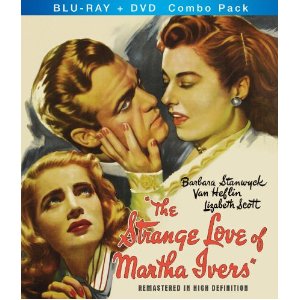
Greed at its glossiest in ‘The Strange Love of Martha Ivers’

The Strange Love of Martha Ivers/1946/Paramount/115 min.

The effects, both corrosive and subtle, of deep-seated greed form the core of “The Strange Love of Martha Ivers,” made for Paramount by prestige director Lewis Milestone. Known primarily for his war films, like the 1930 Oscar-winning classic “All Quiet on the Western Front,” and later for guiding the Rat Packers in the original Ocean’s Eleven (1960), Milestone is equally adept at noir.

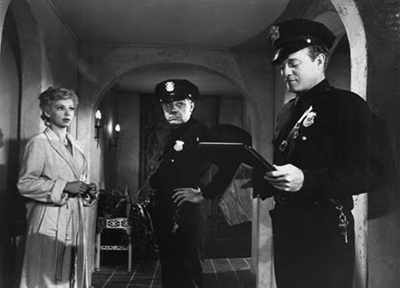
An A-list picture with a budget to match, the film also boasts an A-list noir cast: “Double Indemnity’s” lethal dame Barbara Stanwyck as steely, unwavering Martha; Kirk Douglas in his film debut as Martha’s tough-on-the-outside-but-milquetoast-underneath alcoholic husband, District Attorney Walter O’Neil; the always-superb Van Heflin as Sam Masterson, Martha’s cocky ex-boyfriend; and gorgeous, statuesque Lizabeth Scott as Sam’s latest girlfriend, a kid from the wrong side of the tracks named Toni Marachek.

In some ways, this darkly melodramatic film is not a typical noir – Martha, the femme fatale, hails from a wealthy, prestigious family that’s made its fortune from the workers of a small industrial burg called Iverstown. We learn about the principal characters’ backgrounds and see Martha (Janis Wilson), Walter (Mickey Kuhn) and Sam (Darryl Hickman) as kids.
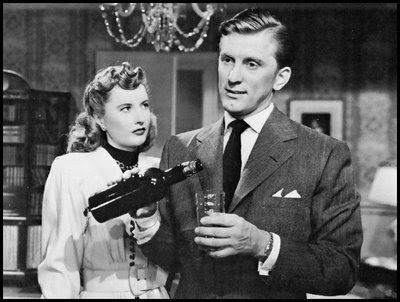
Martha (Barbara Stanwyck) likes to boss her husband Walter (Kirk Douglas). Walter likes to have a bottle nearby at all times.

Young Martha, fed up with her tyrannical spinster aunt/guardian, is on the verge of running away with Sam. She doesn’t quite make it, though, and one fateful night (need I mention dark and stormy?) the trio’s lives are changed permanently after Martha commits a terrible crime. Sam flees but returns nearly 20 years later, catching Martha’s eye again and making Walter squirm with guilt, which he tries to obliterate by drinking breakfast, lunch and dinner.

But in many ways, “Martha Ivers” is classic noir – a cynical, pessimistic mood; sharp visuals; characters trapped by secrets of the past and burdened with the weight of wrongdoing; love warped by a thirst for money and power. That said, not all is bleak – screenwriter Robert Rossen (“The Hustler”) provides a crackling good script with a sly twist, Edith Head designed the costumes, Miklós Rózsa wrote the score, the ideally cast actors nail their parts and there’s an upbeat ending. (Also, watch for Blake Edwards, uncredited, as a sailor/hitchhiker.)
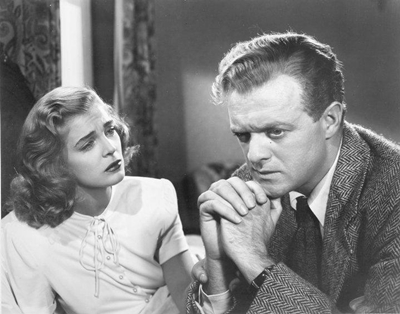
Toni (Lizabeth Scott) and Sam (Van Heflin) become allies and more.

Every time I think I’ve found Heflin’s best performance, I see him in another movie and change my mind – for the next week or so this is my fave. Could anyone else but Heflin deliver a line like: “It’s the perfume I use that makes me smell so nice” and have it work so perfectly?

As a smalltime gambler who lives by his wits, Heflin’s Sam brims with swagger and sweet talk. Stanwyck’s Martha is more than up to the challenge of loving him. Douglas is supremely convincing in a difficult, textured role; Scott brings a sexy warmth and vulnerability to this girl who can’t seem to get a break.

And I particularly enjoyed the cherchez le femme element: setting all the evil into motion is little Martha’s beloved pet, a kitten named Bundles.

“The Strange Love of Martha Ivers” was recently released on Blu-ray by HD Cinema Classics.

Slices of Los Angeles and a screening of ‘Mildred Pierce’

Photo from www.bettycrocker.com

On Saturday, June 16, at 2 p.m. the American Cinematheque will host a presentation on Los Angeles restaurants of the 1920s-1940s and screen the film-noir classic “Mildred Pierce.”

To kick off the event, Veronica Gelakoska, author of “Pig ’n Whistle,” and writer/preservationist Chris Nichols will give an illustrated talk on the Pig ’n Whistle, Melody Lane, Hody’s and other retro spots.
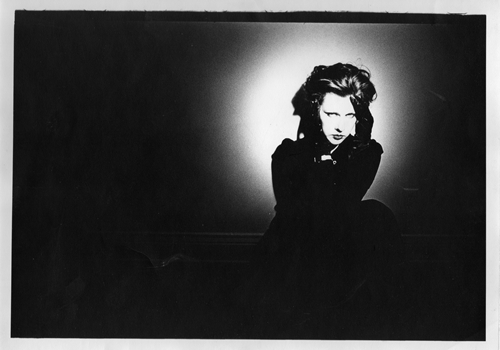
“Mildred Pierce” stars Joan Crawford as a divorced mother who waits tables and bakes pies to support her demanding daughter’s desires. She becomes a successful Los Angeles restaurateur and trouble ensues.
In honor of Ms. Pierce, slices of fruit pies will be sold at the screening. Fast forwarding to LA restaurants of today, I recently reviewed Gordon Ramsay at the London West Hollywood and thought I would share the review. Mmm.

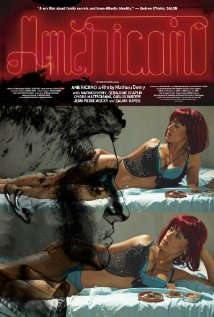
Poetic, mysterious ‘Americano’ lacks emotional resonance

Americano/2011/MPI Media Group/105 min.

“Americano,” Mathieu Demy’s first feature film, contemplates the passing of time and ghosts of memory, the grieving of a parent and letting go of the past. Poetic, dreamlike and visually compelling, the film has the makings of a personal odyssey meets noirish mystery but ultimately is undermined by a thin story that lacks emotional resonance.

Writer/director/actor Demy plays Martin, a real-estate broker who lives with his girlfriend Claire (Chiara Mastroianni) in Paris; he’s on the fence about raising a family with her. When his estranged mother dies, he travels to her home in Venice, Calif., where he spent part of his childhood before moving to France with his father (Jean-Pierre Mocky) after his parents divorced.

Returning to settle his mother’s affairs, with the help of a family friend named Linda (Geraldine Chaplin), Martin finds that in addition to the turmoil of pain, both raw and repressed, he is haunted by the recollection of Lola, a childhood acquaintance (Salma Hayek plays the adult Lola). She remained friends his mother while Martin was in France.

After learning that Lola was deported, Martin takes Linda’s red Ford Mustang convertible and heads to Tijuana (unfamiliar and dangerous territory that is all the more appealing in his grief) to find Lola and probe the relationship she had with his mother. There he finds the brassy, tough chick working in a strip club called Americano. It’s not exactly a happy reunion and Martin must decide whether he can trust this no-nonsense femme fatale.

Though a fictional film, “Americano” is also a valentine to Demy’s parents: French New Wave director Jacques Demy (he died in 1990) and Agnès Varda, who has been directing movies since the 1950s. Showing glimpses of Martin’s childhood in Venice, and simultaneously creating a more personal story, Demy uses footage of himself in Varda’s 1981 film “Documenteur.”

“I wanted the two films to echo one another, with 30 years separating them,” said Demy at a recent press conference in Beverly Hills. The desire to connect the films also prompted Demy to shoot “Americano” in super 16 mm cinemascope; “Documenteur” was shot in super 16 mm. And, of course, Hayek’s character name echoes Jacques Demy’s 1961 “Lola,” his first feature. Like Demy, Mastroianni (daughter of Catherine Deneuve and Marcello Mastroianni) and Chaplin (daughter of Oona O’Neill and Charlie Chaplin) are artists with prodigious legacies.

A.O. Scott, writing for the New York Times, notes, “As a director, [Mathieu Demy] owes less of a debt to his parents than to the American film noir tradition and, above all, to the melancholy romanticism of Wim Wenders, the German auteur whose love of scruffy North American locations, ambiguous quest narratives and the color red seems to resonate through much of ‘Americano.’ ” [Read more…]

‘The Big Sleep’ and more on the big screen

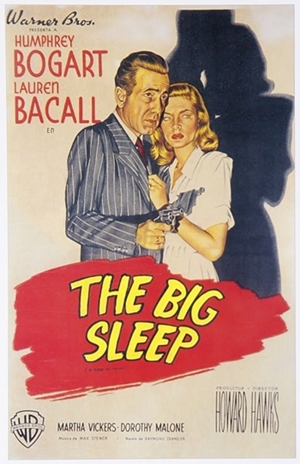
Tonight (Wednesday, June 13) at 8 p.m., the Film Noir Foundation’s Alan K. Rode will host a screening of “The Big Sleep” (1946, Howard Hawks) at the Los Angeles Theatre in downtown Los Angeles. Hawks’ adaptation of Raymond Chandler’s labyrinthine mystery stars Humphrey Bogart as private eye Philip Marlowe and Lauren Bacall as a rich girl who may be helping or hindering him.

The event is sold out, but there will be rush tickets available on a first-come first-serve basis at the box office. For more info on the screening, visit the Los Angeles Conservancy.

Additionally, the Pacific Film Archive, in Berkeley, Calif., is hosting One-Two Punch: Pulp Writers, a film series that explores movie adaptations of three divergent authors: Dorothy B. Hughes, Mickey Spillane and Elmore Leonard. The series comprises classic films noirs such as Nicholas Ray’s “In a Lonely Place” (1950) and George A. White’s “My Gun is Quick” (1957), as well as thrillers like Roy Rowland’s “The Girl Hunters” (1963), starring Spillane as Mike Hammer.

For full details about the series, running June 23-30, visit the Pacific Film Archive.

And on Thursday, the Los Angeles Film Festival begins downtown.

On the shopping radar: Fragrances, the Jetsetter Collection, lip tar, SW1 and Chanel celebrates little black jackets

In between watching TCM’s Flashbacks in Noir tonight (“Possessed,” “They Won’t Believe Me,” “Dead Reckoning,” “Killer’s Kiss” and more), I’m adding to my summer shopping wish-list. If I go to Anne Fontaine one morning for a bit of browsing (the summer sale runs through Wednesday, June 20), this should be sufficient for a dreamy afternoon. ; )

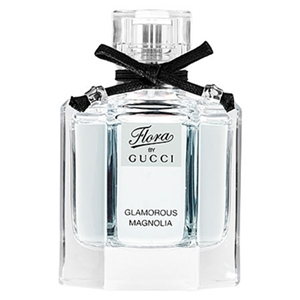
Gucci Glamorous Magnolia eau de toilette, $70 for 1.7 ounces. The Flora Garden Collection is inspired by an iconic pattern from the Gucci archives.

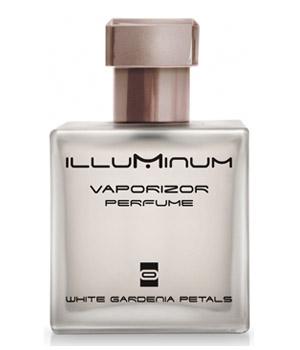
White Gardenia Petals, from Illuminum Perfumes, $150 for 100 ml (15% concentration of essential oil). Worn by Kate Middleton on her wedding day, the feminine fragrance is available in the U.S. exclusively at Henri Bendel.

Also from Henri Bendel: Jetsetter large hanging weekender, $168. Very cute collection.

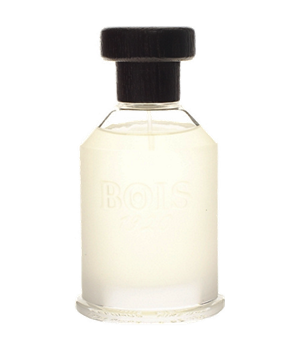
Another tie for Dad … or not: BOIS 1920 Classic 1920, $195 for 100ml. Another idea: Gendarme cologne for men, $75 for 4 ounces. Both available at Barneys New York.

Lip Tar in Stalker by NYC-based Obsessive Compulsive Cosmetics, $14. Says OCC: Goes on slick and moist, and dries to a satin finish. Meant to be mixed, Lip Tar comes in 36 colors.

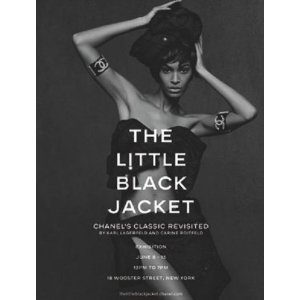
“The Little Black Jacket: Chanel’s Classic Revisited” (Steidl, $98). This photo-book by Karl Lagerfeld and former French Vogue editor Carine Roitfeld comes out Aug. 15. And, in New York, “The Little Black Jacket” photo exhibit runs through Friday, June 15, from 12-7 p.m., at 18 Wooster St.

Alvaro Gonzalez (formerly with Jimmy Choo) is the creative director of Stuart Weitzman’s new accessories line called SW1. Shoes are $675-$775; www.neimanmarcus.com. Photo from Harper’s Bazaar

Free stuff from FNB: Classic Legends Bogart set

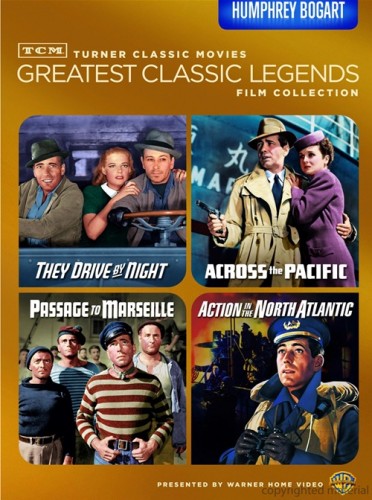
Warner Home Video (WHV) and Turner Classic Movies (TCM) are adding two new sets to the TCM Greatest Classic Legends line. The newest additions feature Humphrey Bogart and Joan Crawford. (On the Crawford set is “Mildred Pierce,” “Humoresque,” “Possessed” and “The Damned Don’t Cry.”)

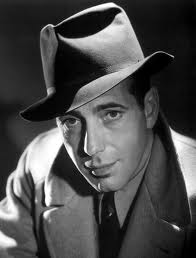
Humphrey Bogart

Courtesy of WHV, I will be giving away the Bogart set, which contains “They Drive by Night,” “Across the Pacific,” “Action in the North Atlantic” and “Passage to Marseille.”

(Additionally, WHV and TCM will release the Greatest Gangster Films: Humphrey Bogart set, featuring “High Sierra,” “The Petrified Forest,” “The Amazing Dr. Clitterhouse” and “All Through the Night.”)

Each set is $27.92 and will be available on June 26.

To enter the June giveaway, for the Classic Legends: Humphrey Bogart set, just leave a comment on any FNB post from June 1-30. We welcome comments, but please remember that, for the purposes of the giveaway, there is one entry per person, not per comment.

The winner will be randomly selected at the end of the month and announced in early July. Include your email address in your comment so that I can notify you if you win. Your email will not be shared. Good luck! (Josh is the winner of the May reader giveaway, a Blu-ray set of “Body Heat,” “L.A. Confidential,” and “The Player.” Congrats to Josh and thanks to all who entered!)

Here’s more info on the movies in the Classic Legends: Humphrey Bogart set.

THEY DRIVE BY NIGHT (1940) – Bogart and George Raft share a driving ambition in a feisty tale of brothers trying to make it as independent truckers in this fine example of Warner Bros. social-conscience filmmaking that’s also a film noir. Ann Sheridan and Ida Lupino also star.

ACROSS THE PACIFIC (1942) – In this wartime thriller, Bogart plays U.S. counterspy Rick, who trades barbs with Mary Astor, matches wits with Sydney Greenstreet and swaps bullets with saboteurs of the Panama Canal. John Huston directs this reunion of the three stars of “The Maltese Falcon.”

ACTION IN THE NORTH ATLANTIC (1943) – This World War II salute to Allied forces stars Bogart as First Officer Joe Rossi, who, along with his captain (Raymond Massey), matches tactics with U-boats and the Luftwaffe. The tactics are so on target that this became a Merchant Marine training film.

PASSAGE TO MARSEILLE (1944) – Bogart reunites with director Michael Curtiz and other key “Casablanca” talent for a tension- and controversy-swept story of a French patriot who escapes Devil’s Island, survives a dangerous freighter voyage and becomes a gunner in the Free French Air Corps.

The ‘pulchritudinous and punctual’ Marilyn Monroe sings Happy Birthday, Mr. President … and more

After reading about Marilyn Monroe and watching some of her movies over her birthday weekend, I felt like sharing these video clips.


Marilyn sang on Saturday, May 19, 1962, for President John F. Kennedy at a celebration of his 45th birthday, 10 days before his actual birthday (Tuesday, May 29).

#

Marilyn sings in “Some Like It Hot,” from 1959, directed by Billy Wilder.

#

Marilyn sings “Diamonds are a Girl’s Best Friend” in the musical “Gentlemen Prefer Blondes,” directed by Howard Hawks and choreographed by Jack Cole. To read more about Cole and his career, visit dance critic Debra Levine’s wonderful arts meme.

#

And, while reading about Marilyn, I was struck by her insightful notes on Fox’s final cut of “The Prince and the Showgirl” (1957, Laurence Olivier): “I am afraid that as it stands it will not be as successful as the version all of us agreed was so fine. Especially in the first third of the picture the pacing has been slowed and one comic point after another has been flattened out by substituting inferior takes with flatter performances lacking the energy and brightness that you saw in New York. Some of the jump cutting kills the points, as in the fainting scene.

“The coronation is as long as before if not longer, and the story gets lost in it. American audiences are not as moved by stained glass windows as the British are, and we threaten them with boredom. I am amazed that so much of the picture has no music at all when the idea was to make a romantic picture. We have enough film to make a great movie, if only it will be as in the earlier version. I hope you will make every effort to preserve our picture.”

In the end, no changes were made to the picture.

From “The Secret Life of Marilyn Monroe” by J. Randy Taraborrelli

(Note: Film noir horoscopes will return next month.)

Happy birthday, Marilyn

For what would have been Marilyn Monroe’s 86th birthday, I’ve compiled quotations from her and about her. If you have a favorite quotation from or about MM, please send it and I will add it to the list. I have credited the photographers wherever possible; copyright of all photos belongs to the photographers and/or their estates/representatives. (Note: Film noir horoscopes will return next month.)

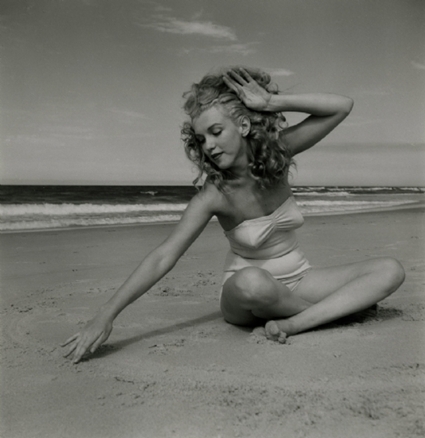
An early shot of Marilyn on the beach; she loved the water.

FROM MARILYN …

“The real lover is the man who can thrill you by touching your head or smiling into your eyes or just staring into space.”

“I love champagne – just give me champagne and good food, and I’m in heaven and love.”

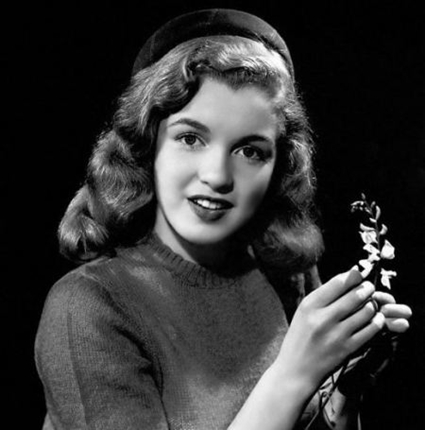
Marilyn started out as a model.

“The body is meant to be seen, not all covered up.”

“Sex is part of nature. I go along with nature.”

“My illusions didn’t have anything to do with being a fine actress, I knew how third rate I was. I could actually feel my lack of talent, as if it were cheap clothes I was wearing inside. But, my God, how I wanted to learn, to change, to improve!”

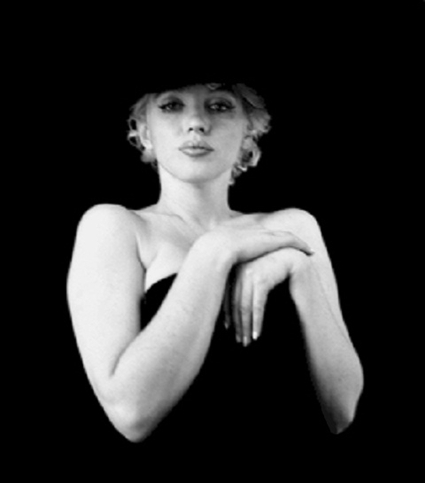
Marilyn shot by Milton Greene

“I don’t mind living in a man’s world as long as I can be a woman in it.”

“Husbands are chiefly good as lovers when they are betraying their wives.”

“People had a habit of looking at me as if I were some kind of mirror instead of a person. They didn’t see me, they saw their own lewd thoughts, then they white-masked themselves by calling me the lewd one.”

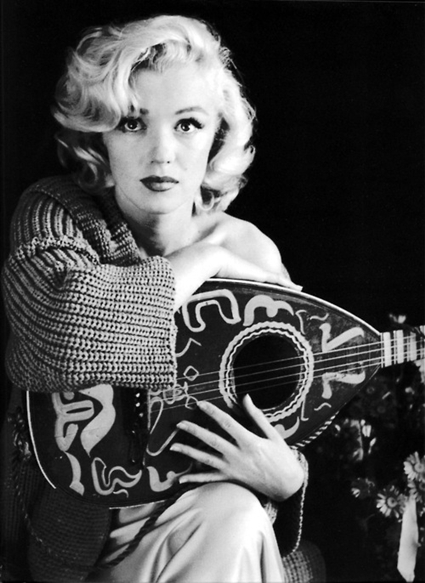
Marilyn shot by Milton Greene

“All the men I know are spending the day with their wives and families, and all the stores in Los Angeles are closed. You can’t wander through looking at all the pretty clothes and pretending to buy something.” – on why she hated Sundays

“Everyone’s just laughing at me. I hate it. Big breasts, big ass, big deal. Can’t I be anything else? Gee, how long can you be sexy?”

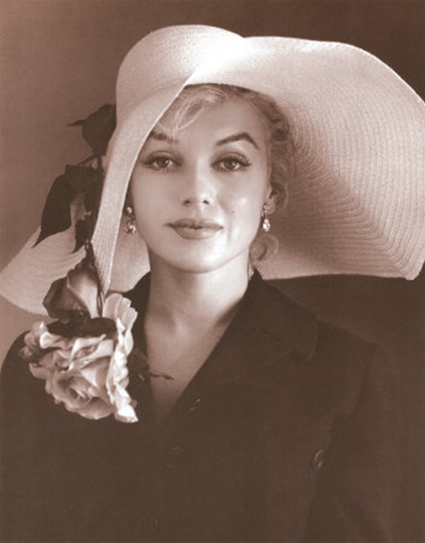
I love this shot and the elegant hat.

“Looking back, I guess I used to play-act all the time [as a child]. For one thing, it meant I could live in a more interesting world than the one around me.”

“No one ever told me I was pretty when I was a little girl. All little girls should be told they’re pretty, even if they aren’t.”

Marilyn in New York, shot by Ed Feingersh

“I’m selfish, impatient and a little insecure. I make mistakes, I am out of control and at times hard to handle. But if you can’t handle me at my worst, then you sure as hell don’t deserve me at my best.”

“My problem is that I drive myself … I’m trying to become an artist, and to be true, and sometimes I feel I’m on the verge of craziness. I’m just trying to get the truest part of myself out, and it’s very hard. There are times when I think, ‘All I have to be is true.’ But sometimes it doesn’t come out so easily. I always have this secret feeling that I’m really a fake or something, a phony.”

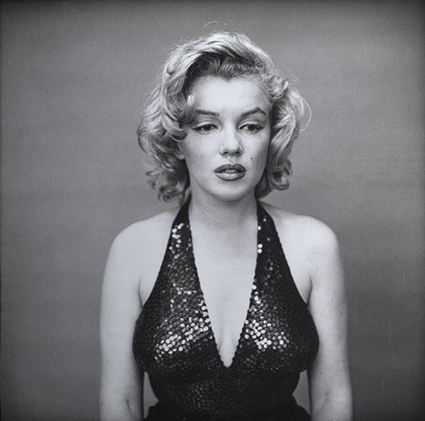
Marilyn shot by Richard Avedon

“Hollywood is a place where they’ll pay you a thousand dollars for a kiss and fifty cents for your soul.”

ABOUT MARILYN …

“Our marriage was a good marriage … it’s seldom a man gets a bride like Marilyn. I wonder if she’s forgotten how much in love we really were.” – Jim Dougherty talking to Photoplay magazine, 1953; they were married from 1942-46.

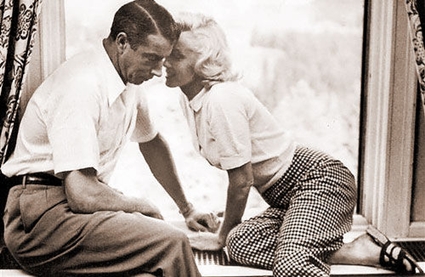
Marilyn and Joe DiMaggio were married less than a year.

“It’s like a good double-play combination. It’s just a matter of two people meeting and something clicks.” – Joe DiMaggio; he was married to Marilyn from Jan. 14, 1954 to Oct. 27, 1954

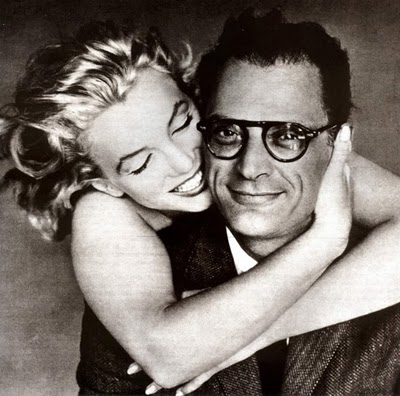
Marilyn and Arthur Miller, her third husband

“She was a whirling light to me then, all paradox and enticing mystery, street-tough one moment, then lifted by a lyrical and poetic sensibility that few retain past early adolescence. …

“She had no common sense, but what she did have was something holier, a long-reaching vision of which she herself was only fitfully aware: humans were all need, all wound. What she wanted most was not to be judged but to win recognition from a sentimentally cruel profession, and from men blinded to her humanity by her perfect beauty. She was part queen, part waif, sometimes on her knees before her own body and sometimes despairing because of it. …

“To have survived, she would have had to be either more cynical or even further from reality than she was. Instead, she was a poet on a street corner trying to recite to a crowd pulling at her clothes.” – Arthur Miller, her husband from 1956-61

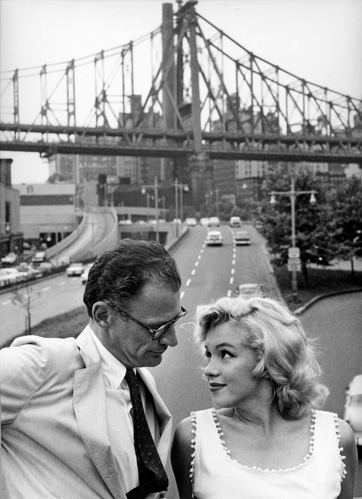
Marilyn Monroe and Arthur Miller in front of the Queensboro Bridge, New York, 1957. Sam Shaw/ Shaw Family Archives, Ltd.

“There’s a beautiful blonde name of Marilyn Monroe who makes the most of her footage.” xxxxxLiza Wilson of Photoplay magazine, writing about “The Asphalt Jungle,” 1950

She was, “a female spurt of wit and sensitive energy who could hang like a sloth for days in a muddy-mooded coma; a child girl, yet an actress to loose a riot by dropping her glove at a premiere; a fountain of charm and a dreary bore … she was certainly more than the silver witch of us all.” – Norman Mailer

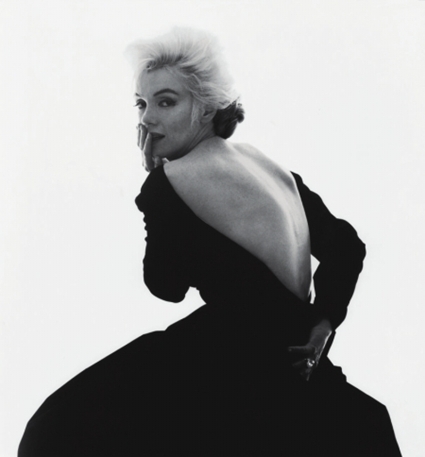
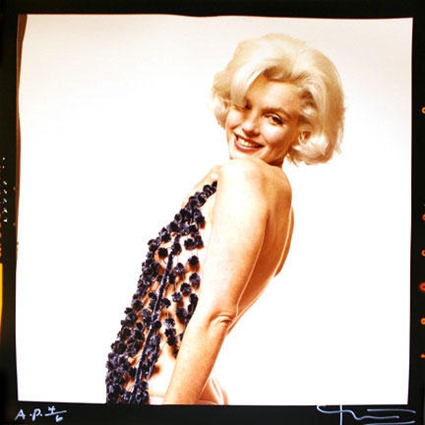
Marilyn shot by Bert Stern, 1962

‘‘From families that owned little but their own good names, she had inherited the fierce pride of the poor. Because she was sometimes forced to give in, to sell herself partially, she was all the more fearful of being bought totally.’’ – Gloria Steinem

“She deeply wanted reassurance of her worth, yet she respected the men who scorned her, because their estimate of her was her own.” – Elia Kazan

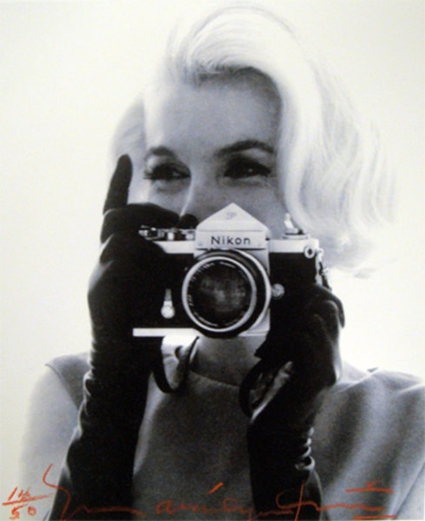
Marilyn shot by Bert Stern, 1962

All the sex symbols were endowed with a large portion of earthy coarseness. Marilyn had the most. … Only an inherent whore could walk like Marilyn and dress like Marilyn. … She had a trick of making all men feel she could be in love with them and I think she could be, a sort of saving each one for a rainy day, for when things would get tough again in her life and she would need help. … I saw the hope and the disappointments. The longing to give what the people wanted and, at the same time, to become a complete person herself. She was also selfish, rude, thoughtless, completely self-centered. She kept people waiting for hours.” – Hollywood columnist Sheilah Graham

Marilyn shot by Bert Stern, 1962

“The luminosity of that face! There has never been a woman with such voltage on the screen, with the exception of Garbo.” – Billy Wilder

“If she’d been dumber, she’d have been happier.” – Shelley Winters

“Everything Marilyn does is different from any other woman, strange and exciting, from the way she talks to the way she uses that magnificent torso.” – Clark Gable, her co-star of 1961’s “The Misfits,” about which he said: “This is the best picture I have made and it’s the only time I’ve been able to act.

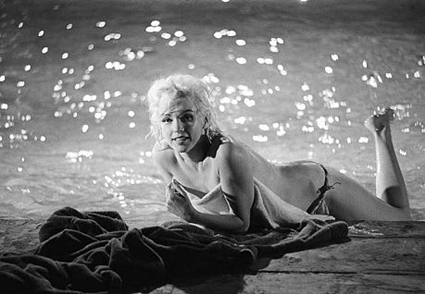
Marilyn shot by Lawrence Schiller on the set of “Something’s Got to Give,” 1962

“Her mixture of wide-eyed wonder and cuddly drugged sexiness seemed to get to just about every male; she turned on even homosexual men. And women couldn’t take her seriously enough to be indignant; she was funny and impulsive in a way that made people feel protective. She was a little knocked out; her face looked as if, when nobody was paying attention to her, it would go utterly slack – as if she died between wolf calls.” – Pauline Kael

“What I particularly liked about Marilyn was that she didn’t act like a movie star. She was down to earth. Although she was 28, she looked and acted like a teenager. … I was most impressed that Marilyn was always polite and friendly to everyone on the set. She was no phony or snob. … Marilyn always seemed determined to talk to me about her childhood. We would be discussing a subject of current interest to her and she would somehow bring up an incident from her bygone days.” – Photographer George Barris

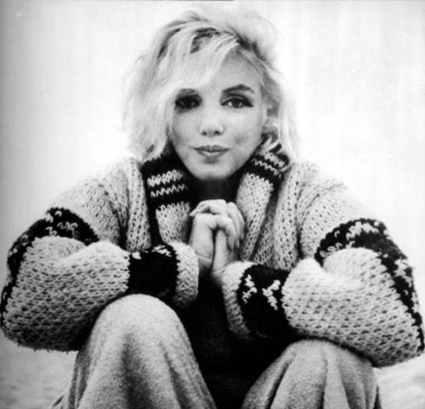
Marilyn shot by George Barris, 1962

“I liked her. She was a good kid. But when you looked into her eyes, there was nothing there. No warmth. No life. It was all illusion. She looked great on film, yeah. But in person … she was a ghost.” – Dean Martin, her co-star in 1962’s (unfinished) “Something’s Got to Give”

“Nobody could be as miserable as she was in such a loving, good-natured way. No matter how sad she may have been, she was never mean, never lashed out at me. Instead she just wanted to hug me and have me hug her and tell her it was all going to work out. That it didn’t, broke my heart.” – George Jacobs, who was Frank Sinatra’s valet

“Marilyn Monroe was a legend. In her lifetime she created a myth of what a poor girl from a deprived background could attain. For the entire world she became a symbol of the eternal feminine.” – Lee Strasberg in his eulogy

‘Murder by Contract,’ ‘Nightfall’ and ‘The Prowler’ close LACMA Mid-century California Noir series

Van Heflin

Louis B. Mayer once looked at me and said, ‘You will never get the girl at the end.’ So I worked on my acting.” – Van Heflin

I’m glad he did. Heflin, one of my favorite ’40s/’50s actors, had charisma and presence to spare, even if he wasn’t classically handsome. A case in point is 1951’s “The Prowler” by Joseph Losey, which played Saturday night at LACMA, after “Murder by Contract” and “Nightfall,” the last in the Mid-century California Noir series.

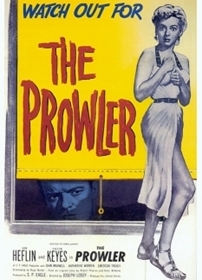
My favorite was “The Prowler,” recently restored by UCLA and the Film Noir Foundation. Here, Heflin plays Webb Garwood, a sleazy cop who’s called to a posh, Spanish-style Los Angeles home by lovely and lonely Susan Gilvray (Evelyn Keyes) after she has a vague suspicion that an intruder is lurking in the garden. Turns out, there’s no one there, but Webb and Susan hit it off and soon begin an affair. Susan’s nights are often free because her DJ husband, John, is at the radio station broadcasting his show.

Evelyn Keyes, John Maxwell and Van Heflin in "The Prowler."

It’s a love triangle in the vein of “Double Indemnity” and “The Postman Always Rings Twice” though here it’s Webb, not the femme fatale, who seizes the opportunity to do away with the wealthy husband and snag some money. Webb shoots John, apparently in the line of duty, leaving him free to marry Susan, ditch police work and move to Vegas.

When Susan announces she’s preggers, it crimps the plan rather a lot because the birth will reveal the true timing of their relationship. (This is actually a shocking plot turn because it reveals beyond a doubt that their relationship was sexual – other noirs hint at this, of course, but I can’t think of another example where it is so explicitly established. Not sure how they got that past the censors.) The two take off for a remote mountain town so she can secretly bear the child with no witnesses around. Once there, however, Webb reveals his knavish, venal nature and Susan takes action of her own.

Heflin perfectly inhabits this deeply flawed character, lending him charm and complexity, even making you sort of like him at times. He could play a snake so memorably – he won the Best Supporting Actor Oscar as a gangster’s pal in “Johnny Eager” and he was excellent in both “Possessed” with Joan Crawford and “Act of Violence,” where he played an Army traitor. Another noir highlight was playing Philip Marlowe on NBC radio in the late 1940s.

Heflin was just as adept at playing average Joes and good guys, most notably in “The Strange Love of Martha Ivers” (a film noir with Barbara Stanwyck and Kirk Douglas), “Shane” and “3:10 to Yuma.”

Keyes’ Susan is no vampy seductress. Instead, she plays the character as written – bland, bored and slightly feckless. Perhaps a fish out of water in the big city; she and Webb bond because they both hail from Terra Haute, Ind., albeit from different sides of the tracks. Keyes conveys that Susan is more than just bored – she yearns for children and perhaps something more than she finds in her cushy but unhappy marriage. And to her credit Keyes completely abandons her glamorous exterior when she’s sweating it out in the mountains.

Dalton Trumbo relaxes in Cannes, 1971.

Blacklisted writers Dalton Trumbo and Hugo Butler produced the script based on a story by Robert Thoeren and Hans Wilhelm. Trumbo provided the voice for Susan’s DJ husband; he is completely uncredited on the film.

It’s a movie that grabs you quickly and doesn’t let go – a testament to Losey’s marvelous direction. Cahiers du cinema pointed to “The Prowler” as the moment Losey became a true auteur. And Losey, who suffered professionally because of his supposed ties to the Communist Party, put it this way: “‘The Prowler’ to me is, and always has been, a film about false values. About the means justifying the end and the end justifying the means. $100,000 bucks, a Cadillac and a blonde were the sine qua non of American life at that time and it didn’t matter how you got them.”

For me, “The Prowler” was the hit of the LACMA triple-bill, though “Murder by Contract” (1958, Irving Lerner) and “Nightfall” (1957, Jacques Tourneur) also made compelling viewing. In “Murder,” written by Ben Maddow and Ben Simcoe, luscious Vince Edwards gives a thoroughly haunting performance as a smart, precise, driven hitman; slick cinematography by the brilliant Lucien Ballard and original guitar music by Perry Botkin add to the mood of tension and doom. The film was a key influence on Martin Scorsese and “Taxi Driver.”

Evocative visuals and location shooting in LA and Wyoming, courtesy of Tourneur and first-rate cinematographer Burnett Guffey, make “Nightfall” easy on the eyes. Given that the movie is based on a David Goodis novel (Stirling Siliphant wrote the script), I was disappointed that I found myself drifting in and out of the slightly thin story. Perhaps a dynamic lead actor, like Van Heflin, could have injected more drama, but Aldo Ray as an innocent man on the run just didn’t do it for me. His one-note realization lacked depth and nuance.

That said, I liked Brian Keith as his bad-guy nemesis (Keith probably could have played Ray’s part quite well) and Anne Bancroft as Ray’s romantic interest, a model and sometime bar-fly. Chris Fujiwara, author of “The Cinema of Nightfall: Jacques Tourneur,” calls her “one of Tourneur’s most distinctive heroines.”

And any film noir that features a sumptuous fashion show at the Beverly Hills Hilton is more than all right by me.

“Murder by Contract” and “Nightfall” are available from Sony Pictures Home Entertainment in the Film Noir Classics series; “The Prowler” from VCI Entertainment.

For author Tere Tereba, mobster Mickey Cohen is the ultimate anti-hero and the story of Los Angeles

Of America’s many grand and gaudy cities, Los Angeles has long been the ultimate siren.

This is the noir metropolis, both sunny and sordid, that gangster Mickey Cohen made completely his own. Brooklyn-born and LA-raised, Cohen as a young adult was uneducated, illiterate and had difficulty counting. But he was smart, tough, ambitious, ruthless, immoral and wildly lucky.

Model/designer/author Tere Tereba shot by Moshe Brakha

He was also the ne plus ultra dreamer, lured by seemingly limitless opportunity to reinvent himself by acquiring staggering amounts of money and clout. It’s hard to imagine his rise from grubby paper boy to one of the most prominent figures in the underworld taking place anywhere but the City of Angels.

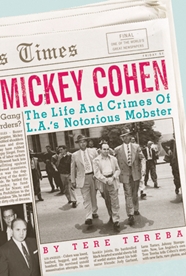
Indeed for author Tere Tereba, Cohen is Los Angeles. Her book “Mickey Cohen: The Life and Crimes of L.A.’s Notorious Mobster” (ECW, $16.95 paperback/$29.95 hardcover) outlines the history of the man and the city, from Prohibition to the mid ’70s. “He was LA’s top mobster for a generation,” Tereba recently told me over a glass of iced tea in her elegant living room.

“He terrorized, captivated and corrupted Los Angeles. He’s about to be introduced to the American public through ‘Gangster Squad’ (the upcoming movie in which Sean Penn plays Cohen) and people don’t know who Mickey Cohen really was.”

Tereba, an award-winning fashion designer and journalist, is a quintessential Angelino. Born in Warren, Ohio, she has lived here since childhood. As a teenager, Tereba frequently saw bands at Sunset Strip clubs and connected with Jim Morrison’s girlfriend, Pamela Courson, who jump-started her design career.

Tere Tereba shot by George Hurrell

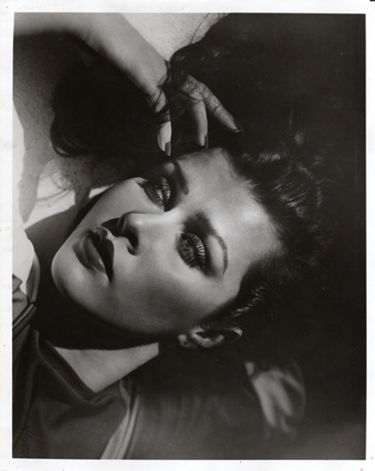
Tereba’s account of Morrison in Paris was selected by The Doors to appear in their book, The Doors: An Illustrated History. In addition to her creative talent, Tereba’s classic features and stop-and-stare bone structure drew much attention, from the likes of famed Hollywood photographer George Hurrell for whom she modeled and Andy Warhol, who cast her in his 1977 black comedy “Bad.” Warhol described Tereba as looking like Hedy Lamarr and acting like Lucille Ball.

The day I met her, she wore a chic black dress, a vintage shrimp-pin and zebra-stripe pumps. “I could put on one of my Irene suits, if you want,” she offered, with a laugh.

Tereba’s book renders a portrait of a complex and compelling man in a city ripe with chances to strike it big, especially for unscrupulous players. Of Cohen’s return to the West Coast in 1937 after a stint in Cleveland and Chicago, Tereba writes: “He found Los Angeles to still be a big small town. The underworld setup, the 23-year-old learned, was not the eastern system.” Or as Cohen put it, “Gambling and everything … was completely run by cops and stool pigeons.”

Fast forward to the fall of 1955, when Cohen, 42, was released from McNeil Island Federal Penitentiary. Tereba describes Cohen’s turf this way: “The land of perpetual summer, carnal delights, and blue-sky ennui still captured the imagination of dreamers everywhere. But L.A. had changed. Bigger and bolder than ever, freeways linked the suburban sprawl. Hollywood’s old guard had lost their luster; a new and different breed was on the horizon.”

Tere Tereba shot by Paul Jasmin

Speaking of Hollywood, Tereba’s book explores the intersection between mafia characters and the Tinseltown elite, such as the 1958 fatal stabbing of Johnny Stompanato by Lana Turner’s daughter, Cheryl Crane.

Until Cohen’s death on July 29, 1976 (he died in his sleep, having survived 11 assassination attempts over the years), the brawny former boxer lived each moment intensely, often courting publicity and flaunting his power.

Said Tereba during our interview: “He was the ultimate anti-hero because he did what he wanted to do. He went against the cops, he fought city hall. He did all the things you’re not supposed to do and everybody’s afraid to do.

“You don’t get more outrageous and brazen than Mickey Cohen. Even his showy style of doing business. He dressed the way he wanted to, in a semi-Zoot suit. He knew what he liked and he followed it.”

Some facts are already well known. In setting the scene, Tereba reminds the reader: “After the [1938] scandal decimated the LAPD, the city of Los Angeles was closed to underworld activity. But Los Angeles County remained wide open.

Tere Tereba shot by Moshe Brakha

“Sheriff Eugene Biscailuz’s mighty domain stretched from Lancaster in the north to Catalina Island, 26 miles off the coast, south to Orange County, and east to San Bernadino County – from the desert to the mountains to the sea.

“Geographically the largest county in the country, at more than 4,000 square miles, it was bigger than many eastern states and made up 43 percent of the state’s population.”

She also reveals never-before-released documents and information, such as the anxiety disorder Cohen struggled with for most of his life, his wife LaVonne’s unsavory background and his relationships with women after he and LaVonne divorced in 1958.

Much has been written, speculated, invented and whitewashed about Cohen and his city. Tereba spent more than 10 years researching and writing her book; she tells Cohen’s story swiftly and assuredly. Her page-turning and entertaining narrative neither glamorizes nor judges its subject.

Mickey Cohen

By the time “Gangster Squad” hits screens this fall and plants Mickey Cohen firmly in the spotlight (which he would have loved) Tereba’s readers will have already pierced through the shadows that have shrouded him for decades.

Tereba will discuss and sign her book at 7:30 p.m. on Thursday, June 14, at Skylight Books, 1818 N. Vermont Ave., Los Angeles, 90027.