Retro restaurants> FNB dishes on dining: Russell’s in Pasadena

Might noir master James M. Cain have drawn inspiration from Russell’s?

Russell’s
30 N. Fair Oaks Ave.
Pasadena, CA 91103
626-578-1404

Hours: Open 7 a.m.-9 p.m. Sunday through Thursday; 7 a.m.-10 p.m. Friday and Saturday.
Parking: Street or garage at 30 E. Union St.
Price: Lunch/dinner entrees: $10-$18; separate breakfast menu

The Set Up: Russell’s is a cozy, upscale diner that’s been around since 1930. James M. Cain’s novel “Mildred Pierce” (published in 1941 and made into a movie with Joan Crawford in 1945) was set in nearby Glendale. Mildred made her small fortune in the restaurant biz; perhaps Cain drew some culinary inspiration from this spot.

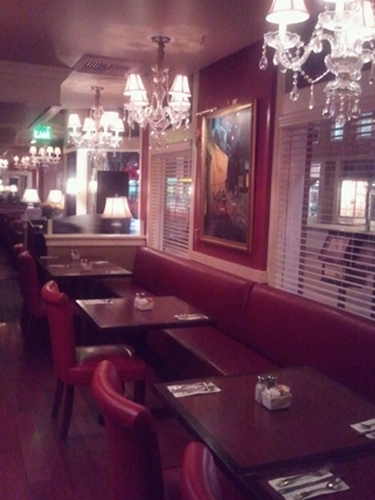
The Style: In terms of décor, Russell’s, with its red leather seats and chandeliers, feels more American bistro than trad diner, but then what’s wrong with some swank while you sup? Nothing in our book.

A slice of pie to make Mildred Pierce proud.

The Stuff: The lunch/dinner menu has a nice variety of meat, fish and pasta dishes along with burgers, sandwiches and salads. We tried the grilled salmon salad (the fillet comes on a generous bed of pristine romaine lettuce, tomatoes and vinaigrette dressing) and a glass of The Crossings New Zealand Sauvignon Blanc. For dessert: cherry pie à la mode mode with coffee. Delicious, fresh and packed with fruit, the best slice of pie we’ve tried in quite a while.

The Sting: Would be nice to see a cocktail list, but Russell’s is licensed for wine and beer only.

The Standout: The food is top-notch and the service is excellent – friendly, attentive and relaxed. When we asked the server what kind of coffee was used, he went to the kitchen to check and brought out a small package of Apffels for us to take home. Lovely!

Btw, this weekend is the last chance to see “A Conversation with Edith Head,” starring Susan Claassen, at the Pasadena Playhouse. This great show closes Dec. 1.

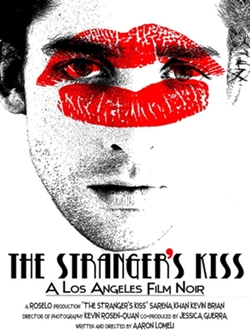
Director looks at intimacy, anonymity in ‘Stranger’s Kiss’ short

“Noir’s almost like a support group,” jokes LA-based filmmaker Aaron Lomeli. “It’s a way of saying ‘Oh, there are other people out there who feel the same way I do.’ Noir is more than pulp magazines and crime films, it’s an attitude I identify with. I’m attracted to the darker side of human nature.”

Lomeli brings his attitude to the screen in his first short film (outside of USC), “The Stranger’s Kiss,” about two young strangers (Sarena Khan and Kevin Brian) who meet outside a bar and quickly become involved – in more ways than one.

Besides wanting to evoke the feeling of classic noir, the writer/director says he wanted to express something about his experience with the LA dating scene, “I find there’s an odd balance between anonymity and intimacy with dating. Young men and women want to get close to someone without giving away too much of themselves just in case the next best thing is right around the corner. It’s hard to ever really know someone out here.”

“The Stranger’s Kiss” will play Saturday, Dec. 1, as part of the Los Angeles Neo Noir Erotic Film Fest, which touts itself as hosting the world’s sexiest and darkest crime short films. The fest plays at 8 p.m. at the Independent Theater, 251 S. Main St., in downtown LA. You can see a trailer of “The Stranger’s Kiss” here.

The Noir File: French style from Jean Gabin in ‘Grisbi’

By Michael Wilmington and Film Noir Blonde

The Noir File is FNB’s guide to classic film noir, neo-noir and pre-noir on cable TV. All movies below are from the schedule of Turner Classic Movies (TCM), which broadcasts them uncut and uninterrupted. The times are Eastern Standard and (Pacific Standard). Lots of Robert Mitchum and Gloria Grahame this week!

PICK OF THE WEEK

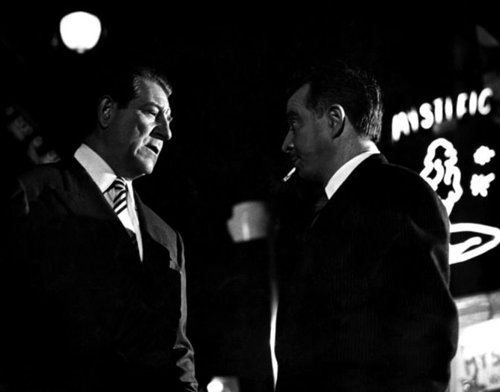
Legendary, stylish Jean Gabin plays a legendary, stylish gangster named Max le Menteur.

Touchez pas au Grisbi” (1954, Jacques Becker). Friday, Nov. 30, 11:15 p.m. (8:15 p.m.): Film noir is a French term and the masters of the form include major French filmmakers as well as Americans. One of those masters is New Wave favorite Jacques Becker (“Casque d’Or“). And Becker’s noir masterpiece is “Touchez pas au Grisbi.” The film takes a wonderfully atmospheric and psychologically acute look at the Parisian underworld: at a legendary, stylish old gangster named Max le Menteur (played by the legendary, stylish Jean Gabin), at the spoils of Max’s last big job and at the unbreakable ties of friendship that entrap him. Adapted by Becker and Albert Simonin from Simonin’s novel, with two later noir mainstays in small roles: Jeanne Moreau and Lino Ventura. The title translates as “Don’t Touch the Loot.” (In French, with subtitles.)

Monday, Nov. 26

7 a.m. (4 a.m.): “The Narrow Margin” (1952, Richard Fleischer).

6:30 p.m. (3:30 p.m.): “The Steel Trap” (1952, Andrew L. Stone). In a neat twist from writer-director Stone, Joseph Cotten plays a bank employee/embezzler, desperately trying to return the loot he filched. With Teresa Wright. A favorite of noir expert Foster Hirsch.

Tuesday, Nov. 27

6 p.m. (3 p.m.): “Brighton Rock” (1947, John Boulting). From Graham Greene’s classic novel about a babyfaced killer on Brighton beach named Pinkie (Richard Attenborough), smartly co-scripted by Greene.

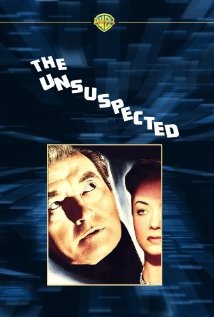
2:30 a.m. (11:30 p.m.): “The Unsuspected” (1947, Michael Curtiz). Lesser-known but strong noir about a radio true crime show, whose producer (Claude Rains) becomes a murderer. With Joan Caulfield, Constance Bennett, Hurd Hatfield and Audrey Totter.

4:30 a.m. (1:30 a.m.): “The Woman on the Beach” (1947, Jean Renoir). Renoir’s U.S. noir: A disturbed guy (Bob Ryan) gets involved with a blind painter (Charles Bickford) and his sexy wife (Joan Bennett).

Wednesday, Nov. 28

7:15 a.m. (4:15 a.m.): “Crossfire” (1947, Edward Dmytryk). The famous postwar thriller about an anti-Semitic murder, co-starring Robert Mitchum, Robert Ryan, Robert Young and Gloria Grahame.

1:15 p.m. (10:15 a.m.): “Macao” (1952, Josef von Sternberg & Nicholas Ray). Robert Mitchum and Jane Russell strike sultry sparks in this exotic thriller from Howard Hughes’ RKO. Directed by Josef Von Sternberg, with uncredited reshooting by Nick Ray. Co-starring Gloria Grahame, William Bendix and Thomas Gomez.

2:45 p.m. (11:45 a.m.): “The Big Heat” (1953, Fritz Lang).

Friday, Nov. 30

12:30 p.m. (9:30 a.m.): “White Heat” (1949, Raoul Walsh).

8 p.m. (5 p.m.): “The Locket” (1946, John Brahm). Flashbacks within flashbacks adorn this stylish psychological noir about a troubled seductress (Laraine Day). With Robert Mitchum and Brian Aherne.

Highly entertaining ‘Hitchcock’ lacks inherent drama

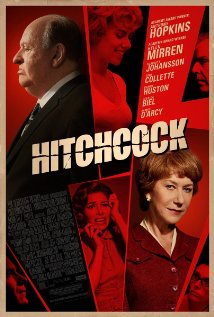
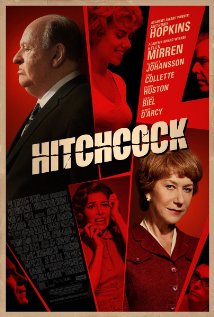
For me, the much-awaited “Hitchcock,” which had its world premiere at AFI Fest 2012 presented by Audi, is the cinematic equivalent of the curate’s egg: parts were good. And the actors were quite good (Oscar-worthy some say) in their parts: Anthony Hopkins as director Alfred Hitchcock, Helen Mirren as his wife Alma Reville and Scarlett Johansson as actress Janet Leigh.

We meet the Hitchcocks in 1959, enjoying the success of “North by Northwest,” Hitch and Alma having made the critical flop “Vertigo” the year before. At 60, the great auteur was at the height of his fame and yet was unable to convince Paramount to finance his next film, “Psycho,” a story based on Robert Bloch’s lurid novel about a serial killer. So the couple decide to finance it themselves – a huge gamble that paid off nicely at the box office and with critics. The movie was nominated for four Oscars.

Against this backdrop, director Sacha Gervasi depicts the artist as a brilliant, shrewd, canny and compulsive man with no end of personal peccadilloes (overeating and obsessing over elegant blondes top the list) and renders a portrait of a marriage that was at times strained but resilient enough to last 54 years.

Upon accepting the AFI Lifetime Achievement Award in 1979, Hitchcock said: “I beg permission to mention by name only four people who have given me the most affection, appreciation, and encouragement, and constant collaboration. The first of the four is a film editor, the second is a scriptwriter, the third is the mother of my daughter Pat, and the fourth is as fine a cook as ever performed miracles in a domestic kitchen. And their names are Alma Reville.”

Arguably, their ultimate bond was the work – making movies that masterfully blend high art, humor and entertainment in a way that has been often repeated and only rarely rivaled.

With its luscious looks, meticulous period details and engaging performances (even if Hopkins sometimes veers into a slightly mannered impersonation), Gervasi’s “Hitchcock” entertains, to be sure. The opening sequence and the scenes where we see Hitch directing Leigh are especially memorable.

But as I watched this glossy yarn, I couldn’t help wondering why this story was being told, what it was adding or subtracting to the legacy of Alfred and Alma. In other words, because “Hitchcock” lacks an inherent drama and an editorial stance by Gervasi, it also fails to involve us deeply or move us. That said, there’s an intrigue to the back story of a film as famous as “Psycho” and, to that end, “Hitchcock” doesn’t disappoint.

“Hitchcock” opens today in limited release.

Happy Thanksgiving, everyone!

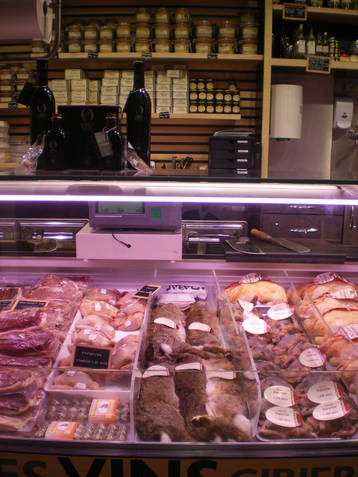
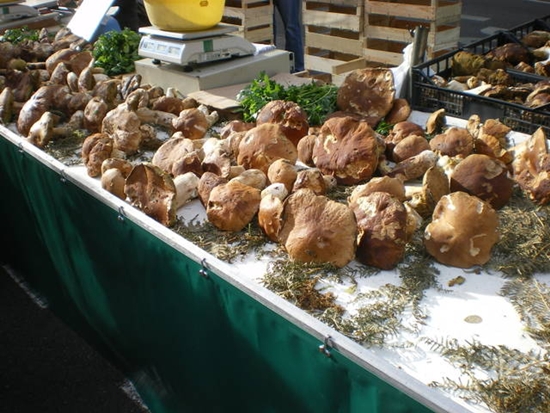
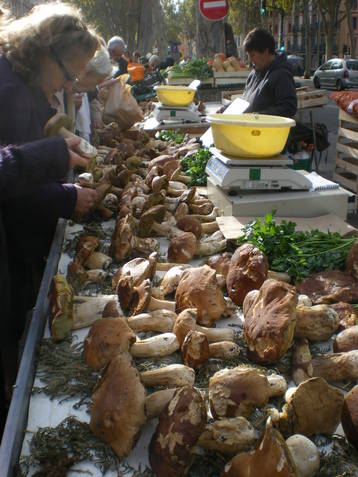
Besides film, one of my great loves is food and in particular French food. (Not that I don’t love the classics, turkey, dressing, pumpkin pie & the rest.) For the feasting holiday, I’m sharing these gorgeous pictures from my treasured friend of many years and beyond-gracious hostess, Veronique Tourneux. Veronique lives in Paris – she shot these on a recent trip to Toulouse.

If, after stuffing, you are inclined to read some movie reviews, I refer you to my Thanksgiving special from last year where I gave thanks for the film noir talents of Fritz Lang, Joan Bennett, Edward G. Robinson and Dan Duryea in “The Woman in the Window” and “Scarlet Street.”

For the rest of the weekend, I am following the lead of Bennett’s character in “Scarlet Street” a.k.a. Lazy Legs and letting the dishes pile up in the sink while I lounge around eating bonbons.

Some of the local specialties, not yet all tested.

Foie gras is just one of the goodies at the covered market.

Terrific those cèpes, especially with a magret de canard and a Cahors red wine.

The open-air market and its seasonal products.

FNB joins History Channel’s new community curator section

I’m very excited to announce that I’ve been selected as one of the History Channel’s Community Curators! Along with several other genre experts, I created a list of my all-time favorite movies in my special category (film noir). Each of them has a short synopsis.

My recommendations for the Best of Film Noir can be found on the site’s shop section, home to a rich variety of contemporary and classic films.

I’m really happy to be associated with the History Channel (HISTORY®), which describes itself as the leading destination for top quality entertainment programming, with award-winning original series and event specials that connect viewers with history in an informative, immersive and engaging manner across multiple platforms. The network’s all-original hit series includes American Pickers®, Ice Road Truckers® and Swamp People® as well as epic specials such as the Emmy® Award-winning Gettysburg.

The Noir File: Six gems by the all-time master of suspense

By Michael Wilmington and Film Noir Blonde

The Noir File is FNB’s weekly guide to classic film noir, neo-noir and pre-noir on cable TV. All the movies below are from the current schedule of Turner Classic Movies (TCM), which broadcasts them uncut and uninterrupted. The times are Eastern Standard and (Pacific Standard).

PICK OF THE WEEK

Six by Alfred Hitchcock (1941-59) Friday, Nov. 23, 6:30 a.m. – 6 p.m. (3:30 a.m.- 3 p.m.)

Hitchcock was the movies’ all-time master of suspense – the supreme chronicler of wrong men on the run and notorious ladies in distress, of psychos and vertigo, of scenic spy chases and excruciating murder scenes, of shadows and strangers and suspicion, and most of all, of expert suspense movies, pulse-pounding pictures that got you on the hook fast, and kept you there until the last minute.

He was also the master of film noir, as this six film mini-marathon of movies proves. Dating from the heyday of both Hitchcock and classic noir (1941 to 1959), they’re films that you may have seen before, but that are always welcome for a fresh viewing. Hitchcock was one of the most punctilious, painstaking and brilliantly inventive of all major movie artists and that’s why you can see these pictures over and over. While you’re in the mood, you’ll probably also want to catch the opening of the new movie “Hitchcock,” Sacha Gervasi’s bio-thriller about the making of “Psycho,” with Anthony Hopkins as the master of suspense himself.

Friday, Nov. 23, 6:30 a.m. (3:30 a.m.): “The Dick Cavett Show” (1972). Cavett interviews Hitch, for the release of “Frenzy.”

8 a.m. (5 a.m.): “Under Capricorn” (1949). In this somewhat stiff Australian-set period romance, Ingrid Bergman plays a reclusive alcoholic torn between bad-tempered husband Joseph Cotten and charming visitor Michael Wilding – with Margaret Leighton a scene-stealer as the obsessive housekeeper. One of the director’s rare commercial flops, “Under Capricorn” is still notable for its complex, long-take moving camera scenes (like the ones in “Rope”).

10 a.m. (7 a.m.): “Strangers on a Train” (1951).

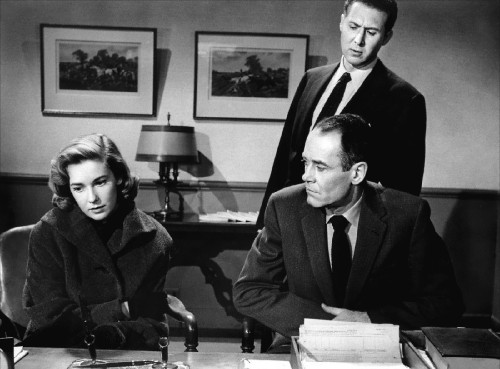
Vera Miles and Henry Fonda star in “The Wrong Man,” which is based on a true incident.

11:45 a.m. (8:45 a.m.) “The Wrong Man” (1956). Hitchcock takes a real-life episode –the arrest and conviction of New York musician Manny Balestrero (Henry Fonda) for a robbery he didn’t commit – and squeezes out as much suspense as he does from his fictional thrillers. Co-scripted by playwright Maxwell Anderson; with Vera Miles and Harold J. Stone.

1:45 a.m. (10:45 a.m.): “North by Northwest” (1959). One of Hitchcock’s two great spy-chase thrillers (the other is “The 39 Steps”), “North by Northwest” follows a suave but beleaguered Manhattan advertising executive (Cary Grant), who’s mistaken for a spy who doesn’t exist, charged with a murder he didn’t commit, pursued by bad guys (James Mason, Martin Landau) whose machinations bewilder him. Oh and he’s involved with a blonde beauty (Eva Marie Saint) who may want him dead. And then there’s that pesky crop-dusting plane “dustin’ where there ain’t no crops.” One of the best, most typical and most beautifully made Hitchcocks. Ingeniously scripted by Ernest Lehman.

4:15 p.m. (1:15 p.m.): “Suspicion” (1941).

6 p.m. (3 p.m.): “Dial M for Murder” (1954).

Sunday, Nov. 18

2 p.m. (11 a.m.): “Casablanca” (1942, Michael Curtiz).

Tuesday, Nov. 20

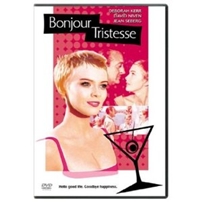
4 p.m. (1 p.m.): “Bonjour Tristesse” (1957, Otto Preminger). Smooth as silk and cool as champagne, Preminger’s adaptation of the young French writer Françoise Sagan’s cynical novel, focuses on a brainy young belle (Jean Seberg), whose intense relationship with her playboy father (David Niven) is disrupted by his perceptive fiancée (Deborah Kerr) – a clash that leads to darker currents and conflicts. Seberg’s chilly performance here inspired her role several years later in Jean-Luc Godard’s “Breathless.”

Film noir titles to release on DVD from TCM and Universal, thriller marathon in January

Turner Classic Movies (TCM) and Universal Studios Home Entertainment (USHE) are releasing a terrific three-disc DVD collection on Dec 3. Dark Crimes: Film Noir Thrillers highlights the work of legendary mystery writers Dashiell Hammett, Cornell Woolrich and Raymond Chandler.

The set includes:

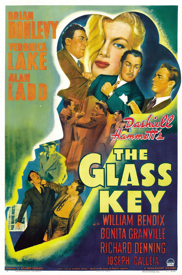
“The Glass Key” (1942, Stuart Heisler) – Brian Donlevy, Alan Ladd and Veronica Lake star in this stylish remake of the 1935 film based on Hammett’s popular novel. The story follows a ruthless political boss and his personal adviser, who become entangled in a web of organized crime and murder involving the daughter of a rising gubernatorial candidate. Akira Kurosawa once claimed this film to be the inspiration for his classic samurai flick “Yojimbo” (1961).

“Phantom Lady” (1944, Robert Siodmak) – A man arrested for murdering his wife is unable to produce his only alibi – a mysterious woman he met in a bar – in this adaptation of a Woolrich novel. Now his loyal secretary must go undercover to locate her. Ella Raines, Franchot Tone, Thomas Gomez, Alan Curtis and Elisha Cook Jr. star. A sexually charged drumming scene was reportedly dubbed by legendary musician Buddy Rich.

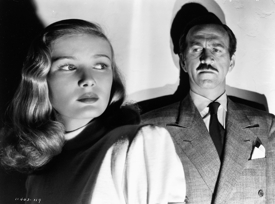
“The Blue Dahlia” (1946, George Marshall) – A WWII veteran who has been accused of killing his unfaithful wife races against time to find the real murderer with the help of a sympathetic stranger. Alan Ladd, Veronica Lake, William Bendix, Howard da Silva and Hugh Beaumont star in this John Houseman production. Chandler’s original screenplay earned an Oscar nomination.

Veronica Lake and Howard da Silva share a tense moment in “The Blue Dahlia.”

Dark Crimes: Film Noir Thrillers will be available from TCM’s online store, which is currently accepting pre-orders. TCM will show “The Glass Key” on Dec. 2.

Additionally, on Jan. 17, author and noir expert Eddie Muller will join TCM host Robert Osborne to present five memorable thrillers from the 1950s. The lineup is set to feature “Cry Danger” (1951, Robert Parrish) with Dick Powell and Rhonda Fleming; “99 River Street” (1953, Phil Karlson) starring John Payne and Evelyn Keyes; “Tomorrow is Another Day” (1951, Felix E. Feist) with Ruth Roman and Steve Cochran; “The Breaking Point” (1950, Michael Curtiz), starring John Garfield and Patricia Neal; and “The Prowler” (1951, Joseph Losey), starring Van Heflin and Evelyn Keyes.

The Noir File: Bogie as Sam Spade and Philip Marlowe, Meeker as Mike Hammer

By Michael Wilmington and Film Noir Blonde

The Noir File is FNB’s weekly guide to classic film noir, neo-noir and pre-noir on cable TV. All the movies below are from the current schedule of Turner Classic Movies (TCM), which broadcasts them uncut and uninterrupted. The times are Eastern Standard and (Pacific Standard).

PICK OF THE WEEK

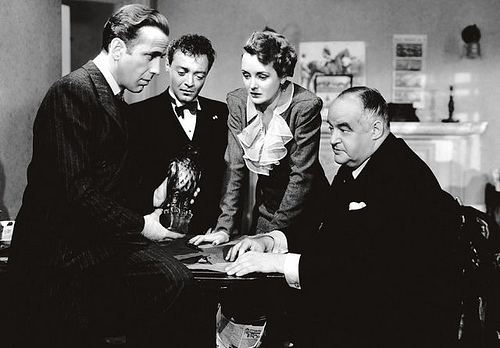
The Maltese Falcon” (1941, John Huston) Wednesday, Nov. 14, 8 p.m. (5 p.m.)

Bogart leads an unbeatable cast in “The Maltese Falcon,” directed by John Huston.

Dashiell Hammett’s supreme hard-boiled detective novel, with Humphrey Bogart as private eye Sam Spade, and an unbeatable supporting cast that includes femme fatale Mary Astor, genial fat man Sydney Greenstreet, perfumed crook Peter Lorre, patsy Elisha Cook Jr., and tough cops Ward Bond and Barton MacLane – all turned by writer-director John Huston into “the stuff that dreams are made of.”

Sunday, Nov. 11

12 p.m. (9 a.m.): “Witness for the Prosecution” (1957, Billy Wilder).

2:30 a.m. (11:30 p.m.): “Pickpocket” (1959, Robert Bresson). Bresson’s celebrated French art film borrows from Dostoyevsky to tell the story of an alienated young Parisian pickpocket (Martin LaSalle) who enters a shadow world of crime, punishment and strange redemption. With Marika Green (In French, with English subtitles.)

Monday, Nov. 12

5:15 p.m. (2:15 p.m.): “The Leopard Man” (1943, Jacques Tourneur). From a story by Cornell Woolrich: the nervous noir of a city plagued, it seems, by serial killings and a runaway wild leopard. Dennis O’Keefe, Margo and Abner Biberman.

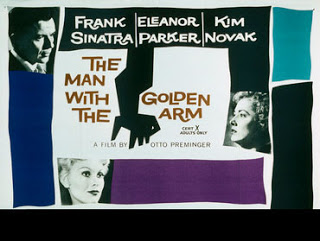
8 p.m. (5 p.m.): “The Man with the Golden Arm” (1955, Otto Preminger). As a man struggling to give up his heroin habit, Frank Sinatra leads a superb cast in this riveting adaptation of Nelson Algren’s novel. Kim Novak plays his ex-girlfriend. Sinatra earned a Best Actor Oscar nom; the film’s music (by Elmer Bernstein) and art direction-set decoration also were considered for Oscars.

12:30 a.m. (9:30 p.m.): “Lolita” (1962, Stanley Kubrick).

Tuesday, Nov. 13

5 p.m. (2 p.m.): “Anatomy of a Murder” (1959, Otto Preminger).

Wednesday, Nov. 14

6:15 p.m. (3:15 p.m.): “Born to Kill” (1947, Robert Wise).

10 p.m. (7 p.m.): “The Big Sleep” (1946, Howard Hawks).

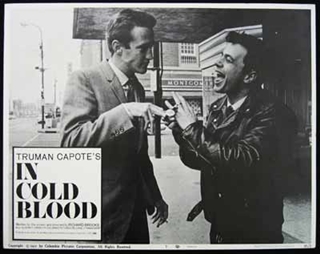
2 a.m. (11 p.m.): “In Cold Blood” (1967, Richard Brooks). From Truman Capote’s legendary true-crime novel: the shattering chronicle of killers Perry Smith and Dick Hickok (Robert Blake and Scott Wilson), the Kansas family they destroyed, and the deadly destiny they shared. With John Forsythe, Charles McGraw and evocative black-and-white cinematography by Conrad Hall.

4:30 a.m. (1:30 a.m.): “Kiss Me Deadly” (1955, Robert Aldrich).

Thursday, Nov. 15

10 a.m. (7 a.m.): “The Mask of Dimitrios” (1944, Jean Negulesco). An engrossing thriller based on Eric Ambler’s classic novel of intrigue, espionage and crime, “A Coffin for Dimitrios.” With Zachary Scott, Peter Lorre, Sydney Greenstreet and Faye Emerson.

4 p.m. (1 p.m.): “A Kiss Before Dying” (1956, Gerd Oswald). A charming psychopath (Robert Wagner) preys on two sisters (Joanne Woodward, Virginia Leith) in this tense adaptation of the novel by Ira Levin (“Rosemary’s Baby”). With Jeffrey Hunter and Mary Astor; directed by Gerd Oswald (“The Outer Limits”).

6 p.m. (3 p.m.) “Strangers on a Train” (1951, Alfred Hitchcock).

Director William Friedkin reveals the father of film noir

Mystery writer Georges Simenon “probably invented film noir,” said Academy Award-winning director William Friedkin on Thursday at a tribute to the famed Belgian author. The panel discussion and cocktail party at the W Hotel in Hollywood was hosted by Georges Simenon Ltd. and the Ile de France Film Commission.

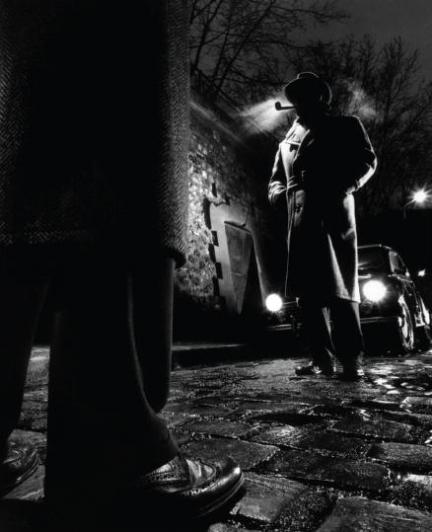
An image from the Simenon tribute invitation

One of the best-selling writers of the 20th century, Simenon (1903-89) was uncommonly prolific – he produced 191 novels and 160 short stories, in addition to other writing.

His spare, minimalist crime stories (particularly his tales of the pipe-smoking café-frequenting Inspector Jules Maigret) clicked with millions of readers and the likes of William Faulkner, Gabriel Garcia Marquez, Jean Renoir, Claude Chabrol and Akira Kurosawa.

Simenon’s work inspired 70 feature films and 500 hours of TV worldwide.

“I started reading Simenon around the time I made ‘The French Connection,’ ” said Friedkin. “I certainly was influenced by his writing. He’s thought of as a thriller writer but he defies genre. The ‘romans durs’ [tough novels] were the ones that most resonated with me. They’re so simple and yet complex in their portrayal of character.”

Friedkin pointed to “The Man on the Eiffel Tower” (1949, Burgess Meredith) as one of the most exciting Simenon adaptations. Based on the novel “A Battle of Nerves” and starring Charles Laughton as Maigret, Friedkin said the scene in a crowded restaurant as the murderer and detective get into a heated talk amid ever-louder violins is “absolutely magnificent and may be my favorite scene in the movies.”

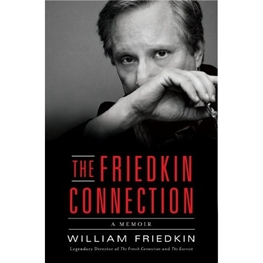
(More of Friedkin’s cinematic influences and inspirations likely will be revealed in his forthcoming book, “The Friedkin Connection: A Memoir,” which he confirmed at the party is scheduled for publication in March 2013.)

Joining Friedkin on the panel were John Simenon (one of the author’s sons), scriptwriter John Brian King and Olivier-René Veillon of the Ile de France Film Commission.

John Simenon confirmed that his father’s friendships with cops, criminals and doctors (he also read medical journals regularly) lent his work a gritty authenticity. Furthering the inventor-of-film-noir description, Veillon explained that the city of Paris, which was radically rebuilt and modernized in the 1860s according to Baron Haussmann’s vision, served as a gift to artists, especially Simenon.

“All the characters are defined by their location and their relationship with the city,” Veillon said. Just as the reconceived Paris and its denizens provided rich fodder for Simenon’s imagination, his fiction is ripe for new adaptations on screen.

Friedkin also asked John Simenon to recount his relationship with his father. “He was demanding in terms of how to conduct yourself and how to be a man. But he was there and he was very present, much more present than many fathers are today and more present than I can be for my son.”

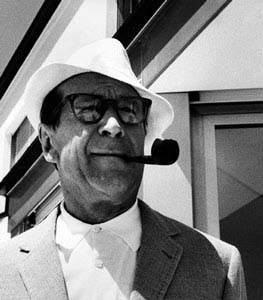
Georges Simenon, 1963, by Erling Mandelmann.

One of the first questions from the audience came from a sly Brit, who wanted to know the secrets to Simenon’s sex life, referencing the notion that Simenon was one of the great Casanovas of his time and claimed to have slept with 10,000 women.

First noting that he had not inherited this trait, John Simenon said this comment was “totally overblown” and “more of a joke” stemming from a reported conversation with director Federico Fellini. Between his work, his children and his love for food and cooking, that much bed-hopping would have been a mighty scheduling challenge.

His personal life aside, one of the most important women Georges Simenon knew was the French novelist Colette (1873-1954), whom he met early in his career and who advised him to eschew the literary, to cut his stories to the bone.