‘D.O.A.’ reveals the ultimate inspiration to solve a murder: when it’s your own

D.O.A./1950/United Artists/83 min.

“I don’t think you fully understand, Bigelow,” says a doctor to his shocked patient, “you’ve been murdered.”
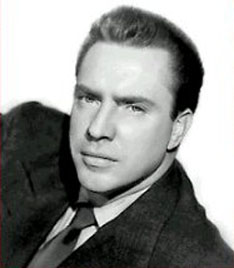
Edmond O’Brien is doomed in “D.O.A.”

This is the premise for 1950’s “D.O.A.,” directed by Rudolph Maté, a classic noir about a standup, solid guy from Banning, Calif., named Frank Bigelow (Edmond O’Brien) who, while on a trip to San Francisco, learns he has been poisoned with a time-released fatal toxin. He has just a few days to find his murderer. And here he thought it was just a hangover.

It’s particularly bad luck because Bigelow hasn’t served time, he doesn’t play the horses, he’s not eyeing easy money. He is a self-employed accountant in a small town near Palm Springs minding his own business. True, he does like hard liquor, is a bit of a skirt chaser and he’s on the fence about committing to doting girlfriend Paula Gibson (Pamela Britton), but those are minor flaws in the noir scheme of things.
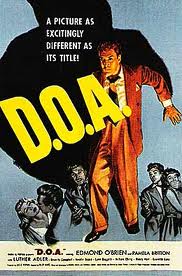
D.O.A posterEven though Bigelow is dying, his genetic tough-guy instinct kicks as he abandons his ledger book and adding machine to follow clues, talk tough, tote a gun and chase his prey. Clearly, he missed his calling as a macho gumshoe who could give Phillip Marlowe or Sam Spade a run for their money.

Checking in via phone calls to Paula, who also happens to be his secretary, he learns that a Mr. Phillips, an importer-exporter in Los Angeles, has been urgently trying to contact him. Bigelow returns to LA but, before he can probe for info, Phillips takes a flying leap from a tall building. So, Bigelow taps Phillips’ inner circle: his brother Stanley (Henry Hart), his wife (Lynn Baggett), his secretary Miss Foster (Beverly Garland, credited as Beverly Campbell), and co-worker Halliday (William Ching).

Turns out that Bigelow’s connection to these Angelinos is that six months prior, he notarized a bill of sale for a shipment of iridium. Phillips bought the stuff from a mysterious man named George Reynolds.
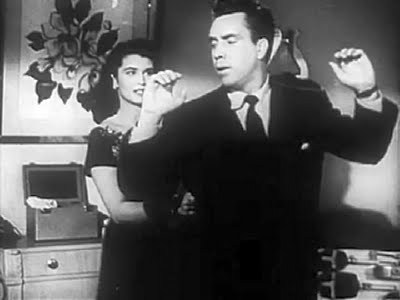
Marla (Laurette Luez) gives Frank Bigelow (Edmond O'Brien) trouble in D.O.A.

Marla (Laurette Luez) gives Frank Bigelow (Edmond O’Brien) trouble in D.O.A.

While working to track Reynolds down, Bigelow encounters a sultry and sullen model Marla Rakubian (Laurette Luez), a man known only as Majak (famed stage actor Luther Adler) – clad all in white and with an indeterminate foreign accent, which instantly makes him suspect in Tinseltown terms –  and a trio of heavies led by raging psychopath Chester (Neville Brand, in his first movie). Though Brand might seem like a miscreant plucked from a dingy alley, he was in fact a WW2 vet, who had received numerous awards, including the Purple Heart.

As he narrows down the suspects, Bigelow also realizes that Paula is The One and the scene where he professes his love is touching. He eventually busts the bad guy in an eye-for-an-eye kind of way, but, as we knew from the start, Bigelow is a goner. No plot spoilers here.

Director Maté, who was the cameraman on foreign classics “Vampyr” and “The Passsion of Joan of Arc” as well as “Foreign Correspondent” and “Gilda,” tells a riveting story. Aided by Ernest Laszlo’s cinematography, Maté creates a mood that is both hard-boiled and slightly surreal. The storyline becomes so lusciously serpentine, with perilous curves and hairpin turns, it rivals Howard Hawks’ “The Big Sleep” from 1946 for the most convoluted plot in all of film noir.
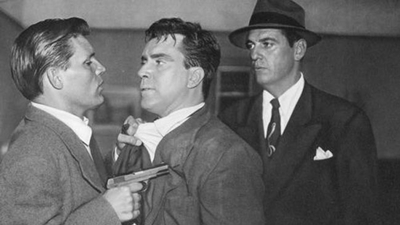
Chester (Neville Brand) gives Edmond O'Brien some more trouble. O'Brien is definitely not having a good day.

Chester (Neville Brand) gives Frank (Edmond O’Brien) some more trouble. Frank is definitely not having a good day.

I especially like the scenes in which Bigelow leaves the comfort of dancing the rhumba and downing a few drinks in the upscale St. Francis Hotel to visit the noisy, smoky Fisherman club, where he watches a bebop jazz band play its all and chats with “jive-crazy, high-society” Jeannie (Virginia Lee), an elegant blonde who turns out to be a mere red herring.

O’Brien, with his good looks and strapping self-confidence, plays the determined Bigelow as every man’s take-charge fantasy. Britton as Paula is the kind of girl next door that bad-ass femmes fatales played by actresses like Barbara Stanwyck and Joan Bennett would eat for breakfast. Her innocence is nicely countered by a rich array of dastardly, devious characters.

Clarence Greene and Russell Rouse wrote the original screenplay, perhaps inspired by a 1931 German film “Der Mann, der seinen Mörder sucht”/ “Looking For His Murderer” directed by master noir creator Robert Siodmak with writing help from the great Billy Wilder. (In “D.O.A.” Rouse’s name, along with Laszlo and assistant director Marty Moss, appears on the guest register of the Allison Hotel in Los Angeles.)

The movie was remade in 1969 as “Color Me Dead” and in 1988 with Dennis Quaid, Meg Ryan and Charlotte Rampling. The original is the best of the lot. Watch it and you’ll see why.

‘Double Indemnity’ proves accessories are make or break

Double Indemnity/1944/Paramount/106 min.

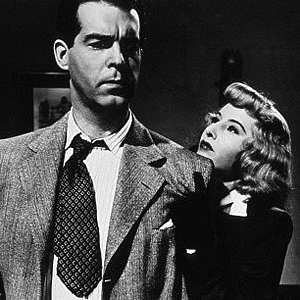
Fred MacMurray and Barbara Stanwyck

She’s got a plan, she just needs a man. And that’s a welcome challenge for a femme fatale, especially one with an ankle bracelet.

In Billy Wilder’s film noir masterpiece, “Double Indemnity,” from 1944 Phyllis Dietrichson (Barbara Stanwyck) wants out of her marriage to rich, grumpy oldster, Mr. Dietrichson (Tom Powers). Poor Phyllis doesn’t get much love from Dietrichson’s adult daughter, Lola (Jean Heather) either. Fresh-faced and feisty, Lola is hung up on her temperamental boyfriend Nino Zachetti (Byron Barr).

For Phyllis, seducing a new guy to help make hubby disappear is so much more cost-effective than hiring a divorce lawyer. A smart insurance man is even better. Along comes Walter Neff (Fred MacMurray) trying to sell a policy, just as Phyllis finishes a session of sunbathing, wearing an ankle bracelet and not much more. That’s about as much bait as Walter needs.

They flirt, fall for each other and eventually arrange to bump off Mr. Dietrichson, making it look like he fell from a train. It’s a one-in-a-million way to go with a huge payoff from a double-indemnity insurance policy issued by Walter’s company. After that, they play it cool and wait for the check. They’ve planned it like a military campaign, so they’re in the clear until Walter starts to suspect that he’s not the only guy who’s been drooling at Phyllis’ ankles.

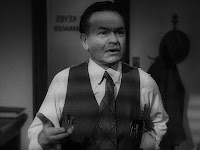
Edward G. Robinson

Besides his lust for the blonde (and their chemistry truly sizzles), Walter’s real love is the platonic father/son relationship he has with his boss at the insurance company, Barton Keyes, sharp, cynical and married to his job, played brilliantly by Edward G. Robinson.

Critic Richard Schickel says “Double Indemnity” is the first true noir. I disagree – what about 1941’s “The Maltese Falcon” and “Stranger on the Third Floor” from 1940? Or even Fritz Lang‘s “M” from Germany in 1931? But the point is “Double Indemnity” was the standard against which every subsequent noir was measured. It’s a glorious treat visually. John Seitz’s luscious lighting and captivating use of shadow bring to mind Vincent Van Gogh’s observation: “There are no less than 80 shades of black.” The score by Miklos Rozsa works perfectly with the visuals to build and sustain atmosphere.

The performances (Stanwyck, MacMurray and Robinson) are tremendous. Though Stanwyck was nominated for the best actress Oscar and “Double Indemnity” was also nominated in six other categories (picture, director, screenplay, cinematography, sound recording and score), MacMurray and Robinson were not in the running and the film didn’t win any Oscars. In retrospect, their work in this movie is some of the best acting of the decade. MacMurray (who might be most familiar as the father in TV’s “My Three Sons”) is such a natural as the easily tempted yet very likeable Neff, it’s surprising now to learn that the role was a major departure from his usual nice-guy parts.

As James Pallot of “The Movie Guide” writes: “Robinson … beautifully gives the film its heart. His speech about death statistics, rattled off at top speed, is one of the film’s highlights.” When Keyes realizes that Walter has betrayed him, it’s heartbreaking in a way that few other noirs are.

Wilder co-wrote the script with Raymond Chandler, based on the taut little novel by James M. Cain, published in 1936. (The novel was inspired by the real-life 1927 Snyder-Gray case.) In the book “Double Indemnity,” smitten Walter says of Phyllis’ physical charms, “I wasn’t the only one that knew about that shape. She knew about it herself, plenty.”

The dark, witty script follows the book pretty closely, but Chandler’s contributions are key. For example, check out this bit of simmering dialogue:

Phyllis: There’s a speed limit in this state, Mr. Neff, 45 miles an hour.

Walter: How fast was I going, Officer?

Phyllis: I’d say around 90.

Walter: Suppose you get down off your motorcycle and give me a ticket.

Phyllis: Suppose I let you off with a warning this time.

Walter: Suppose it doesn’t take.

Phyllis: Suppose I have to whack you over the knuckles.

Walter: Suppose I bust out crying and put my head on your shoulder.

Phyllis: Suppose you try putting it on my husband’s shoulder.

Walter: That tears it…

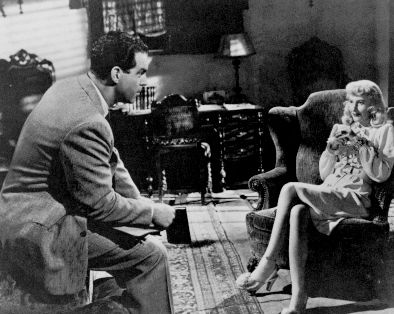
Chatting things over while Mr. Dietrichson is away.

Now it seems egregious that Wilder (1906-2002) and “Double Indemnity” were snubbed at the Oscars. Born in what is now Poland, Wilder escaped the Nazis, but his mother and other family members perished in a concentration camp. He knew firsthand the dark, sometimes horrific, side of life and that knowledge imbued his work with an unparalleled richness and depth. He was also hilarious. If I could have martinis with any film noir director, living or dead, it would be Billy.

I’ve seen interview footage of him where he punctuated his conversation with deep and frequent laughter. And I’ve heard stories about him playing practical jokes – apparently he when he lost the 1944 best director Oscar to Leo McCarey (who won for “Going My Way” starring Bing Crosby) Billy stuck out his foot and tripped McCarey as he walked down the aisle to pick it up. Maybe if I get that fantasy date with the spirit of Billy, I’ll bring Dick Schickel along too. He might benefit from a girly martini and tagging along with Billy and me.

So, suppose you do yourself a favor and watch “Double Indemnity” the first chance you get. You won’t be sorry.

‘Double Indemnity’ quick hit

Double Indemnity/1944/Paramount/106 min.

A hands-down noir favorite. Fred MacMurray and Barbara Stanwyck are adulterous lovers who plot to get rid of Stanwyck’s husband in a seamless “accident” and pounce on his insurance policy. Knock-out performances and marvelous direction from Billy Wilder. Based on a James M. Cain novel, the script, by Wilder and Raymond Chandler, crackles with wit and innuendo.