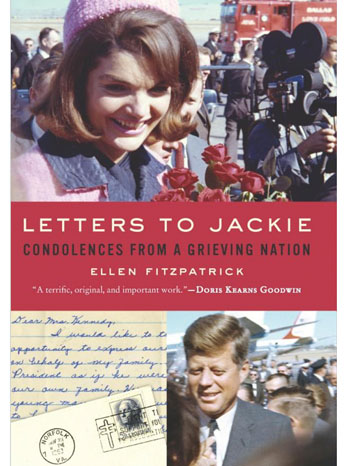
‘Letters to Jackie’ documentary airs Sunday night on TLC

Letters to Jackie

LETTERS TO JACKIE: REMEMBERING PRESIDENT KENNEDY. Directed and written by Bill Couturié, this acclaimed documentary about JFK’s inspirational presidency will air at 9/8c on Sunday, Nov. 17, 2013 on TLC.

The film features 18 stars, including Anne Hathaway, Bérénice Bejo, Michelle Williams, Kirsten Dunst and Chris Cooper, reading from letters sent to Jacqueline Kennedy in the days following the death of John F. Kennedy. These letters illustrate the country’s remarkable ability to unite and uplift their first lady with words of compassion and love.

True Hollywood Noir probes legendary Tinseltown mysteries

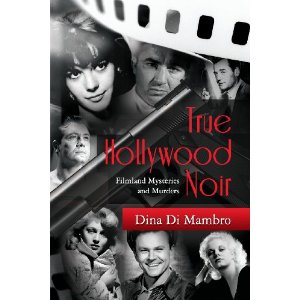
True Hollywood NoirLana Turner was the quintessential film noir blonde,” says author Dina Di Mambro in her new book, True Hollywood Noir: Filmland Mysteries and Murders, pointing to Turner’s standout part as Cora in “The Postman Always Rings Twice.”

The actress’s real life was no less fascinating than any of the roles she portrayed on the screen, says Di Mambro, setting up the chapter on Turner and the 1958 fatal stabbing of her boyfriend Johnny Stompanato.

A coroner’s inquest jury found the act (by Turner’s teenage daughter Cheryl Crane) to be justifiable homicide but there has long been speculation that Turner herself did the deed. In probing that theory, film historian and entertainment writer Di Mambro offers “the story you haven’t heard.”

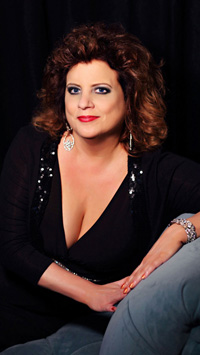
Author Dina Di Mambro

Author Dina Di Mambro

It’s one of 12 stories Di Mambro explores in her book; the others are: William Desmond Taylor, Thomas H. Ince, Jean Harlow, Thelma Todd, Joan Bennett (and the shooting of Jennings Lang), George Reeves, Bob Crane, Gig Young, Natalie Wood, Robert Blake and death of his wife Bonnie Lee Bakley). The finale, as it were, is a lengthy chapter on gangster Mickey Cohen.

Says Di Mambro in the book: “The West Coast mob, city corruption and Hollywood mysteries were often intertwined. This is a common thread through much of this book. … Many of the plots of the noir films were taken from actual happenings in the underworld.”

Di Mambro presents her facts in a straightforward, no-nonsense style, leaving the reader to decide which theory is most likely. Replete with vintage photos, the book clocks in at 230 pages, making it a pretty fast read cover to cover. It’s also a great reference volume if you prefer to dip in one grisly cold case at a time.

We at FNB especially like the fact that Di Mambro includes in her acknowledgements her “muse,” meaning her cat Sunny, who supervised the writing process. Nothing like a regal kitty to tap a true-crime scribe vibe.

Britt Ekland to introduce ‘The Wicker Man’ final cut

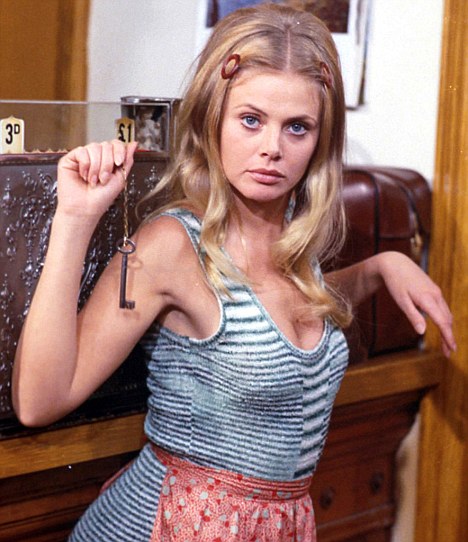
Britt Ekland in

Britt Ekland in “The Wicker Man.”

The Wicker Man final cut/1973/Rialto Pictures/88 min.

Actress Britt Ekland will attend the 7:30 p.m. showing of “The Wicker Man” final cut (1973, Robin Hardy) at the Nuart Theatre, on Friday, Nov. 1. She will introduce the movie and run the Q&A. In addition to her memorable performance in “The Wicker Man,” the Swedish beauty is also well known as the Bond girl in “The Man with the Golden Gun.”

Other notable film appearances include “The Night They Raided Minsky’s,” “Baxter!,” “The Double Man,” “Get Carter” and films with Peter Sellers, her husband from 1964-1968.  In 1975, she provided whispers in French on the end of then-boyfriend Rod Stewart‘s song Tonight’s the Night. Ekland was one of the most photographed and talked-about celebrities in the world. In 1980, she published her best-selling autobiography, True Britt.

I recently saw “The Wicker Man” final cut and it’s a fun flick – so very 70s and so very British. A standup, stiff-upper-lip Scottish police sergeant (Edward Woodward) receives an anonymous note in the mail, claiming that a girl on an island village has gone missing. But, when he arrives on the island to investigate, he receives blank stares and puzzled looks from her fellow villagers.

Wicker Man posterNo one seems to know who the girl is or why he is concerned. They’re more interested in drinking, dancing and pagan fertility rites. The sergeant digs his heels in and decides to stay a while longer; Ekland plays the sexy daughter of the innkeeper.

Inspired by writer/actor David Pinner‘s 1967 novel Ritual, Anthony Shaffer wrote the screenplay. Director Hardy elicits subtle performances, creating an atmosphere of low-key tension and muted anxiety. Cinematographer Harry Waxman shows the austere and rugged beauty of a remote part of the world. While the story might be short on action by today’s standards, this cult horror classic is nonetheless pretty entertaining and well worth viewing on the big screen.  Seen for decades only in mutilated copies, this director-approved restoration by Studiocanal is the culmination of a worldwide search conducted via Facebook.

“The Wicker Man” final cut will play at the Nuart Theatre in Los Angeles for one week: Nov. 1-8.

Robert Wise casts a spell with subtlety, smarts, superb acting

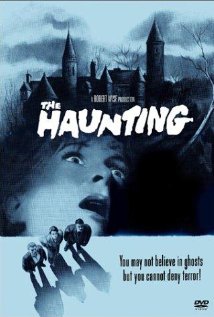
The Haunting posterBy Michael Wilmington

The Haunting/1963/Argyle Enterprises, MGM/112 min.

From Shirley Jackson’s eerie, intellectual ghost story “The Haunting of Hill House” director Robert Wise and screenwriter Nelson Gidding weave a classic supernatural thriller, a shocker without gore, a ghost movie seemingly without ghosts. Or is it?

In “The Haunting,” poltergeist investigator John Markway (Richard Johnson) and his group of spook watchers (Claire Bloom, Russ Tamblyn and Julie Harris) are ensconced in a notorious old dark house together. Harris gives a movie-stealing performance as repressed spinster Nell Lance, who succumbs to Hill House’s shivery spell and terror-laced eroticism. Like Jack Nicholson in “The Shining,Harris makes you feel the story’s terror – the menace and the entrapment of Hill House as Nell is pulled into the evil of the haunted domicile’s very dark past.

The cast is well nigh perfect, from Johnson’s enthusiastic and charming investigator, Bloom’s ambiguous, fancily severe Greenwich Village lesbian, Julie, to Lois Maxwell (Miss Moneypenny of the James Bond series) as Mrs. Markway.

Tamblyn, who will be present for discussion at the 7 p.m. Tuesday screening of “The Haunting” in Westwood, plays smart-alecky nonbeliever Luke Sanderson. Tamblyn was reteaming here with director Wise, who had guided the actor to the highlight of his career, as Jet gangleader Riff in the 1961 Best Picture Oscar winner “West Side Story.”

Wise’s movie is quite faithful to Jackson’s acclaimed novel. The dialogue is literate and tense. The movie’s tasteful production design and the crystal-sharp black and white cinematography (by Davis Boulton) give this picture, shot in England, a classic look. It’s the kind of brainy, spooky cinematic treat Wise might have whipped up for producer Val Lewton in the ’40s, in their RKO prime time of “The Body Snatcher” and “The Curse of the Cat People” if they’d only had this kind of budget.

Roman Polanski once named Wise’s “The Haunting” as one of his favorite movies. It’s a shame that Polanski didn’t direct the 1999 remake of “The Haunting,” which was messed up by the producers and director Jan De Bont, and not helped by its big budget and gaudy effects. Subtlety, intelligence and superb acting are what cast the spell for Wise and company. Polanski probably would have brought all that back and made the movie sexy to boot – something the 1963 “Haunting” doesn’t really need.

Film noir fashionistas in the spotlight

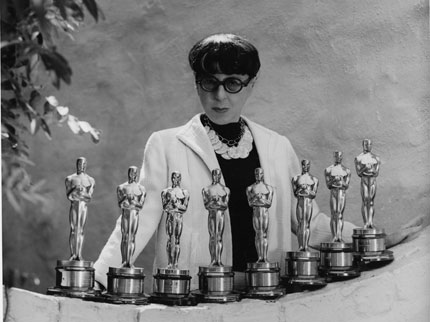
Edith Head worked on film noir titles such as “Double Indemnity,” “Sunset Blvd.,” “Rear Window” and “Vertigo.”

Edith Head worked on film noir titles such as “Double Indemnity,” “Sunset Blvd.,” “Rear Window” and “Vertigo.”

Happy birthday, Edith Head! She was born October 28, in San Bernardino, Calif. In her 60-year career, at Paramount and Universal, she worked on more than 1,131 films, received 35 Academy Award nominations and won eight Oscars, more than any other woman. (Walt Disney, with 22 Oscars, holds the record for a man.)

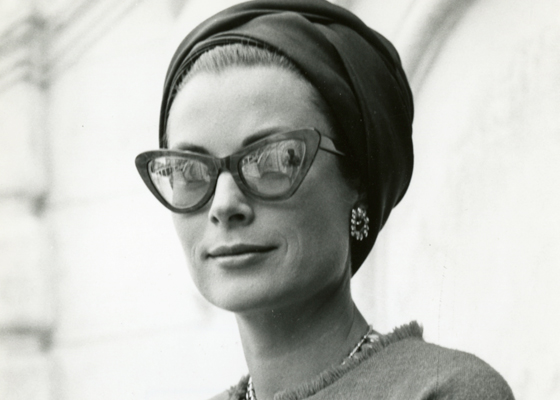
Grace Kelly was born on Nov. 12, 1929 in Philadelphia. She died on Sept. 14, 1982 in Monaco.

Grace Kelly was born on Nov. 12, 1929 in Philadelphia. She died on Sept. 14, 1982 in Monaco.

The exhibition From Philadelphia to Monaco: Grace Kelly Beyond the Icon opens today at the James A. Michener Art Museum, near Philadelphia.

‘The Haunting’ marks 50 years with screening in Westwood

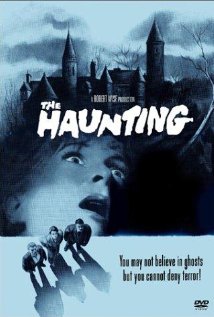
The Haunting posterCelebrating its 50th anniversary, “The Haunting” will screen at 7 p.m. Tuesday, Oct. 29, at the Regent Theatre in Westwood.

Dr. John Markway (Richard Johnson) is psyched to spend a few weeks at a 19th Century New England mansion – need I say haunted? – in order to study its creepiness. As you might suspect, things don’t go to plan. Also starring Julie Harris, Claire Bloom and Russ Tamblyn, who will attend Tuesday’s screening as a special guest. The evening is also a chance to pay tribute to Julie Harris, who died this summer.

At the time of its release, critic Judith Crist called the film “a thoroughly satisfying ghost story for grownups … completely contemporary in its psychological overtones and implications.”

Nelson Gidding wrote the script based on a Shirley Jackson novel; Robert Wise directs. Jan de Bont remade “The Haunting” in 1999, starring Liam Neeson, Catherine Zeta-Jones, Lili Taylor and Owen Wilson.

You can buy tickets here.

Moving, intimate ‘Blue’ delivers on its prizewinner promise

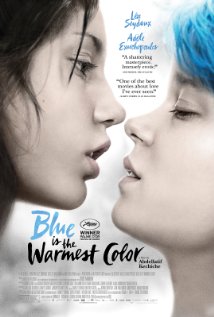
Blue posterBlue Is the Warmest Color/2013/Sundance Selects/179 min.

I’m going to start with a sort of Spoiler Alert: “Blue Is the Warmest Color” is not a neo-noir, not even close. But I was curious about the movie because it created quite a buzz at this year’s Cannes Film Festival and snared the top prize there, the Palme d’Or.

Directed by Abdellatif Kechiche, “Blue” is a coming of age/love story that follows a teenager named Adèle (Adèle Exarchopoulos) as she navigates a brief affair with a boy and a lengthy intimate relationship with an older woman Emma (Léa Seydoux). Adèle also finishes school, finds a job as a teacher, makes mighty platters of pasta and sheds a lot of tears. In other words, it’s a richly detailed character study and an intense, unhurried exploration of a charming but ordinary woman’s everyday life. One day ends, another starts.

At nearly three hours long and containing rather graphic sex scenes, this is perhaps not the movie to go to with Aunt Ginger. I was a bit on the fence about it myself. But, happily, “Blue” never dragged or felt gratuitous, tasteless or solipsistic. What made it so engrossing for me was the sublimely naturalistic performances from everyone in the cast and a story that, while sometimes mundane, is also largely devoid of clichés. Moving and memorable, “Blue” delivers on its prizewinner promise.

“Blue Is the Warmest Color” opens today in LA and New York. In French with English subtitles.

American Film Institute announces festival lineup

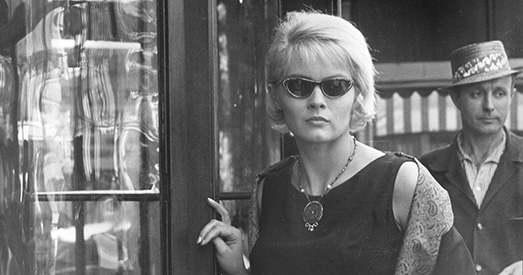
Cleo

“Cleo from 5 to 7” stars Corinne Marchand.

We at FNB are thrilled to be attending the AFI Fest 2013 presented by Audi. The fest runs Nov. 7-14 in Hollywood.

Organizers recently announced the schedule: http://afifest.afi.com/sections. Among the highlights: Agnès Varda is guest artistic director and her 1962 film “Cleo from 5 to 7” will screen at the fest. (There will be a conversation with Varda beforehand.)

Prescription for retro glamour: A look back at Schwab’s

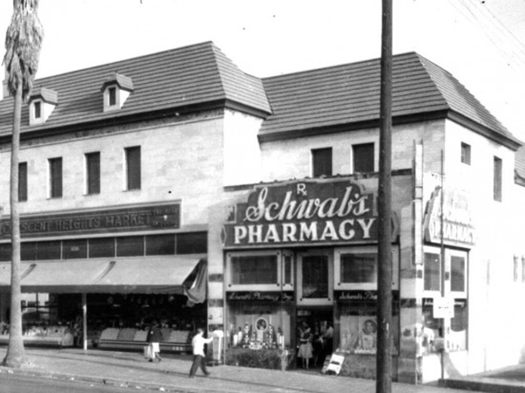
Sunset b & wHeading to the West Hollywood Rite-Aid to do a little schmoozing? Not bloody likely. But, in Tinseltown’s golden age, Schwab’s Pharmacy, at 8024 Sunset Blvd., ranked as one of the city’s top spots to meet, greet, mix and mingle.

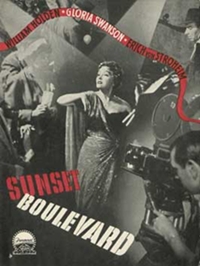
A program Saturday at the Egyptian Theatre highlighted the pivotal role Schwab’s played in Hollywood networking from the 1930s to the 1960s. Teacher/history buff Marc Chevalier delivered a photo-driven presentation, followed by a short that was filmed at Schwab’s to promote a 1946 bio-pic, “The Jolson Story,” and the exquisite movie “Sunset Blvd.” (1950, Billy Wilder), which features the drugstore in a key scene.

Chevalier started his talk with a cherchez la femme angle. The property – on the south side of Sunset Boulevard, between Laurel Avenue and Crescent Heights – first belonged to Dr. George E. Paddleford and his wife, Genevieve McKinney Toomey Teal Paddleford, a “international adventuress and love pirate,” with a string of duped husbands.

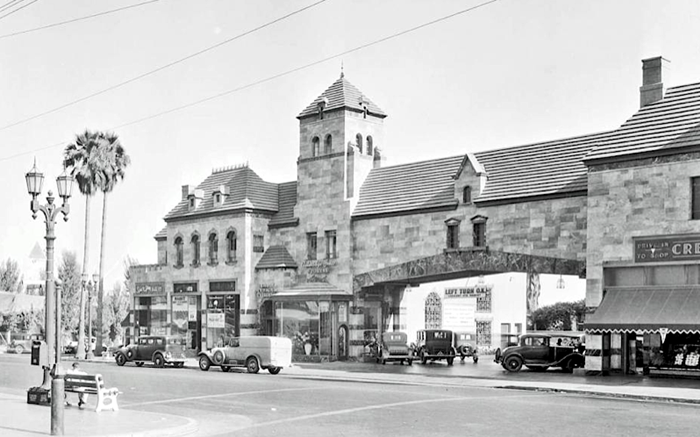
The Sunset Medical Building complex opened its doors in 1931.

The Sunset Medical Building in the 1930s. Schwab’s was to the right of the window awning (far right).

The Paddlefords owned lots 1, 2 and 29 of the Crescent Heights tract and built a mansion on lot 2. Fond of giving Dr. Paddleford’s expensive cuff links and other valuable belongings to her lovers, Genevieve drew her husband’s ire and the couple divorced around 1920. She left for Europe where she continued to live the high life, charm men, court scandal, oh and steal stuff from Ritz-Carlton hotels.

Dr. Paddleford (an associate of oil magnate Edward L. Doheny) sold the property and in 1931 architects Alvan Norstrom and Milton Anderson designed the Sunset Medical Building for developers C.H. Thomsen and W.L. Easley. The year before, for the same developers, Norstrom and Anderson designed a building directly across the street. It’s in use today as the Laugh Factory and Greenblatt’s Deli.

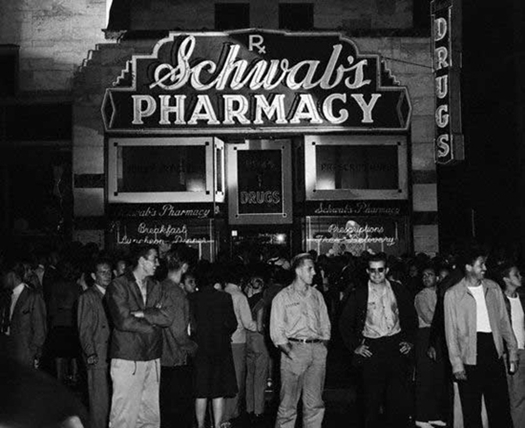
Schwab’s was a place to see and be seen.

Schwab’s was a place to see and be seen.

Despite the prosaic name (it became known as the Crescent Heights Shopping Center and later simply “The Corner”), the new building turned out to be a modern-day palace. Its front and side facades were clad in dark tan marble from Southern France and trimmed in rosso levanto Italian marble. (At the time, the only other commercial structure in Los Angeles that boasted so much marble was downtown’s Merritt Building from 1915.) Inside The Corner, rooms were paneled and floored in mahogany; some had terrazzo marble floors. Doctors’ and dentists’ offices were on the second level. A covered-bridge walkway allowed patients to cross from one wing to another. The back court had a 30-space parking lot.

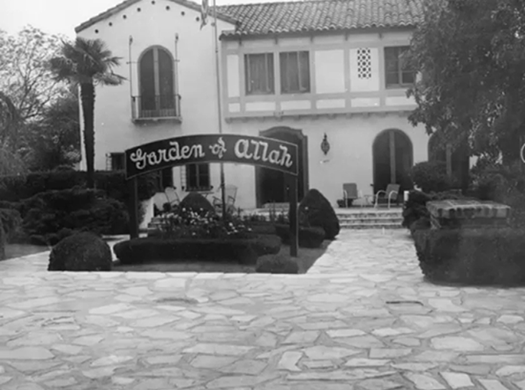
Nearby was the Spanish-Moorish style Garden of Allah apartment complex, originally owned by actress Alla Nazimova in 1919; the Garden was torn down in 1959. Many residents from this chic residence supported businesses at The Corner.

F. Scott Fitzgerald was among the notable residents at the Garden of Allah.

F. Scott Fitzgerald was among the notable residents at the Garden of Allah.

Norstrom and Anderson’s marble stunner housed several merchants on the ground floor, including Richard Talmadge, former actor and stuntman for Douglas Fairbanks, who ran a flower shop, and the owner of the Crescent Heights Market, Ben Ruben, known for insulting his customers at no extra charge. Howard Hughes treated his girlfriends to makeovers at the beauty salon.

In 1932, the Schwab brothers (Bernard, Leon, Jack and Martin) took over a failing drugstore in the complex; they would eventually own six pharmacies. But Schwab’s on Sunset wasn’t just a place to drop off a prescription or buy toiletries. Open from 7 a.m. to midnight, the gathering spot served meals as well as soda-fountain drinks. The store had five phone booths and frequently offered automatic credit. Customers could also buy high-end liquor, tobacco, chocolate, perfume and cosmetics. There was no charge for deliveries.

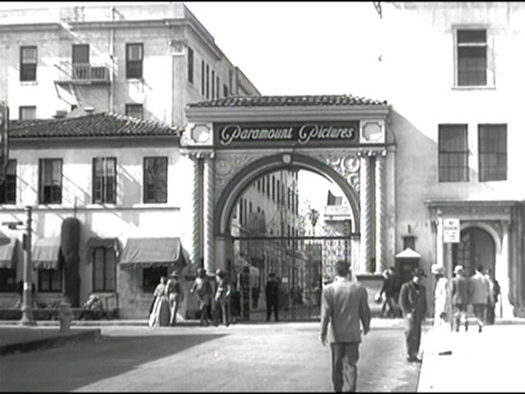
Billy Wilder filmed the Schwab’s  scene at Paramount.

Billy Wilder filmed the Schwab’s scene at Paramount.

In the movie “Sunset Blvd.,” William Holden’s character, a struggling screenwriter named Joe Gillis, tells us the pharmacy is his headquarters, explaining: “That’s the way a lot of us think about Schwab’s. Kind of a combination office, coffee klatch and waiting room. Waiting, waiting for the gravy train.” (Though it would seem the ideal location shoot, Wilder had the interior recreated and filmed on a Paramount lot.)

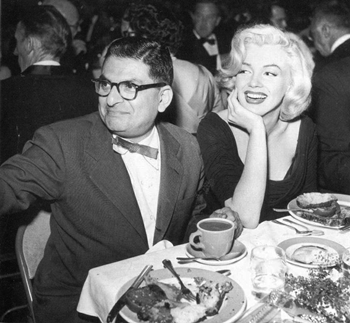
Arguably, what made Schwab’s the place to network and nosh was the fact that journalist/actor/producer Sidney Skolsky wrote his Photoplay column “From a Stool at Schwab’s” in a second-floor office, by arrangement with the Schwab family.

Sidney Skolsky and Marilyn Monroe attend an industry function.

Sidney Skolsky and Marilyn Monroe attend an industry function.

Among Skolsky’s many talents was a knack for nicknames and he dubbed the drugstore Schwabadero’s, an allusion to the Trocadero nightclub down the street. (Even more famously, in 1934, he was the first journalist to write a story using Oscar to refer to the Academy Award.) As a producer on the 1946 movie “The Jolson Story,” it was Skolsky’s idea to shoot the after-party at Schwab’s and use the footage as a publicity short.

Robert Mitchum, Clark Gable, F. Scott Fitzgerald, Mickey Cohen, Gloria Swanson, Judy Garland, the Marx Brothers, Cesar Romero and Shelley Winters were regular Schwabadero’s customers. Marilyn Monroe, another loyal patron, reportedly left messages for Skolsky, under the name Miss Caswell. Charlie Chaplin and Ava Gardner stopped in and made their own milkshakes.

Though it’s widely thought that Lana Turner was discovered sipping a soda at Schwab’s, in fact it was at the Top Hat malt shop, several blocks east on Sunset, that in 1937, at age 16, she attracted the attention of Hollywood Reporter publisher William Wilkerson.

Debunking the myth: Lana Turner was discovered at a malt shop down the street from Schwab’s.

Lana Turner was discovered at a malt shop down the street from Schwab’s.

By the time Schwab’s had its closeup in “Sunset Blvd.,” Russian immigrant/Beverly Hills businessman Martin Belousoff owned the property. In 1949, Googie’s coffee shop, designed by architect John Lautner in Space Age/midcentury modern style, was built nearby and served customers such as James Dean, Marlon Brando and beat-generation poets. (Googie’s lasted until 1989.)

Compared with Googie’s, Schwab’s looked passé and in 1955 Belousoff decided to remodel inside and out, commissioning architects Louis Armet and Eldon Davis for the job. But not long after Schwab’s updated, new Sunset Strip venues were opening up and gaining popularity with aspiring stars and ’60s hipsters.

Schwab’s, which had been in business for 50 years and earned worldwide fame as a Hollywood hive of activity, closed its doors in 1983 and was torn down in 1988. But it remains Hollyood’s most famous drugstore – a legendary place to sip sodas, schmooze, spot stars and, like many a prospective Lana Turner, strut your stuff.

Schwab's was open from 7 a.m. to midnight.

Schwab’s was open from 7 a.m. to midnight.

Hollywood Dogs highlighted in well heeled new book

There’s a photospread in Vanity Fair on a new book from ACC Editions called Hollywood Dogs: Photographs from the John Kobal Foundation. Looks like a fun book.

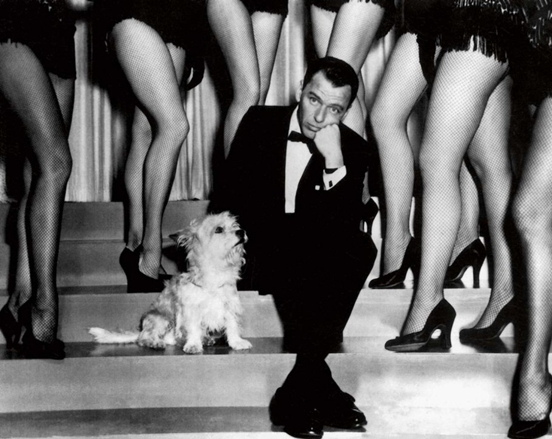
Snuffy, Frank Sinatra’s four-legged co-star in the 1957 musical “Pal Joey,” reportedly aced his audition. Asked to eat a bagel off a plate, the Cairn terrier took it in his mouth, dipped it in some soup, and ate the soggy part.

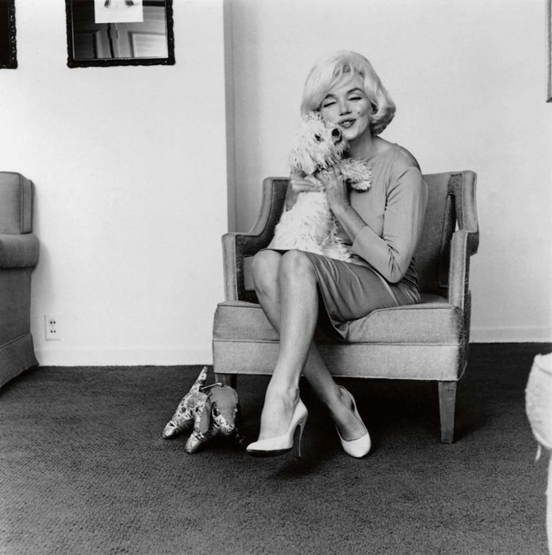
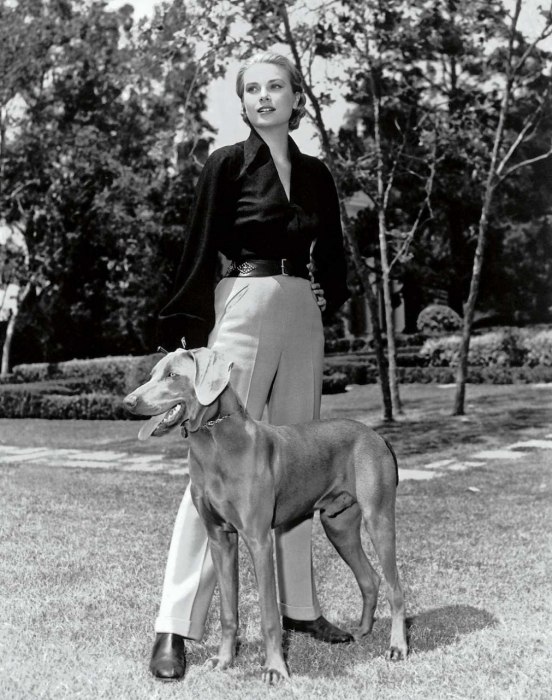
Also shown here: Marilyn Monroe and her Maltese, whom she named Mafia (the dog was a gift from Sinatra), and Grace Kelly with her Weimaraner.

VF Dogs Sinatra

VF Dogs Monroe

VF Dogs Kelly