‘The Third Man’ delivers stellar suspense, performances both haunting and dazzling

TCM’s Classic Film Festival starts tomorrow and I’m fretting about packing in all the viewing and events. Definite draws are the classic noirs “The Third Man,” which screens at 9 a.m. Saturday; Henry Hathaway’s “Niagara” from 1953, starring Marilyn Monroe, screening at 6:15 p.m. on Saturday; and “Gaslight” (George Cukor, 1944) showing at 9:30 p.m. Saturday. Other must-sees: Marlene Dietrich in “The Devil is a Woman” (Josef von Sternberg, 1935) at 10:15 p.m. Friday and “Citizen Kane” (Orson Welles, 1941) at 3:30 p.m. Saturday.

The Third Man/1949/(104 min. UK, 93 min. US)

Alida Valli and Joseph Cotten

If a city could be a femme fatale, it might be Vienna in “The Third Man” from 1949. The voiceover at the beginning of the film refers to “old Vienna with its Strauss music, its glamour and easy charm.” But new Vienna, a war-torn metropolis split into four Allied zones after World War Two, is a city living by its wits, host to a thriving black market. Hey, a girl’s gotta make a living somehow.

The voiceover also introduces us to a slightly naïve and completely broke newcomer to the hallowed city: Holly Martins (Joseph Cotten), an American writer of pulpy Western novels, who has come to visit his old friend and fellow Yank Harry Lime (Orson Welles), a sly operator.

Instead of a buddy reunion, though, Martins ends up at his friend’s funeral: Turns out Harry was hit by a car and has died. Also at the burial is the distinguished Major Calloway (Trevor Howard), who suggests they get a drink.

As they sip, Martins starts asking questions about Lime’s death and eventually suspects foul play. So, Martins hunts for more info and, along the way, he meets a handful of vaguely nefarious characters who traveled in Lime’s orbit: his porter (Paul Hoerbiger), “Baron” Kurtz (Ernst Deutsch), the Romanian known as Popescu (Siegfried Breuer), Dr. Winkel (Erich Ponto). One source he particularly likes is Anna Schmidt (Alida Valli), a sultry, cynical Czechoslovakian actress, who was also Lime’s lover.

What troubles Martins is learning that there were three men who carried Harry’s body from the street after he died, but he can only find two. Finding the mysterious third man drives the action, ultimately leading to a chilling chase through the dank sewers of underground Vienna.

Director/producer Carol Reed, working from a Graham Greene novel, draws us into a perfectly rendered world where tension and trouble pulse just beneath the surface, where anxiety and disillusion are tempered with fleeting pleasures and faded love. I love the details of everyday Viennese life: a moonfaced boy, an ancient balloon seller, a haggard landlady, a prowling cat and the forlorn-looking Teddy bears of the children’s hospital. The lecture hall scene reminds me of a similar passage in Hitchcock’s “The 39 Steps” from 1935. [Read more…]

Quick hit: ‘The Third Man’

The Third Man/1949/(104 min. UK, 93 min. US)

American writer Holly Martins (Joseph Cotten) comes to his visit his school friend Harry Lime (Orson Welles) in Vienna after World War Two. But he discovers that his pal is dead and the city is a hub for black-market corruption. Cotten digs for more details with help from various jaded denizens, including Welles’ girlfriend (Alida Valli) and a British major (Trevor Howard). First-rate fare from director Carol Reed working from a Graham Greene novel; brilliant zither music from Anton Karas.

‘Strangers on a Train’ brings out the bad in the best of us

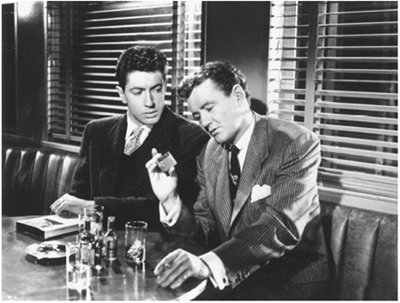
Farley Granger and Robert Walker

Strangers on a Train/1951/Warner Bros. Pictures/101 min.

A friend of mine once went on a second date with a guy who showed up wearing saddle shoes. Let’s just say there wasn’t a third date. If only he’d seen 1951’s “Strangers on a Train.”  Alfred Hitchcock understood the importance of footwear and it shows in this stellar film.

He starts the story by contrasting the shiny, two-toned spats of Bruno Anthony (Robert Walker) with the sensible black dress shoes of Guy Haines (Farley Granger) as each emerges from a Diamond cab. We follow these parallel footsteps as they board the same train, hence the title.

These brief shots contain the crux of the film: Model citizens often hide hard-core badness and the most unsavory renegades and reprobates can surprise you with a virtue or two (especially if we count charm and fashion sense as virtues).

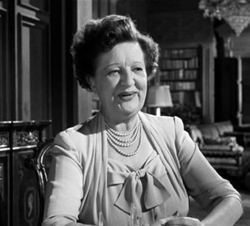
Marion Lorne

Despite their differences, Bruno and Guy both have monkeys on their backs. Bruno is a spiffy playboy with psychopathic tendencies. Besides drinking and gambling, he spends his time hatching schemes for space travel and blowing up the White House. Even though Bruno has his wealthy and wacky mother (Marion Lorne) wrapped around his little finger, his father (Jonathan Hale) isn’t so flexible. In fact, he keeps threatening to have Bruno “taken care of, if necessary, put under restraint.”

Guy is a pro tennis player who wants to marry his dream girl Anne Morton (Ruth Roman), daughter of Senator Morton (Leo G. Carroll). Hitch’s daughter Patricia plays Anne’s little sister, Barbara. Unluckily for Guy, he’s already married to venal and unfaithful Miriam (Kasey Rogers, credited as Laura Elliott).

So, during their train trip, Bruno strikes up a conversation with Guy, telling him: “I certainly admire people who do things.” Over drinks, smokes and a lamb-chop lunch, Bruno proposes a daring, if absurd, solution to both of their glitches: If Bruno murders Miriam, that would leave Guy free to marry Anne. In exchange, Guy would bump off Mr. Anthony. Guy laughs it off, but Bruno takes it as mutual pledge and proceeds to carry out his part of the deal, trailing Miriam to a carnival and murdering her.

When he hears the news, Guy’s shocked, but if he tells the police, Bruno will claim that Guy was an accomplice. Besides, he had motive. As the police investigate, Bruno pressures Guy to fulfill his part of the plan.

Guy resists, but Bruno won’t back down and turns into a bit of a stalker. Bruno also has an ace in the hole: he nabbed Guy’s engraved cigarette lighter when Guy left it behind after their lunch on the train. Guy may lack Bruno’s warped brilliance but he pushes back when cornered and he’s determined to set things right.

If you don’t love “Strangers on the Train,” I’ll be shocked. It’s a gloriously suspenseful story, based on a Patricia Highsmith novel. Raymond Chandler wrote the screenplay, but most of that was trashed and rewritten by Czenzi Ormonde, with uncredited help from Ben Hecht. (Whitfield Cook adapted.) Hitch and Chandler apparently had a hate/hate relationship. [Read more…]

Quick hit: ‘Strangers on a Train’

Strangers on a Train/1951/Warner Bros. Pictures/101 min.

Of the noir genre’s many chance meetings on trains, this is tops. Clean-cut tennis star Guy (Farley Granger) and loony playboy Bruno (Robert Walker) get to chatting. Turns out, they both have thorns in their sides, in the form of Guy’s wife and Bruno’s father. Bruno suggests each of them murder the other’s nemesis and shortly after follows through with his end of the bargain. One of Hitchcock’s best.

Huston explores ‘Asphalt Jungle’ with an unflinching eye

The Asphalt Jungle/1950/MGM/112 min.

“The Asphalt Jungle” was a departure in that it humanized its villains.

“The Asphalt Jungle” was a departure in that it humanized its villains.

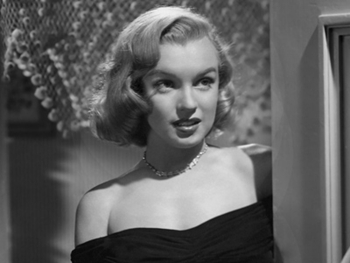
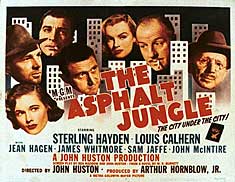
“The Asphalt Jungle” from 1950 by director John Huston is rightly considered a masterpiece. Excellent storytelling and an outstanding cast, including Sterling Hayden, Louis Calhern, Sam Jaffe, Jean Hagen and Marilyn Monroe, have helped it stand the test of time.

But its stark, unwavering realism is not for everyone. Louis B. Mayer, head of MGM, where Huston made the movie, had this to say about the flick: “That ‘Asphalt Pavement’ thing is full of nasty, ugly people doing nasty things. I wouldn’t walk across the room to see a thing like that.”

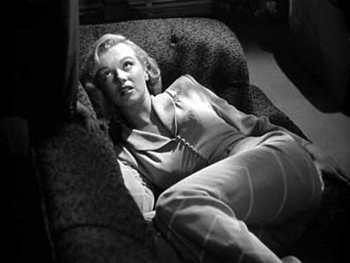
This small but pivotal role helped put Marilyn on the map.

This small but pivotal role helped put Marilyn on the map.

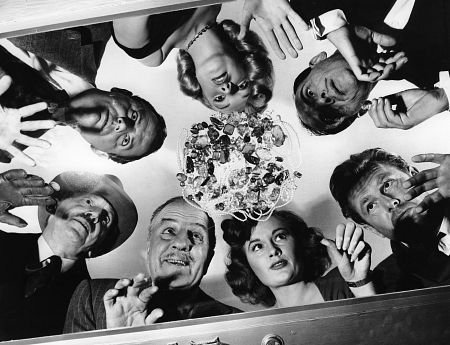
Um, did he not see luminous and fragile Monroe as mistress Angela Phinlay? Huston portrays a gang of thieves as flawed humans trying to make a living. “We all work for our vice,” explains menschlike mastermind Doc Erwin Riedenschneider (Jaffe). Recently released from jail, Doc has planned every detail of a $1 million jewel robbery and seeks to round up the best craftsmen he can find for one last heist.

A fat wallet means Doc can head to Mexico and court all the nubile girls he can handle. Dix Handley (Hayden), a tough guy with swagger to spare, hopes to pay his debts and return to his beloved horses in Kentucky. Getaway driver Gus Minissi (James Whitmore) is sick of running his dingy diner. Bookie ‘Cobby’ Cobb (Marc Lawrence) covets booze. Safecracker Louis Ciavelli (Anthony Caruso) has a wife and kid to support. Alonzo ‘Lon’ Emmerich (Calhern) is a wealthy but overspent lawyer who wants to be solvent again.

“You may not admire these people, but I think they’ll fascinate you,” says Huston in an archive clip included on the DVD. They pull it off, but what heist would be complete without a doublecross and crossing paths with the police?

In this macho, man’s-world movie, there is alas no femme fatale. But rest assured there are flawed women aplenty. Hagen plays the neurotic Doll, a struggling performer, and her vice is Dix. Monroe, as Lon’s barely legal girlfriend, orders mackerel for his breakfast, flips through travel magazines and is fond of saying, “Yipes!” Lon’s bed-ridden wife May (Dorothy Tree) wishes Lon were home more often. Teresa Celli plays dutiful wife Maria Ciavelli.

Said Huston of Marilyn: “She had no techniques. It was all the truth, it was only Marilyn.” (He later directed her in “The Misfits.”)

Said Huston of Marilyn: “She had no techniques. It was all the truth, it was only Marilyn.” (He later directed her in “The Misfits.”)

The actors complement each other deftly. Jaffe, both sage and seedy (when he lusts after pretty young things) is particularly entertaining; he nabbed an Oscar nom for best supporting actor. Helping his rich characterization is the fact that he gets some terrific lines, for instance: “Just when you think you can trust a cop, he goes legit.”

The movie is full of such dry asides. The whip-smart script, by Huston and Ben Maddow, also scored an Oscar nom. W.R. Burnett‘s novel provided the source material, though the book told its story from the police point of view; Huston and Maddow flipped the perspective. Huston was also nominated for best director; Harold Rosson for best B&W cinematography. (None won.)

“Asphalt Jungle” is the only noir I know of that’s set not in NYC, LA, Chicago or London, but in a smaller city in the Midwest, usually seen as the bedrock of integrity, and it’s fun to try to figure out exactly where this is happening.

The dark film was a departure for MGM—known for upbeat, lavish, escapist fare—but the studio’s production chief Dore Schary ushered in a period of social consciousness for the company, notes Drew Casper, film scholar and author of “Post-War Hollywood Cinema 1946-1962,” in his DVD commentary.

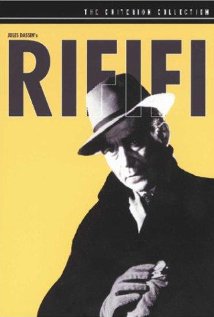
Rififi posterAs for the look of the film, Casper points out that in addition to elements of Expressionism (fractured frames and diagonals or horizontals blunting verticals to create tension), Huston’s experience filming war documentaries as well as the work of Italian Neo-realism (1945’s “Open City” by Roberto Rossellini and Vittorio De Sica’s “The Bicycle Thief” from 1948) also influenced his visuals.

In turn, Huston’s groundbreaking movie clearly had an impact on the great Jules Dassin, director of 1955’s “Rififi,” one of the best of all noirs. “Asphalt Jungle” was remade three times: “Badlanders” (1958), “Cairo” (1962), and “Cool Breeze” (1972). None is considered as good as the original.

Dry but never dull, “Jungle” is a straight-shooting portrait that undermines Hollywood’s often-moralizing and hypocritical gloss. “Crime is only a left-handed form of human endeavor,” as Lon so matter-of-factly puts it. Yipes!

‘The Asphalt Jungle’ quick hit

The Asphalt Jungle/1950/MGM/112 min.

John Huston‘s classic heist movie, which earned four Oscar noms, broke new cinematic ground by humanizing the criminals rather than writing them off as one-dimensional cheats. A suspenseful ride with stellar performers. The top-notch cast includes Sterling Hayden, Louis Calhern, Jean Hagen, James Whitmore, Sam Jaffe and an up-and-coming young starlet named Marilyn Monroe.

‘Sweet Smell of Success’ beautifully captures the sour stink of moral decay

Sweet Smell of Success/ 1957/ United Artists/ 96 min.

Michael Wilmington

This month, I am giving away a copy of Criterion’s new two-disc edition of “Sweet Smell of Success” directed by Alexander Mackendrick. Just leave a comment on any post in March and you will be entered; the winner will be drawn at random. Here, critic Michael Wilmington reviews this unforgettable film.

“Sweet Smell of Success,” an American movie masterpiece and one of the best and gutsiest of all the classic film noirs, is a sleek killer comedy/drama about Broadway in the ’50s.

It centers around two influential New Yorkers: megalomaniac star gossip columnist J.J. Hunsecker (Burt Lancaster) and one of his more energetic publicist-sources, scummy but fashionable Sidney Falco (Tony Curtis).

Falco, who wears a suit black as night, a dazzling white shirt and a poisonous leer that implies he’s seen something dirty and knows something even filthier, lives and dies each day by whether he gets a story planted in Hunsecker’s hugely successful column. Hunsecker, meanwhile, mostly holds court in the night spots that are his fiefdom, condescending to all the people, from Falco and other flacks, to movie stars to a U.S. Senator, who come to sip, smoke and pay him homage.

Hunsecker and Falco are unashamed users, almost proudly amoral. Hunsecker thinks he’s above morality; Falco thinks he can’t afford it now. Falco treats his potential patron with a fawning but mean-eyed servility. Hunsecker, with his ominous spectacles masking eyes of ice, freezes out Falco dismissively. “Match me,” Hunsecker tells the weasely Falco, in one of this movie’s many famous lines. Though Falco doesn’t actually scramble to light his cigarette, he does far worse.

Both these monsters have need of each other in this dark night and smoky day, in this world bounded by the Stork Club, Twenty One, Broadway and 42nd Street. Falco wants to use Hunsecker to ascend higher, into the sweet, smelly heights of Broadway gossip success, to become another Hunsecker.

Meanwhile, Hunsecker has nominated Falco for one of the dirty jobs he can’t get too close to: sabotaging the romance between his younger sister Susan (Susan Harrison) and her straight-arrow musician lover Steve (Martin Milner).

“Sweet Smell” deliberately patterned Hunsecker after one of the country’s most famous and powerful newspapermen Walter Winchell (1897-1972). Winchell’s daughter Walda was the model for Hunsecker’s sister Susan.

When you watch Hunsecker and Falco do their routines – snazzy, cruel, funny – you’ll never forget them. You’ll hear Hunsecker telling Falco, “I’d hate to take a bite out of you. You’re a cookie full of arsenic.” Or Falco circling cigarette girl Rita (Barbara Nichols) and answering her query about whether he’s listening to her by wisecracking, “Avidly, avidly.”

Falco and Hunsecker are classic American movie characters, written with knifelike wit, commanding craft and true street genius by Ernest Lehman (who worked in this world) and Clifford Odets (a one-time playwright king of Broadway). It is directed with stinging life, energy and flawless insight by Alexander Mackendrick, an American of Scottish descent, who was one of the comedy experts of that British treasure-house, the Ealing Studio.

“Sweet Smell” was a sometimes-chaotic production. But Lehman or Odets never produced a better script. Mackendrick never directed a better movie. Elmer Bernstein rarely wrote a jazzier, sharper score. The master cinematographer James Wong Howe (“Hangmen Also Die!” “Pursued,” “Body and Soul”) never shot a darker, more brilliant noir.

Lancaster was sometimes more impressive, more richly colored and dominating, in tonier classics like “Elmer Gantry,” “From Here to Eternity” and “The Leopard.” But Curtis never topped Falco, not even in “Some Like It Hot.”

Lancaster was not Mackendrick’s choice for Hunsecker. He wanted Orson Welles or Hume Cronyn. It’s a weird piece of casting that works and it makes this a stronger, sexier and more subversive film. [Read more…]

Veronica Lake, Alan Ladd are smokin’ in ‘This Gun for Hire’

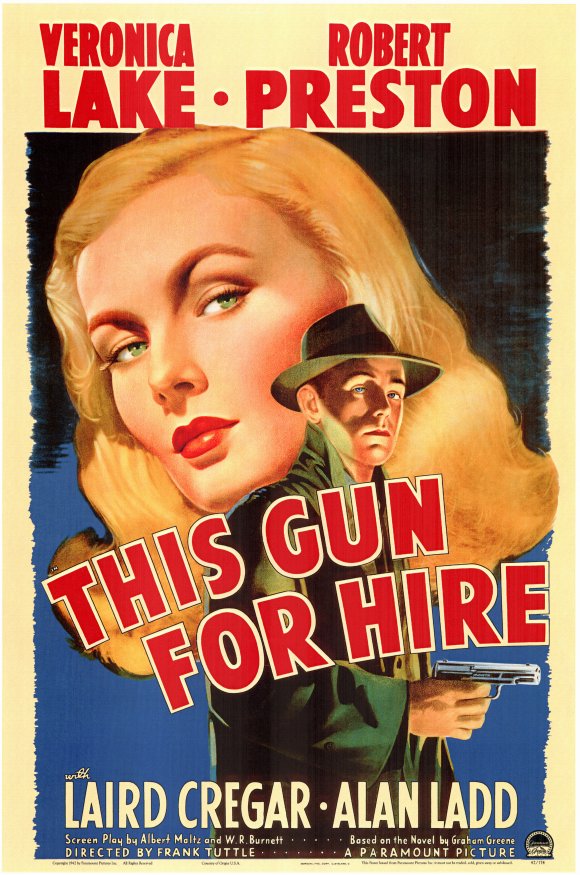
This Gun for Hire/ 1942/ Paramount Pictures/ 80 min.

Veronica Lake in “This Gun for Hire” from 1942 is an angel-food cake kind of femme fatale. Alan Ladd’s stone-faced, yet complex, hitman is a devil, but damn he’s debonair. He also likes cats and kids so it’s hard not to want to cut him some slack.

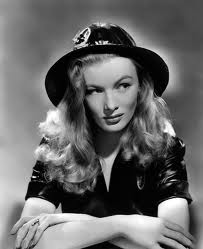
Veronica Lake

Lake plays a smart, svelte and stunning nightclub singer/magician named Ellen Graham who’s essentially engaged to amiable and solid cop Michael Crane (Robert Preston). Essentially but not officially engaged because there’s no ring or dress shopping, just some affectionate banter about getting domestic, which means darning his socks and cooking corned beef and cabbage.

But those scenes aren’t exactly sizzling with passion. That’s because of Ladd. It was his first major film and once he was aboard, director Frank Tuttle realized the actor was A-list material and changed the script to give Ladd more prominence. Even though you know Lake and Ladd aren’t going to end up together, there’s a mighty sexy undercurrent between them.

As Ephraim Katz of “The Film Encyclopedia” puts it: “She clicked best at the box office as the screen partner of Alan Ladd in a matchup of cool, determined personalities.” They went on to make six more flicks together, including noir fare “The Glass Key” (1942) and “The Blue Dahlia” (1946).

In this one, Ladd’s character, Philip Raven is on the trail of Los Angeles-based Willard Gates (Laird Cregar) a blubbery, unctuous exec at a chemical company who hires Raven to bump off his colleague, a blackmailing paymaster named Baker (Frank Ferguson). Gates then pays Raven off in stolen cash, a ploy to put him in the hands of the police.

But chemical formulas aren’t really Gates’ thing – on the side, he likes to chomp on peppermints, hang out in nightclubs in LA and San Francisco, and indulge his “vice,” as he calls it, as a part-time impresario. When he sees the head-turning Ellen perform in San Francisco, he’s hooked and invites her to perform at the Neptune Club in LA.

Ellen’s trying to get close to Gates, too, but not just because she craves the spotlight. She’s been recruited by a senator (Roger Imhof) who wants hard evidence that Gates is the Benedict Arnold of 1942, i.e., he’s suspected of selling chemical formulas to the Japanese. It is war time, after all.

So, as Raven tracks down his prey and eludes the police, Ellen juggles her high-minded snooping with sequin-drenched dress rehearsals. Before long, their paths are bound to cross, especially when they board the same train to LA …

Known primarily for musicals and crime dramas, and for naming names to HUAC during Sen. Joe McCarthy’s reign of terror, director Tuttle wasn’t what you’d call an artist or a poet, but he managed to make a top-notch thriller, based on one of Graham Greene’s best crime novels. True, the movie doesn’t do the book justice, but for every one of its 80 minutes, the film is engaging and entertaining.

Tuttle easily balances moody suspense, wholesome romance, patriotic duty and the not-quite-jaded vibe of young performers trying to earn a living at a nightclub. Cinematographer John Seitz (of “Double Indemnity”) lends his elegant eye to the lighting; the scenes of Ladd and Lake on the train and on the run are especially beautiful. Crisp dialogue comes from writers Albert Maltz and W.R. Burnett, a Midwesterner whose stint as a night clerk in a Chicago hotel inspired the 1929 crime novel (and the 1931 film) “Little Caesar” as well as many other novels and screenplays.

Unrepentant and casual about killing for a living, Ladd’s performance is classic noir; it influenced Jean-Pierre Melville’s “Le Samourai” from 1967. Unlike most femme fatales, Ellen Graham isn’t motivated by money or revenge but by doing her part for the war effort. Still, Lake gives us bemused detachment and a glimmer of tenderness; she also helps humanize Raven. And how could you not love her musical numbers and surprisingly modern costumes, especially the sleek black “fishing” garb with thigh-high boots? [Read more…]

‘This Gun for Hire’ quick hit

This Gun for Hire/ 1942/ Paramount Pictures/ 80 min.

This role hardly qualifies Veronica Lake as a femme fatale. She’s loyal to her man, works for a living and helps out Uncle Sam. Shocker! That said, this movie is still full-on noir and Lake, who blazes a trail with hitman Alan Ladd, completely captivates. Laird Cregar delights, as always, as the peppermint-popping heavy. Based on a Graham Greene novel; directed by Frank Tuttle.

‘D.O.A.’ reveals the ultimate inspiration to solve a murder: when it’s your own

D.O.A./1950/United Artists/83 min.

“I don’t think you fully understand, Bigelow,” says a doctor to his shocked patient, “you’ve been murdered.”

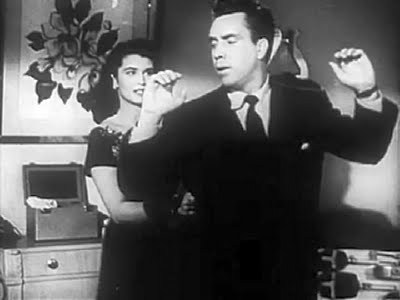
Edmond O’Brien is doomed in “D.O.A.”

This is the premise for 1950’s “D.O.A.,” directed by Rudolph Maté, a classic noir about a standup, solid guy from Banning, Calif., named Frank Bigelow (Edmond O’Brien) who, while on a trip to San Francisco, learns he has been poisoned with a time-released fatal toxin. He has just a few days to find his murderer. And here he thought it was just a hangover.

It’s particularly bad luck because Bigelow hasn’t served time, he doesn’t play the horses, he’s not eyeing easy money. He is a self-employed accountant in a small town near Palm Springs minding his own business. True, he does like hard liquor, is a bit of a skirt chaser and he’s on the fence about committing to doting girlfriend Paula Gibson (Pamela Britton), but those are minor flaws in the noir scheme of things.

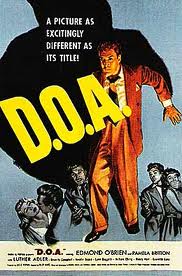
D.O.A posterEven though Bigelow is dying, his genetic tough-guy instinct kicks as he abandons his ledger book and adding machine to follow clues, talk tough, tote a gun and chase his prey. Clearly, he missed his calling as a macho gumshoe who could give Phillip Marlowe or Sam Spade a run for their money.

Checking in via phone calls to Paula, who also happens to be his secretary, he learns that a Mr. Phillips, an importer-exporter in Los Angeles, has been urgently trying to contact him. Bigelow returns to LA but, before he can probe for info, Phillips takes a flying leap from a tall building. So, Bigelow taps Phillips’ inner circle: his brother Stanley (Henry Hart), his wife (Lynn Baggett), his secretary Miss Foster (Beverly Garland, credited as Beverly Campbell), and co-worker Halliday (William Ching).

Turns out that Bigelow’s connection to these Angelinos is that six months prior, he notarized a bill of sale for a shipment of iridium. Phillips bought the stuff from a mysterious man named George Reynolds.

Marla (Laurette Luez) gives Frank Bigelow (Edmond O'Brien) trouble in D.O.A.

Marla (Laurette Luez) gives Frank Bigelow (Edmond O’Brien) trouble in D.O.A.

While working to track Reynolds down, Bigelow encounters a sultry and sullen model Marla Rakubian (Laurette Luez), a man known only as Majak (famed stage actor Luther Adler) – clad all in white and with an indeterminate foreign accent, which instantly makes him suspect in Tinseltown terms –  and a trio of heavies led by raging psychopath Chester (Neville Brand, in his first movie). Though Brand might seem like a miscreant plucked from a dingy alley, he was in fact a WW2 vet, who had received numerous awards, including the Purple Heart.

As he narrows down the suspects, Bigelow also realizes that Paula is The One and the scene where he professes his love is touching. He eventually busts the bad guy in an eye-for-an-eye kind of way, but, as we knew from the start, Bigelow is a goner. No plot spoilers here.

Director Maté, who was the cameraman on foreign classics “Vampyr” and “The Passsion of Joan of Arc” as well as “Foreign Correspondent” and “Gilda,” tells a riveting story. Aided by Ernest Laszlo’s cinematography, Maté creates a mood that is both hard-boiled and slightly surreal. The storyline becomes so lusciously serpentine, with perilous curves and hairpin turns, it rivals Howard Hawks’ “The Big Sleep” from 1946 for the most convoluted plot in all of film noir.

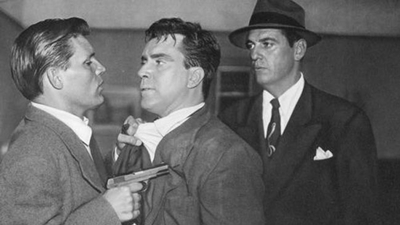
Chester (Neville Brand) gives Edmond O'Brien some more trouble. O'Brien is definitely not having a good day.

Chester (Neville Brand) gives Frank (Edmond O’Brien) some more trouble. Frank is definitely not having a good day.

I especially like the scenes in which Bigelow leaves the comfort of dancing the rhumba and downing a few drinks in the upscale St. Francis Hotel to visit the noisy, smoky Fisherman club, where he watches a bebop jazz band play its all and chats with “jive-crazy, high-society” Jeannie (Virginia Lee), an elegant blonde who turns out to be a mere red herring.

O’Brien, with his good looks and strapping self-confidence, plays the determined Bigelow as every man’s take-charge fantasy. Britton as Paula is the kind of girl next door that bad-ass femmes fatales played by actresses like Barbara Stanwyck and Joan Bennett would eat for breakfast. Her innocence is nicely countered by a rich array of dastardly, devious characters.

Clarence Greene and Russell Rouse wrote the original screenplay, perhaps inspired by a 1931 German film “Der Mann, der seinen Mörder sucht”/ “Looking For His Murderer” directed by master noir creator Robert Siodmak with writing help from the great Billy Wilder. (In “D.O.A.” Rouse’s name, along with Laszlo and assistant director Marty Moss, appears on the guest register of the Allison Hotel in Los Angeles.)

The movie was remade in 1969 as “Color Me Dead” and in 1988 with Dennis Quaid, Meg Ryan and Charlotte Rampling. The original is the best of the lot. Watch it and you’ll see why.