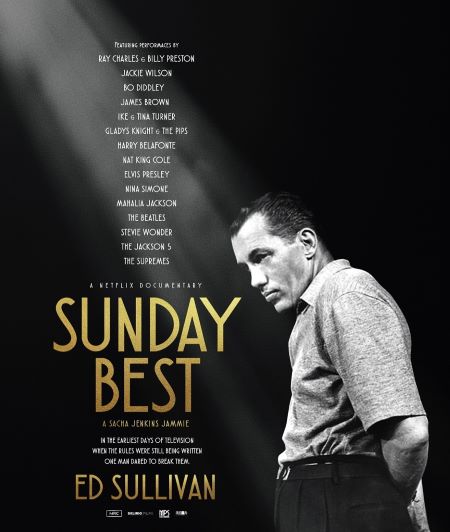
 Today’s consumers of pop culture and infotainment might not have vivid memories of iconic TV host Ed Sullivan, given that he died more than 50 years ago, at age 73, on Oct. 13, 1974 (about 2,000 people attended his funeral at St. Patrick’s Cathedral in New York). That said, he made his mark so deeply and was so famous in his day that even people who were too young to watch “The Ed Sullivan Show,” which ran on CBS from 1948-1971, nevertheless recognize his place in showbiz history.
Not that he was a king of cool. Just the opposite – in fact, he came across as staid, old-fashioned and a bit of a fuddy-duddy, particularly with the advent of rock ‘n’ roll. But the show was still the place to reach mainstream America. When the Beatles appeared on the variety show on February 9, 1964, they drew a record-breaking 73 million viewers.
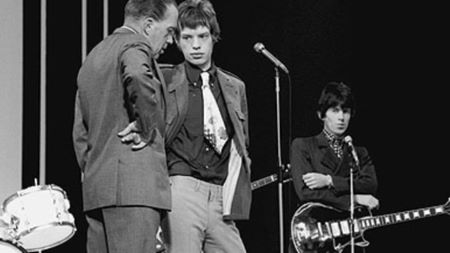
Ed Sullivan talks with Mick Jagger while Keith Richards (right) looks on. When the Rolling Stones performed on the show, Mick found a way to express himself without getting on Sullivan’s bad side. Hence, the Stones were invited back to the show.
Several rock performers made appearances during which they went against the grain – delighting the audience and drawing Sullivan’s ire. Before singing “Light My Fire,” Jim Morrison and the Doors indicated that Morrison would accept Sullivan’s request to substitute “girl, we couldn’t get much better” for “girl, we couldn’t get much higher.” On air, Morrison stuck to his original lyrics. Scandalous! Prior to the Rolling Stones’ appearance, they were told to change “let’s spend the night together” to “let’s spend some time together.” Mick Jagger complied but added a thick layer of sarcasm to his delivery. (To paraphrase Jagger, it wasn’t that what they were doing was especially shocking, it was that people at that time were easily shocked.)
The times were definitely changing. But even before those milestones, Sullivan was changing the course of entertainment in America with his commitment to racial equality and his determination to book Black artists on his show – something that was extremely rare in TV’s early years and an aspect of Sullivan’s character that’s not well remembered today. A fascinating documentary “Sunday Best: The Untold Story of Ed Sullivan” directed by the late Sacha Jenkins highlights the lasting impact Sullivan made by challenging the norms of the day and introducing top-tier artists to the country and the world.
“Sunday Best” showcases performances from Sullivan’s guests, including Mahalia Jackson, Nat King Cole, Elvis Presley, Harry Belafonte, Ray Charles & Billy Preston, The Beatles, Ike & Tina Turner, Bo Diddley, Jackie Wilson, James Brown, Diana Ross & the Supremes, Gladys Knight & the Pips, Nina Simone, Stevie Wonder, and The Jackson 5. There are also clips of guests Cab Calloway, Ella Fitzgerald, Lena Horne, Louis Armstrong, Bill “Bojangles” Robinson, Sammy Davis Jr., and others.
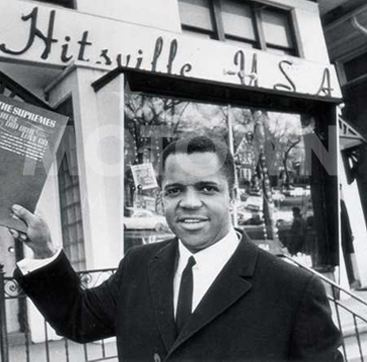
Photo by Tony Spina, Detroit Free Press
Outside Hitsville USA in 1964, Berry Gordy, Detroit native and founder of Motown Records, shows off The Supremes’ “Where Did Our Love Go.”
Numerous interviews with luminaries like Berry Gordy, founder of Motown Records in Detroit, help to put Sullivan’s fighter’s stance (and the risks he took by standing up to CBS and its sponsors) into context. “With Ed, everything changed,” said Gordy. “He seemed to be fearless.”
On the surface, Sullivan was an unlikely choice for such a prime slot in the CBS lineup. He was not a handsome gladhander or a slick showman. As the documentary points out, Sullivan was pilloried by the press for his lugubrious demeanor, stone-faced expression and sour-looking smile.
But he took the role seriously and brought to the job the skills he’d acquired as a journalist. Growing up in a poor but tightknit family in Harlem (at that time residents were mostly Irish and Jewish), he knew early on he wanted to be a writer. Eventually he became a sports reporter and editor, and developed an eye for identifying and describing the unique traits of great athletes.
After working at many newspapers, by the early 1930s, he was the Broadway columnist at the New York Daily News (and had a fierce rivalry with Walter Winchell). Sullivan worked hard to find the best up-and-coming entertainers (often visiting Harlem clubs) and was extremely confident in his critical judgment of talent. Also, he lauded TV’s ability to give everyone in the audience a front-row seat to a superb performance.
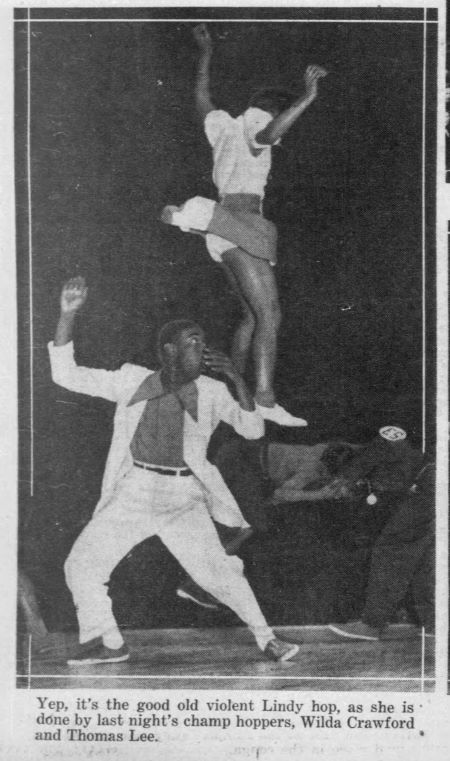
Wilda Crawford and Thomas Lee were the 1940 Lindy Hop dance winners at the Harvest Moon Ball amateur dance competition, which was held annually in NYC.
While still writing his column, he gave radio broadcasts and starred in the 1933 film “Mr. Broadway.” In 1947, CBS televised the Harvest Moon Ball, an amateur dance competition held annually in New York, and Sullivan was the master of ceremonies. The next year, he was selected to host “Toast of the Town” (later renamed “The Ed Sullivan Show”).
By that time, he’d developed a singular stage presence that was dry, straightforward and sincere without being star-struck or sycophantic. “On TV, I’ve been myself and it’s the only thing that saved me,” he said.
In breaking racial barriers, he credited his parents, especially his father, whom he described as sensible and courageous. As Irish immigrants, they’d faced prejudice and ignorance, and were quick to defend an underdog.
“Sunday Best” also gives a glimpse into Sullivan’s personal life. He clearly adored his wife Sylvia and their only child, a daughter named Betty; they were equally devoted to him. Their elegant apartment in the Delmonico Hotel on Park Avenue was packed with photos and other mementos, such as a pair of shoes that had belonged to Bill “Bojangles” Robinson.
By the time Sullivan’s show hit its 20-year mark, the mood and mores in America were far different than they’d been at the time of the program’s launch. The show slowly lost popularity and began to sink in the ratings. Sullivan was angry when in 1971 CBS canceled the show, but he hosted a 25th anniversary special in June 1973.
Though Sullivan could be dictatorial, short-tempered and thin-skinned, his equanimity usually won out. Toward the end of his life, he said, “I had a good long run. I put a good fight for what I believed in. And I have no complaints at all.”
“Sunday Best: The Untold Story of Ed Sullivan” was recently released on Netflix.








From my readers