Clive Owen plays cards close to his chest in compelling ‘Croupier’ revisited after 25 years

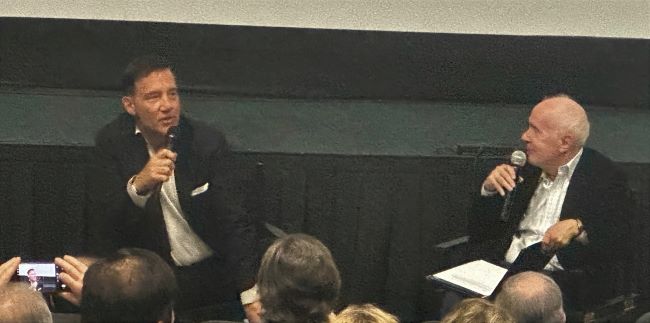
Clive Owen and critic Stephen Farber discuss “Croupier” Wednesday night at the Laemmle Royal in Los Angeles.

Writers are a bit like gamblers. They look for lucky breaks, they hope agents or editors will give their work a chance, they meet deadlines with a nervous mix of triumph and trepidation. Win, lose or break even, they keep taking the bet.

This comparison comes to life in “Croupier,” a British neo-noir directed by Mike Hodges and starring Clive Owen, which released in the US in 2000 and put Owen on the path to Hollywood stardom. The film screened Wednesday night at the Laemmle Royal, as part of the Anniversary Classics Series, with Owen in attendance.
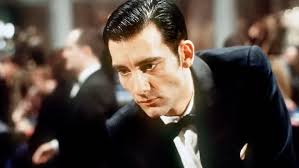
Clive Owen plays it cool in the casino.

Owen plays Jack Manfred, a man in need of a job and a writer in search of material. He finds it amid the grit, stale glamour and greed at the Golden Lion casino in London – a job his cheerful grifter father Jack Sr. (Nicholas Ball) has secured for him. His dad likely has had more downs than ups in his business ventures, but breezily pretends to be a big success.

Night after night, cooly detached Jack sees people at their worst as he encounters shady players, sweaty addicts and sexy ladies. While we see him deal cards, we hear the voiceover of his novel in progress based on his observations at the casino – his inner monologue is reminiscent of the flashback VO recounted by screenwriter Joe Gillis (William Holden) in “Sunset Boulevard” (Billy Wilder, 1950).
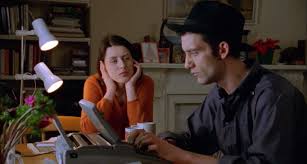
Gina McKee as Marion sits by her man, Jack (Clive Owen).

When not working, Jack is writing or sleeping, and friction grows with his supportive, supremely loyal, live-in girlfriend Marion (Gina McKee), a department-store security guard. She’s put off by the cynical tone of his book and by the main character who enjoys seeing people lose.

Though Jack says he cannot tolerate cheaters and claims he never gambles, he is a scribe on the sly, after all, and it’s not long before he performs some slick shuffling of his moral code – his risk-taking begins with entanglements that put his job on the line. He’s drawn to co-worker Bella (Kate Hardie) and flirts with a mysterious casino patron hailing from South Africa named Jani (Alex Kingston). “If you don’t call me, I’ll understand, but I hope that you do,” she informs him matter of factly, as she hands him her phone number.
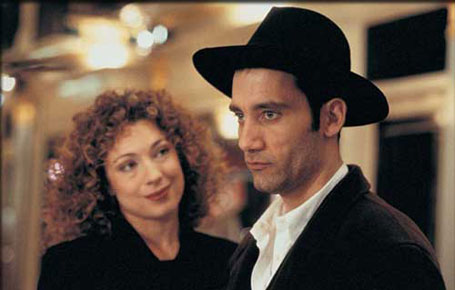
Yani (Alex Kingston) does her femme fatale finest to lure Jack into a scheme.

Not surprisingly, this cig-puffing femme fatale leads Jack further down the road of debauchery, tempting him with a simple role in an inside-job robbery. Steely-eyed, laconic Jack exudes an enigmatic intensity and shows little to no emotion – except on the rare occasion when he completely loses control.

Fast paced with brisk editing and harsh, bleak lighting (nary a noir shadow here), “Croupier” is smart, engrossing, entertaining and laced with moments of dry humor.

Paul Mayersberg’s suspenseful script touches on sexual politics, class divisions, family dynamics, creating art, the duality of human nature and the randomness of existence. If the ending is slightly pat, it doesn’t spoil the story. Owen gives a fine performance as the unflinching anti-hero and his fellow cast members meet him every step of the way, each shining in their roles.

At Wednesday’s screening, critic Stephen Farber and veteran producer/marketing luminary Mike Kaplan introduced the film. Known for his ingenuity and dogged tenacity, Kaplan rescued “Croupier” from almost-certain obscurity. Released with virtually no promotion, the movie (which reportedly had a budget of £3 million) didn’t do well in England.


Director Mike Hodges (1932-2022) remarked at the time, “It wasn’t released. It escaped.” Hodges also directed “Get Carter” (1971), “Pulp” (1972), “Flash Gordon” (1980) and reunited with both Owen and Kaplan for 2003’s “I’ll Sleep When I’m Dead.” He hoped “Croupier” would fare better in America if Kaplan got involved.

“It played for a week in London and it was gone,” said Kaplan. “It was a tragedy because it’s a great movie, but it wasn’t recognized as such … It had an amazing texture of violence with a lot of integrity. It’s technically perfect and it introduced Clive Owen to an international audience in a performance that’s unlike any other.”
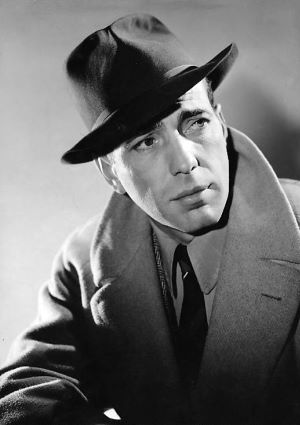
Humphrey Bogart, shown here in 1940, was one of many actors’ names critics mentioned in their reviews of “Croupier.” Last year, in a TV miniseries, Owen played Sam Spade, one of Bogart’s most iconic roles.

So, Kaplan championed the film – coming up with a brilliant ad campaign highlighting major actors Owen had been compared to in critics’ reviews. The esteemed list included Humphrey Bogart, Richard Widmark, Robert Mitchum, Sean Connery, James Mason, Nicolas Cage, Paul Newman and Clint Eastwood. “It played at the Fairfax Theatre (now closed) for two weeks and ran at the Aero, which was a second-run theater at the time, for several months,” said Kaplan.

Farber summed up: “It turned out to be a tremendous success and everybody in Hollywood took notice.”

After the film, Owen talked with Farber. Already an established actor in England, Owen recalled that the script intrigued him, especially the dialogue, which was not naturalistic. “The combination of Mike Hodges who’s very specific, very noir, very grounded and Paul Mayersberg who’s very intellectual and abstract in some ways [results in] the scenes having a kind of heightened quality,” said Owen.

Farber asked him to talk about his co-stars. “It was a great cast Mike Hodges put together,” said Owen. “The actors embraced the non-naturalistic style of dialogue and when you’re all committed to it, then the thing can sing.”

Owen added that he loves noir and has returned to the genre over the course of his career, most recently playing Dashiell Hammett’s famous private detective in the “Monsieur Spade” TV miniseries, which ran last year on AMC.
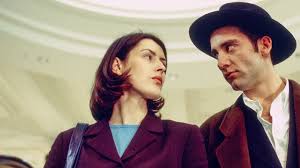
Actress Gina McKee epitomizes the good-girl archetype.

During the audience Q&A, noted Los Angeles writer and publisher of artsmeme.com, Debra Levine asked Owen to share his thoughts about the three female characters and the actresses who played them. She pointed out, in classic noir, there’s a bombshell who brings the character down and, in this film, the women have different trajectories, especially Gina McKee’s character.

Owen responded: “I actually think all the women in their own way are very strong in this movie. They’re all very independent. When I look at it, I think it’s refreshing. I think they are really great parts for women. They’re interesting and they’re powerful women. I think, especially considering it was made 25 years ago, they’re really well written parts and were fun to play. They were all really good actresses as well.”

For him, he acknowledged, the film was a major gear change, radically shifting everything. Said Owen: “It’s something that stayed with me ever since.”


On the radar: Revel in noir at the Aero, Egyptian and Lacma

There’s so much to see on the big screen this month in Los Angeles. See you at the movies!
#
AT THE AERO THEATRE
1328 Montana Ave., Santa Monica; shows start at 7:30 p.m.
#
Saturday, March 3: A sneak preview of the thriller/horror flick “Silent House” starring Elizabeth Olsen followed by 2003’s “Open Water,” a nerve-wracking story about a couple left stranded in the Caribbean after a day of scuba diving. There will be a discussion between films with co-directors Chris Kentis and Laura Lau.

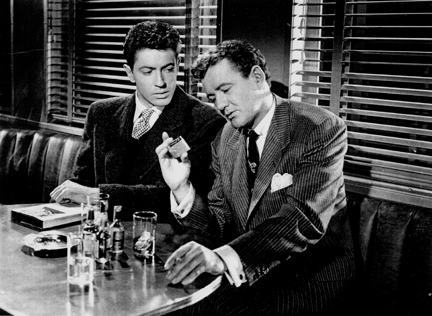
Farley Granger and Robert Walker in "Strangers on a Train"

Wednesday, March 7: One of my all-time favorite Alfred Hitchcock films, “Strangers on a Train” (1951) stars Robert Walker as a psycho playboy intent on committing a double murder with tennis champ Farley Granger. As Hitch shows us in the opening shot, never underestimate the importance of footwear.
#
Wednesday, March 14: Another Hitchcock work that draws on his lifelong love of trains, “The Lady Vanishes” from 1938 takes place on a train en route from the fictional country of Bandrika to Western Europe. Passengers Margaret Lockwood and Michael Redgrave attempt to find a mysterious Miss Froy.
#
Thursday, March 15: In “The Night of the Hunter” (1955, Charles Laughton) the great Robert Mitchum gives an unforgettable performance as a warped preacher with a knack for seducing trusting souls. Also starring Shelley Winters and Lillian Gish. At 6:30 p.m., author Preston Neal Jones will sign his book “Heaven and Hell to Play With: The Filming of The Night of the Hunter.”
#

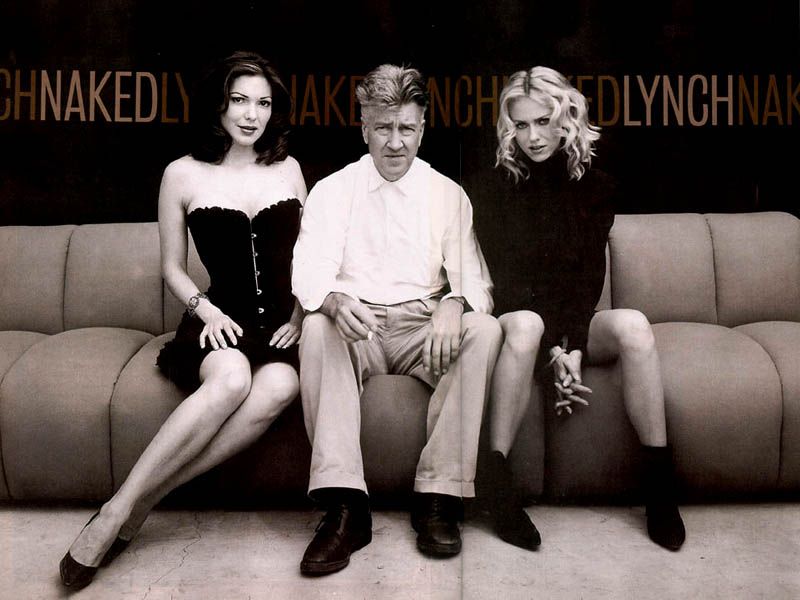
Laura Harring, director David Lynch and Naomi Watts of "Mulholland Dr."

Saturday, March 24: A top-notch double feature, starting with Billy Wilder’s masterpiece noir and scathing look at Hollywood, “Sunset Boulevard” (1950). William Holden, Gloria Swanson and Erich von Stroheim star in this must-see flick. Next up: Naomi Watts and Laura Harring lead the cast of David Lynch’s mesmerizing and surreal portrait of Tinseltown’s latent evil, “Mulholland Dr.” (2001).

Wednesday, March 28: Yet more Hitchcock! Joel McCrea plays reporter Johnny Jones, who encounters intrigue and danger in “Foreign Correspondent” from 1940.
#
Thursday March 29: “The Manchurian Candidate,” starring Frank Sinatra, Laurence Harvey and Angela Lansbury, celebrates its 50th anniversary. Superb direction from John Frankenheimer.
#
AT THE EGYPTIAN THEATRE
6712 Hollywood Blvd., Hollywood; shows start at 7:30 p.m. with multiple showings and one matinee for “The Snowtown Murders”

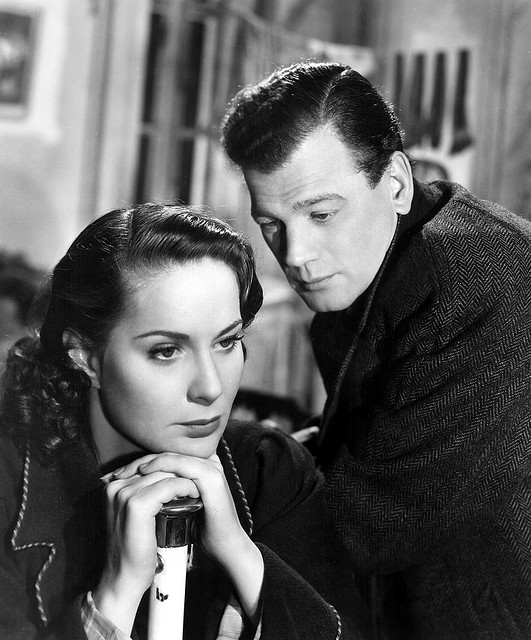
Alida Valli and Joseph Cotten in "The Third Man."

Wednesday, March 7: Carol Reed directs Joseph Cotten, Alida Valli and Orson Welles in 1949’s “The Third Man,” one of the finest thrillers ever made. Don’t miss it!
#
Wednesday, March 14: Orson Welles as auteur and actor. In “The Lady from Shanghai” (1948), an outstanding noir, he co-stars with Rita Hayworth and Everett Sloane. In “Confidential Report” (1955), Welles plays a dad in deep denial about his murky past.
#
Thursday, March 15-Sunday, March 18: Justin Kurzel makes his directorial debut with “The Snowtown Murders,” the story of Australia’s most infamous serial killer. Plays at 7:30 p.m. and 9:30 p.m. Thursday-Saturday and 4 p.m. Sunday.
#
Wednesday, March 28: More brilliance from Orson Welles in this knock-out double feature. “Touch of Evil,” a tale of corruption, is widely considered the last great work of classic film noir. Its unbeatable cast: Welles, Charlton Heston, Janet Leigh and Mercedes McCambridge. “The Trial” (based on Franz Kafka’s novel about paranoia and conspiracy) also boasts amazing talent: Welles, Anthony Perkins, Jeanne Moreau, Romy Schneider and Akim Tamiroff.
#
AT LACMA
5905 Wilshire Blvd.
At 7:30 p.m. Thursday, March 8: As a tribute to Wim Wenders, “The American Friend,” a stand-out neo noir from 1977 is paired with 1982’s “Chambre 666,” a doc with A-list directors about the future of filmmaking.
#
At 7:30 p.m. Friday, March 9: Film noir is partly rooted in French Poetic Realism and these two examples of the genre make an excellent night at the movies. To start: Cinematic genius and master of poetic realism Jean Renoir’s “The Rules of the Game” (1939) followed by Jacques Becker’s “Casque D’Or” (1952). Becker assisted Renoir on “Rules” and “Grand Illusion” (1937).
#

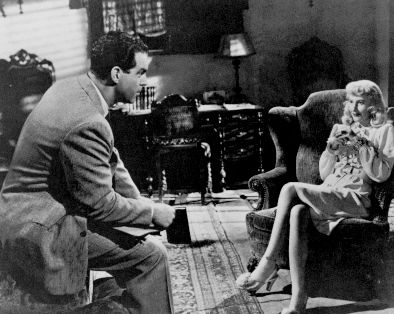
Fred MacMurray and Barbara Stanwyck star in Billy Wilder's "Double Indemnity" from 1944.

At 1 p.m. Tuesday, March 13: Billy Wilder’s “Double Indemnity” (1944) is one of the defining films of the noir genre. Femme fatale Barbara Stanwyck lures insurance agent Fred MacMurray into committing murder for a big payoff. Edward G. Robinson shines as MacMurray’s boss and friend.
#
At noon Saturday, March 24: Christian Marclay’s “The Clock,” winner of the Golden Lion at last year’s Venice Biennale, is a 24-hour single-channel montage constructed from thousands of moments of cinema and television history depicting the passage of time. Begins at noon Saturday and ends at noon on Sunday, March 25.
#
At 1 p.m. Tuesday, March 27: Another prime example of classic film noir, Robert Siodmak’s “The Killers” put Ava Gardner and Burt Lancaster on the track to super-stardom.
#

‘In a Lonely Place’ an ode to romantic, cynical noir love

In a Lonely Place/1950/Columbia Pictures/94 min.

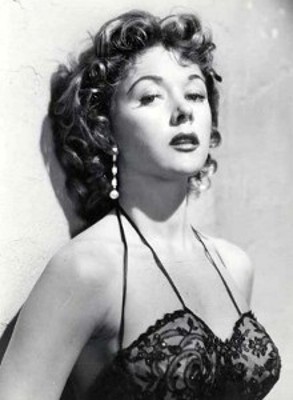
Gloria Grahame

One of Gloria Grahame’s most nuanced performances is as Laurel Gray in 1950’s “In a Lonely Place,” a noir love story from director Nicholas Ray. Laurel eschews any double-dealing or dark deeds in this film. She’s got enough on her hands trying to navigate a new romance: Does she like the way he kisses? Will he call when he says he will? Did he brutally kill a girl for no reason? You know, the usual dating stuff.

Her love interest is her neighbor, Dixon Steele (Humphrey Bogart), a volatile, sometimes violent, screenwriter, with a history of fights and scandals. Her cool affection seems the perfect salve for his simmering aggression.

The fly in the ointment is that Police Capt. Lochner (Carl Benton Reid) is convinced that Dix, in a fit of temper, murdered a hatcheck girl named Mildred Atkinson (Martha Stewart). He was, after all, the last person to see her alive. Dix professes his innocence and Laurel backs him up. But Dix’s erratic behavior gets worse and, when he proposes, Laurel’s too scared to say no.

“In a Lonely Place” is an exquisitely tender love story and it holds up incredibly well for contemporary audiences, who know the ropes of brief, ill-fated affairs. “It’s complicated” would be Laurel’s Facebook relationship status if she’d lived in the age of online communication.

On one hand, she tries to take it slow with Dix, telling him, “I don’t want to be rushed.” But she’s already lied to the police to give him an alibi for the night of the Atkinson murder. At first, the pair conveniently push the reality of Dix’s rage under the rug, though it becomes harder and harder as their shared fear (that he is capable of such a killing) slowly and steadily builds.

Much of the action takes place at the Beverly Patio Apartments complex, where Laurel and Dix both live, offering ample opportunity for skulking and spying.  Director Ray lived in a similar complex in West Hollywood and it served as the model for the film set.

If Ray is a poet as a director, this film is an ode to impossible love, a sensitive portrayal of a strong, egoic man succumbing to dark inner demons and the pain he inflicts on those around him. It might be just as apt to compare Ray to a painter so arresting and assured are his compositions (he studied architecture with Frank Lloyd Wright).

As with most of Ray’s films, “In a Lonely Place” offers powerful, sometimes blisteringly raw, performances all around. Grahame’s tear-stained face at the end is an image that never leaves you once you see it. (Ray and Grahame married in 1948, separated in 1950 and divorced in 1952).

Bogart, though he never loses his swagger, brilliantly conveys Dix’s growing desperation and alienation. Excellent in supporting parts are Frank Lovejoy as Dix’s friend and lone ally at the police station, Jean Marie “Jeff” Donnell as his friend’s wife and Art Smith as Dix’s agent.

Scripted by Andrew Solt, “In a Lonely Place” is based on a novel by Dorothy B. Hughes, which is well worth a read; it’s a very fast read by the way. In the book, Dix is a shadowy, psychopathic killer, not a successful screenwriter with a bad temper, and Hughes explores his psyche in great detail. She also conjures a gritty picture of LA after World War Two.

The movie contains a good dose of noir cynicism about Hollywood and how it treats its struggling denizens. “In a Lonely Place” would make an excellent double bill with Billy Wilder’s “Sunset Boulevard,” also from 1950.

Grahame played in many noirs (and won the best supporting actress Oscar in 1952 for her role in “The Bad and the Beautiful”) but by the early ’60s, her career was dragging and she saw for herself how Tinseltown’s chummy embrace could turn to cold shoulders and closed doors.

“In a Lonely Place” plays at 7:30 p.m. Friday, July 22, at the Los Angeles County Museum of Art (LACMA), 5905 Wilshire Blvd.