Clive Owen plays cards close to his chest in compelling ‘Croupier’ revisited after 25 years

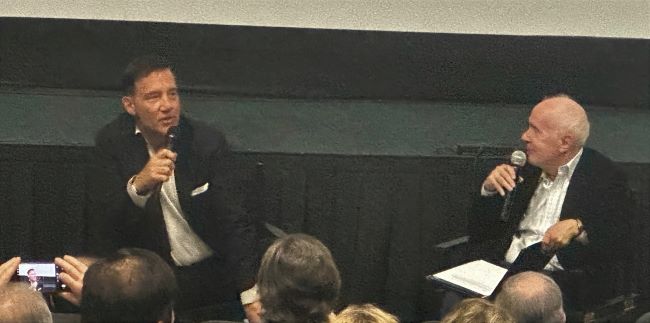
Clive Owen and critic Stephen Farber discuss “Croupier” Wednesday night at the Laemmle Royal in Los Angeles.

Writers are a bit like gamblers. They look for lucky breaks, they hope agents or editors will give their work a chance, they meet deadlines with a nervous mix of triumph and trepidation. Win, lose or break even, they keep taking the bet.

This comparison comes to life in “Croupier,” a British neo-noir directed by Mike Hodges and starring Clive Owen, which released in the US in 2000 and put Owen on the path to Hollywood stardom. The film screened Wednesday night at the Laemmle Royal, as part of the Anniversary Classics Series, with Owen in attendance.
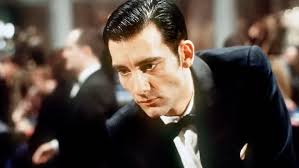
Clive Owen plays it cool in the casino.

Owen plays Jack Manfred, a man in need of a job and a writer in search of material. He finds it amid the grit, stale glamour and greed at the Golden Lion casino in London – a job his cheerful grifter father Jack Sr. (Nicholas Ball) has secured for him. His dad likely has had more downs than ups in his business ventures, but breezily pretends to be a big success.

Night after night, cooly detached Jack sees people at their worst as he encounters shady players, sweaty addicts and sexy ladies. While we see him deal cards, we hear the voiceover of his novel in progress based on his observations at the casino – his inner monologue is reminiscent of the flashback VO recounted by screenwriter Joe Gillis (William Holden) in “Sunset Boulevard” (Billy Wilder, 1950).
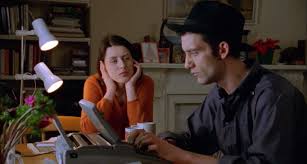
Gina McKee as Marion sits by her man, Jack (Clive Owen).

When not working, Jack is writing or sleeping, and friction grows with his supportive, supremely loyal, live-in girlfriend Marion (Gina McKee), a department-store security guard. She’s put off by the cynical tone of his book and by the main character who enjoys seeing people lose.

Though Jack says he cannot tolerate cheaters and claims he never gambles, he is a scribe on the sly, after all, and it’s not long before he performs some slick shuffling of his moral code – his risk-taking begins with entanglements that put his job on the line. He’s drawn to co-worker Bella (Kate Hardie) and flirts with a mysterious casino patron hailing from South Africa named Jani (Alex Kingston). “If you don’t call me, I’ll understand, but I hope that you do,” she informs him matter of factly, as she hands him her phone number.
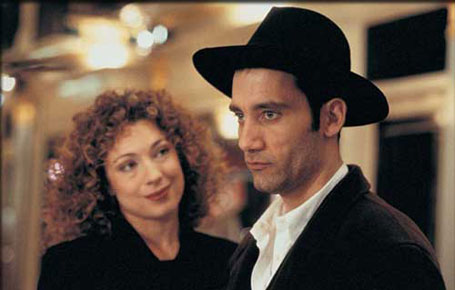
Yani (Alex Kingston) does her femme fatale finest to lure Jack into a scheme.

Not surprisingly, this cig-puffing femme fatale leads Jack further down the road of debauchery, tempting him with a simple role in an inside-job robbery. Steely-eyed, laconic Jack exudes an enigmatic intensity and shows little to no emotion – except on the rare occasion when he completely loses control.

Fast paced with brisk editing and harsh, bleak lighting (nary a noir shadow here), “Croupier” is smart, engrossing, entertaining and laced with moments of dry humor.

Paul Mayersberg’s suspenseful script touches on sexual politics, class divisions, family dynamics, creating art, the duality of human nature and the randomness of existence. If the ending is slightly pat, it doesn’t spoil the story. Owen gives a fine performance as the unflinching anti-hero and his fellow cast members meet him every step of the way, each shining in their roles.

At Wednesday’s screening, critic Stephen Farber and veteran producer/marketing luminary Mike Kaplan introduced the film. Known for his ingenuity and dogged tenacity, Kaplan rescued “Croupier” from almost-certain obscurity. Released with virtually no promotion, the movie (which reportedly had a budget of £3 million) didn’t do well in England.


Director Mike Hodges (1932-2022) remarked at the time, “It wasn’t released. It escaped.” Hodges also directed “Get Carter” (1971), “Pulp” (1972), “Flash Gordon” (1980) and reunited with both Owen and Kaplan for 2003’s “I’ll Sleep When I’m Dead.” He hoped “Croupier” would fare better in America if Kaplan got involved.

“It played for a week in London and it was gone,” said Kaplan. “It was a tragedy because it’s a great movie, but it wasn’t recognized as such … It had an amazing texture of violence with a lot of integrity. It’s technically perfect and it introduced Clive Owen to an international audience in a performance that’s unlike any other.”
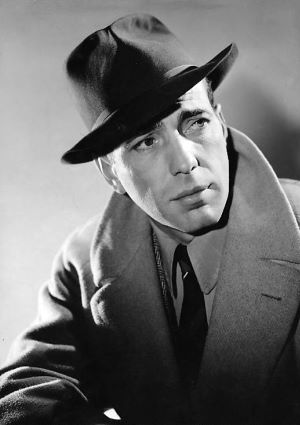
Humphrey Bogart, shown here in 1940, was one of many actors’ names critics mentioned in their reviews of “Croupier.” Last year, in a TV miniseries, Owen played Sam Spade, one of Bogart’s most iconic roles.

So, Kaplan championed the film – coming up with a brilliant ad campaign highlighting major actors Owen had been compared to in critics’ reviews. The esteemed list included Humphrey Bogart, Richard Widmark, Robert Mitchum, Sean Connery, James Mason, Nicolas Cage, Paul Newman and Clint Eastwood. “It played at the Fairfax Theatre (now closed) for two weeks and ran at the Aero, which was a second-run theater at the time, for several months,” said Kaplan.

Farber summed up: “It turned out to be a tremendous success and everybody in Hollywood took notice.”

After the film, Owen talked with Farber. Already an established actor in England, Owen recalled that the script intrigued him, especially the dialogue, which was not naturalistic. “The combination of Mike Hodges who’s very specific, very noir, very grounded and Paul Mayersberg who’s very intellectual and abstract in some ways [results in] the scenes having a kind of heightened quality,” said Owen.

Farber asked him to talk about his co-stars. “It was a great cast Mike Hodges put together,” said Owen. “The actors embraced the non-naturalistic style of dialogue and when you’re all committed to it, then the thing can sing.”

Owen added that he loves noir and has returned to the genre over the course of his career, most recently playing Dashiell Hammett’s famous private detective in the “Monsieur Spade” TV miniseries, which ran last year on AMC.
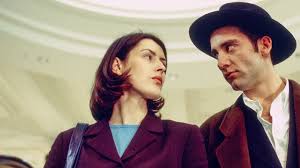
Actress Gina McKee epitomizes the good-girl archetype.

During the audience Q&A, noted Los Angeles writer and publisher of artsmeme.com, Debra Levine asked Owen to share his thoughts about the three female characters and the actresses who played them. She pointed out, in classic noir, there’s a bombshell who brings the character down and, in this film, the women have different trajectories, especially Gina McKee’s character.

Owen responded: “I actually think all the women in their own way are very strong in this movie. They’re all very independent. When I look at it, I think it’s refreshing. I think they are really great parts for women. They’re interesting and they’re powerful women. I think, especially considering it was made 25 years ago, they’re really well written parts and were fun to play. They were all really good actresses as well.”

For him, he acknowledged, the film was a major gear change, radically shifting everything. Said Owen: “It’s something that stayed with me ever since.”


The Noir File: Widmark is unforgettable as Tommy Udo

By Mike Wilmington and Film Noir Blonde

The Noir File is FNB’s guide to classic film noir, neo-noir and pre-noir from the schedule of Turner Classic Movies (TCM), which broadcasts them uncut and uninterrupted. The times are Eastern Standard and (Pacific Standard).

PICK OF THE WEEK

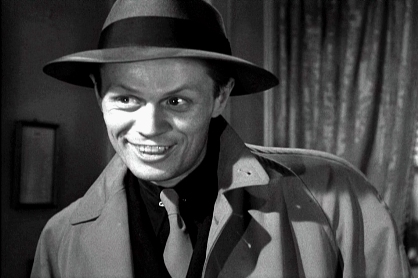
Grinning gangster Tommy Udo was a career-defining role for Richard Widmark.

Kiss of Death” (1947, dir. Henry Hathaway). Tuesday, May 14; 8 p.m. (5 p.m.). One of the most memorable, and scariest, of all film noir villains is Tommy Udo from “Kiss of Death,” as played by the young Richard Widmark. Tommy was a constantly grinning, giggling gunman with a pale, thin, deadly-looking face, topped by a trim fedora – a face and a chuckle that carried the promise of cold-blooded murder.

In “Kiss of Death” – another of director Henry Hathaway’s semi-true crime movies, this time co-scripted by the great Ben HechtVictor Mature plays Nick Bianco, an ex-crook trying to go straight, for his sweet wife Nettie (Coleen Gray). To escape his past, Nick becomes a mole recruited by the cops (including Brian Donlevy and Karl Malden) to infiltrate Udo’s mob and get the goods on this gangster. Udo falls for his new mob-mate, giggling, like a ton of bricks. Obviously, something very bad will happen when this psychopathic hood discovers that his new gun buddy is a traitor.

“Kiss of Death” is a classic, vintage Hollywood crime thriller, one of the film noirs that everyone has to see – to savor Hecht’s smart script and Hathaway’s taut direction, and to enjoy the terrific work of the entire killer cast and company. But mostly, you have to see it for Widmark. His Tommy Udo is an impersonation of pure evil so right-on that it almost freezes your blood to watch and hear him – and so convincing that a real-life member of the Mob, the notorious killer “Crazy Joey” Gallo, patterned his entire public personality after Widmark’s performance.

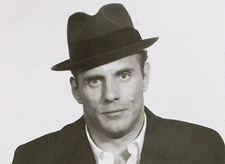
“Crazy Joey” Gallo

The role made Widmark a star, and, though he tried never to repeat it, and played mostly good guys for the rest of his career, he could never really get away from Tommy Udo and his pale, cold eyes, and what James Agee called his “falsetto baby talk, laced with tittering laughs.”

Tommy Udo is the last guy in the world you want to have his eye on you, the last guy whose laugh you want to hear on a dark street. And he’s the last guy you want to see standing behind a sick old lady, in a wheelchair, at the top of a staircase. Giggling.

Friday, May 10

6 a.m. (3 a.m.): “The Informer” (1935, John Ford). With Victor McLaglen, Preston Foster and Heather Angel. Reviewed on FNB December 12, 2012.

11 p.m. (8 p.m.): “Under Capricorn” (1949, Alfred Hitchcock). With Ingrid Bergman, Joseph Cotten and Margaret Leighton. Reviewed on FNB November 17, 2012. [Read more…]

The Noir File: Dark treats from Preminger, Dassin and Lang

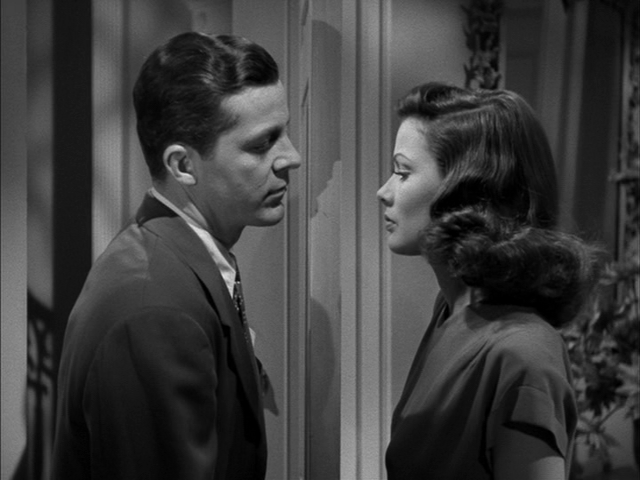
Dana Andrews and Gene Tierney are one of film noir’s great couples.

By Michael Wilmington & Film Noir Blonde

The Noir File is FNB’s guide to classic film noir, neo-noir and pre-noir on cable TV. All movies below are from the schedule of Turner Classic Movies (TCM), which broadcasts them uncut and uninterrupted. The times are Eastern Standard and (Pacific Standard).

PICK OF THE WEEK

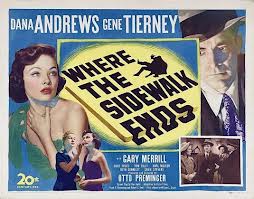
Where the Sidewalk Ends” (1950, Otto Preminger). Thursday, Dec. 27, 1:15 a.m. (10:15 p.m.).
While investigating a murder, a smart but sometimes savage Manhattan police detective named Mark Dixon (Dana Andrews) accidentally kills an innocent suspect (Craig Stevens). Dixon tries to cover it up, but his relentless new boss Lt. Thomas (Karl Malden) keeps pushing the evidence toward an affable cabbie named Jiggs (Tom Tully). And Dixon has fallen in love with Jiggs’ daughter, model Morgan Taylor (Gene Tierney). Gary Merrill plays a crook/gambler.

Scripted by Ben Hecht from William Stuart’s book “Night Cry.” If you want to know what film noir is all about, check this one out.

Thursday, Dec. 27

8 p.m. (5 p.m.): “Black Widow” (1954, Nunnally Johnson). Crime among the Broadway elite, from one of Patrick Quentin’s mystery novels. Not much style, but the cast includes Van Heflin, Ginger Rogers, Gene Tierney, George Raft and Peggy Ann Garner.

4:30 a.m. (1:30 a.m.): “Night and the City” (1950, Jules Dassin). In shadow-drenched, dangerous London, crooked fight promoter Harry Fabian (Richard Widmark) double-crosses everyone he encounters as he tries to outrace the night. The night is faster. This is a top film noir, a masterpiece of style and suspense. From Gerald Kersh’s novel; with Gene Tierney, Herbert Lom, Francis L. Sullivan and Googie Withers.

Sunday, Dec. 30

8:15 a.m. (5:15 a.m.): “Bunny Lake is Missing” (1965, Otto Preminger). Bunny Lake is an American child kidnapped in London, Carol Lynley her terrified mother, Keir Dullea her concerned uncle, Anna Massey her harassed teacher, Noel Coward her sleazy landlord, and Laurence Olivier the brainy police detective trying to put the pieces of the puzzle together. The most important of those pieces: Was Bunny ever really there at all? A neglected gem; based on Evelyn Piper’s novel.

4 a.m. (1 a.m.): “Ministry of Fear” (1944, Fritz Lang). Ray Milland, just released from a British mental institution, wins the wrong cake at a charity raffle and becomes ensnared in a nightmarish web of espionage and murder. The source is one of novelist Graham Greene’s “entertainments.” Co-starring Marjorie Reynolds and Dan Duryea.

Film noir treats this weekend at the American Cinematheque

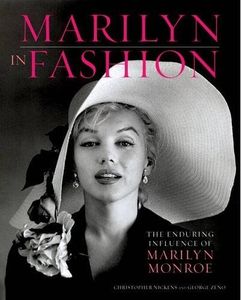
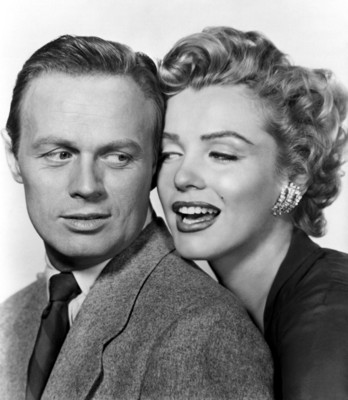
Authors Christopher Nickens and George Zeno will sign their book “Marilyn in Fashion,” today at the Egyptian Theatre, before a screening of 1952’s “Don’t Bother to Knock” starring Marilyn Monroe and Richard Widmark.

Using many rare photographs, the book traces the evolution of Marilyn’s style. The signing starts at 1 p.m. and the film at 2 p.m. The Egyptian Theatre is at 6712 Hollywood Blvd. in Hollywood.

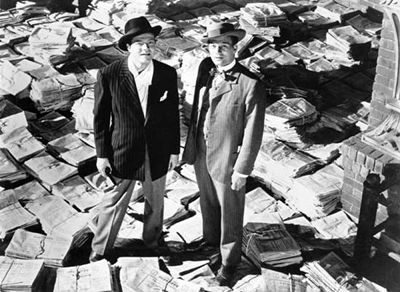
Additionally, “Citizen Kane,” Orson Welles’ masterpiece, plays tonight at 7:30 p.m. at the Aero Theatre in Santa Monica.

On Sunday, July 22, at 7:30 p.m., there’s a great Otto Preminger double-bill: “Laura” (1944) and “Bonjour Tristesse” (1958). Don’t miss it!

The Aero Theatre is at 1328 Montana Ave. in Santa Monica.

The Noir File: Lusty? Low-budget? We’re in!

By Michael Wilmington

A noir-lover’s guide to classic film noirs (and neo-noirs) on cable TV. Just Turner Classic Movies (TCM) so far, but we’ll add more stations as more schedules come in. The times are Pacific Standard (listed first) and Eastern Standard.

Friday, July 13: Sam Fuller Day

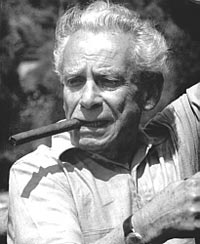
Samuel Fuller

The following four films were all written and directed by noir master Fuller.

5 p.m. (8 p.m.): “I Shot Jesse James” (1949, Samuel Fuller). Western noir, with Preston Foster and John Ireland (as the “dirty little coward … who laid poor Jesse in his grave”). (TCM)

6:30 P.M. (9:30 p.m.): “Park Row” (1952, Samuel Fuller). Fuller’s personal favorite of all his movies was this lusty low-budget period film, set in the 1880s, about newspapering in New York. With Gene Evans (“The Steel Helmet”) as a two-fisted editor and Mary Welch as a femme fatale of a publisher. (TCM)

8 p.m. (11 p.m.): “Shock Corridor” (1963, Samuel Fuller). Aggressive, Pulitzer-hunting reporter Johnny Barrett (Peter Breck) feigns madness and gets himself committed to a mental institution to track down a murderer. Constance Towers is the stripper masquerading as his sister. Quintessential Fuller. (TCM)

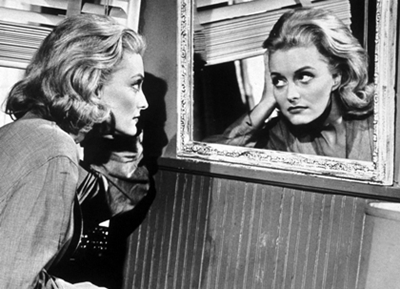
Constance Towers plays in “Naked Kiss” (shown here) and “Shock Corridor.”

9:45 p.m. (12:45 a.m.): “The Naked Kiss” (1964, Samuel Fuller). A hooker, a pervert, and a sleazy cop get involved in small-town scandal and murder. Stanley Cortez (“Night of the Hunter”) photographs noirishly, both here and in “Shock Corridor.” (TCM)

Also on Friday:

3 a.m. (6 a.m.) “Séance on a Wet Afternoon” (1964, British, Bryan Forbes). Acting fireworks from Oscar nominee Kim Stanley and Richard Attenborough as a crooked spiritualist and her meek husband, tangled up in crime. Based on Mark McShane’s novel. (TCM)

3 p.m. (6 p.m.): “Wait Until Dark” (1967, Terence Young). From the hit stage play by Frederick (“Dial M for Murder”) Knott. Blind woman Audrey Hepburn sees no evil and tries to stave off Alan Arkin, Richard Crenna and Jack Weston. (TCM)

Saturday, July 14

4 a.m. (7 a.m.): “The Black Book” (“Reign of Terror”) (1949, Anthony Mann). French Revolution noir, with Robert Cummings, Arlene Dahl, Richard Basehart and Beulah Bondi. Photographed by John Alton. (TCM)

Sunday, July 15

Richard Widmark is unforgettable in “Night and the City,” set in London.

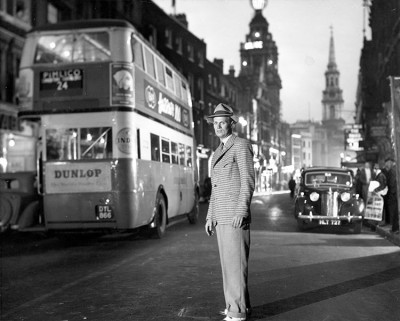
5:30 a.m. (8:30 a.m.): “Night and the City” (1950, Jules Dassin). Crooked fight promoter Harry Fabian (Richard Widmark) tries to outrace the night. One of the all-time best film noirs, from Gerald Kersh’s London novel. With Gene Tierney, Herbert Lom and Googie Withers. (TCM)

7:30 a.m. (10:30 a.m.): “The Reckless Moment” (1949, Max Ophuls). Blackmail and murder invade a “happy” bourgeois home. Based on Elizabeth Sanxay Holding’s novel, “The Blank Wall,” and directed by one of the cinema’s greatest visual/dramatic stylists, Max Ophuls (“Letter from an Unknown Woman,” “Lola Montes,” “The Earrings of Madame de…”) With James Mason, Joan Bennett and Shepperd Strudwick. (TCM)

11 p.m. (2 a.m.): “Sawdust and Tinsel” (“The Naked Night”) (1953, Swedish, Ingmar Bergman). Film master Ingmar Bergman once said that his major early cinematic influences were “the film noir directors, Howard Hawks, Raoul Walsh and Michael Curtiz.” Here is one of the most noir of all Bergman’s films (along with “Hour of the Wolf” and “The Serpent’s Egg”): a German Expressionist-style nightmare of a film about life at a circus, in three rings of adultery, jealousy and torment. (In Swedish, with English subtitles.) (TCM)

Thursday, July 19

Orson Welles and Joseph Cotten star in “Citizen Kane.”

8:15 a.m. (11:15 a.m.): “Caged” (1950, John Cromwell). One of the best and grimmest of the “women’s prison” pictures. A grim look at life locked up, with Eleanor Parker, Agnes Moorehead, Hope Emerson, Jan Sterling and Jane Darwell. (TCM)

11:15 p.m. (2:15 a.m.): “Citizen Kane” (1941, Orson Welles). A dark look at the sensational, profligate life of one of the world’s most powerful and egotistical newspaper magnates, the late Charles Foster Kane (modeled on William Randolph Hearst and acted by George Orson Welles). Still the greatest movie of all time, it’s also a virtual lexicon of film-noir visual and dramatic style, as seminal in its way as “The Maltese Falcon” or “M.” Scripted by Welles and one-time Hearst crony Herman Mankiewicz, photographed by Gregg Toland, with music by Bernard Herrmann and ensemble acting by the Mercury Players: Welles, Joseph Cotten, Everett Sloane, Dorothy Comingore, Agnes Moorehead, George Coulouris, Ruth Warrick, Paul Stewart, et al. (“Rosebud? I tell you about Rosebud…”) (TCM)

‘Don’t Bother to Knock’ a showcase for Monroe’s talent

Don’t Bother to Knock”/1952/Twentieth Century Fox/76 min.

Richard Widmark and Marilyn Monroe

For any fool who still questions Marilyn Monroe’s depth as an actress, “Don’t Bother To Knock” should be required viewing. In this 1952 film directed by Roy Ward Baker and written by Daniel Taradash, Monroe stars with film noir icons Richard Widmark and Elisha Cook, Jr. and entirely holds her own.

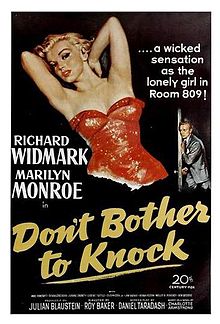
She plays Nell Forbes, a vulnerable and mysterious young woman who might be dangerous. Well, if you look at the movie poster, she’s definitely dangerous, though the image (Marilyn wears a shiny bright-red bustier) is a bit misleading — Nell doesn’t wear anything quite that daring. Of course, no matter what she wears, she’s still uber sexy.

Anyway, Nell has recently moved to NYC, from Washington state, to make a fresh start after a long recovery from a broken heart (a pilot who died in World War Two). Her sole contact in the big city is her ever-nervous and slightly creepy uncle (Cook Jr.), an elevator operator at the McKinley Hotel. When a couple staying at the hotel needs a baby-sitter, Uncle Eddie taps Nell for the job. Lurene Tuttle and Jim Backus play the parents; Donna Corcoran is their daughter Bunny.

Once the little girl goes to bed, Nell kills time by trying on Mrs. Jones’ jewelry, perfume and a negligee. She also notices Jed Towers (Widmark) in a room across the courtyard. He’s a pilot in from Chicago trying to patch things up with ex-girlfriend Lyn Lesley (Anne Bancroft), a sultry and svelte singer who performs at the hotel lounge.

Nell and Jed flirt from afar and he eventually joins her in the Jones’ room, bearing a wicked smile and a bottle of rye. It slowly becomes clear that Nell needs more tonic than a handsome cocky stranger with hard liquor can provide. (Rats!) By leading Nell toward help, Jed reveals a side of himself that changes his relationship with Lyn.

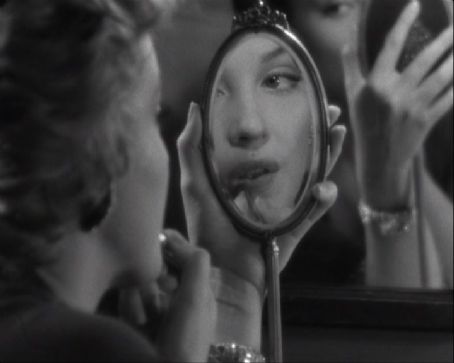
Mirrors (and their suggestion of fractured reality) pop up frequently in film noir.

Though the plot’s quite simple, the film’s strong direction and writing as well as resonant performances from some of the finest actors of the era infuse it with tension that fairly crackles. Luminous, fragile, restless and alluring, Monroe brings an undercurrent of torment and confusion to this memorable role.

Widmark appeals as the insolent yet sympathetic suitor. And the supporting cast is marvelous; in addition to Backus and Tuttle, there’s Verna Felton and Don Beddoe (nosy hotel residents), Willis Bouchey (the hotel bartender), Corcoran as the cute kid, and of course Cook Jr. and Bancroft.

The story is based on the novel “Mischief” by best-selling suspense author Charlotte Armstrong; Taradash wrote the script a year before he won the Oscar for adapting “From Here to Eternity.” “Don’t Bother to Knock” also offers moments of wry humor, such as when Jed asks the bartender if he fights and argues with his wife. The bartender’s deadpan reply: “Some of the time she sleeps.”

If you are a Marilyn fan, you’ll love her even more after seeing this movie and you’ll have definitive proof of her sensitivity and subtlety as an artist from early in career, just in case you ever happen to be chatting with someone who is dismissive of her talent. In 1952, given the way she was marketed and managed, you could forgive an assessment based purely on her physical assets. Nearly 60 years later, however, so much has changed. 😉

Btw, I found a wonderful blog called Blonde & Red. Author Rosanna “loves vintage fashion, red lipstick and Marilyn Monroe” and each week runs Marilyn Mondays. Enjoy!

‘Don’t Bother to Knock’ quick hit

Don’t Bother to Knock/1952/Twentieth Century Fox/76 min.

Great writing and a strong cast (Marilyn Monroe, Richard Widmark, Elisha Cook, Jr., Anne Bancroft) make 1952’s “Don’t Bother To Knock” by Roy Ward Baker a cinematic treasure, but one that is, sadly, often overlooked. Monroe plays a deranged baby-sitter who likes diamonds, perfume and negligees (ok, she’s clearly not completely bonkers) but can’t seem to put her past behind her.