New noirs: ‘The Guard,’ ‘Good Neighbors’

The Guard/2011/Sony Pictures Classics/96 min.

In “The Guard,” Brendan Gleeson is a small-town Irish cop and Don Cheadle a by-the-book FBI agent who comes to the Emerald Isle to bust an international drug-smuggling gang. The two clash at first, then become unlikely allies, then friends, as they get closer to core of the criminal operation.

On the plus side, this black comedy, with a healthy dose of murder, blackmail and corruption, is good for some dark dry laughs, especially from the formidable and funny Gleeson. He knocks back the lines as easily as his character downs a pint. Writer/director John Michael McDonagh is the brother of Martin McDonagh (writer/director of 2008’s “In Bruges”) and, like his brother, he relishes irreverent sarcasm. On the minus side, though, “The Guard” is superficial and derivative; you have seen this movie before.

But if it’s a bit of entertainment you’re after, “The Guard” is your man.

“The Guard” opens July 29.

x

Good Neighbors/2010/Magnolia Pictures/96 min.

According to writer/director Jacob Tierney, “Good Neighbors,” based on a novel by Chrystine Brouillet, isn’t so much a whodunit as it is a satirical movie about people uncovering information and then having to decide what to do with it.

The people in this case are residents of a Montreal apartment building in 1995, three young tenants who become friends: charming, sly Spencer (Scott Speedman), brusque and to-the-point cat lover Louise (Emily Hampshire) and cute but geeky Victor (Jay Baruchel). The above-mentioned information relates to the rape and murder of several young women around the city. Safe at home in a cozy apartment? Not so much, especially since the members of the friendly trio turn out to be capable of shocking, searing violence.

There are more holes than surprises in this movie, the compositions are a little dull looking and it’s not particularly suspenseful until the last reel. That said, the last reel delivers some full-on tension, the actors are interesting to watch, especially Hampshire, and the writing’s not bad. Also, cats figure prominently in the plot – reason enough to see it in my book. 😉

“Good Neighbors” opens July 29.

Totally exciting, wildly preposterous: French police thriller ‘Point Blank’ knocks us out, then keeps right on going

Point Blank/2010/Magnolia Pictures/90 min.

French police thrillers, especially the classics by Clouzot, Chabrol and Melville, used to be a bit more plausible and psychologically acute than their American counterparts – explosive action shoot-’em-ups that have mostly tried to knock us on our asses. Not so these days. The French cops-and-robbers hit movie “Point Blank” out-Yanks the Yanks by knocking us on our derrieres in the first few minutes — and then keeps it up, racing like hell on wheels for the next 80.

That’s the good news: It’s an exciting movie. The bad news is that, like many of its U.S. counterparts, it doesn’t make a hell of a lot of sense. The other good news is that writer/director Fred Cavayé’s movie is so well-gunned and goes by so damned fast, you barely notice the holes as you bounce over them.

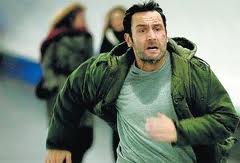
Gilles Lellouche as Samuel is caught between the crooks and the cops.

The plot, jam-packed into the movie’s screamingly fast running time, has to do with a hit man named Hugo Sartet (Roschdy Zem, the somberly magnetic actor of “Days of Glory”) who’s been betrayed and nearly killed. He winds up in the hospital in the custody of the police and the care of a low-key male nurse, Samuel Pierret (the amiable and wonderfully nervous Gilles Lellouche).

Samuel saves Hugo from more would-be assassins and then, to his horror, finds himself trapped between the crooks and the cops – and the crooks who are cops (quite a lot of them, as it turns out). Under the evil command of the Teutonic-looking Commandant Patrick Werner (Gerard Lanvin), who’s actually conducting the investigation of his own crimes, those rogue police start chasing Hugo and Samuel all around Paris.

And, for insurance, they kidnap Samuel‘s beautiful wife Nadia (Elena Anaya), who’s eight months pregnant — threatening her death unless Samuel helps them. Soon Samuel and Hugo have become friends, of a sort, and a large section of Paris has become a bloody battleground.

I told you it didn’t make much sense. And, as I said, it doesn’t really matter. Cavayé, an ex-fashion photographer with a good eye and a blistering sense of pace, also made the big French neo-noir hit “Pour Elle,” which was translated and Americanized into the savagely improbable Russell Crowe thriller “The Next Three Days.” (Hollywood copied it so fast that Cavayé’s French original wasn’t imported and may still pop up here.)

Like Luc Besson and his disciples, Cavayé can do certain high-tech American tricks better than a lot of Americans. How does he get any suspension of disbelief, besides pure speed and kinetic rush? The leads, Zem, Lellouche and Anaya, are all excellent actors (Zem has a great glare) and they bring emotional conviction to a story you can barely believe for a minute.

The title “Point Blank,” by the way, has nothing to do with Cavayé’s original title “A Bout Portant” and nothing to do with the 1967 Lee MarvinJohn Boorman noir classic “Point Blank,” which in turn was adapted from the 1962 Richard Stark-Donald Westlake novel “The Hunter,” which has nothing to do with the 1980 Steve McQueen crime thriller of the same name.

But whether you call it “Point Blank” or “A Bout Portant” or “The French Reconnection” or “Paris Goes Kaboom,” this is still one totally exciting if often wildly preposterous movie.

— Michael Wilmington

“Point Blank” opens July 29. (In French with English subtitles.)

With its engrossing story, gorgeous cinematography and riveting performances, ‘The Conformist’ still compels

The Conformist/1970/115 min.

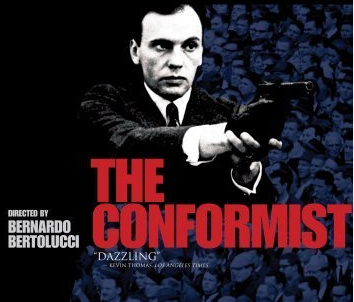
Is Bernardo Bertolucci’s “The Conformist” – an art film classic regarded by many cinematographers as the most beautifully photographed movie of its era – also a neo-noir?

Well, it’s a movie, set in the 1930s, about those old noir standbys: romance, sex, murder, betrayal, guilt and political/police corruption. Adapted from the famous novel by Alberto Moravia, it has a psychologically divided and tormented central character, Marcello Clerici (played by Jean-Louis Trintignant of “Z” and “A Man and a Woman”), who is racked by Freudian desires and guilty secrets. The opaque-faced Marcello has homosexual leanings, which he tries to wipe out by marrying and becoming a good reliable government man. In 1930s Italy, this means being a good fascist.

Marcello is also involved in a messy triangle with his lovely, naive wife Giulia (Stefania Sandrelli) and with the incredibly beautiful bisexual Anna Quadri (Dominique Sanda). In 1970, because of this movie, the ravishing blonde Sanda was often described as the most beautiful actress in movies. Sanda was also Bertolucci’s first choice to be Marlon Brando’s co-star in “Last Tango in Paris.” (She chose motherhood instead.)

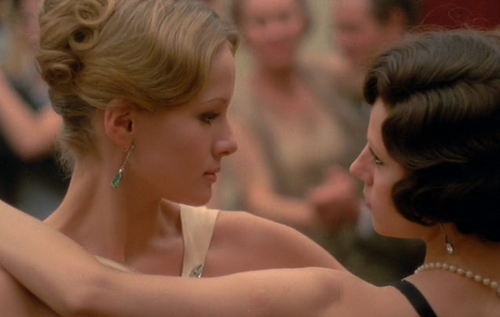
Dominique Sanda and Stefania Sandrelli

“The Conformist,” though, made her a movie immortal. Sanda’s feverish onscreen tango with Sandrelli against an iridescent, gorgeously colored background, while Marcello watches, is one of the most justly famous erotic/musical set-pieces in all of cinema.

Bertolucci later went on to make celebrated and even notorious classics like “The Last Emperor” and “Last Tango,” but many aficionados still prefer “The Conformist” for its engrossing story, the savvy political background, the absolutely gorgeous Storaro cinematography (the color equivalent of a great noir black-and-white), and for the riveting performances by Sanda, Trintignant, Sandrelli, Pierre Clementi, Yvonne Sanson and the others. [Read more…]

Noir greats at LACMA; a Nicholson noir night at the Aero

The Los Angeles County Museum of Art (LACMA) has a particularly good lineup of classic and neo noirs this month.

“Rear Window” (1954) 1 p.m. Tuesday, July 12

“Pickpocket” (1959) 7:30 p.m. Saturday, July 16

“Bay of Angels” (1963) 9 p.m. Saturday, July 16

“The Letter” (1940) 1 p.m. Tuesday, July 19

“The Honeymoon Killers” (1970) 7:30 p.m. Thursday, July 21

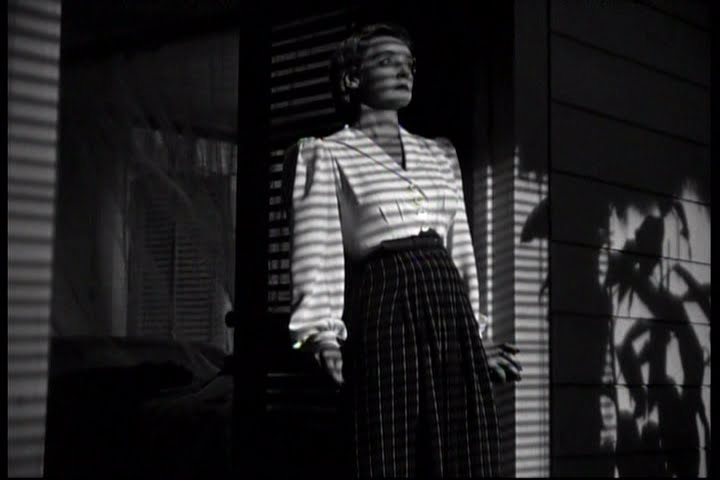
Bette Davis stars in "The Letter" by director William Wyler.

“In a Lonely Place” (1950) 7:30 p.m. Friday, July 22

“The Long Goodbye”(1973) 9:15 p.m. Friday, July 22

“Mulholland Dr.” (2001) 7:30 p.m. Saturday, July 23

“The Lady from Shanghai” (1948) 7:30 p.m. Friday, July 29

“The Conformist” (1971) 9:10 p.m. Friday, July 29

Tickets range from $2 for the matinees to $10 for evening double features ($5 for one film only). Discounts for LACMA members and seniors. For tickets, call 323-857-6010 or visit the web site; there is a $2 charge to buy online. For synopses of the movies, see LACMA’s listings. LACMA is at 5905 Wilshire Blvd., Los Angeles, 90036.

Additionally, the Aero Theatre in Santa Monica is running a “Jack Nicholson Noir” double bill on Saturday, July 23, starting at 7:30. The films are Roman Polanski’s “Chinatown” and “The Two Jakes,” which Nicholson directed. The Aero Theatre is at 1328 Montana Ave. General admission is $11; members pay $7. Visit the American Cinematheque for the complete schedule.

Far out: ‘The Long Goodbye’ stretches the lingo of film noir

The Long Goodbye/1973/United Artists/112 min.

One of the best films of the ’70s or an ugly, boring travesty of a well respected detective novel?

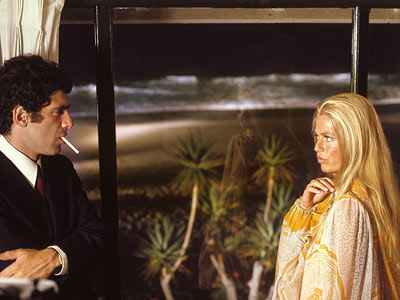
Elliott Gould and Nina Van Pallandt in "The Long Goodbye."

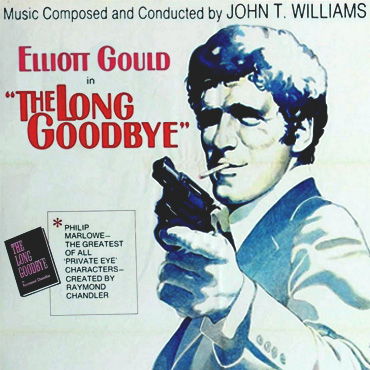
Decide for yourself as you watch Robert Altman’s 1973 movie of “The Long Goodbye,” by Raymond Chandler. The film, starring Elliott Gould as private investigator Philip Marlowe, divided critics, earning the above-mentioned rave from Time Out and the snooty slam from Leslie Halliwell.

It was primarily Gould’s free-wheeling interpretation of the beloved PI that drew ire. Charles Champlin called him an “untidy, unshaven, semi-literate dimwit slob.”

An entertaining yarn, soaked in ’70s atmosphere, the movie captures the sunny, scruffy, solipsistic mood and look of Malibu, Calif., at the start of the Me Decade. Marlowe’s next door neighbors, for example, are pot-brownie-baking, clothing-optional candlemakers. We only see them from a distance but in a way they are timeless party girls, a ’70s version of “The Girls Next Door.”

And “The Long Goodbye” stretches the vocabulary of film noir. As Foster Hirsch, author of “Detours and Lost Highways: A Map of Neo Noir,” writes: “For all its self-indulgence and contradiction – the film both satirizes and seeks acceptance as a cool, contemporary L.A. mystery story – Altman’s ‘new age’ noir suggested the genre’s elasticity at a time when it was considered passé. Produced before nouveau noir had taken root, ‘The Long Goodbye’ anticipates the full-force genre revival of the 1980s and 1990s.”

We meet Marlowe late one night as he’s trying to round up food for his hungry cat (Morris the Cat in the role that launched him to stardom). The story spices up when Marlowe’s friend Terry Lennox (Jim Bouton) asks him, after a marital spat, to drive him to Tijuana.

Marlowe doesn’t have much else going on (besides cat care, of course) and so they make the trip; Marlowe heads back on his own to find that Lennox’s wife is dead. The police press Marlowe for info on Terry’s whereabouts, hoping that a little jail time will jog his memory (David Carradine plays Marlowe’s cellmate). They ease up after Terry Lennox commits suicide, having first written a letter confessing to the murder.

Marlowe’s not buying the suicide, but turns his attention to a new client. The sun-kissed and sophisticated Eileen Wade (Nina van Pallandt) wants Marlowe to find her missing hubby Roger Wade, a boozy writer, (played by the wonderful Sterling Hayden, a veteran of film noirs like “Asphalt Jungle” and “The Killing”).

Searching for Roger isn’t all that challenging, but Marlowe has his hands full with a visit from psychopathic gangster Marty Augustine (director Mark Rydell) and his hoods (including young Arnold Schwarzenegger). They’re sniffing around for a load of cash that Terry Lennox was supposed to deliver to Mexico. Surprise, surprise, the cash never made it. So the surly, anti-social Marlowe plods on toward the truth, trying not to get any sand on the shag carpets. [Read more…]

‘The Long Goodbye’ quick hit

The Long Goodbye/1973/United Artists/112 min.

Private eye Philip Marlowe in the age of political protests and pot brownies. Director Robert Altman and lead actor Elliott Gould referred to the famous Raymond Chandler character as Rip van Marlowe, meaning a guy who wakes up from a 20-year sleep, more than a little groggy. Driving a buddy to Tijuana is the first step into a deep pool of confusion and crime. Nina Van Pallandt and Sterling Hayden co-star in this spectacular neo noir.

Paris, ‘Pulp Fiction,’ the proper way to approach Tarantino

Pulp Fiction/1994/Miramax Films/154 min.

My upcoming trip to Paris (I leave tomorrow) triggered the memory of that great scene in “Pulp Fiction” where two hit men chat about a quarter-pounder with cheese (Royale with cheese) in Paris so I decided to run this review in honor of my trip. For the next two weeks, my posts will slow down a bit as I spend time with a lovely friend and soak in the atmosphere of this ravishingly beautiful city.

Quentin Tarantino at the Cannes film fest in 2008.

Several years ago, at the Cannes Film Fest, I saw Quentin Tarantino rushing down the Croisette but I froze and didn’t approach him to say how much I liked his work. (He was helming the jury that year.) As I stood there, regretting that I’d missed the chance, two English guys walked up and asked me if I was lost. I filled them in; they said I was quite right to have refrained.

But then two Italian men joined us and told me I was crazy not to have said hello. “Maybe he’ll show up at the Ritz,” one of them said, gesturing toward the hotel. “Why don’t we have a glass of champagne there and see if perhaps he arrives?”

As tempting as that sounded, I’d already agreed to meet people at the cheap and cheerful Le Petite Carlton, where the casual, sometimes-raucous crowd spreads out into the street, people bum Marlboros and Gitanes, beer is served in tacky plastic cups and a little kitchen churns out thin-crust pizza well into the early morning hours. Another missed opportunity! 😉

So if by some odd chance, on this trip, I happen to see Tarantino on the Champs Elysee or some charming Italian men invite me to cocktails at the Ritz, I’ll know what to do!

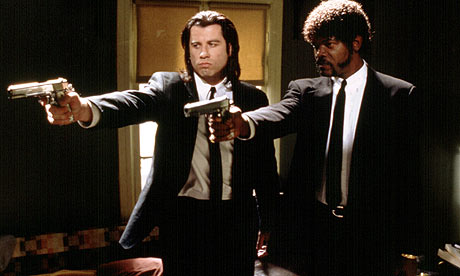
John Travolta and Samuel L. Jackson in "Pulp Fiction."

“Pulp Fiction” is a neo noir of audacious originality, comic brilliance and exquisite craftsmanship. It was one of the most important films of the 1990s. Like his previous film, 1992’s “Reservoir Dogs,” it’s a crime movie that deals with bad guys doing bad stuff – in “Dogs” it’s a robbery gone wrong. In “Pulp Fiction” we’re immersed in three separate but interwoven stories about two chatty hit men, a corrupt boxer who defies a mob boss, and a grunge version of Bonnie and Clyde.

Tarantino tells us the stories out of order, bookended by the scruffy lover bandits (Tim Roth as Pumpkin and Amanda Plummer as Honey Bunny) who hold up an LA coffee shop. Bruce Willis plays Butch the boxer who pulls a double-cross. John Travolta made a stunning comeback as sexy smart-ass Vincent Vega and Samuel L. Jackson dazzles as Jules Winnfield, an armchair philosopher packing heat.

As Vincent and Jules discuss fast food, foot massages and Fate, Vincent is assigned an extra job from brawny bossman Marsellus Wallace (Ving Rhames): to take Mrs. Wallace (Uma Thurman) aka Mia out on the town. A headturner with jet-black hair, Louise Brooks bangs, wide blue eyes and long legs, Mia gets what Mia wants. Topping the list are milkshakes, drugs and dancing. Make that dancing with Travolta, mmm.

There is much to love about this film, particularly the highly original characters and crackling dialogue, which includes one-liners, retro slang, debates over points of logic and lengthy tangents of trivia. The dialogue seems to emerge organically from the characters and random chitchat punctuates major dramatic moments.

Actors talk with their back to the camera and sometimes put the imminent action on hold so they can wind up their conversation. Even though Pumpkin and Honey Bunny probably get the least amount of screen time, through their dialogue, we see several layers of their partnership, both tough and tender. [Read more…]

Brian De Palma’s ‘Blow Out’ sometimes makes us roll our eyes and sometimes holds us spellbound

Having received good feedback from the winner of April’s giveaway – the prize was Criterion’s rerelease of “Blow Out” – I realized it was high time to run the review. 😉

Brian De Palma/1981/ Filmways Pictures/107 min.

Michael Wilmington

By Michael Wilmington

“Blow Out,” Brian De Palma’s 1981 neo noir about a movie sound man (played by John Travolta), who stumbles into a political conspiracy and a string of murders, is a movie for connoisseurs of trash and movie art. One of this movie’s strongest critical admirers (and one of De Palma’s) was Pauline Kael, and one of Kael’s most famous critical essays is called “Trash, Art and the Movies.” We get all three of them here, in a film that sometimes makes us roll our eyes and sometimes holds us spellbound.

“Blow Out” probably took its title partly from Michelangelo Antonioni’s “Blowup,” which is about a swinging ’60s London photographer who stumbles on what may be murder. And it centers around one of Travolta’s sexiest performances, as Jack Terry the lone-wolf Philadelphia sound-effects man, who is working on a sleazy slasher horror movie.

The director is dissatisfied with the scream Jack has supplied for one of the victims. The movie within the movie is a terrible, inept picture, which De Palma stages as a send-up of “Halloween” and other teen slasher pics. But Jack is a pro. He takes his equipment out that night to get more ambient night-sound on a suburban bridge.

Nancy Allen

That bridge is an unusually well-populated one, considering the lateness of the hour. There are crickets and an owl, who stares at us disturbingly, and there’s another filmmaker named Manny Karp (Dennis Franz), who’s got his camera set up somewhere near Jack (but whom Jack doesn’t know and doesn’t see), and finally there’s a speeding car, carrying, amazingly, the current front-running candidate for president of the United States, Governor McRyan, (John Hoffmeister) together with a hot blonde named Sally (Nancy Allen).

Jack hears a couple of bangs (and catches them on his recorder) and the governor’s car plunges through a fence and into the river where it quickly sinks. Jack dives in and is able to rescue Sally, but not the possible next president.

Soon we’re at the hospital, where Sally is groggily coming to. The police, reporters and some political people, visions of Chappaquiddick perhaps dancing in their heads, seem to want Jack and Nancy to just clam up and go away. He won’t. She wants to, at first, but decides she likes Jack.

Then Manny and his Zapruderish film turns up, and ex-Philadelphian De Palma turns the city into a house of horrors more violent than anything in ex-Philadephian David Lynch’s neighborhood, craning and swooping and whirling his camera all around a world gone seemingly mad. There’s a deadly plot of some kind afoot, and its bloodiest agent is a phony telephone company worker named Burke (played with a truly evil stare and icily smug expression by John Lithgow), a cold-blooded killer who seems willing to depopulate half the town to keep all the guilty secrets safe.

If that sounds like a pretty absurd plot, it often plays pretty silly too, though just as often it’s imaginatively over-the-top and hellishly exciting. I‘ve always thought De Palma should avoid solo-writing jobs on his own movie scripts. And “Blow Out” as well as “Raising Cain” and “Femme Fatale” (and 1968’s “Murder a la Mod,” which is included in this Criterion package) are good demonstrations why. “Blow Out” is never boring. But a lot of the time it doesn’t make any bloody sense.

So why did Kael call it a great movie? Mostly, maybe, because she very much liked De Palma’s work, because this movie is made with such great feverish style, and also maybe because she had a crush of sorts on Travolta, as she had on Marlon Brando, Paul Newman and Warren Beatty.

The style is what we remember about “Blow Out” – not the ideas, which are mostly shallow or obvious, or the story, which is both predictable and illogical, or the characters who are mostly overdrawn and somewhat stereotypical (or archetypal, if you prefer), or the movie itself, which is basically a set of ingeniously orchestrated suspense set-pieces, strung together in clever, artful ways that defy plausibility with an almost cheerful impudence. [Read more…]

Coen Brothers’ ‘Man’ is darkly moody, handsomely shot

The Man Who Wasn’t There/2001/Good Machine, et al/116 min.

Scarlett Johansson plays a high-school student in this 2001 film.

What would life be without a dark and handsome companion at night? One I highly recommend is “The Man Who Wasn’t There” by master filmmakers Joel and Ethan Coen. This homage to vintage film noir, gorgeously shot in black and white by cinematographer Roger Deakins, conjures a guy you’ll always remember.

Set in 1949, the film introduces us to a choice cast of characters. Top of the list is introspective and blasé Ed Crane (Billy Bob Thornton), who has fallen into a comfortable, if dull, life in Santa Rosa, Calif. He’s fond of his wife Doris (Frances McDormand), both cynical and oddly sweet, but there’s never been any passion between them.

To earn a living, Ed cuts hair with his brother-in-law Frank (Michael Badalucco) at the family barbershop. (“I don’t talk much,” Ed tells us. “I just cut the hair.”) Doris is a bookkeeper at Nirdlinger’s, the town’s big department store, and together they have it “made” – after all, Ed points out dryly, they have a garbage grinder built into the sink.

When he’s not working or tossing scraps down their fancy drain, Ed kills time mainly by smoking and taking care of Doris after she’s had too much to drink, which is quite often. Doris passes the hours of their lives by playing bingo and having an affair with her boss at Nirdlinger’s, Big Dave Brewster (James Gandolfini), a blustery WW2 vet. Dave’s married to Ann Nirdlinger (Katherine Borowitz), whose family owns the store. Ed knows about the affair but, as he does with everything, takes it in stride.

Ed’s life changes forever the day that unctuous big-mouth businessman Creighton Tolliver (Jon Polito) walks into the barbershop as it’s about to close, gets a very quick trim and happens to mention that he’s in town trying to raise money to invest in drycleaning, which he’s convinced is “the biggest business opportunity since Henry Ford.”

Ed decides later that night that he wants in on the putative drycleaning empire and figures he can raise the requisite $10,000 by anonymously blackmailing Dave. No sooner does Ed get the cash than Tolliver takes off with it. And because Tolliver is so quick to bend ears and beg for money, Dave gets to the bottom of the blackmail scheme and intends to get his money back.

What Dave doesn’t count on is that Ed’s mild facade hides nerves of cold steel; when cornered, Ed’s response to him is quick, instinctive and deadly. But, after news breaks of Doris and Dave’s affair, Doris is arrested for Dave’s murder. [Read more…]

Quick hit: ‘The Man Who Wasn’t There’

The Man Who Wasn’t There/2001/Good Machine, et al/116 min.

What would life be without a dark and handsome companion at night? One I highly recommend is “The Man Who Wasn’t There” by master filmmakers Joel and Ethan Coen. This homage to vintage film noir, gorgeously shot in black and white by cinematographer Roger Deakins, conjures a guy you’ll always remember.

Starring: Billy Bob Thornton, Frances McDormand and James Gandolfini, and a peerless supporting cast.