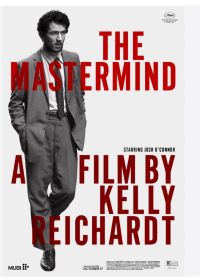
 Less than a week after seeing “Roofman” – starring Channing Tatum as an ingenious but goofy thief in a story “based on actual events and terrible decisions,” as per the movie’s tagline – I went to a screening of “The Mastermind.” It’s a heist film inspired by the 1972 robbery of the Worcester Art Museum in Massachusetts, in which two Gauguins, a Picasso, and a Rembrandt were stolen.
The movie opens with a young family wandering around the “Framingham Museum of Art” (a place invented for this flick). The mom Terri Mooney (Alana Haim) silently leads the boys Carl and Tommy (Sterling Thompson and Jasper Thompson) as Carl chatters about a guessing game. The dad James Blaine Mooney (Josh O’Connor) hangs back. They have the place mostly to themselves; the security guard is zoned out as he catches z’s. It’s the perfect moment to contemplate the paintings or, if you’re a feckless art-school grad who’s bent on rebellion, as James Blaine (JB) is, pull a key out of your pocket, open a display case, and help yourself to a carved figure.
JB’s initial pilfering is just a prelude to his carelessly thought-out plan of stealing four paintings, a feat he pulls off with the help of two accomplices (Cole Doman and Javion Allen), one of whom is armed with a gun. JB hides the artwork in a barn, hoping he’ll be able to sell it and rustle up a wad of cash. Presumably, he’ll add the money to his family’s finances, convincing his wife and parents (Hope Davis and Bill Camp) that he’s finally having success as an architect.
But his deeper motivation appears to be two-fold: railing against the confines and ennui of his middle-class existence, and in some way defying his father. The fact that his father is a local judge paradoxically figures into JB’s cover story when he is questioned by the police.
After JB leaves town and goes on the lam (rather haphazardly), his comfort, security, and entitlement slip away as he grows increasingly desperate, though not exactly downhearted. Watching “The Mastermind,” as it slowly unwinds, there is ample time to ponder JB, his relationships, what drives him, and what he’s lost.
Visually, the film is impeccable. Writer-director-editor Kelly Reichardt meticulously recreates the look and feel of early 1970s Massachusetts and the Midwest under overcast skies. Wardrobe, hair/makeup, art direction, production design, set decoration, lighting, and documentary-like camerawork all contribute to the precise rendering of each scene. Rob Mazurek’s scintillating jazz score provides a dynamic complement to the underplayed performances and spare dialogue.
However, as much as I typically enjoy a slow-burn film and as much as I tried to invest in JB’s fate, I ultimately disconnected with “The Mastermind.” While O’Connor does possess a breezy, everyman energy, he lacked the requisite charisma to make me care about this misguided man trapped somewhat by societal expectations but mainly by his own choices.
“The Mastermind” opens in theaters on Friday, Oct. 17.








From my readers