Noir master Nolan wrings cinema riches from next to nothing

Director Christopher Nolan will appear at the Los Angeles County Museum on Friday, Jan. 4, for a special presentation of his first feature film, “Following,” which was recently released on Blu-ray by Criterion. Michael Wilmington reviews.

Following/1999/ Next Wave Films/70 min.
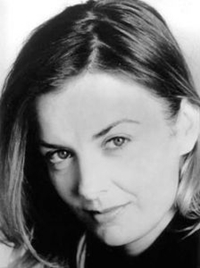
Lucy Russell
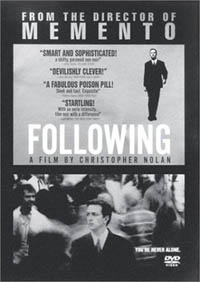
A black and white British neo-noir shot on the cheap, with unknown actors, by a then-unknown writer-director, Christopher Nolan, “Following” is the often-fascinating tale of a thief and a voyeur playing dangerous games. Nolan likes tricks and the Wellesian magicians who play them, and the whole movie is something of a conjuring act.

Done with scant resources and slender means, “Following” grabs you, keeps you guessing and casts its own little spell. It’s an underground movie by a director just about to make his break into the mainstream – with another, more expensive and even trickier film called “Memento.”

You might say that this daring precursor itself was a memento mori. What it reminds us is that, if you cross over the line too far, all kinds of unpleasantness, including death, may be just behind you, following. We start with a nervous young man in trouble (Jeremy Theobald as Bill) relating his story to a policeman. An impoverished writer, Bill has begun to play detective and to follow strangers in the streets of London, seemingly unobserved, as research for his writing. When one of his “subjects,” a slick young operator named Cobb (Alex Haw), turns the tables and confronts his shadow in a coffee shop, Bill is pulled into Cobb’s shady world, the life of a professional burglar.

Bill slides into that world, even changing his persona into something slicker and more Cobb-like, with disturbing ease. Also part of the action is a mysterious nameless blonde (Lucy Russell), who mingles with gangster types and may be involved with both Bill and Cobb. After Bill pursues the Blonde and catches her, bad things begin to happen, and out of chronological order. “Following,” like Nolan’s later work, is told in a non-linear fractured-chronology style.

In this moody, brainy thriller, the seeds of Nolan’s later films (“Memento,” “The Prestige,” “Inception,” and “The Dark Knight” trilogy) are nestled under the gritty, cheapo surface. There’s everything Nolanesque here: alternate worlds, a life out of joint, time running backward, locks and keys, deception and betrayal. The film teases, tricks and gratifies us, the way a good thriller should.

It’s an object lesson in how to wring cinema riches from practically nothing. Nolan, who also photographed “Following,” gets monochrome images worthy of both ’50s American noirs and the ’60s French New Wave. The writing is sharp, literate and good at double-shuffling us. The acting is super (though only Russell went on later to a busy career). The movie doesn’t really haunt your mind afterward and the last slamming door of the plot may feel too open-and-shut, but “Following” is a game worth playing.

Extras: Nolan’s nifty1997 short “Doodlebug,” a Mélièsian-Kafkaesque trick film also starring Theobald (“Doodlebug” is a definitive riposte to critics who think Nolan has no sense of humor). Commentary by and interview with Nolan. The second, chronological edit of “Following.” Side-by-side comparison of Nolan’s shooting script and film scenes. Trailers and booklet with an essay by Scott Foundas.

A few of FNB’s fave posts from 2012

Happy 2013, all! Here’s a look at FNB highlights from 2012.

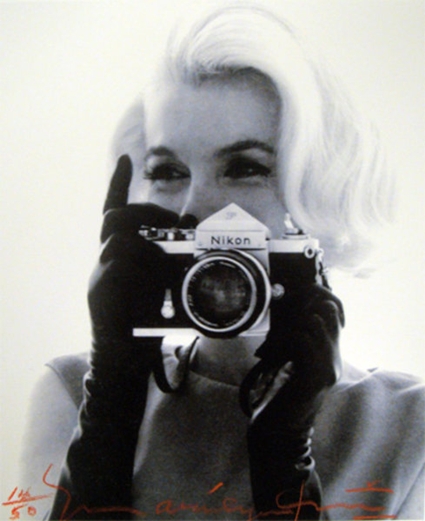
Marilyn Monroe shot by Bert Stern

Top 10 FNB posts (misc.)

Remembering Beth Short, the Black Dahlia, on the 65th anniversary of her death

TCM festival in Hollywood

Interview with Tere Tereba, author of “Mickey Cohen: The Life and Crimes of L.A.’s Notorious Mobster”

Marilyn Monroe birthday tribute

Marilyn Monroe exhibit in Hollywood

Film noir feline stars: The cat in “The Strange Love of Martha Ivers”

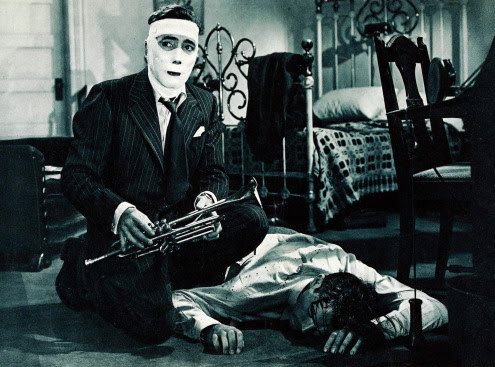
Famous injuries in film noir, coinciding with my fractured toe, or broken foot, depending on how dramatic I am feeling

Panel event on author Georges Simenon with director William Friedkin

History Channel announcement: FNB to curate film noir shop page

Retro restaurant reviews: Russell’s in Pasadena

x

REVIEWS: 2012 neo-noirs or films with elements of noir

Crossfire Hurricane” documentary

Hitchcock

Holy Motors

Killing Them Softly

Momo: The Sam Giancana Story” documentary

Polisse

Rust and Bone

Searching for Sugar Man” documentary

Unforgivable

Wuthering Heights

x

REVIEWS: Classic film noir

Anatomy of a Murder

Criss Cross

Decoy

Gilda

Gun Crazy

Murder, My Sweet

The Postman Always Rings Twice

Possessed

Sunset Blvd.

They Drive By Night

x

REVIEWS: Directed by Alfred Hitchcock

Dial M for Murder

The Lady Vanishes

Marnie

Notorious

The 39 Steps

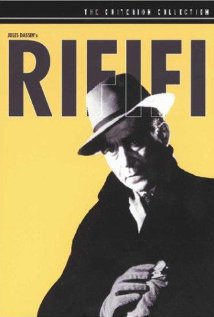
The Noir File: Truffaut’s choice as the greatest film noir: ‘Rififi’

By Michael Wilmington & Film Noir Blonde

The Noir File is FNB’s guide to classic film noir, neo-noir and pre-noir on cable TV. All movies below are from the schedule of Turner Classic Movies (TCM), which broadcasts them uncut and uninterrupted. The times are Eastern Standard and (Pacific Standard). This week, there’s a trio of great heist films on Tuesday, starting at 10 p.m. Eastern (7 p.m. Pacific): “The Asphalt Jungle,” “Rififi” and “Big Deal on Madonna Street.”

PICK OF THE WEEK

Rififi” (1954, Jules Dassin). Tuesday, Jan. 1, 12 a.m. (9 p.m.). Midway through director Jules Dassin’s French crime classic “Rififi” (“Trouble”), Dassin stages a 33-minute-long masterpiece of suspense: a sequence the most critics regard as the most perfect of all movie heist scenes. It’s a brilliantly designed set-piece of excruciating tension and the only sound is the thieves at work.

Probably no one who sees that scene ever forgets it. Here it is: In the early morning hours, a small band of crooks – which include legendary bank robber Tony le Stephanois (Jean Servais), his young married friend Jo Jo (Carl Mohner), a good thief named Mario (Robert Manuel) and the loose-lipped safecracker Cesar (played by Dassin himself, under the stage name Perlo Vita) – break into an exclusive Parisian jewelry store by drilling though the floor of the room above. They work carefully, quietly, methodically. For the entire scene, there is not a word of dialogue, not a note of background music. A tour de force of moviemaking technique, it helped win Dassin the Best Director prize at the Cannes Film Festival. Later, François Truffaut called “Rififi” the greatest of all film noirs.

That heist scene also sets up the grim, fatalistic last act of “Rififi,” which is about how thieves fall apart, set in a Paris that seems shrouded in perpetual clouds and drizzling rain. “Rififi” was regarded as an almost instant classic, and it wiped out the stigma of Dassin’s blacklisting by Hollywood. If you’ve never seen this movie and that scene, you won’t forget them either. (In French, with subtitles.)

Tuesday, Jan. 1

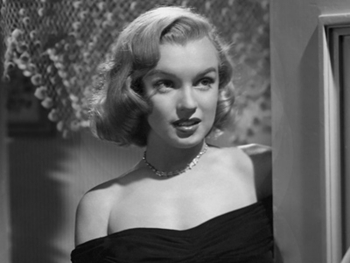
10 p.m. (7 p.m.): “The Asphalt Jungle” (1950, John Huston). With Sterling Hayden and Marilyn Monroe.

Marilyn in one of her first important roles.

2:15 a.m. (11:15 p.m.): “Big Deal on Madonna Street” (1958, Mario Monicelli). An inept gang of burglars, played by front-rank Italian movie stars Vittorio Gassmann, Marcello Mastroianni, Renato Salvatori and Toto, try in vain to break into and rob a store. This is perhaps, along with the Alec GuinnessPeter Sellers “The Ladykillers,” the funniest crime comedy ever made: often remade, endlessly copied, never equaled. (In Italian, with subtitles.)

Saturday, Jan. 5

8 p.m. (5 p.m.): “To Have and Have Not” (1944, Howard Hawks). With Humphrey Bogart and Lauren Bacall.

10 p.m. (7 p.m.): “The Whistler” (1944, William Castle). The first and probably best of the macabre “Whistler” series, based on the popular radio program. Richard Dix, as The Whistler, tries desperately to call off the hit men (Including J. Carroll Naish) he’s hired to kill himself.

2:45 a.m. (11:45 a.m.): “M” (1931, Fritz Lang). With Peter Lorre and Gustaf Grundgens.

Sunday, Jan. 6

4 p.m. (1 p.m.): “The Wrong Man” (1957, Alfred Hitchcock). With Henry Fonda and Vera Miles.

The Noir File: Dark treats from Preminger, Dassin and Lang

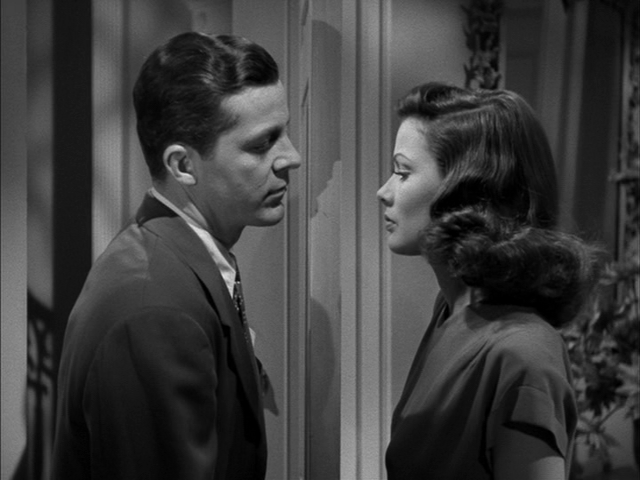
Dana Andrews and Gene Tierney are one of film noir’s great couples.

By Michael Wilmington & Film Noir Blonde

The Noir File is FNB’s guide to classic film noir, neo-noir and pre-noir on cable TV. All movies below are from the schedule of Turner Classic Movies (TCM), which broadcasts them uncut and uninterrupted. The times are Eastern Standard and (Pacific Standard).

PICK OF THE WEEK

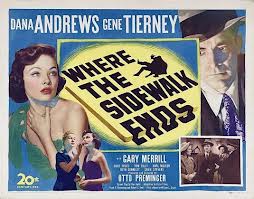
Where the Sidewalk Ends” (1950, Otto Preminger). Thursday, Dec. 27, 1:15 a.m. (10:15 p.m.).
While investigating a murder, a smart but sometimes savage Manhattan police detective named Mark Dixon (Dana Andrews) accidentally kills an innocent suspect (Craig Stevens). Dixon tries to cover it up, but his relentless new boss Lt. Thomas (Karl Malden) keeps pushing the evidence toward an affable cabbie named Jiggs (Tom Tully). And Dixon has fallen in love with Jiggs’ daughter, model Morgan Taylor (Gene Tierney). Gary Merrill plays a crook/gambler.

Scripted by Ben Hecht from William Stuart’s book “Night Cry.” If you want to know what film noir is all about, check this one out.

Thursday, Dec. 27

8 p.m. (5 p.m.): “Black Widow” (1954, Nunnally Johnson). Crime among the Broadway elite, from one of Patrick Quentin’s mystery novels. Not much style, but the cast includes Van Heflin, Ginger Rogers, Gene Tierney, George Raft and Peggy Ann Garner.

4:30 a.m. (1:30 a.m.): “Night and the City” (1950, Jules Dassin). In shadow-drenched, dangerous London, crooked fight promoter Harry Fabian (Richard Widmark) double-crosses everyone he encounters as he tries to outrace the night. The night is faster. This is a top film noir, a masterpiece of style and suspense. From Gerald Kersh’s novel; with Gene Tierney, Herbert Lom, Francis L. Sullivan and Googie Withers.

Sunday, Dec. 30

8:15 a.m. (5:15 a.m.): “Bunny Lake is Missing” (1965, Otto Preminger). Bunny Lake is an American child kidnapped in London, Carol Lynley her terrified mother, Keir Dullea her concerned uncle, Anna Massey her harassed teacher, Noel Coward her sleazy landlord, and Laurence Olivier the brainy police detective trying to put the pieces of the puzzle together. The most important of those pieces: Was Bunny ever really there at all? A neglected gem; based on Evelyn Piper’s novel.

4 a.m. (1 a.m.): “Ministry of Fear” (1944, Fritz Lang). Ray Milland, just released from a British mental institution, wins the wrong cake at a charity raffle and becomes ensnared in a nightmarish web of espionage and murder. The source is one of novelist Graham Greene’s “entertainments.” Co-starring Marjorie Reynolds and Dan Duryea.

Merry Christmas!

I hope your holidays are joyous and that Santa Baby showered you with lovely gifts and rapt attention. Here are a few film favorites of the season. Enjoy!

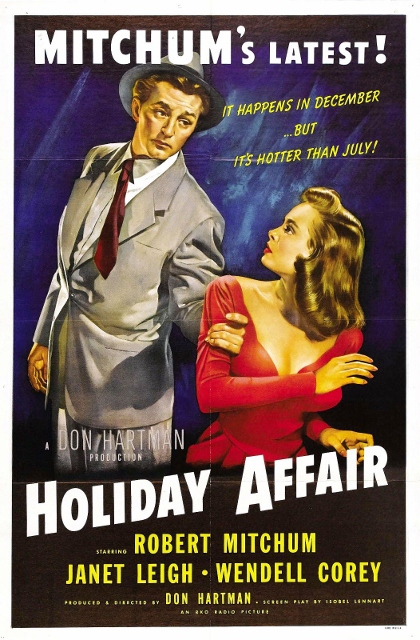
“Holiday Affair” from 1949 stars Robert Mitchum and Janet Leigh. It’s not film noir but Mitchum lends his bad-boy charm nonetheless. Don Hartman directs.

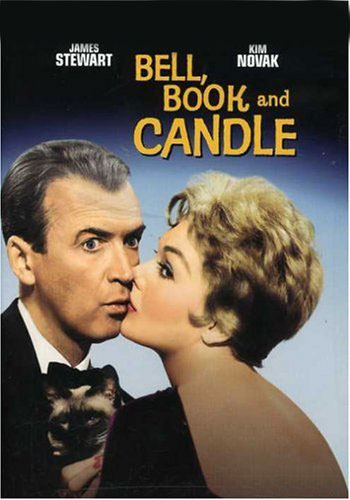
James Stewart co-stars with the enchanting Kim Novak in 1958’s “Bell, Book and Candle,” directed by Richard Quine. Of course, they both bow to the real star, Siamese kitty Pyewacket.

Film Noir Blonde reveals Pyewacket’s offscreen capers here.

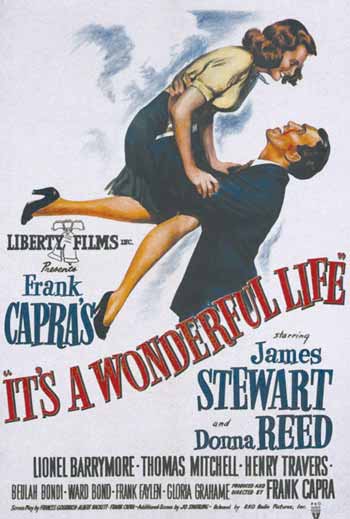
The dark dream sequence in Frank Capra’s 1946 Christmas classic “It’s a Wonderful Life” is pure film noir.

Michael Wilmington reviews “It’s a Wonderful Life.”

And, in case you missed it earlier this month, FNB wrote about “Lady in the Lake,” an experimental film noir with a Christmas setting.

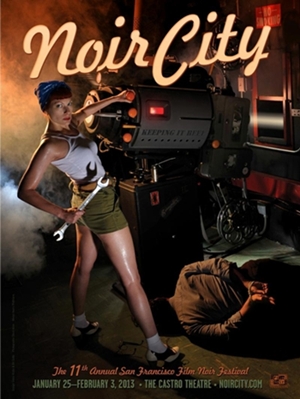
Film Noir Foundation announces schedule for Noir City 11

The Film Noir Foundation’s Noir City film festival, coming to San Francisco’s Castro Theatre in January, will present its most expansive schedule yet – 27 films – including three new 35mm restorations.

This festival kicks off with a tribute to actress Peggy Cummins, legendary for her ferocious performance in “Gun Crazy” (1950, Joseph H. Lewis). As always, Noir City will feature classics and rarities. Opening weekend will feature the world premiere of two of the FNF’s latest film restoration projects: “Try and Get Me!” (1950, Cy Endfield) and “Repeat Performance” (1947, Alfred L. Werker).

The San Francisco festival runs Jan. 25-Feb. 3, 2013. The festival (with variations on the program) travels to several other cities throughout the year. On Thursday, Jan. 17, Eddie Muller and Robert Osborne will co-host “A Night in Noir City” on Turner Classic Movies. The five-film program of rare film noir includes two of the FNF’s restorations, “Cry Danger” (1951, Robert Parrish) and “The Prowler” (1951, Joseph Losey).

The Noir File: All noir, all day, with Stanwyck and Mitchum

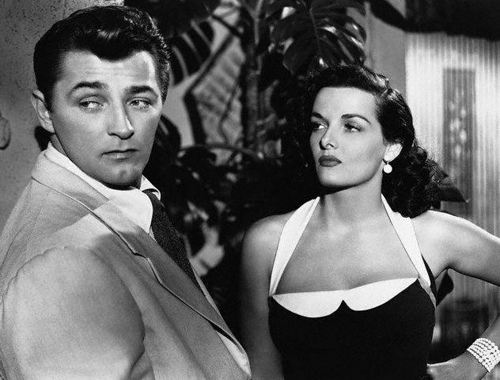
Robert Mitchum and Jane Russell star in “His Kind of Woman.”

By Michael Wilmington & Film Noir Blonde

The Noir File is FNB’s guide to classic film noir, neo-noir and pre-noir on cable TV. All movies below are from the schedule of Turner Classic Movies (TCM), which broadcasts them uncut and uninterrupted. The times are Eastern Standard and (Pacific Standard). This month, TCM pays tribute to one of the great noir dames, Barbara “Missy” Stanwyck. All the Stanwyck film noirs are on Wednesday (Film Noir Day) and Thursday. Robert Mitchum gets a noir tribute on Wednesday too.

PICK OF THE WEEK

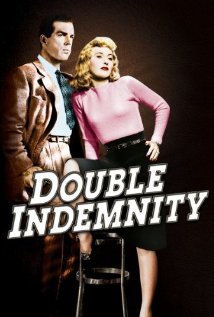
Double Indemnity” (1944, Billy Wilder). Wednesday, Dec. 19, 8 p.m. (5 p.m.). “Yes, I killed him. I killed him for money. And a woman. And I didn’t get the money and I didn’t get the woman. Pretty, isn’t it?” — Walter Neff in “Double Indemnity.”

Sometime before dawn. A dying man, the bullet still in his gut, staggers into his shadowy insurance company office, slumps in a chair, picks up the Dictaphone receiver, and begins to talk. It’s a confession of murder, probably the greatest confession in the history of film noir. The dying man is Walter Neff (Fred MacMurray), a bright, handsome, good-natured insurance salesman who’s sold one policy too many.

He sold it to the husband of Phyllis Dietrichson (Barbara Stanwyck) – the sexiest, blackest hearted dame who ever lit up a cigarette, slipped on (or off) an ankle bracelet, or took out a double indemnity insurance policy on her sap of a husband, prepared by her sap of a salesman/lover. The confession is to his best friend, “hot potato” claims investigator Barton Keyes (Edward G. Robinson). That hurts as much as the bullet. But it doesn’t really matter. There’s not much time left to tell the story. And it’s a hell of a story…

“Double Indemnity” – directed by Billy Wilder, scripted by Wilder and Raymond Chandler from James M. Cain’s great, knife-sharp novel, photographed by John Seitz, with music by Miklos Rozsa – is the pinnacle of film noir. There simply is no better, deeper, darker noir than this one.

Wednesday, Dec. 19

BARBARA STANWYCK AND ROBERT MITCHUM NOIR DAY

Note: For entries that don’t have descriptions, use the search bar on the upper-right side of this page to find previous reviews.

6 a.m. (3 a.m.) “Undercurrent” (Vincente Minnelli, 1946). Mitchum untangles repressions with Katharine Hepburn and Robert Taylor.

8:30 a.m. (5:30 a.m.): “Where Danger Lives” (John Farrow, 1950). Mitchum on the run with psycho flirt Faith Domergue.

10 a.m. (7 a.m.): “His Kind of Woman” (John Farrow, 1951). Mitchum and Jane Russell live it up at a pleasure spot hideaway with mobster Raymond Burr.

12:15 p.m. (9:15 a.m.): “My Forbidden Past” (Robert Stevenson, 1951). Mitchum messes up Ava Gardner and Melvyn Douglas.

1:30 p.m. (10:30 a.m.): “Angel Face” (Otto Preminger, 1953). A Preminger classic with Mitchum and Jean Simmons.

3:15 p.m. (12:15 p.m.): “Second Chance” (Rudolph Maté, 1953). More Mexican high jinks with Mitchum, Linda Darnell and Jack Palance.

10 p.m. (7 p.m.): “The Strange Love of Martha Ivers” (Lewis Milestone, 1946).

12 a.m. (9 p.m.): “Sorry, Wrong Number” (Anatole Litvak, 1948). Tense movie adaptation of the famed Lucille Fletcher radio play about an invalid woman (Stanwyck) terrorized by phone calls.

1:45 a.m. (10:45 p.m.): “Clash by Night” (Fritz Lang, 1952).

3:45 a.m. (12:45 a.m.): “Jeopardy” (John Sturges, 1953).

5 a.m. (2 a.m.): “Witness to Murder” (Roy Rowland, 1954). Did Stanwyck witness a murder? George Sanders and Gary Merrill wonder.

Thursday, Dec. 20

6:30 a.m. (3:30 a.m.): “Crime of Passion” (Gerd Oswald, 1957).

8 a.m. (5 a.m.): “Barbara Stanwyck: Fire and Desire” (Richard Schickel, 1991). Dick Schickel documentary on Stanwyck’s life and career. With Sally Field.

9 a.m. (6 a.m.): “The Two Mrs. Carrolls” (Peter Godfrey, 1947).

Saturday, Dec. 22

2:15 a.m. (11:15 p.m.): “Anatomy of a Murder” (Otto Preminger, 1959).

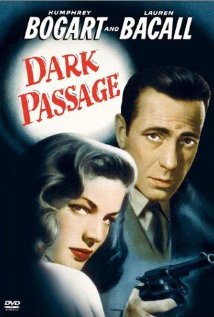
Extolling virtues of ‘Dark Passage’: Bogie, Bacall and more

Dark Passage/1947/Warner Bros./106 min.

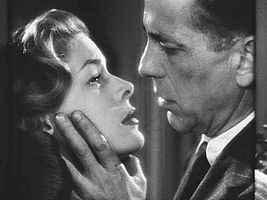
“Dark Passage” was the third of four films Bogart and Bacall made together.

I recently wrote about 1947’s “Lady in the Lake,” a Raymond Chandler/Philip Marlowe tale, starring and directed by Robert Montgomery. Its chief claim to fame is the experimental subjective camera – the story is told entirely from Marlowe’s point of view.

In that review, I noted that “Dark Passage,” starring Humphrey Bogart and Lauren Bacall, also from 1947, uses a subjective camera as well, though just for the first half-hour of the movie. The limited use of the technique in “Dark Passage” pays off much better than the full-on treatment in “Lady.” Though “Dark Passage” wasn’t a huge hit in its day – audiences weren’t crazy about being deprived of Bogart – it’s a film noir treasure that rarely gets its due.

Admittedly, the plausibility police would have a field day with this one. From the moment we meet Bogart as escaped San Quentin prisoner Vincent Parry and Bacall as Irene Jansen, his mysterious helper/wealthy benefactor, the phrase “never gonna happen” pops into your mind and lingers as the rather bizarre plot unfolds. This is not a realistic movie. So sue director/writer Delmer Daves and novelist David Goodis, who provided the source material.

Bogart has an awful lot to account for in “Dark Passage.”

I don’t think the filmmakers’ aim was to tell a story that’s relatable in a literal sense. The idea was to explore ideas about trust, identity, revenge, isolation and paranoia in the shell of an entertaining thriller that’s also infused with the famous Bogie-Bacall chemistry. At the same time, the sometimes-unwieldy narrative has depth and intelligence – it’s not merely a slapdash concoction of the outlandish and absurd. Goodis was a particularly pessimistic writer and a harsh social critic.

Here Bacall’s Irene is calling the shots, outwitting the cops and doling out shrewd suggestions to Vincent in her singular husky voice. Irene is the only person who believes in Vincent’s innocence –that he was wrongly convicted of murdering his wife. Dressed to elegant perfection in every scene, she spurs Vincent to spruce up his wardrobe as well. But Vincent needs more than a fashion overhaul if he is to avoid recapture.

Besides the leads, “Dark Passage” has a tremendous cast – Bruce Bennett shines as Irene’s solid, decent friend and the inimitable Agnes Moorehead sparkles as Madge, the ultimate conniving shrew, with a penchant for animal prints, no less. Houseley Stevenson is unforgettable as the unsavory but highly skilled Dr. Walter Coley. The creepy doctor proves pivotal in Vincent’s quest to remake himself. Even the small parts –a small-time crook, a chatty cabbie and a diner waiter (played by Clifton Young, Tom D’Andrea and Tom Fadden) – are great fun to watch.

The Franz Waxman score, along with San Francisco locations and slick cinematography by Sid Hickox, result in a noir rapture – including a nightmare sequence that is still unsettling 65 years later. Every detail of this strange little work, though not a great film, feels intriguing, satisfying and true to its own (slightly warped) logic.

‘Dark Passage’ quick hit

Dark Passage/1947/Warner Bros./106 min.

The sometimes-neglected “Dark Passage,” by writer/director Delmer Daves, has ingredients that result in a noir rapture: Humphrey Bogart and Lauren Bacall leading a terrific cast (Agnes Moorehead shines as a shrew with a penchant for animal prints), a bizarre story, Franz Waxman’s score, San Francisco locations and slick cinematography by Sid Hickox – including a nightmare sequence that is still unsettling 65 years later.

Every detail of this little film feels intriguing, satisfying and true to its own (slightly warped) logic. A subjective/first-person camera is used for the first half-hour of the movie. Based on a David Goodis novel.

Dita Von Teese to appear at perfume event in Los Angeles

Dita Von Teese photo by Ali Mahdavi

Dita Von Teese will appear at an in-store perfume event in Los Angeles this Saturday, Dec. 15. The event runs from 2-6 p.m. at Fred Segal, 8118 Melrose Ave., West Hollywood, 90046, 323-651-1800. This will be the launch of the second DVT fragrance, Rouge. As Dita puts it: “Perfume sets the mood and I’m in the mood to seduce.”

Dita Von Teese perfume is available online in most countries from RonRobinson.

On Sunday, Dec. 16, makeup artist Julie Hewett, who created Scarlett Johansson’s Janet Leigh look in “Hitchcock” and draws from film noir in her product line, is scheduled to give 30-minute private consultations from 10 a.m. to 5 p.m. at Blushington, a makeup studio at 8591 Sunset Blvd., West Hollywood, 90069. Call 310-652-5874 to make an appointment. You’ll be charged a $50 deposit at the time of booking, which can be used toward product purchases.