The Noir File: Barbara Stanwyck and Fred MacMurray star in the all-time great film noir: ‘Double Indemnity’

By Michael Wilmington & Film Noir Blonde

The Noir File is FNB’s guide to classic film noir, neo-noir, sort of noir and pre-noir on cable TV. All movies below are from the schedule of Turner Classic Movies (TCM), which broadcasts them uncut and uninterrupted. The times are Eastern Standard and (Pacific Standard).

PICK OF THE WEEK
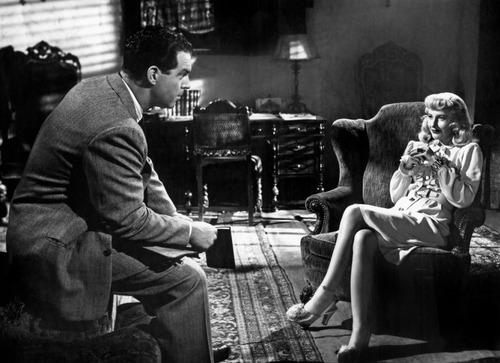
Phyllis (Barbara Stanwyck) figures that having Walter (Fred MacMurray) get rid of her husband will be far more cost-effective than hiring a divorce lawyer.

Double Indemnity” (1944, Billy Wilder). Thursday, Feb. 21, 8 p.m. (5 p.m.).

She’s got a plan, she just needs a man. And that’s a welcome challenge for a femme fatale, especially one with an ankle bracelet.

In Billy Wilder’s film noir masterpiece, “Double Indemnity,” from 1944 Phyllis Dietrichson (Barbara Stanwyck) wants out of her marriage to rich, grumpy oldster, Mr. Dietrichson (Tom Powers). For Phyllis, seducing a new guy to help make hubs disappear is so much more cost-effective than hiring a divorce lawyer. A smart insurance man is even better. Along comes Walter Neff (Fred MacMurray) trying to sell a policy, just as Phyllis finishes a session of sunbathing, wearing an ankle bracelet and not much more. That’s about as much bait as Walter needs. Read the full FNB review here.

Thursday, Feb. 21

3:45 p.m. (12:45 pm): “The Long Voyage Home” (1940, John Ford). Superb film noir cinematography by the matchless Gregg Toland (“Citizen Kane”) graces this dark, moody John FordDudley Nichols adaptation of four of Eugene O’Neill’s great, gloomy sea plays. The themes and mood are noir too. With Thomas Mitchell, Barry Fitzgerald, Ward Bond, Mildred Natwick and John Wayne – who always called “The Long Voyage Home” one of his favorite films.

5:45 p.m. (2:45 p.m.): “Foreign Correspondent” (1940, Alfred Hitchcock). After “Rebecca,” his Oscar-winning 1940 American debut, Alfred Hitchcock’s second Hollywood movie was more truly Hitchcockian. It’s an ingeniously crafted spy melodrama, scripted by Charles Bennett, Joan Harrison and (uncredited) Ben Hecht. Joel McCrea plays a foreign correspondent who gets enmeshed in pre-WW2 intrigue; co-starring Laraine Day, George Sanders, Edmund Gwenn and Robert Benchley. This very anti-Nazi picture was intended to encourage the U.S.’s entrance into the war, to help rescue Hitch’s British countrymen, and it probably did. It’s also a corking Hitchcock spy thriller in the “39 Steps”-”Lady Vanishes” tradition.

Saturday, Feb. 23

1:30 p.m. (10:30 a.m.): “Anatomy of a Murder” (1959, Otto Preminger). With James Stewart, Lee Remick and Ben Gazzara. Reviewed in FNB March 14, 2012
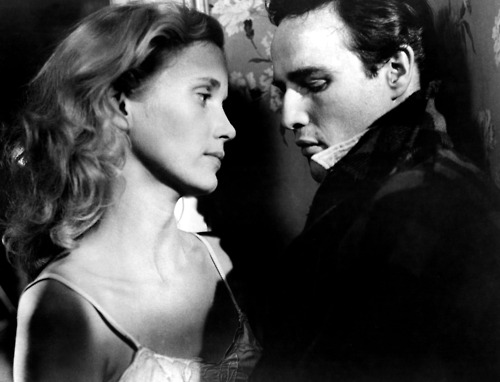
“On the Waterfront” won eight Oscars.

8 p.m. (5 p.m.): “On the Waterfront” (1954, Elia Kazan). One of the great ’50s American social dramas is also one of the great ’50s film noirs, with director Elia Kazan, screenwriter Budd Schulberg and cinematographer Boris Kaufman giving us a two-fisted, beautifully shot and acted drama of a corrupt labor union gang. The star is Marlon Brando, as the slightly punchy, fight-scarred ex-boxer and dockworker Terry Malloy (Brando’s greatest performance), whose brother Charley (Rod Steiger) is a mouthpiece for the crooked union run by mobster Johnny Friendly (Lee J. Cobb). Terry has to decide whether he’ll rat out all the rats to a government investigating committee – exposing the thugs who killed the dockworker father of Edie (Eva Marie Saint) with whom Terry has fallen in love.

All the actors above were nominated for Oscars. (Brando and Saint won, along with Kazan, Schulberg, composer Leonard Bernstein and the movie). Also a nominee was supporting actor Karl Malden as the fighting pro-worker priest, Father Barry. And, in addition to the film’s many prizes, several generations of actors all wanted passionately to be like Brando and to play a scene like the one in “On the Waterfront,” acted with Steiger in a taxicab, where Terry says, heart-rendingly: “Charley, Charley, you don’t understand, I coulda had class….I coulda been a contender.” They never matched that scene, and neither did Brando.

10 p.m. (7 p.m.): “The Harder They Fall” (1956, Mark Robson). Humphrey Bogart’s last movie, and a good one. He’s a respected sports reporter turned unrespectable publicist, hired by a crooked boxing promoter (Rod Steiger) to bilk the public and exploit a huge but naive and ill-skilled South American boxer, Toro Moreno (Mike Lane). Based on a book by boxing aficionado Budd Schulberg.
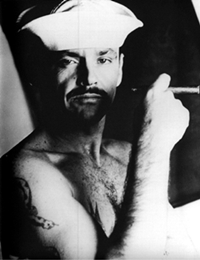
Jack Nicholson

4:30 a.m. (1:30 a.m.): “The Last Detail” (1973, Hal Ashby). Jack Nicholson gave one of his best performances as “Bad Ass” Buddusky, an astonishingly foul-mouthed and cynical Navy lifer who pulls guard duty and has to escort a hapless Navy thief named Meadows (Randy Quaid) to eight years of hard time at Leavenworth. Bad Ass decides (unwisely) to let the kid live a little along the way. One of director Hal Ashby’s best movies, and one of Robert (“Chinatown”) Towne’s greatest scripts, adapted from a novel by Navy man Darryl Ponicsan.

Sunday, Feb. 24

2:30 a.m. (11:30 p.m.): “Midnight Express” (1978, Alan Parker). Oliver Stone wrote the no-punches-pulled screenplay for this searing Alan Parker-directed biographical thriller about real-life American tourist/smuggler Billy Hayes (Brad Davis) and his hellish times in a Turkish prison. With John Hurt and frequent jailbird (in this column at least) Randy Quaid.

Win tickets to ‘Sparks’ premiere at Cinequest Film Festival

“Sparks,” a superhero noir thriller set in the 1940s, is slated to make its world premiere on Friday, March 1, at the Cinequest Film Festival in San Jose, Calif. “Sparks” will debut as a feature-length film and graphic novel.

The story focuses on a masked vigilante named Ian Sparks, whose pursuit of a notorious criminal leaves Sparks’ life in ruins.

The film version pairs two of Hollywood’s rising stars, Chase Williamson (“John Dies at the End”) and Ashley Bell (“The Last Exorcism Part II”), with an award-winning supporting cast: Clancy Brown, Clint Howard, Jake Busey and William Katt.

Chase Williamson

As for the filmmakers, Christopher Folino and Todd Burrows directed “Sparks.” Producers are Folino, Tyler Endicott, Mike Anthony Smith and Eric D. Wilkinson.

“Sparks” will premiere at 7 p.m. Friday, March 1, at the California Theatre in San Jose. The cast and crew will be in attendance for a Q&A after the screening. There will be another screening and Q&A at 2 p.m. Saturday, March 2, at the San Jose Repertory Theatre. A third screening will take place at 4:45 p.m. Tuesday, March 5, at the San Jose Repertory Theatre. Folino will attend.

If you would like to be entered into a random draw to win tickets to the premiere on March 1, follow Film Noir Blonde on twitter and retweet a “Sparks” tweet. Two winners will be selected; each will win two tickets. Winners will be notified via twitter on Feb. 28 and tickets can be collected March 1 at the California Theatre’s will-call window.

Susan Andrews to introduce ‘Laura’ at the Egyptian Theatre

The delightful, urbane and unapologetically posh film noir “Laura” (1944, Otto Preminger) screens at 7:30 p.m. Wednesday, Feb. 20, at the Egyptian Theatre in Hollywood.

Here’s a quick synopsis from the event organizers: Investigating a murder, chain-smoking Detective McPherson (Dana Andrews) falls in love with the dead woman, only to find out it wasn’t she who was murdered. The brilliant cast includes Gene Tierney as the gorgeous Laura, Clifton Webb as Waldo Lydecker and Vincent Price as Laura’s fiancé, Shelby Carpenter. The film is said to have been an inspiration for David Lynch’s “Twin Peaks.”

You can read my full review of “Laura” here.

Dana Andrews’ daughter, Susan Andrews, will introduce the movie. Author Carl Rollyson will sign copies of his book “Hollywood Enigma: Dana Andrews” at 6:30 p.m. in the lobby. (“Laura” was recently released on Blu-ray and is a great addition to your film library.)

On Valentine’s Day, much noir love from FNB

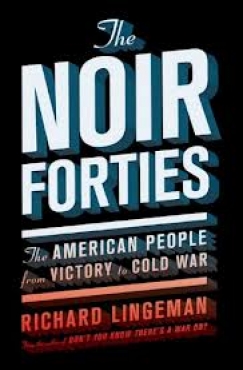
Happy Valentine’s Day, everyone! This sounds like a book to love: “The Noir Forties: America from Victory to Cold War” by Richard Lingeman.

From the LA Times review: “Films noir,” Lingeman declares at the outset, “are a key for unlocking the psychology, the national mood during those years.” But despite its title, The Noir Forties is not a book about the films – for that, readers should turn to J. Hoberman’s recent book An Army of Phantoms: American Movies and the Making of the Cold War, and to the classic More Than Night: Film Noir in its Contexts by James Naremore. Instead, Lingeman’s book provides a broader history of the brief but crucial period when the world of the New Deal died and the iron cage of Cold War politics and culture was forged. It would remain in place for the next 45 years.

Meanwhile, if you are in need of last-minute Valentine’s gift ideas for your guy(s), click here.

Happy 80th birthday, Kim Novak!

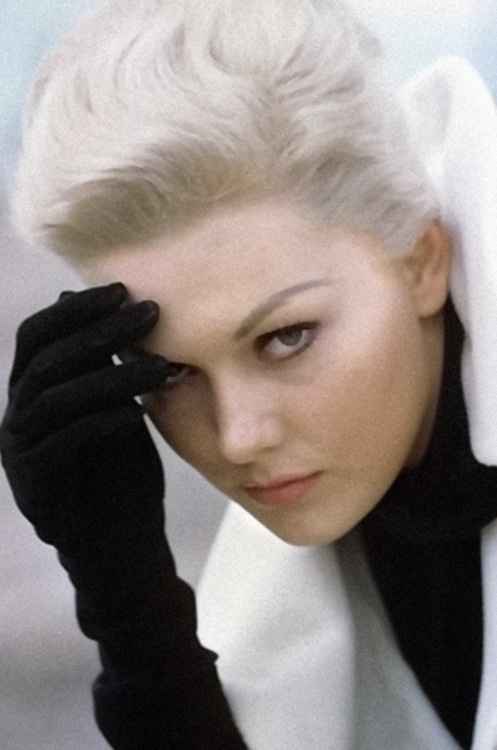
Lovely Kim Novak in a still from “Vertigo,” one of her most famous movies.

One of our all-time favorite film noir blondes, Kim Novak, turns 80 today. She was born Marilyn Pauline Novak in Chicago, where as a young woman she found work as a model. She moved to Los Angeles to continue modeling but instead became an actress.

Among her many screen credits, she is perhaps best known for her work in “Picnic” (1955), “The Man with the Golden Arm” (1955), “Pal Joey” (1957), “Vertigo” (1958) and “Bell Book and Candle” (1958).

“For every answer,” Novak once said, “I like to bring up a question. Maybe I’m related to Alfred Hitchcock or maybe I got to know him too well, but I think life should be that way.”

TCM will honor Novak with a tribute night and screening of four films on March 6. The evening will open with the premiere of Kim Novak: Live from the TCM Classic Film Festival, a one-hour interview special hosted by TCM’s Robert Osborne and taped at last year’s festival in Hollywood.

The Noir File: ‘Notorious’ affair is decades ahead of its time

By Michael Wilmington & Film Noir Blonde

The Noir File is FNB’s guide to classic film noir, neo-noir, sort of noir and pre-noir on cable TV. All movies below are from the schedule of Turner Classic Movies (TCM), which broadcasts them uncut and uninterrupted. The times are Eastern Standard and (Pacific Standard).

PICK OF THE WEEK

Notorious” (1946, Alfred Hitchcock). Tuesday, Feb. 12, 10:15 p.m. (7:15 p.m.)

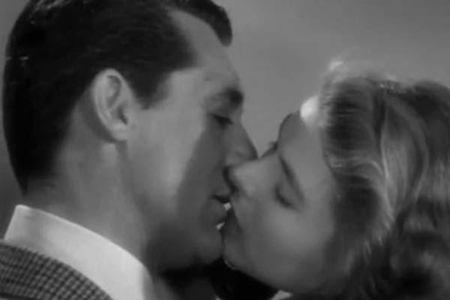
“Notorious” ranks as one of Alfred Hitchcock’s best films and Ingrid Bergman as Alicia Huberman is one of the most contemporary of all ’40s noir heroines. In this splendid 1946 suspense thriller, Bergman’s Alicia is a U.S. secret agent assigned to infiltrate a group of Nazis who have resurfaced in South America after WW2. Alicia risks her life to root out the Nazis’ source of uranium, an ingredient in atomic bombs. She also likes to throw parties, expose her midriff (love the sequin zebra-print top) and pursue her man, fellow secret agent T.R. Devlin (Cary Grant). Dev’s easy on the eyes, but he’s suspicious, uptight and seemingly unfeeling.

Their “strange love affair” as she calls it, tinged with cynicism and mistrust, is decades ahead of its time. And their record-breakingly long kisses, which look tame now, were considered extremely racy in 1946. Read the full review here.

Wednesday, Feb. 13

6 a.m. (3 a.m.): “The Stranger” (1946, Orson Welles). With Welles and Loretta Young.

6:30 p.m. (3:30 p.m.) “The Window” (1949, Ted Tetzlaff). With Bobby Driscoll and Arthur Kennedy.

12:30 a.m. (9:30 p.m.): “The Narrow Margin” (1952, Richard Fleischer). With Charles McGraw and Marie Windsor.

Thursday, Feb. 14

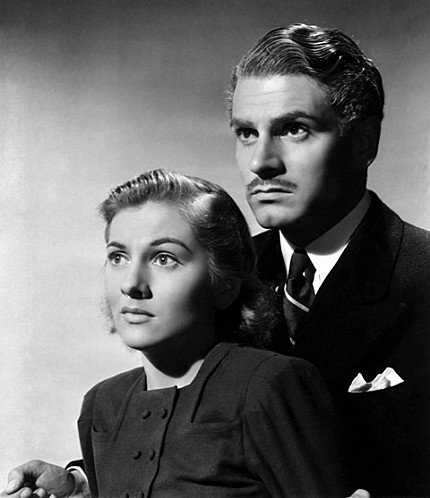
Joan Fontaine and Sir Laurence Olivier star in “Rebecca.”

12 a.m. (9 p.m.): “Rebecca” (1940, Alfred Hitchcock). Daphne du Maurier’s supreme gothic romantic thriller about a shy, nameless young woman (Joan Fontaine), picked by a rich, brooding widower, Maxim de Winter (Laurence Olivier), as his new bride, to replace his late, intimidatingly beautiful, acid-tongued and unforgettable spouse, Rebecca.

To the new bride’s fear and dismay, Rebecca still casts an eerie spell over the De Winter mansion Manderley – as do the house’s spooky, terrifying housekeeper (Judith Anderson) and Rebecca’s rascally seducer cad of a cousin (George Sanders). This elegant and faithful David O. Selznick production is directed, thanks to Selznick’s famous interference, in somewhat fettered, but ingenious style by Hitchcock. One can’t imagine it being done better. “Rebecca” was the Best Picture Oscar winner for 1940: a very good year for Hitchcock, Selznick, Fontaine, Du Maurier – and us.

2:30 a.m. (11:30 p.m.): “Spellbound” (1945, Alfred Hitchcock). With Ingrid Bergman and Gregory Peck.

Saturday, Feb. 16

12 a.m. (9 p.m.): “North by Northwest” (1959, Alfred Hitchcock). With Cary Grant and Eva Marie Saint.

2:30 a.m. (11:30 p.m.): “Bad Day at Black Rock” (1955, John Sturges). With Spencer Tracy, Robert Ryan and Lee Marvin.

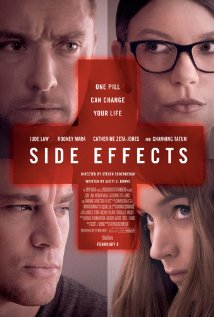
Stylish, seductive ‘Side Effects’ intrigues, doesn’t fully satisfy

Side Effects/2012/Open Road/106 mins.

Steven Soderbergh’s provocative new thriller, “Side Effects” is drawing much buzz. Glossy, intelligent and compelling, with an A-list cast, it’s part mystery, part exposé, part strangely subdued melodrama that’s played out among good-looking, affluent people, all of whom are in some way affected by the use of prescription medicine. “One pill can change your life,” says the movie’s tagline.

The movie opens with a shot of a New York apartment building; inside one unit is a bloody crime scene. Then we flashback several months before to another pivotal moment – the flat’s owners Emily and Martin Taylor (Rooney Mara and Channing Tatum) are reunited after Martin is released from a four-year prison sentence he received for insider trading. The two try to rebuild their lives, but it’s an uphill struggle.

Emily suffers from depression and, after a failed suicide attempt, she agrees to take an antidepressant prescribed by a kind, ambitious doctor named Jonathan Banks (Jude Law). When her symptoms don’t improve, Dr. Banks suggests a new drug, one that turns out to have dire results for the Taylors as well as for Banks and his wife (Vinessa Shaw).

And as Emily grapples with the consequences of committing a crime she doesn’t remember, Banks probes ever more obsessively into her past, specifically her psychiatric treatment by Dr. Victoria Siebert (Catherine Zeta-Jones), icy and ultra-competent with an answer for everything.

Though at times “Side Effects” is a little hard to follow and perhaps awkwardly plotted, it’s well directed and never boring. There’s a lot going on and the powerful final twist upends everything we thought we knew about the principals.

“I wanted to write a noir-style thriller that took the audience in and spun it around, like ‘Double Indemnity’ or ‘Body Heat,’ set in the world of psychopharmacology,” says screenwriter Scott Z. Burns (“Contagion”).

Enjoyment of the movie may hinge on this factor: knowledge of these superficially interesting characters never develops into caring about them – they’re not sympathetic nor are they entertaining in their badness. For me, that made a difference – Rooney Mara’s character in particular struck me as more than a little odious, a woman with zero redeeming features.

Also, the insistently low-key emotional tone (almost as if the film itself had popped a Prozac) feels unsatisfying, given the high stakes of the story. But perhaps that was exactly Soderbergh’s intent. In a society that places a premium on quick fixes, instant answers and easy panaceas, it stands to reason that we’re comfortably numb more than often than we like to acknowledge.

“Side Effects” opens today nationwide.

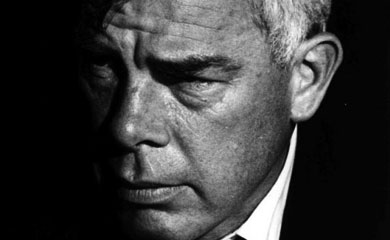
Lee Marvin on the big screen at American Cinematheque

Lee Marvin

One of the screen’s top tough guys, Lee Marvin (1924-1987) is being honored with a film program at the American Cinematheque. The series starts Friday, Feb. 8, and runs until Feb. 21; movies will be shown at the Aero Theatre in Santa Monica and the Egyptian Theatre in Hollywood.

The tribute to Marvin will include “Point Blank,” “The Killers,” “Cat Ballou,” “The Man Who Shot Liberty Valance,” a rare print of “Hell in the Pacific” and “The Professionals.”

The New York native and former Marine (a Purple Heart recipient) was working as a plumber’s assistant when he stumbled into acting. Marvin was a natural for roles in war movies and later expanded his range to tackle more complex, nuanced parts. One of our faves: the menacing, misogynistic Vince Stone, who scalds his girlfriend Debby (Gloria Grahame) with hot coffee in 1953’s “The Big Heat.”

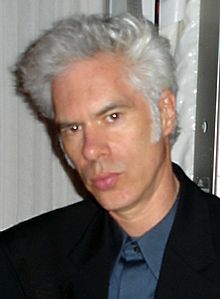
Jim Jarmusch

Director Jim Jarmusch once told me at a film festival (with a not completely straight face) that he had founded a group called the Sons of Lee Marvin for tall dudes with deep voices. Maybe Jarmusch will show up at a screening, provided he can find a seat with extra leg room.

Special guests to honor Marvin include “Cat Ballou” director Elliot Silverstein, author Dwayne Epstein, actor Clu Gulager and Lee Marvin’s son, Christopher Marvin. Epstein will sign copies of his book “Lee Marvin: Point Blank” at 6:30 p.m. Feb. 8 in the Aero Theatre lobby before the “Point Blank” screening.  I am eagerly awaiting my review copy of Epstein’s book and am told I will receive a copy to give away to a reader. Stay tuned.

See the American Cinematheque website for the complete Lee Marvin lineup. Additionally, there are French crime films and thrillers featured in the AC tribute to composer Michel Legrand, which runs Feb. 8-26.

LA County Museum hosts New York noir-neorealism series

Barry Fitzgerald stars in “The Naked City” by director Jules Dassin.

Mark your calendars: a great film noir series starts Friday at the Los Angeles County Museum.

The Naked City: New York Noir and Neorealism series will screen 10 films shot on location in and around New York during the period (1945-53) that photographer and filmmaker Stanley Kubrick spent documenting the city.

SaysSays the museum: “These films reveal a restless metropolis where you’re either on your way up, on your way down, or just laying low. It’s a city where you can never really disappear, not matter how dark the back alleys or how crowded the boulevards may be.”

The movies are as follows:

“The Naked City” 7:30 p.m. Feb. 8
“Kiss of Death” 9:15 p.m. Feb. 8
“Where the Sidewalk Ends” 7:30 p.m. Feb. 15
“The Thief” 9 p.m. Feb. 15
“Little Fugitive” 7:30 p.m. Feb. 16
“The Window” 9 p.m. Feb. 16
“On the Waterfront” 7:30 p.m. Feb. 22
“Force of Evil” 9:30 p.m. Feb. 22
“Killer’s Kiss” 7:30 p.m. Feb. 23
“The Glass Wall” 8:45 p.m. Feb. 23

Support provided by the Academy of Motion Picture Arts and Sciences.

‘Purple Noon’ marked milestone for Clément and Delon

“Purple Noon,” recently released by Criterion, is the prize for FNB’s January-February reader giveaway. Michael Wilmington reviews.                                                                          

Purple Noon/1960/Robert and Raymond Hakim/118 min.

“Plein Soleil,” or “Purple Noon” is a classic thriller and an exceptionally riveting and beautiful movie about desire and cruelty, murder and malice. It’s a smoke-and-mirrors game of make-believe played by a psychopathic killer, a villain from a classic of 20th Century crime fiction – 1955’s “The Talented Mr. Ripley” by the brilliant American novelist Patricia Highsmith.

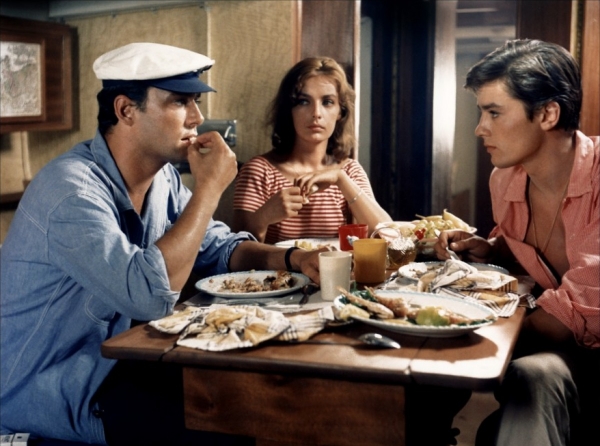
Alain Delon (right) plays Tom Ripley, a conman who fools a reckless playboy named Philippe (Maurice Ronet) and his girl, Marge (Marie Laforêt). The movie was adapted from Patricia Highsmith’s novel.

Shot in Italy, we first meet Ripley in the Bay of Naples, on a sailboat, surrounded by blazing sunlight (“plein soleil”). Two good-looking young men are laughing and smiling. The joke is that one of them, a handsome, penniless hanger-on named Tom Ripley (Alain Delon), will kill the other one, a rich, reckless playboy named Philippe Greenleaf (Maurice Ronet), assume his identity, take his money, and maybe seduce his girl, Marge (Marie Laforêt).

They are both laughing (but Philippe’s eyes are wary, Tom’s predatory), smiling with the special joie de vivre and cruel merriment of the young and careless – the high giddy spirits of, say, Robert Walker as Bruno Anthony planning his criss-cross murder with Farley Granger as Guy Haines in Highsmith and Alfred Hitchcock’s “Strangers on a Train.” But then Tom really kills Philippe. A knife thrust. A scream. “Marge!” cries the victim, the knife stuck in his chest. When the murder comes, it’s so swift, so effortless, so unexpected, yet so oddly inevitable, that it’s hard to believe we’ve seen what we’ve seen.

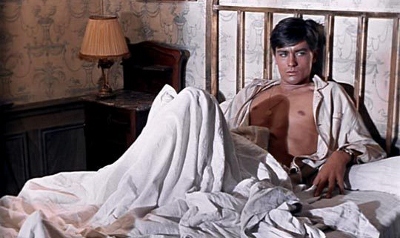
Ripley (Alain Delon) is a man trying to live a life that isn’t his.

Released in 1960, the same year as “Psycho” and “La Dolce Vita,” “Purple Noon” was an off-type movie for French filmmaker René Clément, a gifted and highly regarded director, who, by 1960, had won two major Cannes Film Festival awards, two Oscars (for 1949’s “The Walls of Malapaga” and 1952’s “Forbidden Games”) and two Golden Lions at Venice. In 1946, Clement had served as Jean Cocteau’s “technical adviser” (his co-director, some think) on the romantic fantasy masterpiece “Beauty and the Beast.”

Clement was a technical genius who chose challenging subjects. But he had been famously attacked in an influential article by the young François Truffaut. Writing in Cahiers du Cinema, Truffaut accused Clement and other filmmakers of being pretentious, over-praised mediocrities. Truffaut was a great filmmaker and a great film critic, but he sometimes said nasty and unfair things (as he admitted in later years) to draw attention to himself and kick up controversy. His dismissal of Clement was one of his bigger critical injustices.

Did Clement take it to heart? Most tellingly, “Purple Noon” is obviously influenced by Hitchcock, whom all the young Cahiers du Cinema critic/directors loved (they called themselves the “Hitchcocko-Hawksians”). “Purple Noon” is a film that most of them would probably have liked to have directed, but didn’t. Couldn’t?

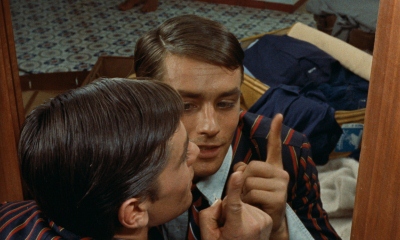
Delon plays a love scene with his reflection in a mirror.

There is, however, a notable deviation from the Hitchcock thematic pattern. “Purple Noon” is not a movie about a wrong man falsely accused of a crime he hasn’t committed, like Cary Grant in “North by Northwest,” or Robert Donat in “The 39 Steps.”

In “Purple Noon,” Ripley is guilty. He’s a man trying to live a life that isn’t his, a life that belonged to the man he killed. “Purple Noon” is about the idle rich, and Ripley is a conman who wants to be idle and rich. Both Highsmith and Clement are unusually successful in getting us immersed in a story where most of the people are rich and selfish, where the leading man is irredeemably evil and the only really likeable character is Philippe’s abused girlfriend Marge, a writer with bad taste in men.

Ripley is in Italy at the behest of Philippe’s parents to talk Philippe into coming home. Instead, the guys become carousing hell-raising buddies. After the murder, Ripley takes Philippe’s bank records, fakes a passport, forges Philippe’s signature, imitates his voice on the phone, and lays a paper trail of hotel receipts to pretend that the dead man is still alive, still joy-riding somewhere around Italy.

Ripley is the real killer, constantly being mistaken for his own victim. It’s a brilliant Highsmith idea, and one that generates near-constant suspense, especially in the great scene when Ripley, disguised as Philippe, is confronted by Philippe’s suspicious friend Freddy Miles (Bill Kearns). That Tom-and-Freddy chase was also the only great scene in Anthony Minghella’s 1999 American movie version of “The Talented Mr. Ripley,” with Matt Damon miscast as Ripley. And the only reason that scene was great was because of Philip Seymour Hoffman’s marvelously snide performance as Freddy.

There’s a great performance in “Purple Noon” too: the tigerishly seductive Alain Delon, in his first important part. Delon is one of those impossibly good-looking actors who get careers they seemingly don’t really deserve (and that Delon said he initially didn’t want), but whose looks the movies feed on, and whom, it is said, the camera loves.

Delon, a working-class Adonis, is one of the few actors who could play, as he does here, a believable love scene with his own reflection in the mirror. We may not want Ripley to escape, but he generates unusual simpatico for a cold-blooded swindler and killer. And Maurice Ronet, with his haunted eyes and bedazzled smile, is just right as the irresponsible Philippe.

Delon, of course, was wrong for the part of Ripley in one major respect. It is impossible to believe that he (or Ronet) is an American. But in other respects, he’s an apt choice, and once you see him in the part, it’s hard to discard his image. (Damon, by contrast, though he’s played some movie villains, seems inherently too nice a guy for Ripley.)

Clement made the kind of thriller Truffaut would have loved to have made, but never did. And for the rest of Clement’s career, he was often typed as a thriller specialist, because of “Purple Noon,” which became one of the most influential of all French crime/suspense movies.

It deserves to be. “Purple Noon” still plays beautifully, especially in the scenes where Ripley battles the elements after the murder. Two years later, in 1962, a talented young Polish film director, Roman Polanski, made a thriller, set on a sailboat, that reminds you greatly of the bay scenes in “Purple Noon.” (“Knife in the Water” became an international hit and eventually brought Polanski to Hollywood where he made superb mass-audience thrillers like “Rosemary’s Baby” and “Chinatown.”)

I wish Clement had had a few more opportunities like Polanski did. Maybe Truffaut wished it as well. Maybe the maker of “The Four Hundred Blows” wished he hadn’t been so quick to thrust in the knife.

Extras: Interviews with Patricia Highsmith, Alain Delon and Clement scholar Denitza Bantcheva; Trailer; Booklet with a fine essay by Geoffrey O’Brien and a 1981 interview with René Clément.