Noir writer/director Paul Schrader dishes on ‘The Canyons,’ guerilla filmmaking and Lindsay Lohan

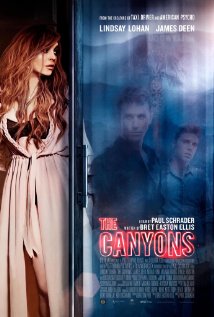
Is the low-budget neo-noir thriller “The Canyons,” starring Lindsay Lohan and James Deen, a cold, dead movie? Director Paul Schrader certainly hopes so.

“Well what did you expect?” said Schrader at a screening and Q&A Monday night at UCLA’s Billy Wilder Theater in Westwood. “Brett [Easton Ellis] and I have track records. If we can’t make a cold, dead movie, who can?”

The film’s release (VOD and a smattering of theaters) has been preceded by bad publicity, stemming from the crazed production and the erratic Lohan. Schrader said the “cold, dead” epithet came from “the nincompoop that runs the South by Southwest Film Festival,” which rejected the film.

The Sundance festival also took a pass but “The Canyons” has been picked up out-of-competition at the Venice Film Festival. (According to several media sources, the S x SW quote was: “There’s an ugliness and a deadness” to “The Canyons.” Regardless of the exact wording, when a movie is rejected from a festival, staff typically refrain from making any public comment.)

That the film, which novelist Brett Easton Ellis wrote and Alexander Pope produced, was finished at all is a minor miracle. Schrader said the total budget was about $500,000 and was intended from the outset for VOD.

“I’ve always enjoyed pushing people’s buttons. The button I’m trying to push now is the on-demand button on your remote,” said Schrader in response to a comment during the Q&A from Robert Rosen, former dean of UCLA’s School of Theater, Film and TV. Rosen lauded Schrader for “the pride we have in [Schrader] as a trouble-making filmmaker.”

Schrader calls his latest foray into “guerilla” filmmaking “an exhilarating experience.” As he put it: “It’s the mystery of could you do such a thing? Could I pull off such a thing?” Yes and yes. The film is already in profit, Schrader said, thanks to a distribution deal with IFC.

The movie came together through a combination of good luck and false starts, including online auditions via LetItCast, Ellis’ “promiscuous twitter finger” that lured porn star James Deen to the project, writer/novelist Kirsten Smith’s stunning Malibu Canyon home (aka the film’s third star) that fell into Schrader’s lap courtesy of Kickstarter, as well as his “high-maintenance” lead actress, who “lives in a cone of crisis.”

“If a crisis doesn’t exist, she makes one up,” Schrader said. “It’s exhausting. I told her, ‘It must be so exhausting to be you.’”

Schrader sums up the movie as “beautiful people doing bad things in nice rooms.”

A case in point: Schrader said Lohan recently made a last-minute call to Deen (even though they didn’t get along on the set) and asked him to drop what he was doing (in the Valley) to join her on the set while she co-hosted “Chelsea Lately” with Chelsea Handler on the E! channel (taped on the west side, at Olympic and Bundy).

Schrader said: “She has the ability to make you care. She suckered me and I’m a big fan. But there are people who live to hate this girl. There’s an extraordinary predisposition in the media to say something negative about this girl or to satisfy a [need for] media cruelty which we in our culture now thrive on.”

During “The Canyons” shoot, Schrader reportedly stripped off his clothes to coax her to do a nude scene. He didn’t mention this Monday night. Nevertheless, it was a bare-bones operation, made without insurance or permits. Actors worked for $100/day (with Lohan getting a bigger cut of profits later on) and provided their own makeup, hair and transportation.

Paul Schrader (Image from Indiewire)

The filmmakers also decided to skip asking the MPAA for a rating because they knew the film would play in a few theaters only. Said Schrader: “The MPAA is just another one of the dinosaurs wandering around La Brea. They’re all going to the swamps.”

Set in Los Angeles, “The Canyons” examines the, um, complicated love lives of Christian (Deen), a sneering twentysomething with a trust-fund, and his trophy girlfriend Tara (Lohan), a once-aspiring actress now looking for men to take care of her in high style. A dilettante moviemaker, Christian casts a sweet and caring corn-fed actor named Ryan (Nolan Funk) in his upcoming sleazy flick.

Ryan is also Tara’s ex-boyfriend and he’s still hot for her, even though he now lives with Gina (Amanda Brooks), who is Christian’s assistant. Christian and Ryan form another lust triangle with Cynthia (Tenille Houston), an actress-turned-yoga-instructor. But Tara is the object of Christian’s obsession. At his whim, he and Tara indulge in threesomes and foursomes with partners culled from apps such as Blendr and Grindr. Christian records these trysts on his phone; later he turns to violence for kicks.

Schrader, who was a film student at UCLA in the late 1960s/early 70s, sums up the movie as “beautiful people doing bad things in nice rooms. … This film is not about Hollywood or making movies, it’s about the hookup generation.”

Lindsay Lohan

To the extent that that generation is made up of grasping, one-note Angelenos, “The Canyons” feels chillingly, depressingly truthful. Your enjoyment of this movie will likely depend on your tolerance for seeing slick, superficial portraits of Hollywood pretty people who, for the most part, are soulless, self-serving and vacuous. “This is an art movie and doesn’t play the empathy card that strong,” Schrader says.

Fair enough. Yet it struck me as short on insight. Images of dilapidated theaters symbolize changes in the way we watch movies. Texting and apps and other tech-savvy ways of derailing human connection are second nature to the hookup generation. Right. And?

On the plus side, the performances are somewhat compelling because they are infused with so much stark reality. By the same token, the roles don’t exactly stretch the actors. Visually, to be sure, the movie delivers. Shot by John DeFazio, “The Canyons” looks pretty amazing, whether capturing Hollywood Boulevard by night or showing off the majestic Malibu hills bathed in white light. Overall, though, the film is at best uneven.

Would Schrader take another gamble on a low-budget project? “I made my money and I should probably leave the casino,” said Schrader. “But I probably won’t.”

“The Canyons” is available on VOD and is showing at select theaters.

Film Noir File: Deneuve, Buñuel cast spell with ‘Belle de Jour’

By Film Noir Blonde and Mike Wilmington

The Noir File is FNB’s guide to classic film noir, neo-noir and pre-noir from the schedule of Turner Classic Movies (TCM), which broadcasts them uncut and uninterrupted. The times are Eastern Standard and (Pacific Standard).

PICK OF THE WEEK: Two by Luis Buñuel as part of Catherine Deneuve Day

Tristana” (1970, Luis Buñuel). Monday, Aug. 12, 10 p.m., (7 p.m.).

Belle de Jour” (1967, Luis Buñuel ). Monday, Aug. 12, 2:15 a.m. (11:15 p.m.).

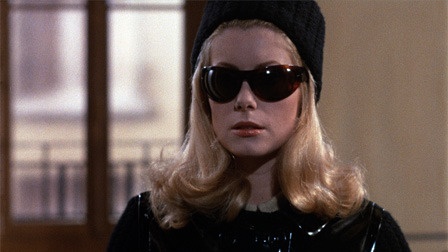
Icy, ravishing Catherine Deneuve stars in “Belle de Jour.”

The most beautiful movie actress alive paired with the most brilliantly rebellious filmmaker.

That was the incendiary match-up of star Catherine Deneuve and director Luis Buñuel – who were most famous for their 1967 French erotic drama “Belle de Jour.” In that great film, Deneuve – so lovely and so classically, radiantly, sexily blonde that she took up residence in male dreams forever – played Severine, a Parisian wife, who becomes a prostitute during the day to escape her boring bourgeois life and her handsome but boring husband (Jean Sorel). Severine then falls into a world of crime, hypocrisy, dreamlike perversity and peril. It was the most popular, and the best-remembered, film of Buñuel’s entire career.

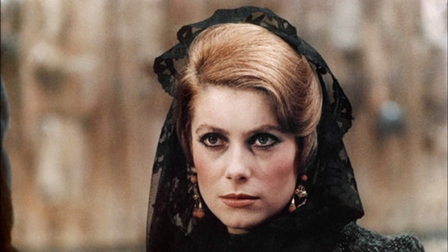
But they made another film that Buñuel preferred and is one of his most personal: “Tristana (1970). Shot in Spain, based on a novella by famed author Benito Perez Galdos (adapted by Buñuel and Julio Alejandro), this not underrated but definitely underseen film starred Deneuve in a role just as alluring and frightening as the wayward Severine: Tristana, the young orphan seduced, exploited and virtually imprisoned by her guardian Don Lope (Fernando Rey). Don Lope, worldly and egocentric, is an aristocrat of radical political beliefs, whose desire for his ward undermines his ethics – even as Tristana, a seeming victim, turns exploiter herself and exacts a terrible revenge.

“Tristana” earned the admiration of Alfred Hitchcock.

“Tristana” is a masterpiece, but it’s also a grimmer, sadder, more psychologically disturbing picture than “Belle de Jour.” Buñuel, notorious for his audacity, has directed some of the cruelest scenes in cinema, in films like “Un Chien Andalou,” “Los Olvidados” and “Viridiana.“ But he never filmed a more wounding scene than Tristana on the balcony: a sequence that delighted no less an epicure of sadism than Alfred Hitchcock. “Tristana! That leg! That leg!” Hitch exclaimed when the two directors met at a party. Buñuel probably only smiled.

Other Deneuve Day highlights include: “Repulsion” (1965, Roman Polanski), “Mississippi Mermaid” (1969, François Truffaut) and “Un Flic” (1972, Jean-Pierre Melville). See TCM for the full list. Films are in French (“Tristana” in Spanish) with English subtitles. [Read more…]

From crushing emptiness to eternal star: Remembering Marilyn Monroe on the anniversary of her death

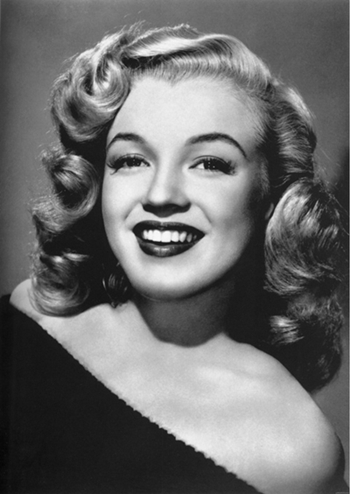
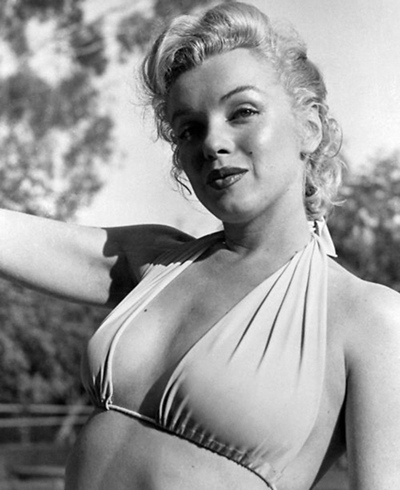
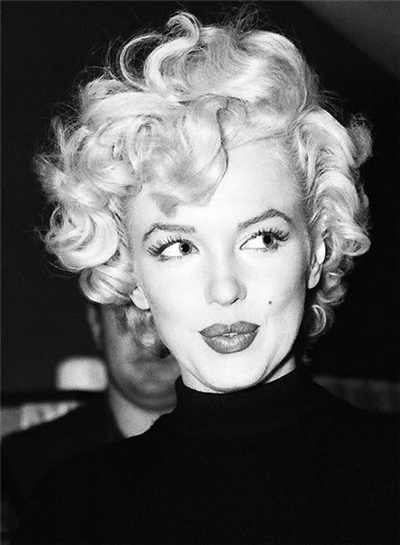
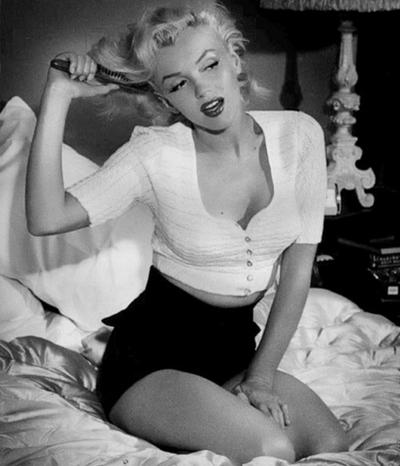
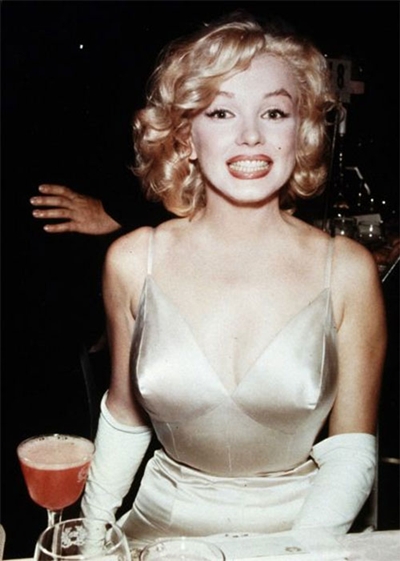
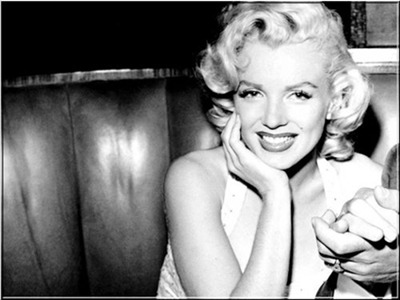
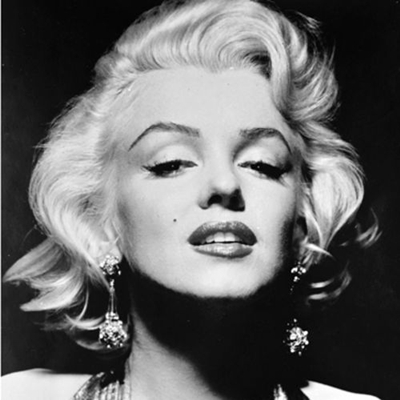
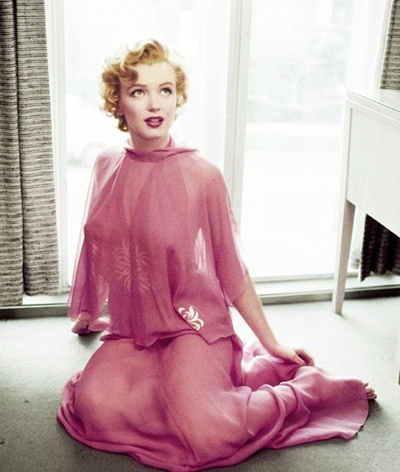
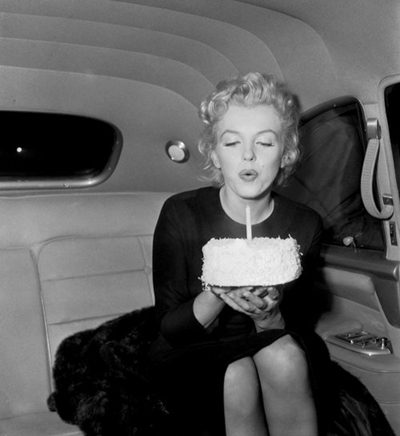
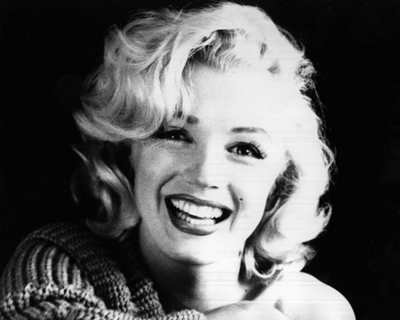
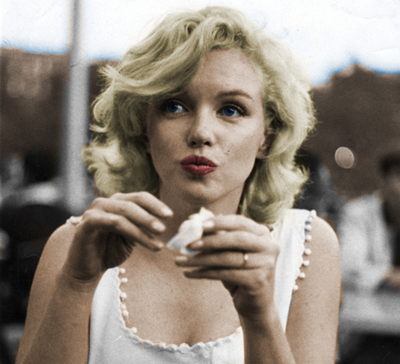
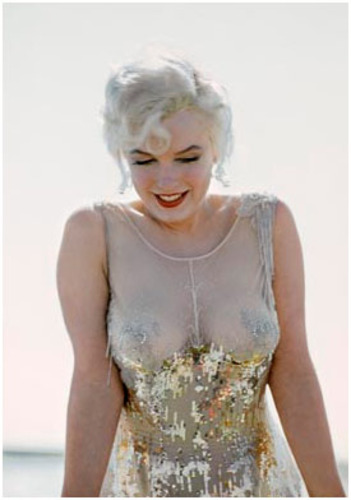
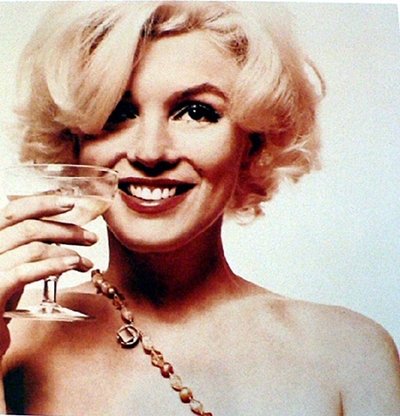
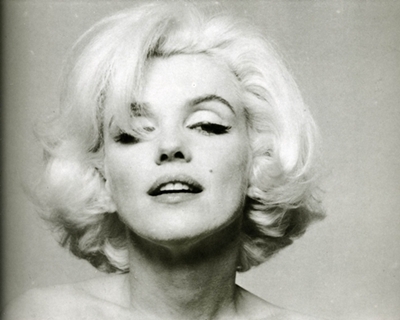
Marilyn Monroe (June 1, 1926-Aug. 5, 1962) will be honored at a memorial service on Monday, Aug. 5, in Westwood.

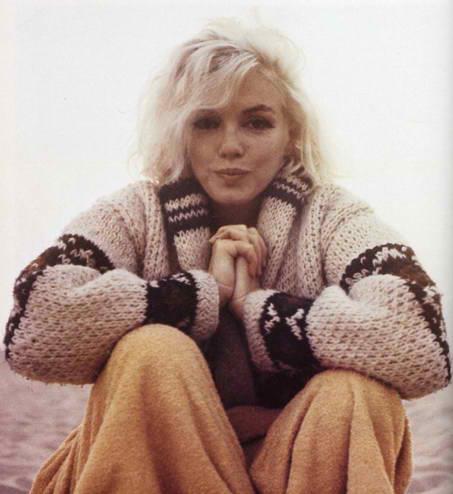
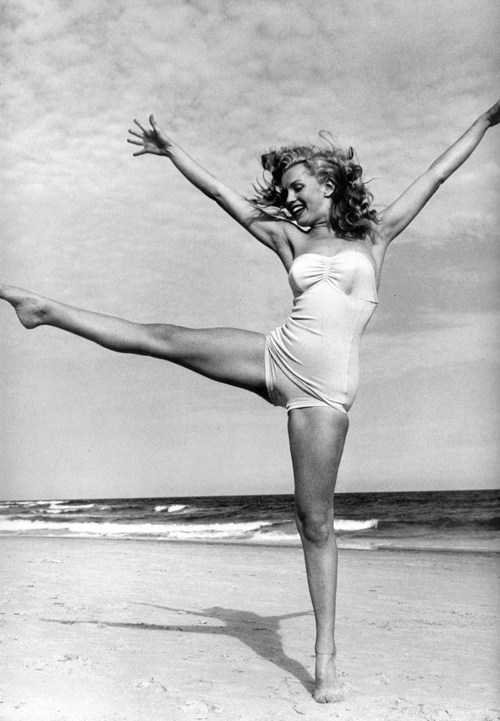
Born and raised in Los Angeles, Marilyn modeled to support herself.

Bugs. Dogs. God. Since childhood, she was quick to ask questions about the everyday and the esoteric. This little girl named Norma Jean, as curious and proud as she was lonely and neglected, grew up to be Marilyn Monroe, the world’s most iconic and enduring sex symbol. Her love affair with the public still burns bright more than 50 years after her death on Aug. 5, 1962. She was 36.

Perhaps she sought answers and collected facts as a distraction from the grinding poverty and desperate uncertainty she faced as a kid. Her mother, Gladys, who fought bouts of mental illness, was unable to take care of her and her father had long been absent from their lives.

Norma Jean bounced between friends’ places and foster homes in Los Angeles. She was treated poorly for the most part, made to bathe in dirty water, molested by a man named Mr. Kimmel, pushed into marriage at 16 to Jim Dougherty, whom she barely knew, to avoid returning to the orphanage.

She was physically as well as intellectually precocious, fully developed by 12, and she knew her looks would open doors for her. There was a way, she believed, she could parlay her games of make believe into something refined, meaningful and artistic. If she got training and made the right connections, she could escape from her harrowing childhood.

“The truth was that with all my lipstick and mascara and precocious curves, I was as unsensual as a fossil. But I seemed to affect people quite otherwise.” — MM on her school days

Groucho Marx described Marilyn as Mae West, Theda Bara and Little Bo Peep all rolled into one.

“In Hollywood a girl’s virtue is much less important than her hair-do.” — MM

“After a few months, I learned how to reduce the boredom [at a Hollywood party] considerably. This was to arrive around two hours late.” — MM

As a struggling model and actress, Marilyn would spend Sundays at Union Station in downtown Los Angeles, watching people walk from the trains to be greeted, hugged and kissed, wondering what it would feel like to be cared about, to be missed and wanted.

“I could never be attracted to a man who had perfect teeth. I don’t know why, but I have always been attracted to men who wore glasses.” — MM

She got a few small parts in the pictures, studied acting and attended Hollywood parties, carefully crossing her legs to hide the holes in her nylons, quietly watching other guests play cards and win money.

“When the men laughed and pocketed the thousands of dollars of winnings as if they were made of tissue paper, I remembered my Aunt Grace and me waiting in line at the Holmes Bakery to buy a sackful of stale bread for a quarter to live on a whole week,” she recalled in her memoir (co-written with Ben Hecht), “My Story.”

The studio suits weren’t encouraging. Darryl Zanuck and Dore Schary told her that she was unphotogenic, that she didn’t have the right look. She persevered. Eventually, it was her enraptured fans (she garnered 7,000 letters a week) who fueled her fame and propelled her rise to the top. “I knew I belonged to the public and to the world, not because I was talented or even beautiful but because I had never belonged to anything or anyone else.”

“We were the prettiest tribe of panhandlers that ever overran a town.”         — MM on her early years as a Hollywood actress.

One of her most important movies, early on, was a film noir: “The Asphalt Jungle” (1950, John Huston). “Don’t Bother to Knock” (1952, Roy Ward Baker) and “Niagara” (1953, Henry Hathaway) also showcased her talent for playing dark, dangerous women.

The studio pushed her toward lighter fare – musicals and comedies – where she played frothy flirts and bubble-headed gold diggers: “Gentlemen Prefer Blondes” (1953, Howard Hawks), “How to Marry a Millionaire” (1953, Jean Negulesco) and “There’s No Business Like Show Business” (1954, Walter Lang).

Marilyn pushed back, wanting more complex parts and sometimes she got them. She teamed up with some of Hollywood’s greatest directors: Huston, Hawks, Otto Preminger in “River of No Return” (1954), Joshua Logan in “Bus Stop” (1956), twice with Billy Wilder, in 1955’s “The Seven Year Itch” and four years later in the black-comedy classic “Some Like It Hot.”

In 1960, she worked with George Cukor in “Let’s Make Love.” Cukor also directed her in the unfinished “Something’s Got to Give” (1962). She co-starred with Sir Laurence Olivier (he also directed) in “The Prince and the Showgirl” (1957) and earned acclaim for her work, especially from European critics.

“In a daydream you jump over facts as easily as a cat jumps over a fence.” — MM

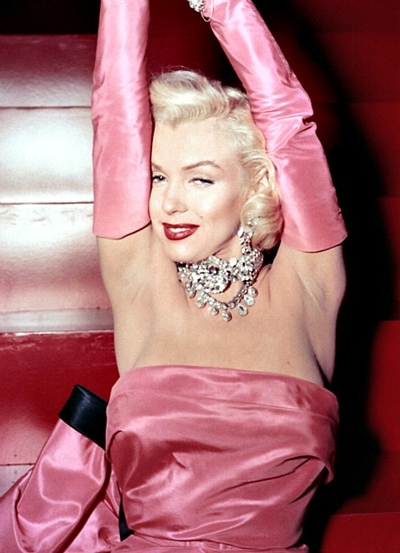
It was choreographer Jack Cole’s idea to pair pink and red in the color scheme of 1953’s “Gentlemen Prefer Blondes.”

Marilyn was the favorite movie actress of the French philosopher/novelist/playwright Jean-Paul Sartre, and he wrote the lead female part in his original script “Freud” (1962) for her. (Susannah York played it.)

“I’ve often stood silent at a party for hours listening to my movie idols turn into dull and little people.” — MM

Her boyfriends reportedly included Marlon Brando, Frank Sinatra, Elia Kazan, Orson Welles, Yves Montand, John F. Kennedy and Robert Kennedy; her best girlfriend (and one-time roommate) was Shelley Winters. During the height of her fame, Marilyn married two more times – to Yankee baseball great Joe DiMaggio (January-October 1954) and to playwright Arthur Miller (1956-1961).
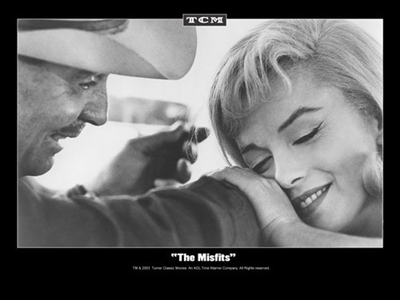
Miller wrote “The Misfits” (1961) for her. In that ill-fated film, Marilyn co-starred with Clark Gable, the movie star she’d so often pretended was her father, and was directed by Huston, whom she considered a genius. During the arduous shoot in the Nevada desert, the Monroe-Miller marriage came apart. Gable died from a heart attack days after the filming ended. Said Huston of Marilyn: “She went right down into her own personal experience for everything, reached down and pulled something out of herself that was unique and extraordinary. She had no techniques. It was all the truth, it was only Marilyn.”

Marilyn once implored a LIFE reporter: “Please don’t make me a joke.”

Her vulnerability and little-girl-lost quality, coupled with her stunning looks and glamour, are often cited as the reasons for her widespread, lasting appeal.

There’s no doubt she faced a litany of lingering problems: a family history of mental illness; emotional instability and physical maladies; a dependency on drugs and alcohol; endometriosis, abortions and miscarriages; difficulty remembering lines and showing up on time; broken marriages and failed affairs as well as frustration and fights with 20th Century-Fox (the studio refused to let her see scripts in advance of a shoot, then relented).

Some of her early work is slightly cloying – the breathy voice a little too mannered, her demeanor a little forced. And despite critical recognition for “Bus Stop,” “Prince” and “Some Like It Hot,” she remained pigeonholed as a blonde bombshell, a sexy joke.

“When you’re a failure in Hollywood – that’s like starving to death outside a banquet hall with the smells of filet mignon driving you crazy.” — MM

Orry-Kelly designed Marilyn’s clothes in “Some Like It Hot.”

“When you’re broke and a nobody and a man tells you that you have the makings of a star, he becomes a genius in your eyes.” — MM

Marilyn’s marriage to playwright Arthur Miller came apart while making “The Misfits.” Co-star Clark Gable died days after shooting ended.

Yet it was her precise and subtle comic timing that set her apart from other actresses. As Wilder put it: “She was an absolute genius as a comic actress, with an extraordinary sense for comic dialogue. … Nobody else is in that orbit; everyone else is earthbound by comparison.”

“To love without hope is a sad thing for the heart.” — MM

Humor was likely a coping mechanism she’d honed in an effort to ward off the crushing emptiness she’d known since childhood. Norma Jean saw movies again and again at Hollywood theaters; play-acting with other kids, she thought up the good stuff, the drama.

Marilyn liked her body and, some days, she enjoyed the attention she got from her looks. But she also gave the impression that her beauty could be swiftly forgotten, that she got bored too fast to dwell on her appearance. Underneath the surface, right alongside the troubled soul, was a well of pure bliss that wasn’t hard to reach, if she had a receptive audience, whether it was a likeminded bookworm friend or a movie palace packed with people.

When the fantasy was in full, giddy swing, she laughed sweetly and cynically, sometimes at herself. She could be funny with a look, a gesture or a makeshift prop – sparking joy from nothing at all.

Sir Laurence Olivier said of Marilyn: ”Look at that face – she could be five years old.”

Photographers include: George Barris, Richard Avedon, Philippe Halsman, Milton Greene, Sam Shaw and Bert Stern.

Film Noir File: Here’s looking at you, Bogie

By Film Noir Blonde and Mike Wilmington

The Noir File is FNB’s guide to classic film noir, neo-noir and pre-noir from the schedule of Turner Classic Movies (TCM), which broadcasts them uncut and uninterrupted. The times are Eastern Standard and (Pacific Standard).

PICK OF THE WEEK: HUMPHREY BOGART DAY (Thursday, Aug. 1)

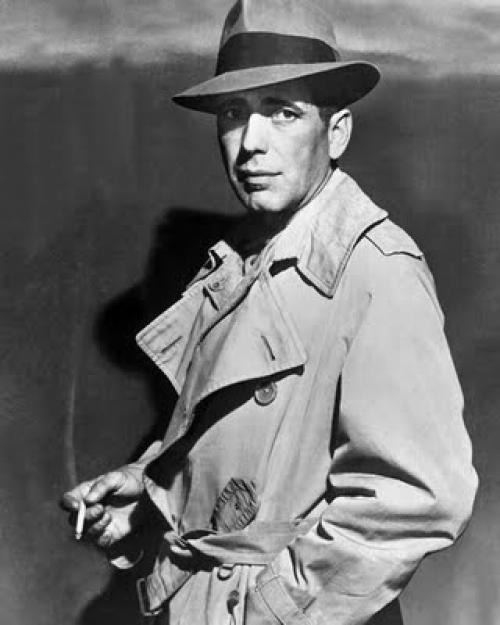
Bogart poses in his classic fedora and trenchcoat.

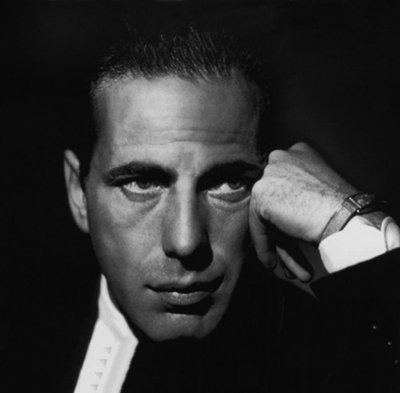
If there is a country of film noir, then Humphrey Bogart is its president, its first citizen, its uncrowned king – a man of one unforgettable face and of many standout roles. Bogie was Philip Marlowe and Sam Spade, two ace detectives. He was Roy Earle and Duke Mantee, outlaws on the run.

He played gang leaders (“The Roaring Twenties”) and their prosecutors (“Marked Woman,” “The Enforcer”), a treasure hunter (in “Sierra Madre”) and a bad-tempered screenwriter (“In a Lonely Place”). Outside the land of noir, he was sloppy steamboat Captain Charlie Allnut in “The African Queen” and mad Captain Queeg of “The Caine Mutiny.”

Perhaps most famously he was Rick Blaine of “Casablanca,” the melancholy, sexy night club owner, no stranger to secrets, cynicism and, ultimately, sacrifice for the greater good.

Bogart’s career was sluggish at the start; he owed his big break to Leslie Howard. They starred, with Bette Davis, in “The Petrified Forest.”

As he walked the dark, rainy streets of noir, he often wore a raincoat and fedora, with a cigarette curling smoke past his grimacing, partly paralyzed lip (the result of a fight when he was in the Navy) and likely carrying a gun. His eyes were dark and sad, his voice was low and hard-edged. There was usually a snarl in that voice.

Bogart was born into a comfortable Manhattan home, the son of a surgeon and an artist. In 1918, Bogart joined the Navy, after which he went into theater and film. One of his first movies was a prison baseball comedy called “Up the River,” directed by John Ford and starring, also in one of his first movie roles, Spencer Tracy. (Ford later called the picture “one of my mortal sins.”)

Bogart’s big break came in “The Petrified Forest” (1936, Archie Mayo). Co-star Leslie Howard insisted Bogie be cast as gangster Duke Mantee (they previously starred in the play’s Broadway run). Bogie quickly became a Warner Brothers contract player fixture. He started off as mostly a villain, then an anti-hero, then finally mostly a hero.

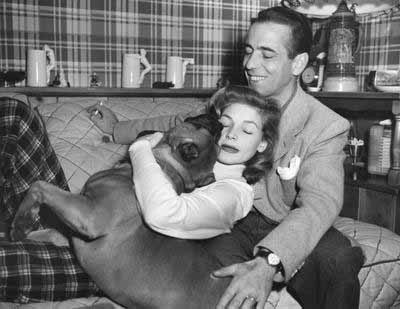
Bogart and Bacall were married from 1945 until Bogart’s death in 1957.

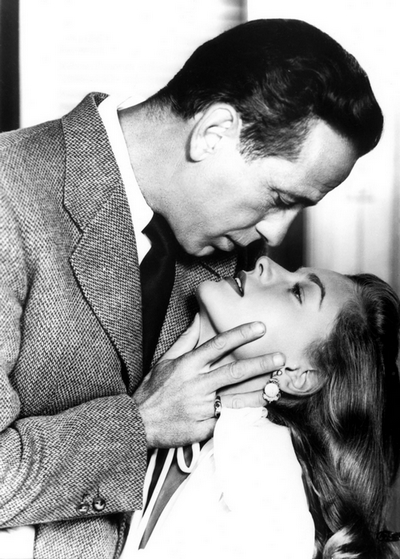
Howard Hawks once labeled Bogie as probably the most insolent guy in movies. Then Hawks told Bogart he was going to put him in a movie with a young actress even more insolent: Lauren Bacall. Hawks directed them in 1944’s “To Have and Have Not” and they fell in love. Like Tracy and Hepburn, Bogie and Bacall became one of the great Hollywood couples – and their marriage (her first, his fourth) was the stuff that dreams are made of.

At 57, Bogart died of throat cancer from too many of those signature cigarettes of his. Speaking at the funeral, John Huston, his favorite and most sympatico director, said: “We shall not look upon his like again.”

When Bogart won his Oscar for “The African Queen” – beating out Marlon Brando in “A Streetcar Named Desire” and Montgomery Clift in “A Place in the Sun,” two of the most influential movie performances of the ’50s – he explained, “I’ve been around for a long time. Maybe the people like me.”

Bogart and Bacall were introduced by director Howard Hawks.

They do like him, still. Nobody wore a raincoat, cracked wise to a crook or a cop, or walked down a mean noir street, like Bogie. Nobody ever will. Here’s looking at you, kid.

(Note: Most of the following titles have been reviewed on FNB. Use the search tool on the right to find them.)

6 a.m. (3 a.m.): “Bogart: The Untold Story” (1996). A documentary look at Bogie’s life in (and out) of movies, hosted by his son, Stephen Bogart.

7 a.m. (4 a.m.): “High Sierra” (1941, Raoul Walsh).

9 a.m. (6 a.m.): “The Maltese Falcon” (1941, John Huston).

10:45 a.m. (7:45 a.m.). “To Have and Have Not“ (1944, Howard Hawks).

12:30 p.m. (9:30 a.m.): “The Treasure of the Sierra Madre” (1948, John Huston).

2:45 p.m. (11:45 a.m.) “Tokyo Joe” (1949, Stuart Heisler).

4:15 p.m. (1:15 p.m.). “Beat the Devil” (1954, John Huston).

6 p.m. (3 p.m.): “In a Lonely Place” (1950, Nicholas Ray).

8 p.m. (5 p.m.). “The Big Sleep” (1946, Howard Hawks).

10 p.m. (7 p.m.): “Key Largo” (1948, John Huston).

4 a.m. (1 a.m.): “The Harder They Fall” (1956, Mark Robson). [Read more…]

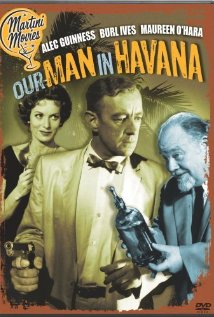
‘Our Man in Havana’ offers wit, savvy and suspense

By Michael Wilmington

Our Man in Havana/1959/Kingsmead Productions, Columbia Pictures Corp./111 min.

Our Man in Havana,” a dark 1959 comedy starring Alec Guinness,  was the third and final film that British thriller writer Graham Greene and director Carol Reed made together. Their first was 1948’s “The Fallen Idol.” Their masterpiece was “The Third Man” (1949).

“Our Man in Havana,” about spying and murder and vacuum cleaners in pre-revolutionary Cuba, is not as suspenseful as “The Third Man” and, even as a comedy, it’s not all that funny. That doesn’t mean it’s a bad film or even a mediocre one.

“Our Man” is just not as good as we want it to be, not as good as the deliciously tense, scathingly witty and beautifully sad “The Third Man,” which boasts a wonderful cast, gorgeous cinematography by Robert Krasker and that haunting zither music by Anton Karas. At least one group of British critics selected “The Third Man” as the finest British picture of all time.

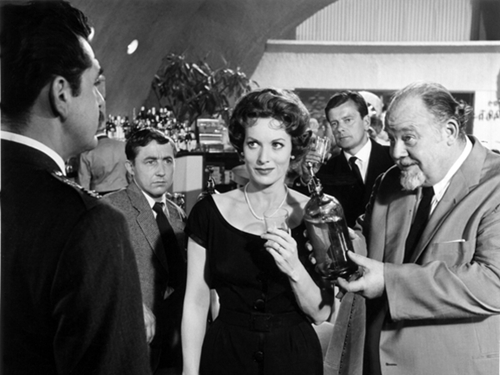
But perhaps we expect too much from “Our Man” and miss what’s there: a good amount of intelligence, wit, suspense, romance, political savvy, elegant Havana-location photography by Oswald Morris and a pretty wonderful, if uneven, cast. Guinness, as Wormold, the vacuum cleaner salesman turned reluctant spy, joins Ralph Richardson and Noel Coward as the maladroit spymasters who hire and employ him; Maureen O’Hara, as his affair-minded assistant spy; Burl Ives as Wormold’s best friend, Dr. Hasselbacher; and Ernie Kovacs as the urbane, sadistic Cuban head cop, Captain Segura, who’s in love with Wormold’s daughter Milly (Jo Morrow).

The time of “Our Man in Havana” is the 1950s, with Cuba under the Batista regime. Wormold is a typical guilt-ridden Greene character and Guinness plays him with some of the introverted whimsy he put into the role of the fussy inventor in “The Man in the White Suit.” Light on cash, Wormold allows himself to be recruited by a local MI6 agent named Hawthorne (Coward). Hawthorne asks Wormold to put together a spy team for MI6, which is run back in England by the dithering “C” (Richardson). Wormold, who has no experience and no contacts, hits on the stratagem of simply making up an agent list and writing phony reports – along with the plans for what looks like fictional weaponry but is actually one of his vacuum cleaners.

So convincing are all Wormold’s fantasies and absurd inventions that MI6 wants more and sends him a helper (O’Hara), to gather more of his non-intelligence. But there is a real world of spies and killers operating in Batista’s Cuba, and soon some of them are after Wormold, with real murder on their minds. Like “The Third Man,” the plot plunges a naïve but imaginative amateur into a political game that turns deadly serious in a dark, corrupt city that is filled with criminals and deceptions.

A masterpiece? Not so much. But “Our Man” knows how to have a good time.

The movie was shot on location in Havana, in Castro’s post-revolutionary Cuba although the novel, published in 1958, was set in Batista’s Cuba and that may have created a problem. Greene’s and Reed’s Havana never seems as real or as sinister as their Vienna in “The Third Man.”

There are two bits of miscasting. Burl Ives doesn’t have the accent for Hasselbacher and he plays his one mournful note too dolorously. And Jo Morrow can’t make you think she’s a British teenager (even when Wormold “explains” that she picked up her accent in America).

Most of this unusually talented cast, though, seems to be having fun, especially Guinness, Coward and Richardson – and, more surprisingly, Ernie Kovacs, who’s so good he makes you forget he isn’t Cuban and doesn’t seem at first to belong in a Graham Greene movie.

The biggest joke of Greene and Reed’s last film though, is that the plot is based on real life. Greene (a WWII spy before he became a writer) heard a story about a Spanish spy for the Nazis named Garbo who did exactly what Wormold did: invented a whole fictional spy team and submitted fictitious reports to his gullible employers. That tale clearly appealed to Greene, master of thrillers and deception – a good Catholic, albeit with sins on his conscience.
Sony Pictures recently released “Our Man in Havana” on DVD.

Film Noir File: ‘Paths of Glory’ seduces you with its beauty, shatters you with its horror

By Film Noir Blonde and Mike Wilmington

The Noir File is FNB’s guide to classic film noir, neo-noir and pre-noir from the schedule of Turner Classic Movies (TCM), which broadcasts them uncut and uninterrupted. The times are Eastern Standard and (Pacific Standard).

PICK OF THE WEEK

Paths of Glory” (1957, Stanley Kubrick). Saturday, July 27: 1:30 p.m. (10:30 a.m.)

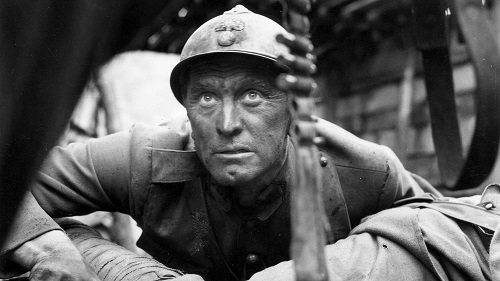
In 1957, Stanley Kubrick, still in his 20s – with “Dr. Strangelove,” and “2001: A Space Odyssey” still in his future – made one of the greatest of all anti-war movies: his grim, stylish and incredibly moving adaptation of Humphrey Cobb’s World War I novel, “Paths of Glory.”

Kubrick may not have known war first hand. But, in that film, he created an indelible image of war’s inhumanity and horror. “Paths of Glory” is a compelling, wrenching nightmare of a movie with a brilliant (and very noir) cast including Kirk Douglas, Ralph Meeker, George Macready and (at his best, or worst) Timothy Carey.

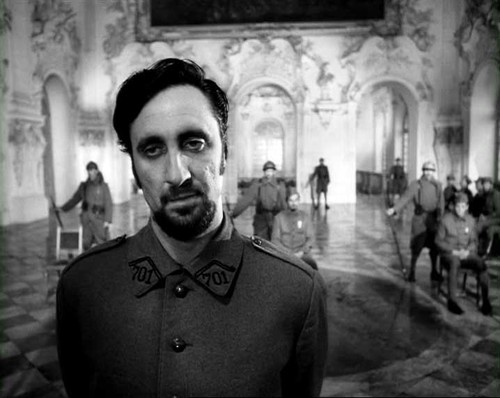
Based on a real-life episode, the movie was made on location in Bavaria and is set in the French trenches, where the infantry soldiers eat and sleep in the cold, dirt, and mud – and from which they charge forth to fight and die. It’s also set in an elegant chateau, far from the battlefield, where rich, ambitious generals plot the sometimes-insane strategies that will get their men killed.

Michael Douglas plays Dax, the regiment’s idealistic commanding officer.

When one ill-advised attack against the Germans fails, Macready, as the vainglorious Gen. Mireau, flies into a murderous rage and demands that his own men be executed for cowardice. His superior, the wily Gen. Broulard (Adolphe Menjou), argues the number of the condemned down to three soldiers: Meeker, Carey and Joe Turkel. Defending them is Colonel Dax, the regiment’s courageous and idealistic commanding officer (played by Douglas, one of the leading Hollywood liberals of the ’50s and ’60s). Outraged by the mad injustice of the trumped-up court-martial , Dax – a famous criminal lawyer in civilian life – argues eloquently and fearlessly for the lives of those three guiltless men.

What a great movie this is! “Paths of Glory” is a film to see when you’re young and more innocent, like the three soldiers. And to see again when you’re stronger, more mature and full of fiery ideals, like Dax. And finally to watch yet again when you’re even older and have witnessed a lifetime of the awful compromises and vile injustices that “Paths of Glory” paints with such absolute lucidity, such deadly, inexorable narrative force.
Timothy Carey had worked with Kubrick in 1956’s “The Killing.”

By the time he directed and co-wrote “Paths of Glory,” Kubrick, 29, had three features already under his belt (including the classic 1956 film noir, “The Killing”). His partner on “The Killing,” James B. Harris, produced “Paths of Glory.” Douglas – then at the height of his Hollywood stardom and power – made it happen.

Two great American novelists collaborated with Kubrick on the screenplay: Oklahoma-born noir ace Jim Thompson (author of the crime classics “The Killer Inside Me,” “The Grifters” and “The Getaway”) and the acidly funny Southern novelist Calder Willingham (“End as a Man,” “Eternal Fire”) Probably thanks to those two, “Paths of Glory” has one of the darkest visions, some of the richest characters and some of the most pungent dialogue of any American movie of that era.

Kubrick’s masterpiece of war’s injustice seduces you with its beauty, shatters you with its horror. The battle scenes are shot with a black and white grit and shock reminiscent of Lewis Milestone’s “All Quiet on the Western Front,” but also with the Max Ophuls-like grace and romanticism that Kubrick loved and that ironically permeates his film.

War is hell. It’s also noir.

Paths of Glory” is available in DVD on Criterion. [Read more…]

Di Leo Italian Crime Collection Vol. 2 releases Tuesday

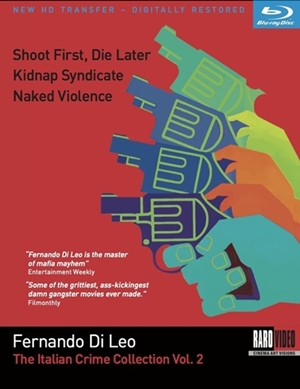
Famous for his bold, intricately plotted, ultra-violent stories about pimps and petty gangsters, director and writer Fernando Di Leo perfected the genre with an uncanny accuracy that prefigured the works of Quentin Tarantino and John Woo.

Raro Video U.S. collects some of his finest work in Fernando Di Leo: The Italian Crime Collection Volume 2, a three-DVD set that includes Di Leo’s lost masterpiece, “Shoot First, Die Later,” which has never been available on DVD or Blu-ray before, along with “Kidnap Syndicate” and “Naked Violence.”

The set, which also contains an impressive list of bonus features, will arrive on DVD and Blu-ray on Tuesday, July 30.

Down the road from Raro Video: DVD and Blu-ray versions of The Conformist directed by Bernardo Bertolucci, restored from the original 35mm negative. Stay tuned for release date and bonus features.

Film noir gem ‘Murder by Contract’ highlighted in new book

This summer, my friend Rob Elder released a new book (his sixth): The Best Film You’ve Never Seen: 35 Directors Champion the Forgotten or Critically Savaged Movies They Love.

As Roger Ebert put it: “How necessary this book is! And how well judged and written! Some of the best films ever made, as Robert K. Elder proves, are lamentably all but unknown.”

It’s a great read and an invaluable reference tome for any serious film lover. To give you an idea of the treasures you will discover, Rob has kindly agreed to let me run an excerpt of the chapter in which he discusses “Murder by Contract” (a taut and chilling film noir) with director Antonio Campos.

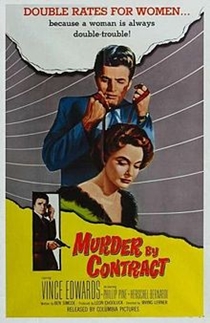
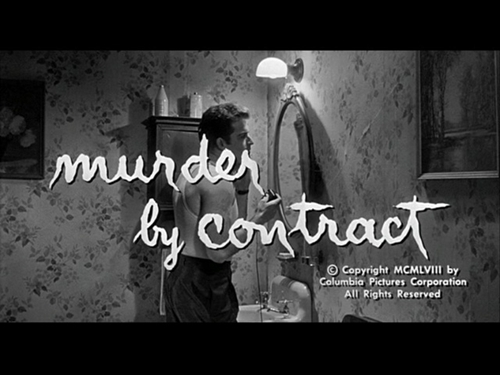
Murder by Contract
1958, Directed by Irving Lerner. Starring Vince Edwards, Phillip Pine and Herschel Bernardi.

Claude (Vince Edwards) is an unusual hit man. He wasn’t born to the life, but instead he made himself a resourceful, calculating contract killer with an existentialist worldview. “He is so committed to his point of view and his philosophy that he’s developed—you respect that,” says Antonio Campos, who champions Murder by Contract. Campos praises the stylized off-camera hits, the economy of shots, and Edwards’s lead performance in this B-level noir film, shot in eight days.

That’s not to say he thinks it’s a perfect film. “What’s also charming about the film is that it is kind of a diamond in the rough,” Campos says. “Whatever rough edges Murder by Contract has are ultimately completely overshadowed by the brilliant dialogue and the commitment to a tone that was so ballsy.”

Antonio Campos, selected filmography:
Afterschool (2008), Simon Killer (2012)

Robert K. Elder: How would you describe Murder by Contract to someone who’s never seen it?
Antonio Campos: It’s a faithful noir film about a contract killer, from a time when not many films were made like that.

What made it special?
Campos: I remember vividly, I’d seen it at the Film Forum, and I remember feeling like I hadn’t seen anything like that in the program, and also I’d never seen anything like that outside of even contemporary film. Obviously there are contract-killer films now, but there was something about it, and the lightness, the light touch that it had, that really struck me as something very unique.

Let’s talk about the star, Vince Edwards, who was best known as the lead in TV’s hospital drama Ben Casey. Can you talk about him as a leading man?
Campos: The first time I ever saw Vince Edwards was in Stanley Kubrick’s The Killing (1956). And I think he’s one of these B actors from that period. I was thinking about Vince Edwards and I was thinking about Timothy Carey in The Killing—they’re very specific kind of actors but could never be the classic leading man. Vince Edwards could be the leading man in that film, but he couldn’t be—he would never be—the movie star that he probably wanted to be. And I find those kinds of actors fascinating.

What does Edwards do in this role that makes him so magnetic, that pulls us through the film?
Campos: It’s his charisma as an actor. As a character, it’s the fact that he believes in something. As fickle as it may be, he has this amazing control. He is so committed to his point of view and his philosophy that he’s developed—you respect that.

If the film was made today, you’d have a little bit more violence to make the character a little more complex. You’re kind of rooting for him from the beginning.

Claude (Vince Edwards) is misanthropic but he has a heart and certain principles.

This is Edwards’s first film with Irving Lerner, a former documentarian, and shot in eight days.
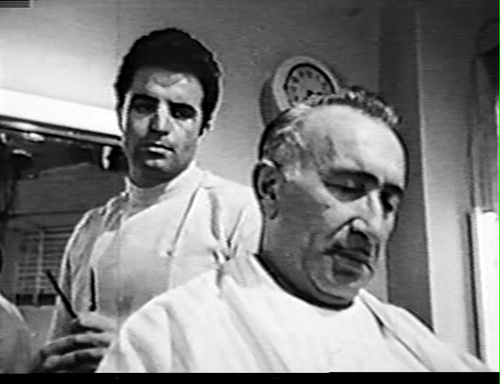
Campos: What I find really interesting is that it isn’t a perfect film. It’s not a film that you watch and you think, “This guy is some brilliant unknown director!” What’s interesting is, for example, the first scene where Claude meets the character of Mr. Moon, that long shot that plays out. That felt like a very strong choice. It felt like Irving Lerner was in complete control of the way this film was made.

In Afterschool, many of your characters are also kept out of frame, especially in that first twenty minutes. Am I right to draw that parallel to Murder by Contract?
Campos: It wasn’t necessarily a direct influence. There was a certain kinship, I felt, with the way that he was approaching his composition.

My feeling about offscreen action and that fragmentation of characters is that you heighten the mystery and the tension because you’re holding back someone who feels very important to the story. Those moments in which the characters are offscreen or, for lack of a better word, decapitated by the frame, you almost make the universe of the film larger. In terms of Afterschool, you always felt like there was a bigger world outside of the frame that you wanted to see and also a bigger world outside of the frame that you couldn’t see. That, to me, is one of the things that can make a smaller film or a lower-budget film feel bigger.

Claude’s solitary nature is similar to Travis Bickle’s loner life in “Taxi Driver” by Martin Scorsese.

And one of the other parallels is the solitary nature of Vince’s character, especially inside his room—something it shares with the protagonist in Afterschool. Was that sequence influential?
Campos: Murder by Contract definitely could’ve played a sort of subconscious influence on me. I find that there are the filmmakers whose body of work I’ve become very familiar with, but then I’m aware of them influencing me. And then there are those one-off films that I see that subconsciously have made a greater effect on me that I don’t realize.

That particular sequence also influenced Martin Scorsese. Lerner’s austere training montage is reflected in Taxi Driver.
Campos: For Claude, it’s a job, and he’s had to train himself. He says many times that this is not the way he was born. He’s developed a certain coldness intentionally so that he can be a contract killer. Obviously, film noir was so much about antiheroes, and this is about someone who is a very cold-blooded killer and so calculated. The other thing that struck me is his point of view of the world that was quite misanthropic and quite cynical, but at the same time, he had a heart and he had certain principles that he was struggling with.

Why do you think we, as viewers, are drawn to the charismatic psychopath or sociopath?
Campos: We’re drawn to them when they’re done a certain way. Taxi Driver, for example, has Travis Bickle, and Bickle is the charismatic sociopath. At first, you sympathize with the fact that he is so disconnected and confused.

I don’t feel like they’re completely sociopaths. They have sociopathic tendencies or something, but deep down inside, there is a heart and humanity. [Read more…]

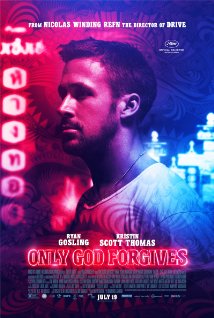
Can Ryan Gosling save ‘Only God Forgives’?

“Only God Forgives,” starring Ryan Gosling and Kristin Scott Thomas, opened on Friday to mixed (mostly negative) reviews. This art house/crime thriller film, written and directed by Nicolas Winding Refn, was nominated for the Palme d’Or at this year’s Cannes Film Festival.

In 2011, Refn, Gosling and Carey Mulligan teamed up for the eloquent and extremely violent “Drive.” You can read Stephanie Zacharek’s review of “Only God Forgives” here.

And on the small screen: The success of political-intrigue TV dramas such as “Scandal,” “House of Cards” and “Homeland” means the Beltway has displaced Manhattan and Los Angeles as the capital of noir, says James Wolcott in next month’s Vanity Fair. You can read the full story here.


Happy b’day, Babs! FNB joins Barbara Stanwyck Blogathon

Very few actresses truly deserve accolades like stellar, peerless, magnificent and amazing. Barbara Stanwyck, who had a stage, film and TV career spanning more than 50 years, is surely one of that select group. She might have cringed at such lofty praise, however, referring to herself as “a tough old broad from Brooklyn.”

Adjectives aside, Stanwyck stands out for the range of parts she played, her discipline as an artist, and the subtlety and strength of her performances. That’s why I was so pleased when Aubyn at The Girl with the White Parasol let me join this month’s Barbara Stanwyck Blogathon, which runs through July 22.

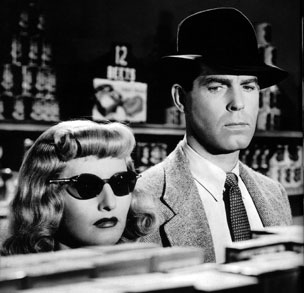
For my contribution, I’m highlighting a fluffy detail from the great “Double Indemnity” (1944): Phyllis Dietrichson’s tawdry blonde wig. The piece also includes some observations from master director Billy Wilder on working with Barbara – born Ruby Catherine Stevens on July 16, 1907, and later nicknamed Babs, Missy and The Queen. She still rules today.

A Babs Stanwyck moment for FNB

On Phyllis Dietrichson’s wig: Looking through some photos the other day, I noticed how often I lost the fight with my fine, curly hair and let it go wild (left). Not every day can be a good hair day.

If I ever need assurance that every femme fatale has a styling glitch from time to time, I look at Barbara Stanwyck’s awful wig in “Double Indemnity,” a quintessential noir from 1944, directed by Billy Wilder.

Paramount production head Buddy DeSylva said of the stiff blonde ’do, “We hired Barbara Stanwyck and here we get George Washington.”

It also reminded me that it had been ages since I’d looked at my copy of “Conversations with Wilder” by Cameron Crowe, published in 1999. Of course, I flipped right to Wilder’s answer to Crowe’s question about the direction given to Barbara Stanwyck in “Double Indemnity” for the silent shot on her face while the murder is occurring.

Said Wilder: Sure, that was a highly intelligent actress, Miss Stanwyck. I questioned the wig, but it was proper, because it was a phony wig. It was an obviously phony wig. And the anklet – the equipment of a woman, you know, that is married to this kind of man. They scream for murder.

Barbara Stanwyck and Fred MacMurray star in “Double Indemnity” from 1944. Both played against type.

Yeah, naturally we rehearsed this thing. But I rehearsed it with her once or twice, that’s the maximum, and it was not that much different from the way she would have done it. She was just an extraordinary woman. She took the script, loved it, right from the word go, didn’t have the agent come and say, “Look, she’s to play a murderess, she must get more money, because she’s never going to work again.”

With Stanwyck, I had absolutely no difficulties at all. And she knew the script, everybody‘s lines. You could wake her up in the middle of the night and she’d know the scene. Never a fault, never a mistake – just a wonderful brain she had.

Crowe asked if the part had been written for Stanwyck. Wilder said: Yeah. And then there there was an actor by the name of Fred MacMurray at Paramount, and he played comedies. Small dramatic parts, big parts in comedies. I let him read it, and he said, “I can’t do that.” And I said, “Why can’t you?” He said, “It requires acting!” [Laughs.] I said, “Look, you have now arrived in comedy, you’re at a certain point where you either have to stop, or you have to jump over the river and start something new.” He said, “Will you tell me when I’m no good?” [He nods: a partnership is born.] And he was wonderful because it’s odd casting.

Paramount image of “Double Indemnity”