‘Roofman’ manages to climb into your heart and charm you

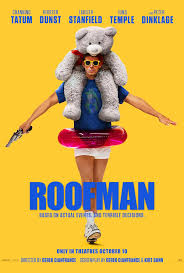
“Roofman” sneaks into the film noir genre like a clumsy cat burglar – and that’s fitting because the movie’s protagonist is real-life robber Jeffrey Manchester (played by Channing Tatum) – a US Army vet with a high IQ who’s bold, brilliant, and daring, but also a colossal screw-up. Indeed, the name of the film might just as easily be “Goofman.”

In an early scene, Jeffrey’s friend Steve (LaKeith Stanfield) – a fellow vet and a straight shooter – shakes his head at Jeff’s smart-dumb dynamic and his lack of a steady income, telling him to capitalize on his gift for noticing a myriad of details. Jeffrey heeds Steve’s advice in his own wily way by thinking outside the box to find a novel way of getting inside a box and plundering it. In other words, instead of breaking and entering through a door or window, he goes through the roof.

He starts by stealing cash from a local McDonald’s, gets away with it, and goes on to commit more than 40 robberies. For a while, it’s all good as far as he’s concerned and he’s able to provide a better life (and better birthday gifts) for his three kids and his ex-wife (Melonie Diaz).

Eventually, he’s arrested and sentenced to 45 years in jail. But he plots a clever escape and evades capture by holing up in a hidden space in a Toys “R” Us store. By day, he surreptitiously keeps tabs on the pompous store manager named Mitch (Peter Dinklage) and staffers Leigh (Kirsten Dunst), a recently divorced, hardworking, church-going mom of two girls, as well as meek and mild Otis (Emory Cohen).

At night, Jeffrey disables the security cameras and leaves his “room” to roam the aisles, nosh on candy, and purloin video games, which he will later sell for cash. After learning that Leigh is organizing a toy drive at her church, he grabs toys to donate. When he shows up at the church to drop them off, he introduces himself as John Zorin, from New York. Leigh is intrigued and later, at a church singles event, they hit it off and begin dating. To account for his mysterious comings-and-goings and vague backstory, “John” tells her he is an undercover government agent.

From there, “Roofman” becomes a tale of doomed love as we wait to see how long Jeffrey can keep the ruse going without Leigh suspecting or the police narrowing in. Jeffrey wins not only Leigh’s heart but also the affection of her daughters, sweet and adorable Dee (Kennedy Moyer) and Lindsay (Lily Collias), a moody teenager. We’re rooting for Jeffrey and Leigh’s crazy relationship to work out, though, as mentioned, this is a tale of doomed love …

As such, it’s surprisingly affecting and moving, thanks to sharp direction from Derek Cianfrance and first-rate acting, especially from Tatum, a great casting choice. Tatum’s performance, while very human, exudes more sweetness than menace, more sincerity than malice. And Dunst rings true as a harried mom who wants a second chance at love.

“Roofman” gives us entertaining moments, no doubt, but it’s not quite a dark comedy. Cianfrance – whose previous work includes “Blue Valentine” (2010), “The Place Beyond the Pines” (2012), and “The Light Between Oceans” (2016) – counters the playful, almost whimsical, mood with an undercurrent of sadness. Cianfrance co-wrote the script with Kirt Gunn.

Cinematographer Andrij Parekh uses 35mm to lend a sometimes-garish brightness and Christopher Bear’s subtle piano score reminds us that Jeffrey’s freedom is merely fleeting. “Roofman” manages to climb into your heart and charm you with a heavily flawed main character, full of head-scratching contradictions and unrealized potential.

“Roofman” opened in theaters on Friday, Oct. 10.

Neo-noirs now playing: ‘Trance,’ ‘The Company You Keep,’ ‘Room 237,’ ‘The Place Beyond the Pines,’ ‘Spring Breakers’

By Michael Wilmington and Film Noir Blonde

The Noir City film fest starts tonight at the Egyptian Theatre in Hollywood. Additionally, Joanna Lancaster, Susie Lancaster, actor Ed Lauter and author James Naremore will attend tonight’s screening of a new print of “Sweet Smell of Success” at the Billy Wilder Theater in Westwood.

And in case you’re more of a full-color fan, there are a several interesting neo-noir titles opening this weekend and currently playing in Los Angeles theaters. (Check your local listings for showtimes.)

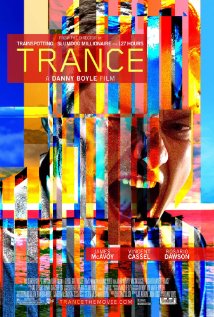
Trance/2013/Fox Searchlight Pictures/101 min.

Danny Boyle’s new movie “Trance” begins with the theft of a world-famous painting (Francisco Goya’s spooky “Witches in the Air”) from a London auction in mid-sale. It continues through all kinds of slick neo-noir alleys and crannies of bloody gangsterism and psychological mystery, and ends with an unraveling that twists and turns, and changes a lot of what went before.

What seems to be happening at first is a clockwork heist of the painting, complete with smoke bombs and switcheroos, by a brutal but stylish gang led by the fashionable Frank (French star Vincent Cassel). One of the auction house’s employees, Simon (James McAvoy), tries to save the painting by encasing and running off with it. (Or does he?). And he’s stopped and cracked on the head by Frank. (Or is he?)

Soon we discover that Simon is part of the caper, that the painting has now disappeared and that, because of the head-crack, Simon hasn’t the foggiest where it is. So Frank hires a luscious and oh-so-smart American hypnotherapist named Elizabeth (played by Rosario Dawson), to unlock the priceless secret in Simon’s mind, which she confidently tries to do. (Or does she?)

Boyle is rejoined here by his first screenwriter John Hodge (of “Shallow Grave” and “Trainspotting”), along with Joe Ahearne, who wrote (and directed) the 2001 TV film, also called “Trance,” on which this “Trance” is based. Like “Shallow Grave,” there’s a touch of meanness about the movie along with a roller-coaster speed, which can slightly discombobulate and even alienate you, while still giving you a dependably thrilling ride.

The actors are all top-chop and compellingly neo-noirish, including the hypnotic Dawson, the spellbound McAvoy, all the heavies and especially Cassel. The film, shot by Boyle’s usual camera-mate Anthony Dod Mantle, is full of glowing colors, helter-skelter action, pungent villains and sumptuous sights – the most sumptuous of which is the beautiful and brainy Ms. Dawson. As they said in the heyday of ’40s noir when a real femme fatale walked by, hubba hubba.

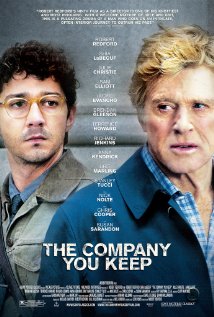
The Company You Keep/2012/Sony Pictures Classics/125 min.

“The Company You Keep,” a political thriller based on a Neil Gordon novel, is Robert Redford’s ninth film as a director and his first as both actor and director since 2007’s “Lions for Lambs.” Contemplative, nostalgic and insightful, “Company” satisfies, despite being a little short on suspense.

He plays Jim Grant, a public-interest lawyer and single father, who lives a quiet life in a suburb of Albany, New York. Grant’s peaceful existence is shaken up when an ambitious reporter named Ben Shepard (Shia LaBeouf) reveals that Grant is a former Weather Underground activist wanted for murder.

Grant must leave his daughter behind as he leaves Albany to find the person who can clear his name. As Grant backtracks through his past associations and across the country, he’s pursued by the FBI and by Shepard, eagerly digging for more details to use in his next story. Grant has more than one secret, natch.

The tension isn’t as strong as it needs to be in a thriller and the denouement, in Michigan’s upper peninsula, seems a bit tacked on – something we’ve seen many times before. But, for me, those were minor quibbles. Redford creates an unforgettable mood of wistfulness and regret, of love lost and found.

He elicits memorable performances from an outstanding cast, which includes Julie Christie, Sam Elliott, Brendan Gleeson, Terrence Howard, Richard Jenkins, Anna Kendrick, Brit Marling, Stanley Tucci, Nick Nolte, Chris Cooper and Susan Sarandon. Shot by Adriano Goldman, the naturalistic cinematography and striking compositions serve the story well.

“Dissent can be dicey,” says Sarandon’s character. In “Company,” Redford takes a nuanced look at a dicey chapter of American history.

Room 237/2012/IFC Midnight/102 min.

No matter how many times you’ve seen Stanley Kubrick’s “The Shining” (1980), it’s unlikely you’ve delved into its subtext and symbols, and dissected its meaning(s) to the extent that the talking heads have in a new doc called “Room 237.”

Director Rodney Ascher puts the spotlight on die-hard fan/theorists who have spent years studying this mesmerizing, iconic yet flawed film starring Jack Nicholson, Shelley Duvall, Scatman Crothers and Danny Lloyd.

These fans (ordinary folk as opposed to industry-insiders, authors, academics or other experts) offer extensive and elaborate arguments for their interpretations, which range from the movie being a metaphor for genocide to proof that Kubrick faked the Apollo moon landings footage.

You may walk out believing none of the theories, but the energy, enthusiasm and imagination of these diligent decoders is great fun from start to finish.

The Place Beyond the Pines/2012/Focus Features/140 min.

“The Place Beyond the Pines” is the Iroquois Indian phrase for Schenectady, New York. Schenectady is where this madly ambitious neo-noir – about father and sons, motorcycles and bank robberies, and tragic destiny – takes place and where the movie was shot, super-documentary style, by director/co-writer Derek Cianfrance (“Blue Valentine”) and cinematographer Sean Bobbitt (“Hunger” and “Shame”).

Watching the collision between an outlaw and a cop, and its aftermath, is often riveting. The cast, an unusually good one, is topped by Ryan Gosling (as a carnival motorcyclist turned bank robber) and Bradley Cooper (as the cop). Eva Mendes, Rose Byrne and Ray Liotta are supporting players.

It’s a terrific-looking film. Cianfrance and Bobbitt shot the movie in a kind of coldly sunny blur of metallic speed and near-constant movement that starts out with a five-minute-long tracking shot.

“The Place behind the Pines,” unlike most big-star Hollywood vehicles, is something the people involved obviously cared about, that they wanted to be great. And it had a chance. The problem is the third act, which is by far the weakest. The dramatic devices are too easy to spot, the resolution too pat and some of the scenes too hard to swallow.

Spring Breakers/2012/A24/94 min.

Harmony Korine’s movies – up to and including his latest, “Spring Breakers” – are mostly outlaw pictures and weirdo comedies about people who don’t want to grow up, or shouldn’t have to: kids, crooks, artists. “Spring Breakers” is about four college girls who take off for collegiate revels in Tampa, Fla., and begin to descend into Hell.

It may be the apotheosis or culmination of all the Korines: a picture that starts off, as many have noted, like an arty “Girls Gone Wild” video, inflated to Hieronymus Boschian or Pieter Brughelian beach party proportions, and ends up doing a riff on the Al PacinoBrian De Palma 1983 “Scarface,” mashed up into “Charlie’s Angels” gone homicidal.

It’s a sometimes fascinatingly dumb movie, about fascinatingly dumb people doing fascinatingly dumb things. The story makes absolutely no sense. But some of “Spring Breakers” is great – namely the shimmering, sun struck , stunning cinematography (part of the movie was shot quasi-verité at an actual spring break) by Belgian/French maestro Benoit Debie. And there’s the amazingly entertaining gangsta-pranksta performance by James Franco. His brain-fried hip-hop-druggie, Alien, who calls his bed an art piece and plays piano and AK47s, is a triumph of charismatic dopiness and rebel posturing.

The ending is beyond ridiculous and not funny enough to save things. The four femme stars (Selena Gomez, Vanessa Hudgens, Ashley Benson and Rachel Korine) could have used better parts and better lines, but what the hell? The movie’s credibility vanishes after the restaurant robbery scene anyway, which is shot flashily, in a “Gun Crazy”-style single take.”