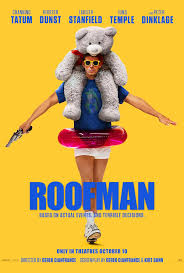
 “Roofman” sneaks into the film noir genre like a clumsy cat burglar – and that’s fitting because the movie’s protagonist is real-life robber Jeffrey Manchester (played by Channing Tatum) – a US Army vet with a high IQ who’s bold, brilliant, and daring, but also a colossal screw-up. Indeed, the name of the film might just as easily be “Goofman.”
In an early scene, Jeffrey’s friend Steve (LaKeith Stanfield) – a fellow vet and a straight shooter – shakes his head at Jeff’s smart-dumb dynamic and his lack of a steady income, telling him to capitalize on his gift for noticing a myriad of details. Jeffrey heeds Steve’s advice in his own wily way by thinking outside the box to find a novel way of getting inside a box and plundering it. In other words, instead of breaking and entering through a door or window, he goes through the roof.
He starts by stealing cash from a local McDonald’s, gets away with it, and goes on to commit more than 40 robberies. For a while, it’s all good as far as he’s concerned and he’s able to provide a better life (and better birthday gifts) for his three kids and his ex-wife (Melonie Diaz).
Eventually, he’s arrested and sentenced to 45 years in jail. But he plots a clever escape and evades capture by holing up in a hidden space in a Toys “R” Us store. By day, he surreptitiously keeps tabs on the pompous store manager named Mitch (Peter Dinklage) and staffers Leigh (Kirsten Dunst), a recently divorced, hardworking, church-going mom of two girls, as well as meek and mild Otis (Emory Cohen).
At night, Jeffrey disables the security cameras and leaves his “room” to roam the aisles, nosh on candy, and purloin video games, which he will later sell for cash. After learning that Leigh is organizing a toy drive at her church, he grabs toys to donate. When he shows up at the church to drop them off, he introduces himself as John Zorin, from New York. Leigh is intrigued and later, at a church singles event, they hit it off and begin dating. To account for his mysterious comings-and-goings and vague backstory, “John” tells her he is an undercover government agent.
From there, “Roofman” becomes a tale of doomed love as we wait to see how long Jeffrey can keep the ruse going without Leigh suspecting or the police narrowing in. Jeffrey wins not only Leigh’s heart but also the affection of her daughters, sweet and adorable Dee (Kennedy Moyer) and Lindsay (Lily Collias), a moody teenager. We’re rooting for Jeffrey and Leigh’s crazy relationship to work out, though, as mentioned, this is a tale of doomed love …
As such, it’s surprisingly affecting and moving, thanks to sharp direction from Derek Cianfrance and first-rate acting, especially from Tatum, a great casting choice. Tatum’s performance, while very human, exudes more sweetness than menace, more sincerity than malice. And Dunst rings true as a harried mom who wants a second chance at love.
“Roofman” gives us entertaining moments, no doubt, but it’s not quite a dark comedy. Cianfrance – whose previous work includes “Blue Valentine” (2010), “The Place Beyond the Pines” (2012), and “The Light Between Oceans” (2016) – counters the playful, almost whimsical, mood with an undercurrent of sadness. Cianfrance co-wrote the script with Kirt Gunn.
Cinematographer Andrij Parekh uses 35mm to lend a sometimes-garish brightness and Christopher Bear’s subtle piano score reminds us that Jeffrey’s freedom is merely fleeting. “Roofman” manages to climb into your heart and charm you with a heavily flawed main character, full of head-scratching contradictions and unrealized potential.
“Roofman” opened in theaters on Friday, Oct. 10.











From my readers