French film noir fest starts Friday in San Francisco

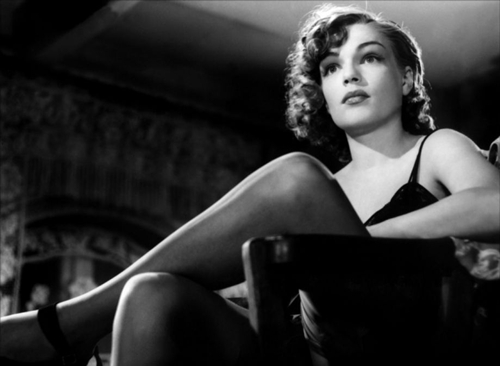
Simone Signoret in “Dedee D’Anvers,” one of the films in The French Had a Name for it at the Roxie Theater in San Francisco.

Simone Signoret in “Dedee D’Anvers,” one of the films in The French Had a Name for it at the Roxie Theater in San Francisco.

Mick LaSalle of SF Gate reports: “The Roxie Theater is launching a remarkable festival on Friday, Nov. 14, of films you’ve never heard of. Until a couple of weeks ago, I’d never heard of them either. I didn’t know they existed, or even that there were movies of this kind. But now I’ve seen every one of them, and the experience is like finding gold where you thought was rock.

“The festival is called The French Had a Name For It: French Film Noir 1946-1964. Of course, I knew that the French adored American noir and that the French critics gave the genre its name. But I had no idea they were also churning out noirs themselves, nor that they were doing them so well.

“Some of these films are great. Some are very good. And some are completely insane.”

Read the rest of his story here.

Oh, how I would love to dash up north for this festival!

But I’m not complaining. We at FNB are fully immersed in the AFI Fest by Audi, which runs through Thursday in Hollywood.

Film noir vintage poster book belongs on your shelf

The-Art-of-Noir-The-Posters-and-Graphics-from-the-Classic-Era-of-Film-Noir-by-Eddie-Muller[1]Who doesn’t love the sexy drama and irresistible hype that’s packed into just about every movie poster made in the heyday of film noir?

Now available in the U.S. and the U.K., “The Art of Noir: The Posters and Graphics from the Classic Era of Film Noir” (Overlook Duckworth Publishers), by noir czar Eddie Muller, is brimming with vintage allure.

Full of swaggering dudes, feisty ladies with perfect pouts and a whole lot of phallic imagery, these brash, bold posters were saturated with style and rich with original artistry.

The films covered in the book were produced in the U. S. between 1940 and 1960, though one of the book’s themes is how artists of other countries depicted the peculiarly American phenomenon of film noir, writes Muller.

Primarily, he says, the book is a tribute to the craftspeople who created the artwork. And, although film noir is the segment of the poster collector’s market that has seen the steepest rise in value, the posters in the book weren’t chosen for their monetary worth. Instead, says Muller, he made his selections based on the posters’ artistic and historic relevance as well as their ability to spotlight cinematic contributions from writers, directors and performers.

We will discuss the book more extensively later on, but just wanted everyone to know it is now available on both sides of the pond. Meanwhile, you can read Anne Billson’s review in the London Telegraph.

Edgar G. Ulmer films to screen at the Academy

Detour poster 214A double-bill of “Detour” and “The Strange Woman” on Friday, Nov. 6, will launch the Academy’s Edgar G. Ulmer screening series. A production designer and director, Ulmer worked in many genres and, as the “King of Poverty Row” in Hollywood, was underrated in his lifetime. We, of course, adore his film noir titles.

The six-film series is running in conjunction with the ongoing exhibition Haunted Screens: German Cinema in the 1920s at the Los Angeles County Museum of Art (Lacma). The films will be shown at Lacma’s Bing Theater.


Film noir features prominently at AFI FEST 2014

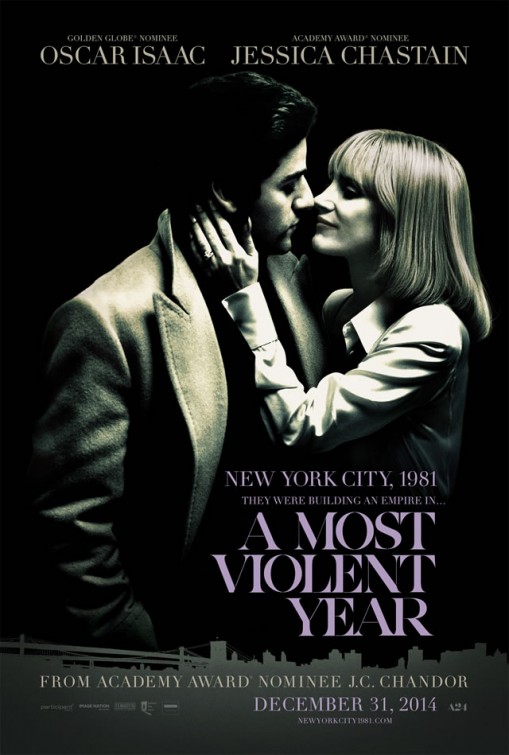
A Most Violent Year poster largeWe at FNB are eagerly awaiting the start of AFI FEST 2014 presented by Audi.

The terrific slate of shows runs Nov. 6-13 in Hollywood. The fest opens and closes with neo-noir titles that are generating Oscar buzz. “A Most Violent Year,” starring Oscar Isaac, Jessica Chastain and David Oyelowo, will kick things off. Set in 1981 in New York City, the film tells the story of an immigrant struggling to survive amid intense crime and danger. “A Most Violent Year” is directed by J.C. Chandor (“Margin Call” and “All Is Lost”).

Inherent Vice posterThere will be two screenings on Sat., Nov. 8., of director Paul Thomas Anderson’s latest feature: an adaptation of “Inherent Vice” by novelist Thomas Pynchon. Joaquin Phoenix stars as P.I. Doc Sportello in 1970-ish Los Angeles. We’re in. Phoenix leads a stellar cast including Katherine Waterston, Josh Brolin, Owen Wilson, Reese Witherspoon, Benicio Del Toro, Jena Malone, Maya Rudolph and Martin Short.

On Monday, Nov. 10, “The Gambler” is the gala screening. In this remake of the 1974 James Caan film, Mark Wahlberg plays Jim Bennett, a college professor immersed in the watch-your-back world of underground gambling. English director Rupert Wyatt (“The Escapist” and “Rise of the Planet of the Apes”) joins forces with Boston-born writer William Monahan (“The Departed”).

Foxcatcher,” the closing night movie, is based on the real-life saga of ’80s Olympic wrestling champs Dave and Mark Schultz (Mark Ruffalo and Channing Tatum) and their uneasy working relationship with ultra-wealthy wrestling hobbyist/“coach” John du Pont (Steve Carell). Things go from tense to deadly in this spare and thoughtful drama, for which Bennett Miller took home the Best Director prize at the Cannes Film Fest. (His previous work includes “Capote” and “Moneyball.”) We caught this at a press screening last night – it is very chilling and very well done. From his pasty skin to his zombie rasp that passes for a voice, Carell perfectly conveys the menacing imperiousness and internal emptiness that apparently defined du Pont’s personality. Ruffalo and Tatum are excellent as well.

sophia-loren-afi-tribute[1]These are just a few of the film-noir offerings and there is much more going on, such as the Sophia Loren tribute on Nov. 12. Who doesn’t love this supremely talented and stunningly beautiful actress?

The complete AFI FEST program includes 118 films (73 features, 45 shorts), representing 39 countries. There are 29 films directed/co-directed by women, 16 documentaries and 17 animated films.  The breakdown by section is: Galas/Tributes (6), Special Screenings (8), American Independents (8), New Auteurs (10), World Cinema (29), Midnight (4), Breakthrough (4), Conversations (4), Cinema’s Legacy (4) and Short Films (45), and includes 9 official Foreign Language Film Oscar® submissions.

Free tickets are available: http://www.afi.com/afifest/freetickets.aspx

Film noir comes in focus at the Skirball’s Holiday Pop-Up Shop

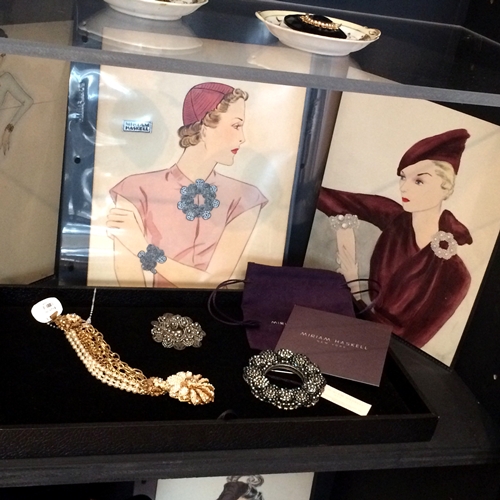
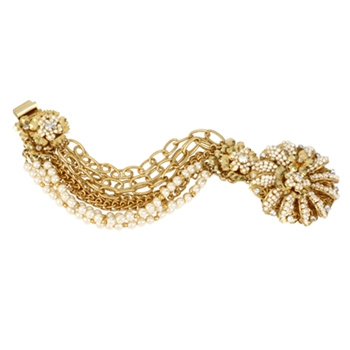
Miriam Haskell costume jewelry on display at the Skirball Cultural Center’s Holiday Pop-Up Shop.

Miriam Haskell costume jewelry on display at the Skirball Cultural Center’s Holiday Pop-Up Shop.

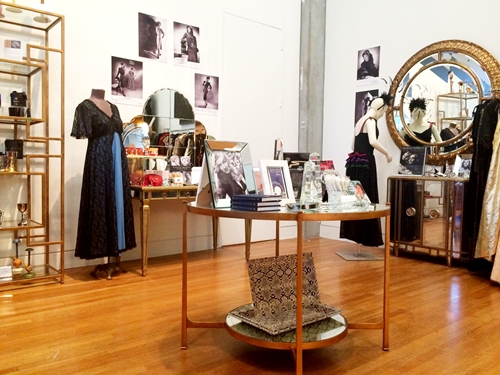
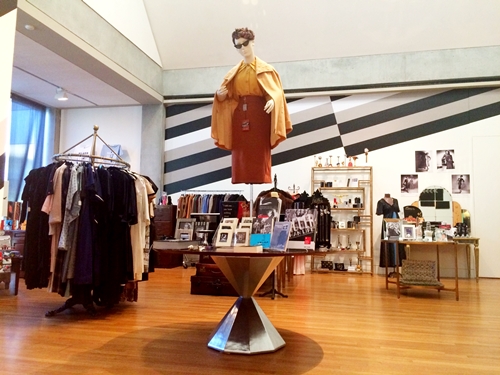
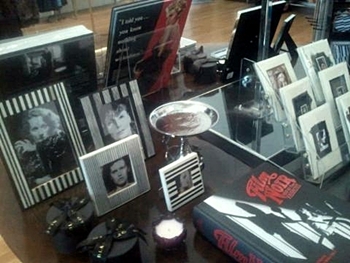
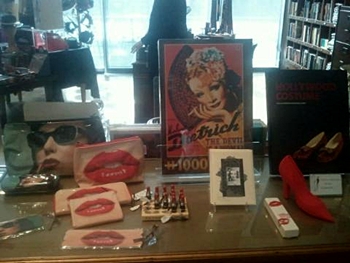
Do yourself a favor and be sure to stop by the Light & Noir Holiday Pop-Up Shop at the Skirball Cultural Center in West Los Angeles. Allow plenty of time because you’ll be amazed at all there is to see.

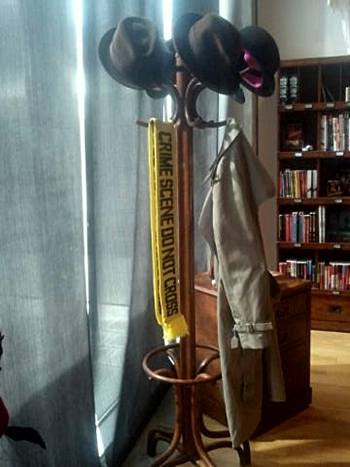
The shop houses a terrific variety of merchandise – from bar accessories, Black Dahlia candles, bright yellow Crime Scene scarves and a slew of books in the detective’s office to the vintage dresses, hats, lingerie and cosmetics in the femme fatale’s boudoir.

The Light & Noir Holiday Pop-Up Shop at the Skirball Cultural Center.

The Light & Noir Holiday Pop-Up Shop at the Skirball Cultural Center.

And what boudoir would be complete without jewelry? One exquisite example: a limited-edition vintage reproduction brooch and bracelet from costume jewelry house Miriam Haskell.

Additionally, there are toys, T-shirts and games as well as several items that play up the high-contrast black-and-white cinematography of film noir, such as stunning compact mirrors and specially designed chocolate bars.

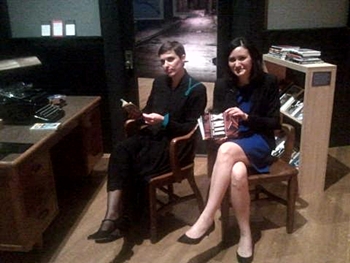
Light & Noir curator Doris Berger (left) and The Noir Effect curator Linde Lehtinen. FNB photo

Light & Noir curator Doris Berger (left) and The Noir Effect curator Linde Lehtinen. FNB photo

The Light & Noir Holiday Pop-Up Shop is open through Jan. 4, 2015. The outstanding exhibitions Light & Noir: Exiles and Émigrés in Hollywood, 1933–1950 (curated by Doris Berger) and The Noir Effect (curated by Linde Lehtinen) run through March 1.

Take a walk through all three and explore the richly layered legacy of film noir. Ahead of their time artistically, the classic movies still intrigue today and their neo-noir counterparts continue to reinvent the genre. What’s particularly fascinating from a historical perspective and what the Skirball shows illustrate so beautifully is the unusual confluence of forces that came together to give birth to film noir.

The film noir visual style is referenced in the Holiday Pop-Up Shop.

The film noir visual style is referenced in the Holiday Pop-Up Shop.

The influx into Hollywood of supremely talented Jewish and anti-Fascist artists that began in 1933 after the Nazi government came into power forever changed the American movie-making landscape.

The exiles and émigrés brought a sophisticated, cynical and wryly humorous sensibility to their new work. Perhaps most strikingly, they brought the daring and sublime visual style that many had learned while working at the German movie studio UFA in the 1920s.

Detail of a Miriam Haskell pearl bracelet on display at the Holiday Pop-Up Shop.

Detail of a Miriam Haskell pearl bracelet on display at the Holiday Pop-Up Shop.

But German Expressionism wouldn’t have meshed with musicals, comedies or lightweight whodunits. By serendipity, there was a perfect narrative pairing: the hard-boiled, realistic work of American crime writers, such as James M. Cain, Dashiell Hammett, Raymond Chandler, Patricia Highsmith and Dorothy B. Hughes.

Sometimes snubbed by the literary establishment, these scribes took inspiration from downtown, dangerous streets, from real court-room cases, from seedy dive bars and elite private drinking clubs. They wrote tough, gritty detective stories as well as satirical novels about doomed love and perverse murder schemes. Heavyweight writers like Chandler, Billy Wilder, William Faulkner and Ben Hecht turned these books into scripts.

The Holiday Pop-Up Shop has great gifts for men. FNB photo

The Holiday Pop-Up Shop has great gifts for men. FNB photo

Another boon: Hollywood was in its heyday. In 1946, 80 million people (57 percent of Americans) went to theaters every week. Post–World War II audiences craved realistic fare and film noir fit the bill. Technical innovations allowed for more creativity with the camera.

At the same time, the bare-bones budgets of B movies typically left directors to their own devices, spurring their inventiveness. The strict codes of the censors also drove writers and directors to find subtle ways to subvert the status quo.

To bring larger-than-life characters like Philip Marlowe and Phyllis Dietrichson to the big screen, there was a remarkable pool of Golden Age acting talent. Robert Mitchum, Humphrey Bogart, Robert Ryan, John Garfield, Edward G. Robinson, Peter Lorre, Lauren Bacall, Barbara Stanwyck, Gloria Grahame and Joan Crawford were just a few of the charismatic, one-of-a-kind stars who played these unforgettable roles.

Candles and chocolate and books, oh my! FNB photo

Candles and chocolate and books, oh my! FNB photo

All these factors came together at exactly the right time to engender a startlingly original and truly international cinematic art form. But, as in any film noir story, there was a dark and troubling side underneath the surface.

The exiles and émigrés often faced bias and fierce anti-Semitism in America. Some of them couldn’t find work, some were relegated to low-budget titles, some of their careers faltered and faded. It stands to reason that a sense of fear and persecution lingered in their psyches long after they left Europe.

Step back in time with a little boudoir browsing. FNB photo

Step back in time with a little boudoir browsing. FNB photo

Imagine then, the new surge of terror they must have felt when in 1947 the House Un-American Activities Committee hearings (into alleged Communist ties and influence) named the Hollywood Ten, six of whom were Jewish.

After the hearings, the studios blacklisted hundreds of artists and many had to leave the U.S. in order to survive.

But, today, more than 80 years after the rise of Hitler and the emigration that followed, these artists are widely recognized and their work endures in one of the most powerful, stylish, resonant and entertaining of all movie genres: film noir.

(Photos not identified as FNB are courtesy of the Skirball Cultural Center.)

Real-life noir mystery or publicity gimmick?

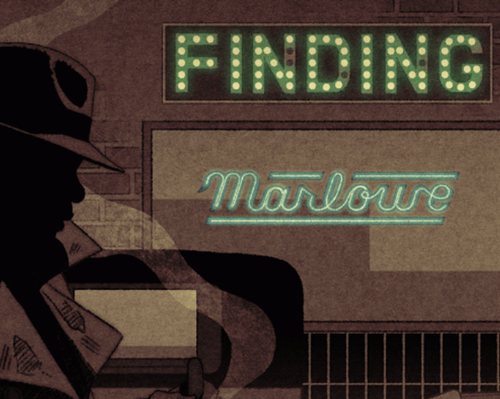
Finding Marlowe LA Times

Did a Jamaican immigrant and Los Angeles gumshoe inspire Raymond Chandler’s and Dashiell Hammett’s characters? LA Times writer Daniel Miller posits a fascinating theory that is short on solid evidence. It looks as though he was duped by an aspiring screenwriter seeking publicity for the movie she wants to make. Well, it wouldn’t be the first time a guy got tricked by a dame.

Read the story and see what you think: http://graphics.latimes.com/finding-marlowe/

Ahead of her class: Remembering a legendary designer

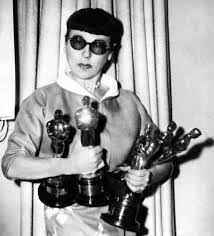
Edith Head won eight Oscars.

Edith Head won eight Oscars.

Edith Head was born today in 1897 in San Bernardino, Calif. Starting with scant experience and no design training, she nonetheless had a stellar career – at Paramount and Universal, frequently collaborating with Alfred Hitchcock.

Grace Kelly, Tippi Hedren, Kim Novak, Veronica Lake, Barbara Stanwyck, Ingrid Bergman, Rita Hayworth, Marlene Dietrich, Sophia Loren, Natalie Wood, Audrey Hepburn and Katharine Hepburn were just some of the women she dressed.

Head won eight Academy Awards for costume design. She died on Oct, 24, 1981. You can learn more about her work at the Academy’s Hollywood Costume show.

 Slacking off

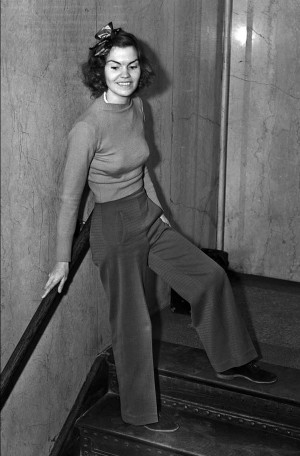
Meanwhile, the Los Angeles Times recently shared this nifty item from 1938 about a woman who went to jail for wearing slacks in courtroom. Yikes! Times have changed, just a bit.

 Helen Hulick defied convention by wearing slacks. Photo by Andrew H. Arnott/L.A. Times Archive/UCLA

Helen Hulick defied convention by wearing slacks. Photo by Andrew H. Arnott/L.A. Times Archive/UCLA

Skirball Cultural Center’s The Noir Effect exhibition explores the far-reaching influence of film noir

ROUSE & JONES, Dead End, 2009, courtesy of the artists.

ROUSE & JONES, Dead End, 2009, courtesy of the artists.

Pick up a glossy magazine and there’s a good chance you’ll see a fashion layout or an advertisement featuring a mysterious, glamorous woman, dressed to kill, shot in high-contrast black and white. She’s retro but cutting-edge contemporary as well.

Scroll through a Netflix menu and it won’t be long before you find a slew of crime movies with archetypal characters: the private eye, the corrupt cop, the vicious gangster and the woman who lures men to lust and doom.

Why does noir – a term that covers much more than movies – continue to intrigue and delight? My theory is that film noir’s strikingly elegant style, moral ambiguity and political awareness put the pictures way ahead of their time when they were made in the 1940s and ’50s. Not surprisingly then, they still resonate with audiences of today.

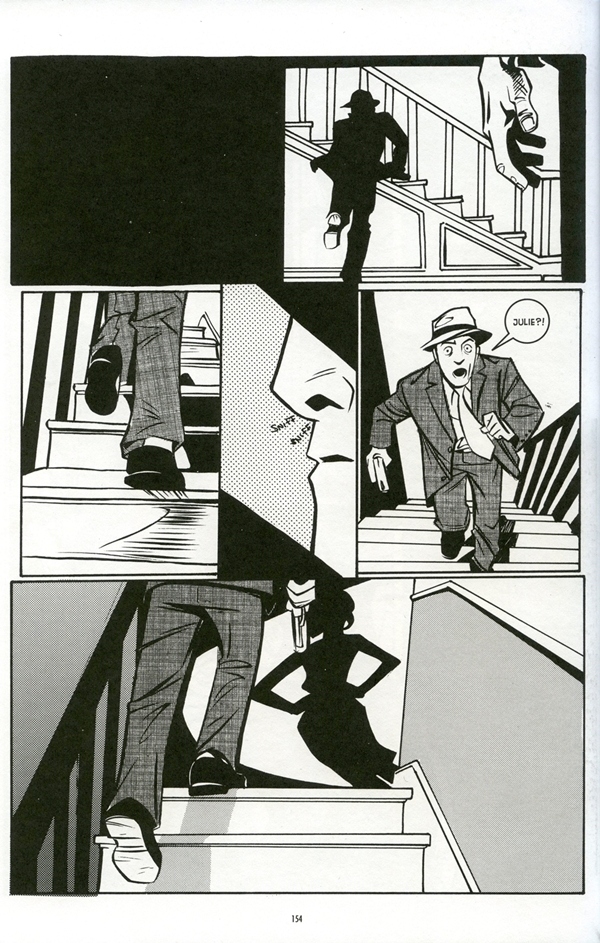
Page from You Have Killed Me. Illustrations by Joëlle Jones and story by Jamie S. Rich, 2009.

Page from You Have Killed Me. Illustrations by Joëlle Jones and story by Jamie S. Rich, 2009.

At the Skirball Cultural Center in West Los Angeles, running in conjunction with the Light & Noir: Exiles and Émigrés in Hollywood, 1933–1950 exhibition, The Noir Effect examines how the film noir genre gave rise to major contemporary trends in American popular culture, art and media.

The show, which runs Thursday, Oct. 23, 2014 to March 1, 2015, highlights noir elements such as the city, the femme fatale, the anti-hero and moral codes.

As Skirball Cultural Center Assistant Curator Linde Lehtinen says: “Noir remains a powerful approach and style because its dark, urban sensibility and its perspective on identity, morality and the shifting nature of the modern city continue to be relevant and timely.”

Bill Armstrong, Untitled (Film Noir #1401), 2011.

Bill Armstrong, Untitled (Film Noir #1401), 2011.

In addition to clips from neo-noir films such as “Chinatown” (1974, Roman Polanski) and “Brick” (2005, Rian Johnson), the exhibition will feature contemporary art, literature, photography and fashion advertising as well as children’s books, games and comics, including Luke Cage Noir and Spider-Man Noir.

Featured artists include Bill Armstrong, Ronald Corbin, Helen K. Garber, David Lynch, Daido Moriyama, Karina Nimmerfall, Jane O’Neal, Alex Prager, Rouse & Jones, Ed Ruscha and Cindy Sherman.

The Noir Effect will allow visitors to reinvent noir for themselves. A costume wall and portrait station invite visitors to pose for their own noir-inspired “museum selfie,” while writing materials encourage on-the-spot noir narratives. The Skirball Cultural Center will also hold an online photo contest as a way to gather visitor snapshots of L.A. neighborhoods captured in classic noir style.

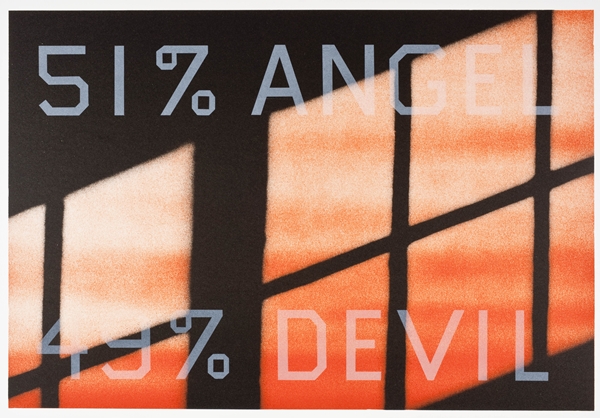
Ed Ruscha, 51% Angel / 49% Devil, 1984, Los Angeles County Museum of Art, Graphic Arts Council Fund.

Ed Ruscha, 51% Angel / 49% Devil, 1984, Los Angeles County Museum of Art, Graphic Arts Council Fund.

Additionally, the site-specific installation Café Vienne pays tribute to the important cultural role of the Viennese coffee house. In the early 20th century, female artists and writers embraced these coffee houses as places for debate, networking and inspiration.

Contemporary visual artist Isa Rosenberger (b. 1969) uses this historical setting to address the life and work of Austrian- American Jewish writer Gina Kaus (1893–1985), once known in literary circles as “Queen of the Café.” A best-selling novelist before she was driven from Europe by the Nazi regime, Kaus eventually emigrated to the U.S. where she became a Hollywood screenwriter.

We at FNB are very excited about this terrific programming and can’t wait for it to start. We’ve long been captivated by film noir and it’s gratifying to find so many others who share our passion.

Noiristas have gobs of events to choose from on Halloween

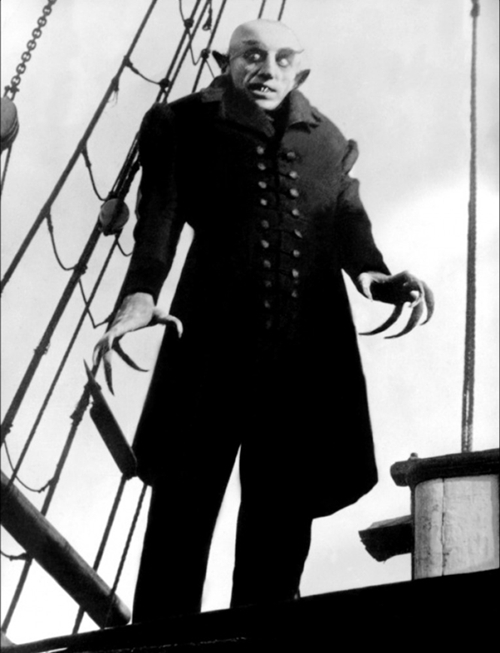
“Nosferatu” is considered one of the greatest horror movies of all time.

“Nosferatu” is considered one of the greatest horror movies of all time.

When Halloween falls on a Friday night, why stay at home? There’s a whole lot going on in Los Angeles.

Need a primer on German Expressionism? Watch “Nosferatu” (1922, F. W. Murnau) – one of the greatest horror movies of all time and a vampire classic with brilliant visual style – on the big screen with live music accompaniment at Walt Disney Concert Hall.

Have you ever wanted to dress up as a work of art? Then you’re in luck because Lacma is hosting its 11th annual costume ball. Music, dancing, food and drink! Oh, and you can see the excellent exhibition: Haunted Screens: German Cinema in the 1920s.

Starting at Thursday midnight, pull an all-nighter of the living dead. The Crest Theater in Westwood is hosting a super series: “Night of the Living Dead,” “Child’s Play,” “Killer Klowns from Outer Space,” “Dawn of the Dead” and “Blacula.”

The New Beverly Cinema is hosting an all-nighter hosted by Eli Roth.

Not to be outdone, Cinefamily is putting on Childhood Haunts, an all-night audio/visual bash.  As the organizers put it: “This signature Mondo video collision covers the hazy, freaky-deaky memories of these pivotal pieces of films and TV that pretty much screwed us up for life.”

The Aero Theatre in Santa Monica is showing “The Lego Movie” in 3-D!  Come in costume as your favorite character, take photos and get free toys and treats, says the Aero.

Light & Noir at the Skirball Cultural Center tells a spellbinding story of immigration and innovation, set in Hollywood

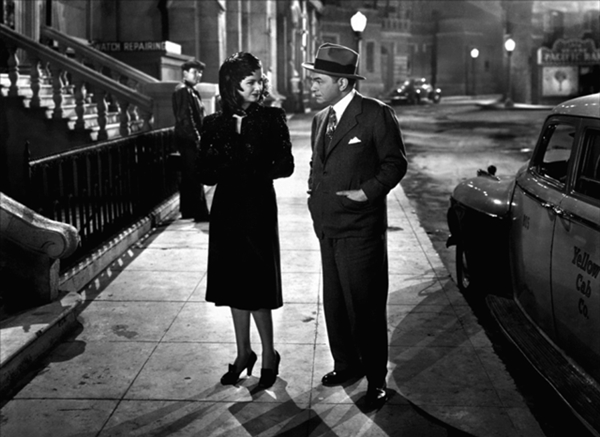
Joan Bennett entraps Edward G. Robinson in 1944’s “The Woman in the Window,” directed by Fritz Lang. The film will screen at the Skirball Cultural Center as part of Exiles and Émigrés in Hollywood, 1933–1950.

Joan Bennett entraps Edward G. Robinson in 1944’s “The Woman in the Window,” directed by Fritz Lang. The film will screen at the Skirball Cultural Center as part of Exiles and Émigrés in Hollywood, 1933–1950.

“Making movies is a little like walking into a dark room,” said legendary director Billy Wilder, who made more than 50 films and won six Academy Awards. “Some people stumble across furniture, others break their legs but some of us see better in the dark than others.”

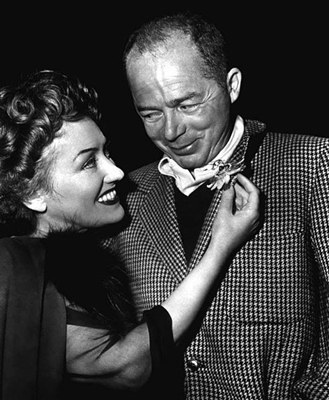
“Sunset Blvd.” won three Oscars: writing, music and art direction. Shown: Gloria Swanson and Billy Wilder.

“Sunset Blvd.” won three Oscars: writing, music and art direction. Shown: Gloria Swanson and Billy Wilder.

By the time the Austrian-born journalist, screenwriter and director came to America in 1934, he’d seen more than his share of darkness, on screen and off. Wilder left Europe to escape the Nazis; his mother died in Auschwitz.

He joined many other prominent Jewish artists (such as directors Fritz Lang, Otto Preminger and Fred Zinnemann, composer Franz Waxman, and writers Salka Viertel and Franz Werfel) as they left their homes and careers in German-speaking countries to build new lives and find work in Hollywood.

Starting on Thursday, Oct. 23, a new exhibition at the Skirball Cultural Center in West Los Angeles Light & Noir: Exiles and Émigrés in Hollywood, 1933–1950 highlights the experiences of these émigré actors, directors, writers and composers.

They came to California at a pivotal time in the world’s history and in the evolution of the movie-making capital, greatly contributing to Hollywood’s Golden Age and raising the artistic bar for its productions.

In particular, film noir was born when the talents of these European émigrés merged with the hard-boiled stories of American pulp crime fiction and the subtle sensibilities of French Poetic Realism.

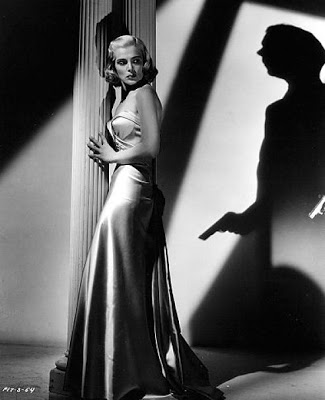
Lizabeth Scott and Dick Powell star in “Pitfall.”

Lizabeth Scott and Dick Powell star in “Pitfall.”

Films, concept drawings, costumes, posters, photographs and memorabilia will help tell the story of Hollywood’s formative era through the émigré lens. Accompanying the show is a plethora of events: film screenings, readings, talks, tours, courses (photography and cooking with a Café Vienne installation), comedy, family programs, a holiday pop-up shop and more.

Organized by the Skirball Cultural Center and co-presented with the Academy of Motion Picture Arts and Sciences, the exhibition will run through March 1, 2015.

Running in conjunction with the show is The Noir Effect, which explores how the film noir genre gave rise to major contemporary trends in American popular culture, art and media. (More on that in an upcoming post.)

Of course, I’m especially looking forward to the impressive lineup of films. On Oct. 30, Jan-Christopher Horak, a German-exile cinema historian and director of the UCLA Film and Television Archives, will describe how Hollywood became the prime employer of European émigré filmmakers as Nazi persecution grew. The lecture will be followed by a screening of Austrian émigré Fritz Lang’s “Hangmen Also Die!”

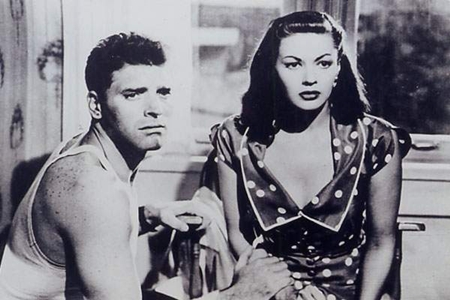
Yvonne De Carlo and Burt Lancaster play doomed lovers in “Criss Cross,” (1949, Robert Siodmak). The movie will play in January.

Yvonne De Carlo and Burt Lancaster play doomed lovers in “Criss Cross,” (1949, Robert Siodmak). The movie will play in January.

(Additionally, continuing through April 26, 2015, at the Los Angeles County Museum is Haunted Screens: German Cinema in the 1920s. The series explores approximately 25 masterworks of German Expressionist cinema, a national style that had international impact.)

At the Skirball Cultural Center, on Dec. 7, fashion expert Kimberly Truhler will discuss the effect of World War II on film costume design and American fashion in the 1940s. Gabriela Hernandez, founder of Bésame Cosmetics, will share the history of make-up and tips on achieving the film noir look.

And in January, the Skirball Cultural Center will host the film series “The Intriguante: Women of Intrigue in Film Noir,” which will feature: “The Woman in the Window,” “Pitfall,” “Criss Cross,” “The File on Thelma Jordon” and the 2008 documentary “Cinema’s Exiles: From Hitler to Hollywood.”