Italian-French ‘Like Crazy’ is crazy good

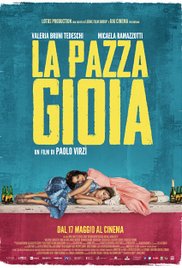
Like Crazy” (Folles de Joie in French and originally titled La pazza gioia), an Italian-French production, had its Los Angeles premiere at the COLCOA French Film Festival. The film won the Audience Special Mention Award at the fest.
There’s an Italian proverb: “Chi trova un amico, trova un tesoro,” which means “whoever finds a friend finds a treasure.”

The leads of “Like Crazy,” directed and co-written by Paolo Virzi, bear this out on-screen in a uniquely dysfunctional and hilariously messed-up way.

You may remember Valeria Bruni Tedeschi from the 2013 films “Human Capital” or “A Castle in Italy” (she directed, co-wrote and starred in the latter). After seeing this film, you won’t soon forget her. In “Like Crazy,” she plays Beatrice, a chic, snobby, well-to-do party girl a bit past her prime who never stops talking and namedropping.

It’s a little hard, though, to be a social butterfly as a resident of a group-home facility for people suffering from mental and emotional disorders. (“Facility” doesn’t quite do the place justice – it’s an enchanting villa that Beatrice’s family once owned.)

Sure that she does not belong there, Beatrice decides that her fellow residents are freaks with the exception of a withdrawn, depressive 20something named Donatella (Micaela Ramazzotti), who also happens to be drop-dead gorgeous, extremely expressive and endlessly watchable as an actress. She too will remain in your memory long after the credits roll.

Beatrice insists that she and Donatella will be pals and sets about grooming her as a sidekick. Donatella doesn’t have the strength to resist her overtures and when Beatrice finds a way to break free from the group home, Donatella doesn’t need much convincing.

Thus begins a spree of sweet-talking and stealing, boozing and barhopping, haute hustling and hightailing it from the cops and the admin staff at the home.
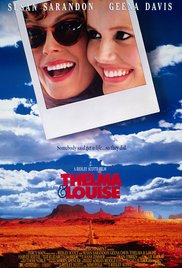
Smart, funny and deeply touching, thanks to Virzi’s deft and soulful directing, “Like Crazy,” is a stellar addition to the commedia all’Italiana tradition. It also reminds us of classic road-trip movies, such as 1991’s “Thelma and Louise” (directed by Ridley Scott and written by Callie Khouri), and is reminiscent of the days when American movies featured authentic, fleshed-out characters with human flaws and quirky peccadilloes.

(That’s not something we much these days, unfortunately. A case in point: “You Choose,” which closed the COLCOA festival. Amusing and innocuous, it’s a by-the-numbers, superficial comedy.)

Having a woman’s input (Virzi co-wrote the script with Francesca Archibugi) lends “Like Crazy” a special nuance and sensitivity.

Granted, the film follows a fairly conventional structure but all of the filmmaking elements – in particular the writing and acting – are presented so honestly, so movingly and with such consummate skill that we are swept along for one hell of a ride.

“Like Crazy” opens Friday in Los Angeles at the Laemmle Royal Theatre and the Laemmle Playhouse 7.

‘A Woman’s Life’ is a story that charms, chills and resonates

A Woman’s Life” (Une Vie), which had its West Coast premiere at the COLCOA French Film Festival, won the Los Angeles Film Critics Association’s Jury Award at the fest.

In the opening scene of “A Woman’s Life” (Une Vie), we watch the lovely lead character Jeanne le Perthuis des Vauds (Judith Chemla) watering a vegetable garden on her family estate. The copper watering can gleams in the sunlight, water and mud spatter on Jeanne’s dress. It’s a day like any other for her – unhurried, predictable, peaceful. She is the only child of wealthy land owners in Normandy, France, in 1819, and her comfortable future is taken for granted.

But in fact these days of tranquility will dwindle and, as Jeanne’s life unfolds, we are drawn into her emotionally compelling world, viscerally experiencing her moments of poignancy and pain.

At the urging of her mother (Yolande Moreau), Jeanne marries the dapper but weasely Julien de Lamare (Swann Arlaud), who has a pedigree, a shiny frock coat and not much else. The marriage turns out to be short-lived and their child, Paul, grows up to be a willful, selfish brat of the highest order. (Finnegan Oldfield plays the adult Paul.)
Jeanne continues to love Paul blindly, falling back on her father (Jean-Pierre Darroussin) and the family maid Rosalie (Nina Meurisse) for companionship and support.

Director Stéphane Brizé’s film (which he co-wrote with Florence Vignon, based on Guy de Maupassant’s novel) is subtle, complex and layered. Beautifully shot, impeccably acted and featuring first-rate art direction and costumes, “A Woman’s Life” almost seems to have its own organic existence so heightened and intense is its poetic mood and darkly enchanting atmosphere.

(The novel has been adapted one other time: In 1958, director Alexandre Astruc made “One Life” (Une vie) with Maria Schell and Christian Marquand. It was released as “End of Desire” in the U.S.)

Most obviously, Brizé’s film looks at the strict and narrow conventions that defined a woman’s role in family and society at that time. On another level, it’s a study of loyalty and sacrifice, broken trust and betrayal. Jeanne’s mother’s ulterior motives cause Jeanne suffering; her father’s devotion is steadfast.

After she marries, Jeanne turns to a priest for moral counsel but cannot bring herself to follow his advice, lest she inflict pain on an innocent party. A treacherous decision by one of Jeanne’s acquaintances (Clotilde Hesme) has disastrous consequences. Jeanne’s unwavering love and generosity toward her son become her undoing.

At a time of need, Jeanne is rescued by a friend with whom she has a long and complicated history. The film ends with the ultimate symbol of commitment and perhaps fresh hope.

It’s a story that charms, chills and resonates.

“A Woman’s Life” opens Friday in Los Angeles at the Laemmle Royal Theatre and the Laemmle Playhouse 7.

Basinger and Pearce delight a sold-out audience at anniversary screening of ‘L.A. Confidential’

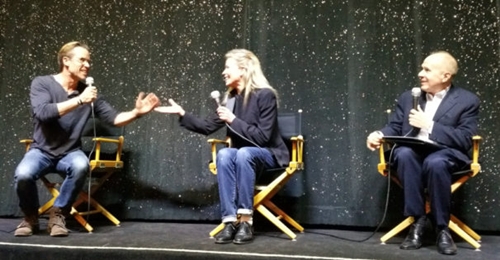
Guy Pearce and Kim Basinger spoke with critic Stephen Farber after the screening.

Kim Basinger’s initial answer to playing the voluptuous call girl Lynn Bracken in “L.A. Confidential” was a resounding “no.”

“I’m not going to play a whore! I’m a Mom now,” she recalled saying. (Basinger gave birth to daughter Ireland Baldwin in October of 1995.)

Basinger was speaking at Tuesday night’s screening of the movie, marking its 20th anniversary, held at the Laemmle Ahrya Fine Arts Theatre in Beverly Hills. Co-star Guy Pearce (squeaky clean Det. Ed Exley) joined her for the Q&A, which was moderated by critic Stephen Farber.

But the film’s director Curtis Hanson was determined and invited Basinger to meet him at the Formosa Café to discuss the idea. (The famous bar/restaurant would later feature in the film – it’s there that Kevin Spacey as cop Jack Vincennes gives his perfectly timed line: “It is Lana Turner.”)

At the Formosa, Basinger said she experienced “the seduction of Curtis Hanson,” referring to his eloquence and deadpanning that he was “very manipulative.”

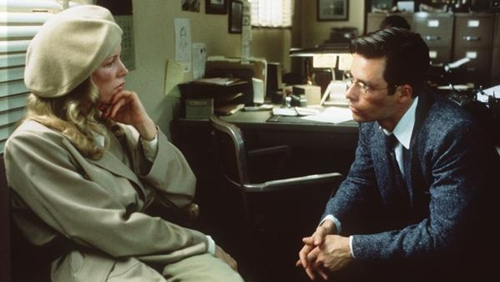
Kim Basinger and Guy Pearce share a scene in “L.A. Confidential.”

Hanson’s persistence paid off: Basinger won a Best Supporting Actress Oscar for her portrayal. “He believed in me much more than I believed in myself,” she said. “He had a magical connection with actors and with people in general.”

(Hanson and Basinger worked together again in 2002’s “8 Mile,” with Hanson remarking, while she was deciding whether to take the part, “I know if she fears it, she’s going to do it.” Sadly, Hanson died on Sept. 20, 2016.)

Fans wait in line late Tuesday afternoon at Laemmle’s Ahrya Fine Arts Theatre on Wilshire Boulevard in Los Angeles.

Playing Ed Exley was a much easier choice for Pearce, who was unknown in America at that time, though he remembered being a little overwhelmed by the plot’s twists and turns. “I read the script and I was really confused,” he laughed.

(Hanson and Brian Helgeland earned an Oscar for their screenplay adaptation of James Ellroy’s novel.)

Once Pearce heard that fellow Aussie Russell Crowe had been cast as muscle-bound cop Bud White, he was eager to be a part of the production, adding that he went through extensive screen tests at Warner Bros. before it was a done deal.

“L.A. Confidential” turned out to be Pearce’s break-through role. As he put it: “It’s the greatest film I’ve ever been a part of. It sticks with me like nothing else.”

(Pearce went on to make many more films, including “Memento” in 2000, “The Hurt Locker” in 2008, and “Iron Man 3” in 2013.)

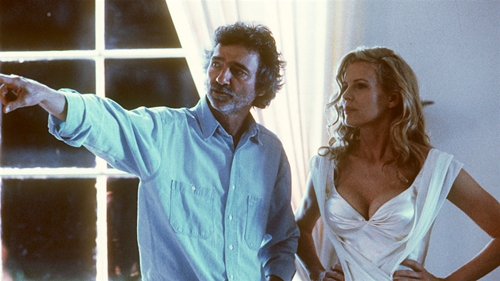
Basinger said director Curtis Hanson was a calming influence.

Pearce and Basinger both credit Hanson with being a calming presence and encouraging them to bring stillness to the screen. A true cinephile who had the cast watch a “film noir retrospective” to get in an old-school mood, Hanson pushed back when he was nudged by execs to speed up the production, telling them: “You can hurry me along all you want but I’m not going to go any faster.”

Veronica Lake was famous for her hair. Basinger was as well – as a Breck Shampoo girl. In the film, Basinger plays a call girl who is Lake’s doppelgänger.

Hanson’s treatment of his actors was often gentle but also spare. Basinger remembered being rattled after doing a scene repeatedly, noting that she had trouble walking gracefully in long gowns and clunky 1940s shoes, à la Veronica Lake.

She asked Hanson for help. His answer: “Do it again.”

“He was utterly inspiring, really,” said Pearce. “He was a mentor, a father figure and we stayed close friends.”

Pearce also shared Crowe’s advice before a close-up. He told Pearce: “Don’t blink.”

Basinger took the opportunity on Tuesday night to thank Pearce and Crowe for their support in her Oscar win, explaining that she’d been too flustered to do so at the time. With “Titanic” sweeping the awards that year, she was sure the trophy would go to Gloria Stuart. “When you hear your name, you freeze! You lose your hands. You lose your feet. You can’t think. I just sat there until Curtis, who was sitting behind me, nudged me. Jack Nicholson had to help me to the stage.”

At 63, and still every inch a beautiful blonde, Basinger looked sleek and slim in a black blazer and blouse, cuffed jeans, white socks and black Oxfords.

When an audience member asked if they had considered making Lynn a brunette for the film’s final scene (in which she leaves Los Angeles, with Bud, for Arizona), Basinger paused a moment, then replied:  “I don’t think there was any thought of that,” she said. “I think she was really happy being a blonde.”

Noir royalty ‘Le Cercle Rouge’ boasts Melville’s chaste classic style, five legendary actors and austere Bressonian rigor … Film Noir Series features three neo-noir titles

By Mike Wilmington

Film Noir has many faces and that’s proven once again with the French noirs, old and new, shown this year at the 21st edition of the COLCOA French Film Festival, April 24 to May 2 at the Directors Guild theaters – which are appropriately named for three great French cineastes, Jean Renoir, François Truffaut and Jean-Pierre Melville.

Ranging from the sublime to the more predictable, the COLCOA Festival offers a few of those noir faces – including three titles by new young directors, and one classic from a film noir master (Melville himself) that is regarded by many fans and experts as one of the greatest examples of noir cinema: Melville’s all-star heist picture from 1970, “Le Cercle Rouge.”

Returning to his signature themes of life outside the law and honor among thieves, Melville crafted another prototypical crime thriller, with juicy parts from his superstar cast: Alain Delon (as the silky criminal mastermind) Yves Montand (as the genius marksman/alcoholic), Gian Maria Volontè (as the psycho escaped convict), Bourvil (as the truculent pursuer) and François Périer (as a weasely detective).

These five legendary actors, representing the cream of this profession, elevate the film to something near noir royalty and the famous 20-minute jewelry-store robbery (undoubtedly inspired by Jules Dassin’s “Rififi”) is a transfixing suspense piece.

“Le Cercle Rouge,” done with all Melville’s chaste classic style and austere Bressonian rigor, was shown in the Jean Renoir Theater on Friday, April 28, as part of a celebration of Melville’s centenary. Preceding it was the new restoration of Melville’s long-lost debut film, the moving 1946 documentary “A Day in a Clown’s Life,” starring the renowned circus clowns Beby and Maiss.

The two Melvilles are essential viewing for lovers of film noir, or of French cinema in general. The three new noirs, by contrast, are more ordinary, despite the recognition they’ve received in France. The best of them, Thomas Kruithof’s Kafkaesque spy thriller “The Eavesdropper,” gives us that sorrowful-looking French star François Cluzet, as an alcoholic ex-accountant who becomes enmeshed in a right-wing conspiracy when he’s hired to retype some mysterious documents.

Director/co-writer Nicolas Silhol’s “Corporate” is another high-tech corporate thriller that shows us the bad side of business, as experienced by two contentious and beautiful young women (Céline Sallette and Violaine Fumeau). And Jean-Patrick Benes’ “Ares” is another sci-fi gladiatorial tale.

The three newcomers are not bad. But they’re not Melville.

‘Requiem’ tempers the hilarity at TCM Classic Film Festival

By Film Noir Blonde and Michael Wilmington

The TCM Classic Film Festival focused on comic films this year but of course there was a dark side. (Isn’t that always the case?) One of the highlights (or lowlights) for the Film Noir Blonde team was the screening of “Requiem for a Heavyweight” (1962, Ralph Nelson).

The film was introduced by Eddie Muller, founder and president of the Film Noir Foundation (a.k.a. the czar of noir). He thanked the audience for coming to “the bleakest, most depressing movie of the fest.” He added that his father had been a longtime boxing columnist for the San Francisco Examiner so he was familiar with the hardscrabble life of a fighter.

The boxer in the film is “Mountain” Rivera (Anthony Quinn) who must choose a new path upon realizing that his best years are behind him. But his options are limited, not only because his whole life has been swinging punches but also because his manager (Jackie Gleason) is not above perpetrating an act of searing betrayal. Mickey Rooney plays Mountain’s trainer and Julie Harris plays an awkward social worker who tries to help him find another kind of job.

The film originated as a teleplay by Rod Serling and aired in 1956 on a show called Playhouse 90, starring Jack Palance in the lead; Kim Hunter played the social worker. Also directed by Nelson, the teleplay received Peabody and Emmy awards. In the film, Cassius Clay (later known as Muhammad Ali) and Jack Dempsey appear as themselves.

Quinn shows us an achingly vulnerable human being starting the last chapter of his life. Without sentimentality, he makes us feel the pain, sadness and frustration of Rivera’s deadly predicament. He also shows us how this once-great, over-the-hill athlete has been victimized by his world: the seedy, sleazy, exploitative milieu of professional boxing.

As Muller put it: “It’s really a Greek tragedy.”

TCM fest’s comic theme provides needed tonic in the wake of Robert Osborne’s passing

By Michael Wilmington and Film Noir Blonde

It’s glorious and exciting, but it’s also sad.

Once again, the TCM Classic Film Festival – running April 6-9 in Hollywood – presents a wondrous bill of fare of great films, unique cinema rarities and restorations, along with lively conversations with critics, scholars and some of the people who made the movies of Hollywood’s Golden Age.

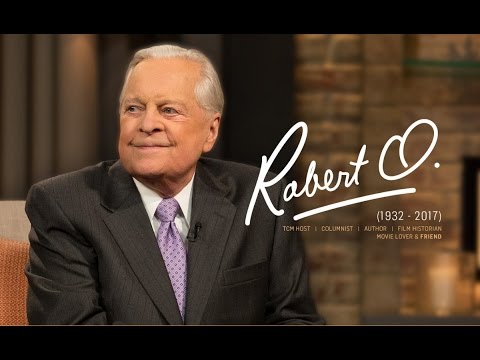
It’s a time for celebration. But it’s also a time of melancholy and reverie. This year a vital link has been broken. The passing of critic/columnist/interviewer supreme Robert Osborne, whom many saw as the face and voice of Turner Classic Movies, marks the loss of a movie buff and guide who was (just like one of the programs he hosted so entertainingly) one of the “Essentials.” We will all miss him.

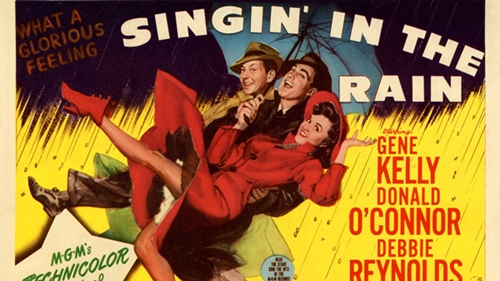
Fittingly in a way, the TCM Festival has chosen to celebrate Robert and the love of movies he exemplified, by choosing as its special theme this year that immortal slogan from “Singin’ in the Rain,” Gene Kelly and Stanley Donen’s rib-tickling masterpiece: “Make ’em Laugh” (Comedy in the Movies). The beloved musical will screen on Sunday.

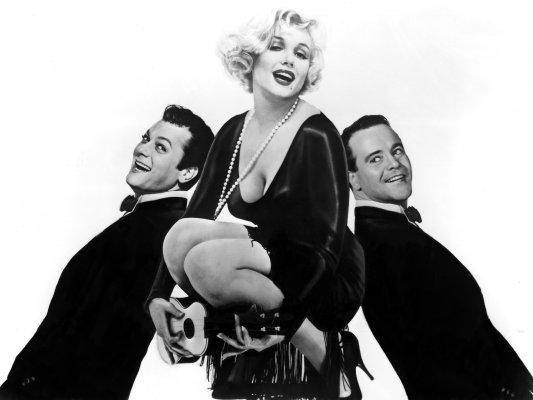
Comic relief is much needed tonic – even for noiristas – RO’s passing is a huge loss. What else can you see this year? How about the movie lots of folks think is Hollywood’s greatest comedy – 1959’s “Some Like It Hot,” a funny film with a film-noir pedigree.

Curtis, MM and Lemmon star in a classic, enduring comedy.

Written and directed by the great noir auteur Billy Wilder, the risqué flick stars Tony Curtis and Jack Lemmon in drag, as “Josephine” and “Daphne,” pursued by Chicago gangsters (Including George Raft as the dour, murderous Spats Colombo).

The “girls” hide out in a female jazz band, tumbling into priceless erotic escapades with the nonpareil Marilyn Monroe as the slightly boozy doozy of a chanteuse Sugar Kane. Joe E. Brown also makes the most of every second of his screen time.

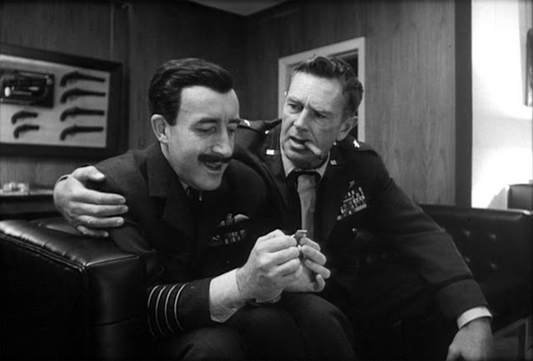
Another top choice is Stanley Kubrick’s and writer Terry Southern’s murderously funny, magnificently screwy masterful satire that’s drenched in noir mood, style and cynicism: “Dr. Strangelove, or How I Learned to Stop Worrying and Love the Bomb.” You might die laughing here and watch the planet blow up along with you.

Peter Sellers and Sterling Hayden star in “Dr. Strangelove.”

Sterling Hayden shines as the psychotic Air Force general, Jack D. Ripper, who illegally sends off the bombing raid that will trigger World War 3. George C. Scott is the bellicose hawk-and-a-half Gen. Buck Turgidson, who wants to blast the world too, but judiciously.

And the inimitable imitator Peter Sellers in three terrific roles: the mild-mannered Stevensonian U.S. President Merkin Muffley, the stiff upper lip British officer, Mandrake, trying to stay sane in a world of madmen, and the Kissingeresque Doomsday adviser himself, Dr. Strangelove.

Sellers was also slated to play the cornpone captain of the top plane on the bombing raid, “King” Kong, but dropped out for medical reasons (or, perhaps, as some say, because he was having trouble getting the accent). He was replaced by the amazing Western character actor and ex-rodeo clown Slim Pickens. Slim turned out to be practically perfect casting.

Bud Cort and Ruth Gordon are an unlikely pair in 1971’s “Harold and Maude.”

There you have three of the finest, funniest, most unforgettable movie comedies ever made. What else? How about the cult April-December romantic hit Hal Ashby’s and writer’s Colin Higgins’ 1971 “Harold and Maude,” starring Bud Cort as the boy who keeps trying to kill himself, and the amazing Ruth Gordon as the ebullient old lady who gives him back his life?

How about the super train comedy “Twentieth Century”? Here, Carole Lombard is the crazy glam-goddess Hollywood superstar and John Barrymore hams it up as her crazier stage director and Svengali. Directed by Howard Hawks (at his peak) with a script by Ben Hecht and Charlie MacArthur (at their peaks).

How about Stanley Kramer’s (underrated) all-star epic “It’s a Mad, Mad, Mad, Mad World”? Or the Marx Brothers in “Monkey Business” and W.C. Fields in “Never Give a Sucker an Even Break,” which pretty much speaks for itself, and the great Charlie Chaplin, tweaking Hitler in “The Great Dictator.” How about Preston Sturges’ “Unfaithfully Yours” and “The Palm Beach Story”?

Oh, and don’t forget Frank Capra’s “Arsenic and Old Lace,” Leo McCarey’s “The Awful Truth,” Harold Lloyd in “Speedy,” plus Laurel and Hardy in “Way Out West.”

How about it? We’re in!

God bless the clowns. And Robert Osborne too.

TCM Classic Film Festival honors Robert Osborne’s legacy

The TCM Classic Film Festival is dedicated to famed host and historian Robert Osborne. The fest runs Thursday through Sunday in Hollywood.

By Film Noir Blonde and Michael Wilmington

This year’s edition of the TCM Classic Film Festival will be bittersweet. Our excitement about four days filled with gorgeous movies and great guests is tempered with sadness because of a very sad loss: TCM host and historian Robert Osborne passed away on March 6 at his home in New York City. He was 84.

The fest, which runs in Hollywood from Thursday, April 6, to Sunday, April 9, is dedicated to Osborne’s memory and we hope that this year’s theme – Comedy in the Movies – will help to chase the blues away.

At Wednesday’s press conference, held at the TCL Chinese Multiplex Theatre, TCM representatives noted that Robert Osborne was the festival. As to how Osborne’s legacy and contributions (specifically his intros to the films) will be remembered going forward, TCM host Ben Mankiewicz said: “We would like to bring Bob back, sure, but there’s the question of doing it the right way. Maybe it’s a matter of having an introduction to his introduction.”

“Whatever Happened to Baby Jane?” screens poolside Friday night. Do we need to watch Bette and Joan for the 5,000th time? Maybe …

Some of the titles for a comedy-focused fest have obvious appeal, for example: “Born Yesterday,” “The Graduate,” “The Jerk,” “High Anxiety” and “Whats Up, Doc?

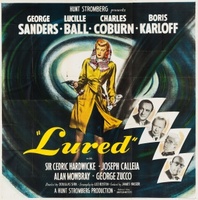
Others have a dark slant … which is right up our alley, of course: “Some Like It Hot,” “Beat the Devil,” “Unfaithfully Yours,” “Lured,” “Twentieth Century,” “Bonnie and Clyde,” “Harold and Maude,” “Dr. Strangelove” and “The Front Page.”

And the campy noir treat “Whatever Happened to Baby Jane?” will screen Friday night poolside at the Roosevelt Hotel.

Additionally, there are tearjerkers, such as “Postcards from the Edge,” perhaps the greatest musical of them all, “Singin in the Rain,” and other feel-good fare, such as  “The Princess Bride,” “Casablanca,” “Bye Bye Birdie” and “Willy Wonka and the Chocolate Factory.”

There are, in fact, nine themes for the fest: Discoveries; Essentials; Festival Tributes; Dark Comedies; Divorce Remorse; Movies Spoofs; Hey, That’s Not Funny; Special Presentations; and Nitrate.

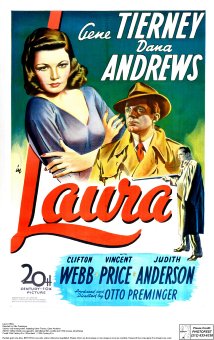
As for Nitrate, the TCM program guide points out that films produced before the early 1940s were released on nitrate stock, which has a luminous quality and higher contrast than the cellulose acetate film that superseded it. (Nitrate was replaced because of its volatile nature.) The film noir classic “Laura” is part of this roster.

TCM programming director Charlie Tabesh explained at the press conference: “We try to get everyone interested in classic film, young and old. When we book, we try to put very different films against each other … so that people have a choice.”

That is an understatement! There are about 90 films at the fest.

Plus, there is a full slate of special guests and events – Mankiewicz will interview veteran actor Michael Douglas; director Peter Bogdanovich will discuss his career as will blacklisted actress Lee Grant; comedy greats Carl and Rob Reiner will be honored at a hand and footprint ceremony at the TCL Chinese Theatre IMAX – as well as panels, parties, presentations, book signings and more.

Mr. Osborne would be proud.

Celebrating the 70th anniversary of groundbreaking ‘Gentleman’s Agreement’ at the Lasky-DeMille Barn

By Film Noir Blonde and Mike Wilmington

The Hollywood Heritage Museum and the Hollywood Foreign Press Association will present on Wednesday, April 12: An Evening at the Barn – “Gentleman’s Agreement”: Hollywood’s Stand Against Anti-Semitism.

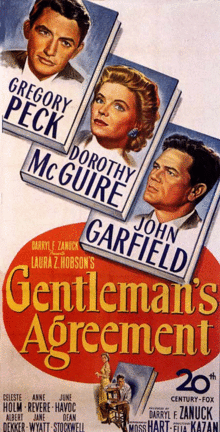
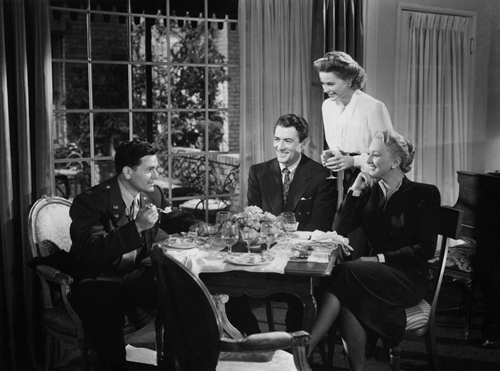
Directed by Elia Kazan and starring Gregory Peck and Dorothy McGuire, “Gentleman’s Agreement” was a critical and box-office hit. The film was nominated for eight Academy Awards and was named Best Picture of 1947, additionally winning Oscars for Best Supporting Actress for Celeste Holm and Best Director for Kazan.

Few critics would rank it that high today – it’s perhaps too much a message picture. That said, many of its performances are vastly underrated.

For Peck, it was one of his most curious, controversial movie roles: a New York City magazine writer named Philip Schuyler Green, who (at first reluctantly) takes on the assignment of writing an exposé of contemporary American anti-Semitism.

Phil decides to personalize the piece by posing as a Jewish man and recording how he’s treated or mistreated in the posh sections of Manhattan, Darien, Conn., and elsewhere – places that usually welcome him, or anyone else who looks like Gregory Peck, with open arms.

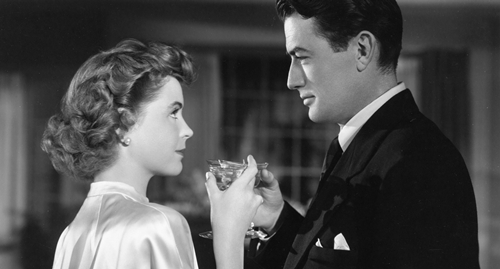
Kathy (Dorothy McGuire) and Phil (Gregory Peck) have the ideal romance. Or do they?

Peck’s Phil, who renames himself Phil Greenberg, gets more than he bargained for, from restaurateurs, real-estate agents, hotels, and from his increasingly skittish girlfriend, Kathy Lacy (McGuire) and her parents and friends.

Meanwhile, with the House Un-American Activities Committee (HUAC) operating in high gear, the postwar movie audience got a lesson in tolerance of unusual candor – from a first-class director (Kazan), Laura Z. Hobson’s highly acclaimed and best-selling source novel, a brilliant screenwriter (Moss Hart) and top actors (including Holm, Albert Dekker, Anne Revere, Dean Stockwell, June Havoc and Jane Wyatt.)

From left: John Garfield, Gregory Peck, Dorothy McGuire and Celeste Holm.

Stealing every scene he’s in, is a bona-fide New York Jewish actor, John Garfield, who begged to do the film and gives a powerhouse performance. Peck, McGuire, Revere and Hart received Oscar noms, as did Harmon Jones for editing.

Ironically, though many of the 1947 Hollywood moguls were themselves Jewish, they all shied away from the project. It took the 20th Century Fox head Darryl F. Zanuck (a Gentile) to get “Gentleman’s Agreement” on the screen.

(And it should be noted: in 1952, Kazan gave HUAC the names of eight actors who had been members with him of a Communist Party unit in the Group Theatre.)

At Wednesday’s event, film historian Claudine Stevens will discuss the book and the movie, with clips, and Cecilia Peck, daughter of Gregory Peck, will talk about her father and his part in the film.

Reserve your tickets now for this special event, which will take place in the historic Lasky-DeMille Barn. Free parking is available in Hollywood Bowl Lot D, which is directly adjacent to the museum.

Restored ‘Jamaica Inn’ highlights top acting talent

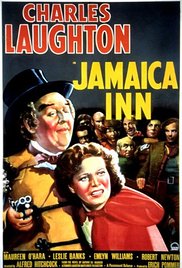
In Hollywood’s Golden Age, no one held court quite like Charles Laughton. Pompous and puffed-up, charming and shrewd, he often played characters brimming with confidence, or, some might say, entitlement. A case in point is Alfred Hitchcock’s “Jamaica Inn,” from 1939, in which Laughton plays Sir Humphrey Pengallan, an aristocrat lording it about in Cornwall, England, in the early 1800s, amid shipwrecks and pirates and a butler named Chadwick (Horace Hodges). Of course.

Based on a Daphne Du Maurier novel and made a year before Hitchcock’s Oscar-winning movie of Du Maurier’s “Rebecca,” the film introduces Maureen O’Hara as Mary, a headstrong young Irish woman (is there any other kind?) who travels to Cornwall to find her Aunt Patience, her last surviving relative. Mary finds Patience as well as much crafty scheming and seaside battles.

“Jamaica Inn” was the last film Hitchcock made in England before embarking on his stellar Hollywood career. Hitchcock’s wife and creative partner Alma Reville Hitchcock also worked on the movie. Laughton co-produced. (Laughton and O’Hara reunited for “The Hunchback of Notre Dame,” also 1939, directed by William Dieterle. Lest anyone think Laughton was typecast as a British bigwig, this famous and poignant part let him show his acting chops.)

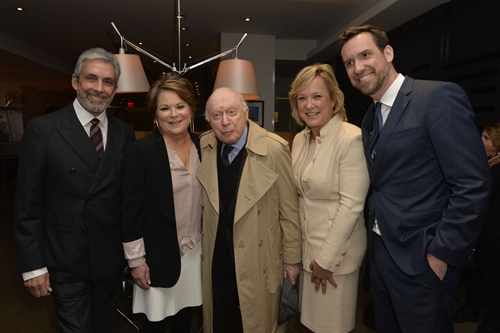
From left: Cohen Media Group Chairman and CEO Charles S. Cohen, Alfred Hitchcock’s granddaughter Tere Carrubba, Hitchcock leading actor Norman Lloyd, Alfred Hitchcock’s granddaughter Katie Fiala and KCETLink Media Group President and CEO Michael Riley at Tuesday’s screening of “Jamaica Inn.” Photo courtesy of Lisa Rose.

“Jamaica Inn” was recently restored and shown Tuesday night on the big screen at the Pacific Design Center’s SilverScreen Theater in Los Angeles, hosted by KCETLink Media Group, BAFTA Los Angeles and Cohen Media Group. The “Jamaica Inn” screening was held in advance of the movie’s KCET broadcast premiere, part of KCETLink’s Cohen Film Classics lineup.

Cohen Film Classics’ telecast of “Jamaica Inn” will air on Friday, March 24, on KCET in Southern California at 10:20 p.m. PT and on Link TV nationwide (DirecTV 375 and DISH network 9410) at 9 p.m. ET/PT. The restoration looks great and is well worth seeing.

Special guests at Tuesday’s event included Charles S. Cohen, KCET’s host of Cohen Film Classics, KCETLink Media Group’s Michael Riley, two of Hitchcock’s three granddaughters – Katie Fiala and Tere Carrubba – and legendary actor-producer Norman Lloyd, who played in “Saboteur” (1942) and “Spellbound” (1945) and produced many episodes of “Alfred Hitchcock Presents.”

Lloyd, 102, had the audience in the palm of his hand as he shared memories and anecdotes about working with the Master and Mistress of Suspense. “Alma Hitchcock knew as much about film as anyone who ever lived and Hitch knew it,” said Lloyd.

As for his famous leap from the Statue of Liberty in “Saboteur,” Lloyd said Hitch asked him: “Norm, can you do a back flip over the railing?” Lloyd agreed and it was shot in one take. “Hitch got it. I gave it. And forever after we were great friends. It was the greatest piece of acting I’ve ever done!”

‘This Gun for Hire’ opens Noir City: Hollywood Festival on Friday at the Egyptian Theatre

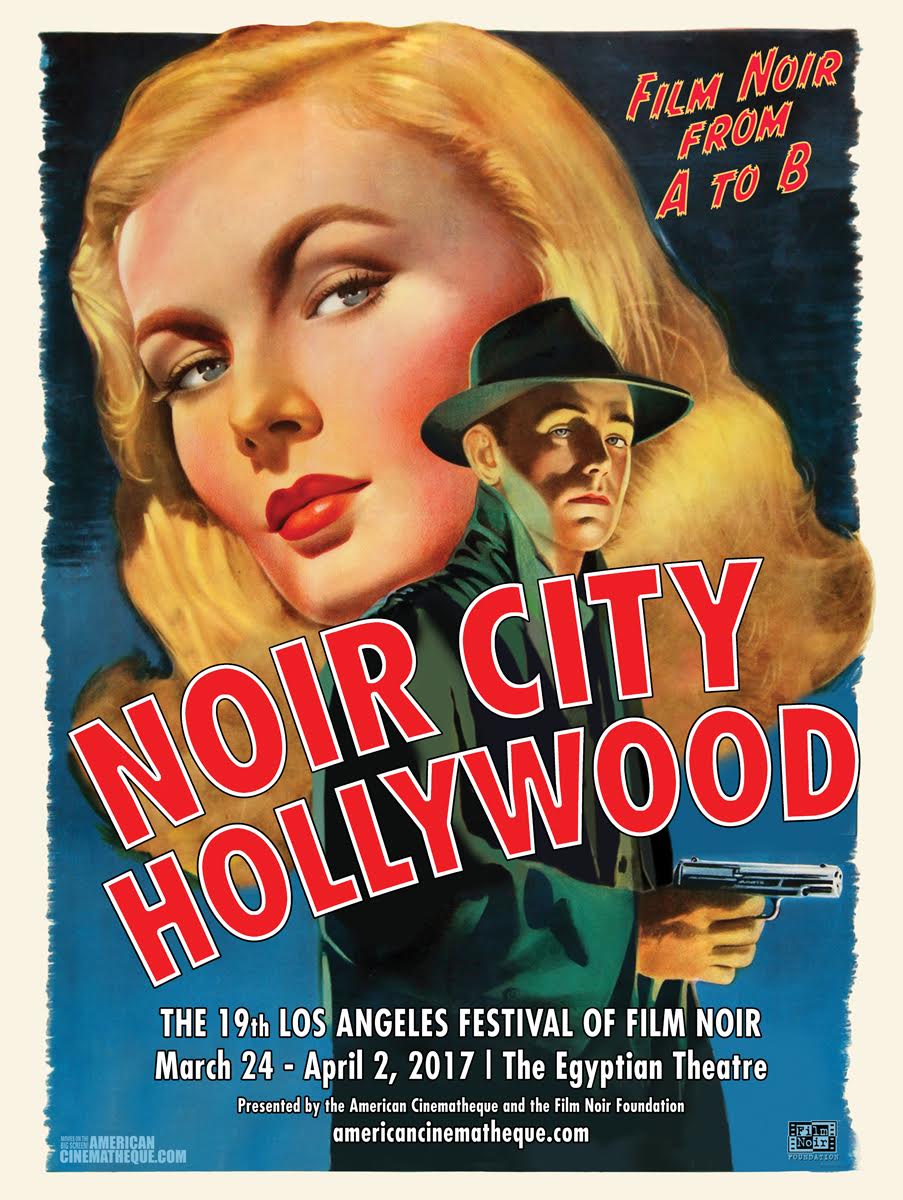
The Veronica LakeAlan Ladd quintessential film noir “This Gun for Hire,” co-starring Laird Cregar, opens the Noir City: Hollywood Festival on Friday at the Egyptian Theatre. Directed by Frank Tuttle from a Graham Greene novel, the 1942 film helped shape many archetypes of the genre. Albert Maltz (one of the Hollywood Ten) and W.R. Burnett wrote the script, with an uncredited contribution from Tuttle. John F. Seitz shot it and Edith Head designed the costumes.

Noir City: Hollywood, the longest-running film noir festival in Los Angeles, is now in its 19th year. For 2017, the Film Noir Foundation and the American Cinematheque will present a program “replicating the movie-going experience of that time – 10 double bills, each featuring a major studio A picture paired with a shorter B movie … showcased exactly as it was back in the day.”

In Friday’s B-movie slot is the well regarded “Quiet Please, Murder” (1942, John Larkin), which stars the inimitable George Sanders as a con artist.

The Film Noir Foundation’s Eddie Muller will introduce the lineup. There’s a cocktail hour between films for all ticket buyers, sponsored by Clarendelle inspired by Haut-Brion and Teeling Irish Whiskey.

Compiled by Muller, Alan K. Rode and Gwen Deglise, the festival runs through April 2.

In honor of the film and the fest, we are re-running an earlier review of “This Gun for Hire.”