For author Tere Tereba, mobster Mickey Cohen is the ultimate anti-hero and the story of Los Angeles

Of America’s many grand and gaudy cities, Los Angeles has long been the ultimate siren.

This is the noir metropolis, both sunny and sordid, that gangster Mickey Cohen made completely his own. Brooklyn-born and LA-raised, Cohen as a young adult was uneducated, illiterate and had difficulty counting. But he was smart, tough, ambitious, ruthless, immoral and wildly lucky.
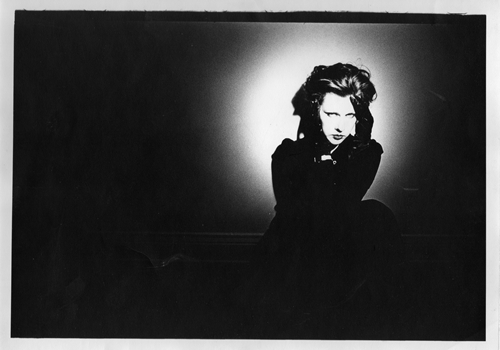
Model/designer/author Tere Tereba shot by Moshe Brakha

He was also the ne plus ultra dreamer, lured by seemingly limitless opportunity to reinvent himself by acquiring staggering amounts of money and clout. It’s hard to imagine his rise from grubby paper boy to one of the most prominent figures in the underworld taking place anywhere but the City of Angels.

Indeed for author Tere Tereba, Cohen is Los Angeles. Her book “Mickey Cohen: The Life and Crimes of L.A.’s Notorious Mobster” (ECW, $16.95 paperback/$29.95 hardcover) outlines the history of the man and the city, from Prohibition to the mid ’70s. “He was LA’s top mobster for a generation,” Tereba recently told me over a glass of iced tea in her elegant living room.

“He terrorized, captivated and corrupted Los Angeles. He’s about to be introduced to the American public through ‘Gangster Squad’ (the upcoming movie in which Sean Penn plays Cohen) and people don’t know who Mickey Cohen really was.”

Tereba, an award-winning fashion designer and journalist, is a quintessential Angelino. Born in Warren, Ohio, she has lived here since childhood. As a teenager, Tereba frequently saw bands at Sunset Strip clubs and connected with Jim Morrison’s girlfriend, Pamela Courson, who jump-started her design career.
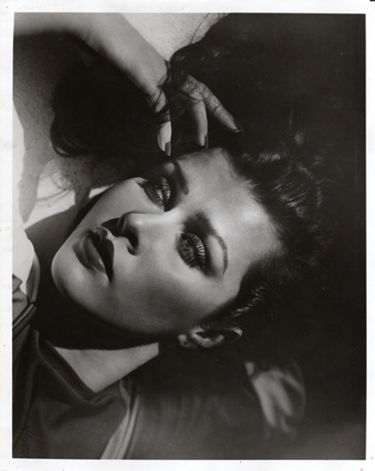
Tere Tereba shot by George Hurrell

Tereba’s account of Morrison in Paris was selected by The Doors to appear in their book, The Doors: An Illustrated History. In addition to her creative talent, Tereba’s classic features and stop-and-stare bone structure drew much attention, from the likes of famed Hollywood photographer George Hurrell for whom she modeled and Andy Warhol, who cast her in his 1977 black comedy “Bad.” Warhol described Tereba as looking like Hedy Lamarr and acting like Lucille Ball.

The day I met her, she wore a chic black dress, a vintage shrimp-pin and zebra-stripe pumps. “I could put on one of my Irene suits, if you want,” she offered, with a laugh.

Tereba’s book renders a portrait of a complex and compelling man in a city ripe with chances to strike it big, especially for unscrupulous players. Of Cohen’s return to the West Coast in 1937 after a stint in Cleveland and Chicago, Tereba writes: “He found Los Angeles to still be a big small town. The underworld setup, the 23-year-old learned, was not the eastern system.” Or as Cohen put it, “Gambling and everything … was completely run by cops and stool pigeons.”

Fast forward to the fall of 1955, when Cohen, 42, was released from McNeil Island Federal Penitentiary. Tereba describes Cohen’s turf this way: “The land of perpetual summer, carnal delights, and blue-sky ennui still captured the imagination of dreamers everywhere. But L.A. had changed. Bigger and bolder than ever, freeways linked the suburban sprawl. Hollywood’s old guard had lost their luster; a new and different breed was on the horizon.”
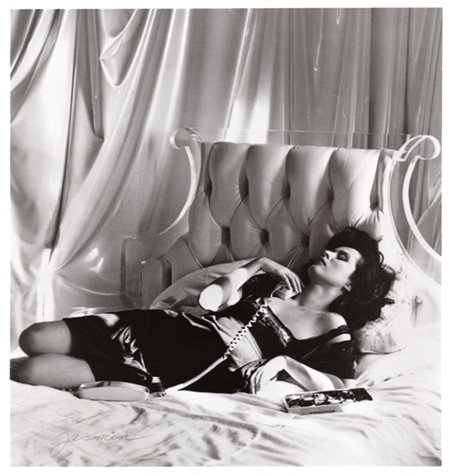
Tere Tereba shot by Paul Jasmin

Speaking of Hollywood, Tereba’s book explores the intersection between mafia characters and the Tinseltown elite, such as the 1958 fatal stabbing of Johnny Stompanato by Lana Turner’s daughter, Cheryl Crane.

Until Cohen’s death on July 29, 1976 (he died in his sleep, having survived 11 assassination attempts over the years), the brawny former boxer lived each moment intensely, often courting publicity and flaunting his power.

Said Tereba during our interview: “He was the ultimate anti-hero because he did what he wanted to do. He went against the cops, he fought city hall. He did all the things you’re not supposed to do and everybody’s afraid to do.

“You don’t get more outrageous and brazen than Mickey Cohen. Even his showy style of doing business. He dressed the way he wanted to, in a semi-Zoot suit. He knew what he liked and he followed it.”

Some facts are already well known. In setting the scene, Tereba reminds the reader: “After the [1938] scandal decimated the LAPD, the city of Los Angeles was closed to underworld activity. But Los Angeles County remained wide open.

Tere Tereba shot by Moshe Brakha

“Sheriff Eugene Biscailuz’s mighty domain stretched from Lancaster in the north to Catalina Island, 26 miles off the coast, south to Orange County, and east to San Bernadino County – from the desert to the mountains to the sea.

“Geographically the largest county in the country, at more than 4,000 square miles, it was bigger than many eastern states and made up 43 percent of the state’s population.”

She also reveals never-before-released documents and information, such as the anxiety disorder Cohen struggled with for most of his life, his wife LaVonne’s unsavory background and his relationships with women after he and LaVonne divorced in 1958.

Much has been written, speculated, invented and whitewashed about Cohen and his city. Tereba spent more than 10 years researching and writing her book; she tells Cohen’s story swiftly and assuredly. Her page-turning and entertaining narrative neither glamorizes nor judges its subject.

Mickey Cohen
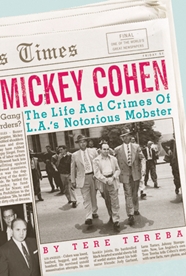
By the time “Gangster Squad” hits screens this fall and plants Mickey Cohen firmly in the spotlight (which he would have loved) Tereba’s readers will have already pierced through the shadows that have shrouded him for decades.

Tereba will discuss and sign her book at 7:30 p.m. on Thursday, June 14, at Skylight Books, 1818 N. Vermont Ave., Los Angeles, 90027.

FNB free stuff: ‘Body Heat,’ ‘L.A. Confidential,’ ‘The Player’

This month, I am giving away a must-have neo-noir triple feature from Warner Bros. on Blu-ray: “Body Heat” (1981, Lawrence Kasdan), “L.A. Confidential” (1997, Curtis Hanson) and “The Player” (1992, Robert Altman). I will post reviews of “Body Heat” and “The Player” later this month.

(Paul is the winner of the April reader giveaway, a Criterion DVD set of “Criss Cross” and a TCM mug. Congrats to Paul and thanks to all who entered!)

To enter the May giveaway, just leave a comment on any FNB post from May 1-31. We welcome comments, but please remember that, for the purposes of the giveaway, there is one entry per person, not per comment.

The winner will be randomly selected at the end of the month and announced in early June. Include your email address in your comment so that I can notify you if you win. Your email will not be shared. Good luck!

Director Maïwenn on working with the actors of ‘Polisse’

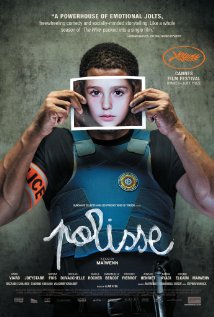
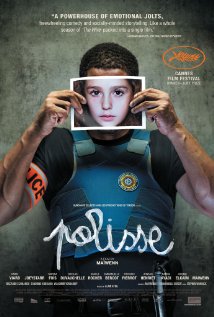
“Polisse,” a French cop drama, features truly outstanding performances, ones that linger in your memory long after the credits roll.

“When I felt that the kids were too much pushed by their parents, I wouldn’t take them,” said director/writer/actor Maïwenn.

How did director and co-writer Maïwenn (she also played Melissa the photographer) get this stunning work from her cast?

At a recent press conference in Beverly Hills, after first saying she was simply lucky, Maïwenn elaborated on her collaboration with actors. She said the key was to keep it simple and true. “I think the secret is the way you [the actors] listen to me, the way you listen to the script. All the cases were true, based on real cases.”

As for working with the children, Maïwenn said she was extremely careful to shield the kids from any negative impact that might result from playing characters in such traumatic situations. This included involvement from a French child-protection agency and a psychologist.

And recognizing their limits. “When the kids were on the set, we had to go fast. They want to have it fun so it has to be short. Otherwise, if they have to wait too much, they’re getting bored.

Additionally, she put much thought and effort into casting the children. “I am a mother so I’m used to talking with kids and I knew them a long time before the shoot and I met their parents. … When I felt that the kids were too much pushed by their parents, I wouldn’t take them. I was an actress child and my mother was pushing me too much. … I chose the kids when they were authentic and when they were not too much actors. … The kids I loved, when I asked them, ‘Why do you want to do this movie?’ they said because it’s true cases.”

Maïwenn discovered that fine-tuning the script to minimize lewd words and the suggestion of acts involving the kids improved the storytelling. “I discovered that the less you show, the more it’s powerful.”

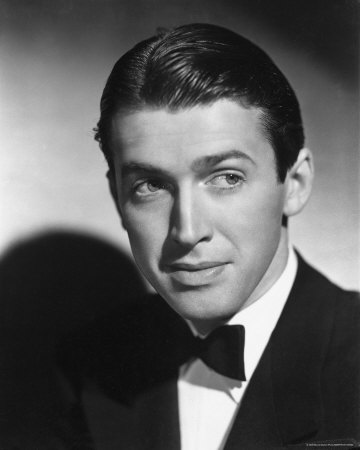
Happy birthday, Jimmy Stewart

Remembering Jimmy Stewart: May 20, 1908 – July 2, 1997. What’s your favorite JS movie?

French drama ‘Polisse’ delivers raw story, rich performances

Polisse/2011/127 min.

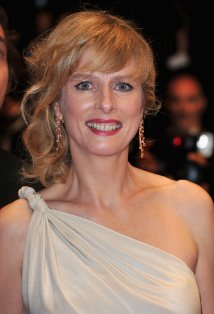
Karin Viard

#
Lately, I’ve been admiring the work of acclaimed actress Karin Viard, a sort of French Everywoman and the star of “Polisse,” a gripping cop drama.

Viard, 46, brings to her parts a blend of jolting spontaneity and what-you-see-is-what-you-get earthiness grounded by a subtle, thoughtful core. She reminds me of Laura Dern, both in her looks and her impressive versatility as an actress.

In “Polisse,” directed by Maïwenn, Viard plays Nadine, a cop with the Parisian police department’s child protection unit. Of course, it’s a grim day-to-day routine – confronting criminals, often abusive parents, and tending to damaged children – and the members of this tightly knit crew rely on each other to deal with their anguish and stress.
#
They frequently let off steam over meals or after-work drinks; they know the details of each other’s personal lives. Nadine, for example, is going through a painful divorce, and confides in the tightly wound Iris (Marina Foïs), who is struggling with infertility.
#
Through swift, sometimes dizzying, editing, the kaleidoscopic narrative weaves together chapters of the cops’ own domestic dramas and vignettes of cases the unit tackles. Raw, often repellent, and unvarnished, the crimes that unfold can be hard to watch. But, overall, the story is fiercely compelling.
#
#
Director/writer/actress (“The Fifth Element,” “High Tension”) Maïwenn co-wrote “Polisse,” a child’s spelling of the word police, with Emmanuelle Bercot after researching and spending time with an actual police unit. They both act in the film; Bercot is Sue Ellen and Maïwenn plays Melissa, a photographer on assignment to document the team. This strand, inserting the photographer as an outside observer, strikes me as a misstep. It feels clunky and tacked on at first, then weirdly out of control once Melissa becomes romantically involved with Fred (French rapper Joey Starr).
#
That said, Maïwenn elicits unforgettable performances from the cast, with Viard leading the pack. (“Polisse,” which played in Los Angeles at the COL•COA film festival in April, won the jury prize at last year’s Cannes Film Festival as well as two César awards, Yann Dedet and Laure Gardette for best editing and Naidra Ayadi for most promising actress.) As the film spins to a devastating end, it makes a deep emotional mark. You have walked in these cops’ shoes and lived briefly in their world – dire, chaotic and sadly mundane.
#
“Polisse” opens today in New York and LA.

A pre-noir from Fritz Lang: ‘The Spiders’ is out on DVD

The Spiders/1919-20/Decla-Bioscop AG, Kino Lorber DVD/173 min.

By Michael Wilmington

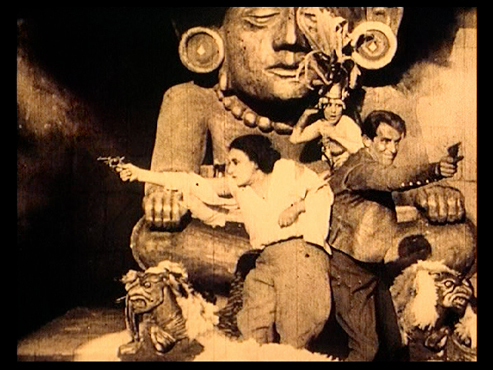
Fritz Lang (“M,” “Metropolis,” “Die Nibelungen”) was a master of horror, crime and adventure, and he combines them all – along with a dark touch of romance and a smidgen of humor – in this epic movie, recently released on DVD by Kino Lorber.

It’s a tale of lost treasure, exotic Peruvian climes, a daring adventurer (Carl de Vogt as the almost insanely courageous explorer from San Francisco, Kay Hoog), a band of ruthless criminals who tunnel under Chinatown and make up the international gang The Spiders, the priceless and elusive Buddha’s Head Diamond, the beauteous sun priestess Naela (Lil Dagover) and one of the more murderous of all femme fatales, the perfidious Lio Sha (Ressel Orla).

This spectacular black and white silent movie was released in two episodes (both in this DVD) – Part One: “The Golden Sea” (1919) and Part Two: “The Diamond Ship” (1920). It was quite obviously influenced by Louis Feuillade’s French crime serials (“Judex,” “Fantomas” and “Les Vampires”), which are better, but not by much. Serial followers with campier tastes might prefer the jovial, high-spirited nonsense of American cliff-hangers like “The Perils of Pauline,” but even considering The Spiders’ lack of humor, it’s easy to see that both Lang and Feuillade are superior artists, and that Lang would grow into an even more important one.

Only Hitler and the Nazis, worse monsters and more evil criminals than The Spiders, could drive out Lang and the other German and Austrian film noir greats to Hollywood, stopping his rise in his own country. But these remnants of high adventure remain.

(Silent movie with intertitles and music score by Ben Model.)

‘Casablanca’ kicks off Oscars Outdoors summer series

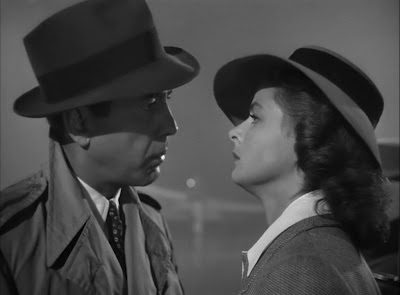
“Casablanca” screens on Friday, June 15.

“Casablanca” will kick off Oscars Outdoors, an exciting summer series from the Academy of Motion Picture Arts and Sciences.

Starting June 15 and running Friday and Saturday nights through Aug. 18, screenings will take place at a new open-air movie theater (with an outdoor surround-sound system) at 1341 Vine St., just south of the ArcLight Cinemas in Hollywood; capacity is 350 seats. You can view the complete lineup and buy tickets here.

Tickets for each Oscars Outdoors screening are $5 for the public, free for children 10 years and younger and $3 for Academy members and students with ID. Seating is unreserved. Gates will open at 6:30 p.m., and screenings begin at sunset. Attendees are encouraged to bring low lawn chairs, blankets and warm clothing. Popular food trucks will be on site during each screening.

In addition to hosting the Oscars Outdoors screening series, the venue is expected to serve the Academy and the community as an event space for special screenings, educational programs and other functions, according to The Hollywood Reporter.

The Academy’s summer and fall programming calendar is available here.

Blogathon to bring ‘The White Shadow’ to your computer

I am re-running my most recent Hitchcock review to support For the Love of Film: The Film Preservation Blogathon III, hosted by Ferdy on Films, the Self-Styled Siren and This Island Rod.

Working with National Film Preservation Foundation (NFPF), this blogathon aims to bring “The White Shadow,” a 1923 melodrama, to a wider audience. Directed by Graham Cutts, it was also the first film Alfred Hitchcock had a major role in creating (assistant director, screenwriter, film editor, production designer, art director, set decorator). The film was restored in New Zealand and repremiered by the Academy of Motion Picture Arts and Sciences last September at the Samuel Goldwyn Theater in Los Angeles.

To make “The White Shadow” available for free on its web site, the NFPF needs to raise $15,000. This money will allow the foundation to host and stream the film for four months and to record Michael Mortilla’s marvelous new score. It is the mission of this year’s For the Love of Film Blogathon to raise the money so that anyone with access to a computer can watch this amazing early film.

I hope you’ll read the great posts from fellow scribes and that you’ll make a donation.

‘Notorious’ is the film noir equivalent of an icy flute of Veuve Clicquot

1946/RKO, Vanguard Films/101 min.

“Notorious” ranks as one of Alfred Hitchcock’s best films and Ingrid Bergman as Alicia Huberman is one of the most contemporary of all ’40s noir heroines. In this splendid 1946 suspense thriller, Bergman’s Alicia is a U.S. secret agent assigned to infiltrate a group of Nazis who have resurfaced in South America after WW2. Alicia risks her life to root out the Nazis’ source of uranium, an ingredient in atomic bombs. She also likes to throw parties, expose her midriff (love the sequin zebra-print top) and pursue her man, fellow secret agent T.R. Devlin (Cary Grant). Dev’s easy on the eyes, but he’s suspicious, uptight and seemingly unfeeling.

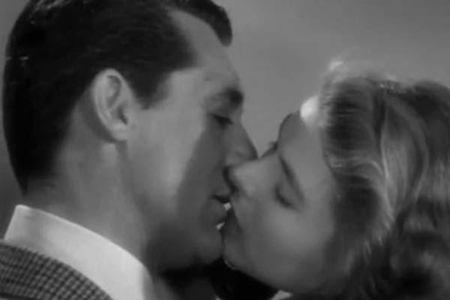
The Production Code stipulated that a kiss could not last more than three seconds.

Their “strange love affair” as she calls it, tinged with cynicism and mistrust, is decades ahead of its time. And their record-breakingly long kisses, which look tame now, were considered extremely racy in 1946.

The Production Code (ie, censors) stipulated that a kiss could not last more than three seconds. Hitchcock obeyed, but followed Bergman and Grant’s first swift kiss with another and another and another. Most importantly, she kisses him, noting that he hasn’t said, “I love you.”

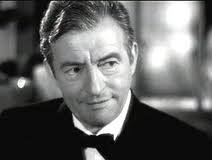
The demands of their work (spying and info gathering) create pressure. Alicia must charm Alexander Sebastian (Claude Rains), a wealthy, suave and impeccably dressed Nazi. Even though Alex is a high-ranking fascist, we never see him hatching his evil plans, so it’s a bit easier for the audience to put his heinousness on the back burner. Alex dotes on Alicia and is far more emotionally available than the shut-down Dev.

Claude Rains

Leopoldine Konstantin

Before long, Alex proposes to Alicia and gives her quite the rock to seal the deal. Alicia accepts after getting the OK from her unsympathetic and cold boss, Captain Paul Prescott (Louis Calhern).

Living with Alex will let Alicia poke around his stately home, where Prescott reckons trouble is literally brewing, and bring her into frequent contact with baddies like ringleader Eric Mathis (Ivan Triesault), scientific mastermind “Dr. Anderson” (Reinhold Schünzel) and weak link, Emil Hupka (Eberhard Krumschmidt).

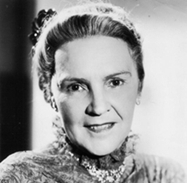
Living with Alex also means dealing with the other Mrs. Sebastian, Alex’s mother. Czech-born actress Leopoldine Konstantin, in her only American film, plays the hard and imperious Mrs. Anna Sebastian. When Alex asks Anna to be friendly to Alicia, the battle-ax tartly replies: “Wouldn’t it be a bit much for both of us to be grinning at her like idiots?”

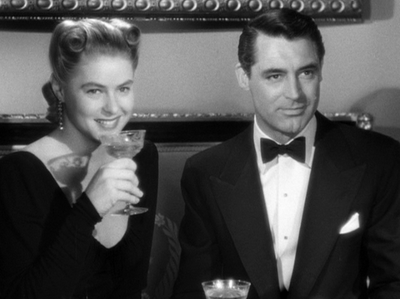
Alicia (Ingrid Bergman) and Dev (Cary Grant) are secret agents assigned to infiltrate a group of Nazis in South America after WW2.

Declaring a shortage of closet space (that’s our girl!), Alicia explores the nooks and crannies of the Sebastian mansion, but finds the wine cellar is off-limits. So, she decides to throw a champagne reception and steal the cellar key from her husband.

She invites Devlin, natch, and the two discover that wine is not the only thing stored in the cellar. (Hitchcock makes his cameo at the shindig, swigging some bubbly.)

Alex realizes the key has been stolen and that his secret is no longer safe, at which point he seeks maternal support. Anna’s fresh out of that, telling him: “We are protected by the enormity of your stupidity, for a time.”

The uranium angle is merely a MacGuffin, Hitchcock argot for a narrative device to advance the plot. The real story is whether Devlin and Alicia can work through their issues, such as his hypocrisy and lack of emotion, her drinking and their mutual game playing, which gets downright cruel. “Our all-too-human capacity for inhumanity is the dark mystery at the heart of ‘Notorious,’ ” writes film scholar William Rothman in his liner notes for the Criterion DVD edition. “And yet, in ‘Notorious,’ the possibility remains alive that the miracle of love can save us from our own perversity.”

This is one of the most beautiful films Hitch ever made, from his gorgeous leads to ravishing cinematography from Ted Tetzlaff – the closeups of Dev and Alicia at the racetrack and the famous crane shot at the mansion before Alicia’s champagne reception are standouts. I also like the imposing silhouettes of Alex and his mother after Alicia susses that they’ve been spiking her coffee. The lighting is magnificent throughout. Using rear-projection, Hitchcock combined footage of the principals filmed on a set with background shots taken in Rio.

The movie clocks in at 102 minutes but it glides by so gracefully that it feels half an hour. Ben Hecht’s sparkling script went through revisions and rewrites with input from Clifford Odets and Hitchcock. (David O. Selznick, on board as producer until he sold his rights to RKO in order to raise cash for another flick, likely tossed ideas around as well. Selznick had eyed Vivien Leigh for the Alicia role.) A few elements of “Notorious” came from a short story by John Taintor Foote called “The Song of the Dragon.”

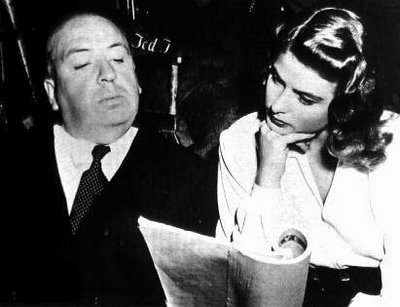
“Ingrid was very fond of my parents,” recalls Pat Hitchcock O’Connell in her book “Alma Hitchcock: The Woman Behind the Man.”

The entire cast dazzles and delights; the subtlety of the performances rewards multiple viewings. Hitch even accepted an idea from Bergman on shooting the dinner party scene.

In her book “Alma Hitchcock: The Woman Behind the Man,” the daughter of Alma and Alfred, Pat Hitchcock O’Connell, recalls that: “Ingrid was very fond of my parents. I remember, she’d finish one film with Daddy and she’d come over, sit on the couch, and say, ‘When do we start the next one?’ ” (Hitchcock O’Connell’s tribute to her mother makes a fun, chatty read and includes some of Alma’s favorite recipes and menus for home entertaining.)

In 1945, Bergman and Hitchcock made “Spellbound” co-starring Gregory Peck and in 1949 Hitch directed her in “Under Capricorn” opposite Joseph Cotten. Also in ’49, Bergman went to Italy to film “Stromboli” with Italian director Roberto Rossellini. Director and star fell in love, and Bergman left her husband Petter Lindstrom for Rossellini. Because of the scandal, Bergman’s reputation in the U.S. suffered, then rebounded; over the course of her career, she earned three Oscars (two for best actress and one for best supporting actress).

One of the most enjoyable and sophisticated films of the black and white era, “Notorious” strikes me as the film noir equivalent of an icy flute of Veuve Clicquot. Cheers!

MGM recently released “Notorious” along with “Rebecca” (1940) and “Spellbound” (1945) on Blu-ray.

Happy Mother’s Day!

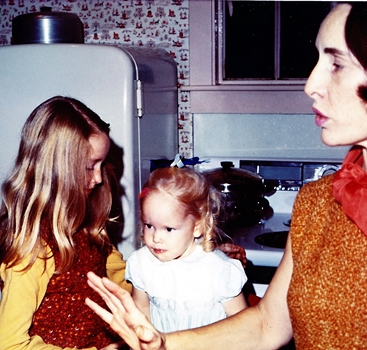
Here’s to all of those remarkable women who taught us how to look on the bright side, savor the moment and always have dessert! Shown here: FNB in the center with Big Sis on the left, Mom on the right.

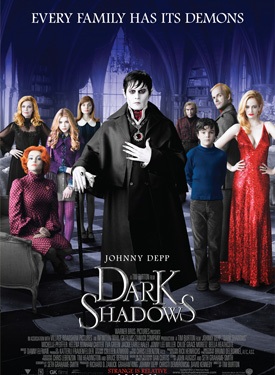
‘Dark Shadows’ fam is all dressed up with nowhere to go

Dark Shadows/2012/Warner Bros. Pictures, Tim Burton Productions/113 min.

A vampire may be able to live on blood alone, but few movies can exist on camp alone. As much as I was hoping to enjoy Tim Burton’s much hyped and highly anticipated “Dark Shadows,” I found it disappointing.

On the plus side, Dark Shadows” looks slick and gorgeous – the art direction, cinematography, set decoration and special effects are spot on. As always, charismatic Johnny Depp is fun to watch. The character he inhabits here is Barnabas Collins, born in Liverpool in the mid 1700s. The Collins family acquires wealth and power not to mention an imposing mansion in their namesake city of Collinsport, Maine.

When Barnabas grows up, he crosses the wrong woman. Angelique Bouchard (Eva Green) is a witch, who turns Barnabas into a vampire and buries him alive. Two centuries later, Barnabas is freed from his tomb and walks into a world of hippies, macramé and mini-skirts. This is 1972. It’s hard to be lord of the manor, though, when the manor is falling apart and Angelique wants to reignite their dangerous romance.

The rest of the ragtag Collins clan includes Elizabeth Collins Stoddard (Michelle Pfeiffer), Carolyn Stoddard (Chloë Grace Moretz), Roger Collins (Jonny Lee Miller), David Collins (Gulliver McGrath), live-in psychiatrist Dr. Julia Hoffman (Helena Bonham Carter) and groundskeeper/butler Willie Loomis (Jackie Earle Haley). Bella Heathcote plays the newly recruited governess, Victoria Winters, and Barnabas’ true love from the past Josette DuPres.

But somehow these characters never really get off the ground nor do they jell as a “strange family.” This random crew, despite their fetching costumes and makeup, seems purely the result of stunt-casting. They aren’t given much to do besides exchange arch looks (Moretz does some good lip curls) and roll their eyes at Barnabas.

There’s minimal effort to develop these characters; for example, the attempt to delve into Victoria’s past (she was institutionalized as a child) feels supremely clumsy. And there’s little attention paid to why any of this is happening other than you know that the movie itself is a remake of “Dark Shadows,” a popular daytime TV soap opera that ran from 1966-71.

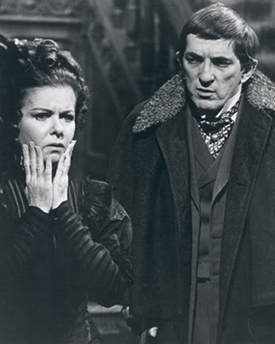
Joan Bennett and Jonathan Frid starred in the daytime TV soap opera, which ran from 1966-71.

The bland and feeble script from Seth Grahame-Smith creaks along with Barnabas remarking on child-birthing hips and unshaven young people, ie hippies. To liven things up, the Collinses throw a ball and hire Alice Cooper to perform. Barnabas declares that Alice is the most unattractive woman he’s ever seen. Were these jokes layered into an actual story, they would be fun but, by the time Cooper appears, the anachronistic humor is wearing pretty thin.

There is supposed to be a love triangle between Barnabas, Angelique, the icy-blonde bad girl and wide-eyed good girl Victoria. Green does an excellent turn as the powerful, alluring femme fatale. But there’s no tension – Barnabas seems strangely detached from both of them – and Angelique’s hell-hath-no-fury antics grow as tedious as the ’70s jokes.

I wasn’t familiar with the TV series (created by Dan Curtis, it starred Jonathan Frid as Barnabas and film-noir great Joan Bennett as Elizabeth), but one of its strengths was fusing low-key campiness and spooky-goth atmosphere. Burton’s anemic version sorely lacks on the eerie/creepy/scary front.

Though Depp is at his best here, to watch and truly enjoy him for almost two hours would require that he not be completely covered up in top coat and breeches.

“Dark Shadows” opens today nationwide.