Archives for July 2025

Despite engrossing story, ‘Shoshana’ lacks emotional core


Director Michael Winterbottom knows how to use the tools of his craft to build a world the audience can enter and, over his long career, has rendered onscreen realities that merge with superb storytelling, across a variety of genres. A few highlights of his work include: “Jude” 1996, “Welcome to Sarajevo” 1997, “Wonderland” 1999, “24 Hour Party People” 2002, “The Road to Guantanamo” 2006, “A Mighty Heart” 2007, “The Killer Inside Me” 2010 and “The Trip” series (starting in 2010 and starring Steve Coogan and Rob Brydon.)

His latest effort is “Shoshana,” a political thriller/drama that takes place in 1930s-1940s British-run Palestine and is based on real-life events and people. For a little background: Britain gained control of Palestine after World War I and, in 1922, the League of Nations granted a mandate over the territory. The mandate, which aimed to establish a national home for the Jewish people while safeguarding the rights of the existing Arab population, ended on May 14, 1948, with the declaration of the State of Israel. Arab nationalists opposed the mandate, leading to violence and clashes with British authorities.
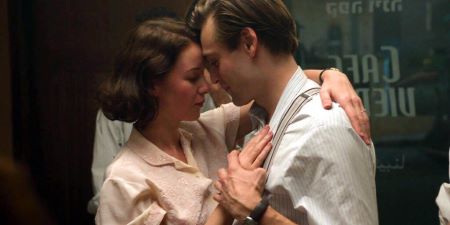
Shoshana (Irina Starshenbaum) and Tom (Douglas Booth) try to keep their love alive.

The film stars Irina Starshenbaum as Shoshana Borochov, a strong-willed Jewish writer and member of the Haganah underground military organization, who’s romantically involved with a smart, charming, easy-on-the-eyes British police officer named Tom Wilkin (Douglas Booth). Tom reports to Geoffrey Morton (Harry Melling), who becomes increasingly ruthless as they pursue Zionist militant Avraham Stern (Aury Alby). At the same time, Shoshana and Tom’s relationship grows more and more fractious.

No doubt, Winterbottom does an excellent job of transporting the viewer to Tel Aviv (shot in Italy) and creating a mood of tension and uncertainty, thanks to seamless production design, wardrobe, music and other period detail. Though riveting and fast-paced, the movie is sometimes a bit hard to follow.

“Shoshana” doesn’t really belong to its eponymous character (it’s hard to connect with what she’s feeling below the surface), and the love story seems more tacked on than central to the narrative. The script, previously titled “Promised Land” and written by Winterbottom, Laurence Coriat and Paul Viragh, doesn’t draw Shoshana and Tom vividly enough. Because their relationship lacks chemistry, they never sizzle, even during their tempestuous scenes. Without much of an emotional core in “Shoshana,” it’s hard to be moved by the actors’ performances, despite the high-stakes situations the characters find themselves in amid the ominous onset of World War II.

“Shoshana” opens in Los Angeles theaters on July 25.


‘Don’t Let’s Go to the Dogs Tonight’ offers richly textured, nuanced portrait of turbulent childhood in Africa

Childhood comes with a singular sense of time, place, atmosphere, and emotion – which stamps our memory both indelibly and unreliably – as each of us tries to stake out our small corner of the world and understand our place within it.

Exploring this formative chapter of life has long been fertile ground for master filmmakers, and has produced classics of the genre, such as: “Pather Panchali” (1955, Satyajit Ray),  “Les Quatre Cents Coups,”/“The 400 Blows,” (1959, François Truffaut), “Ivan’s Childhood” (1962, Andrei Tarkovsky), “To Kill a Mockingbird” (1962, Robert Mulligan), “The Spirit of the Beehive” (1973, Victor Erice), “Fanny and Alexander” (1982, Ingmar Bergman), “Au Revoir Les Enfants” (1987, Louis Malle), “Hope and Glory” (1987, John Boorman), “Celia” (1989, Ann Turner), and “Pan’s Labyrinth” (2006, Guillermo del Toro).

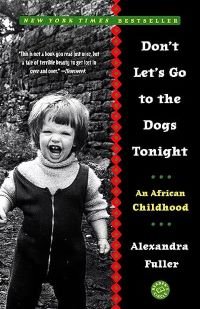
A new and notable entry in the category is “Don’t Let’s Go to the Dogs Tonight” by Embeth Davidtz, who wrote, directed and acted in the movie. Davidtz adapted the screenplay from Alexandra Fuller’s acclaimed 2001 memoir of the same name. The story, told through the eyes of an 8-year-old child nicknamed Bobo (Lexi Venter), recounts a British family’s life on a farm in Zimbabwe (then known as Rhodesia) during the Rhodesian Bush War, which ended in 1980.

“I fell in love with the book,” said Davidtz, an American-South African actress, at a recent sneak preview at the Laemmle Royal Theatre. Davidtz optioned the book and, though she hadn’t intended to write the screenplay, eventually began chipping away at it and decided to direct as well. “I thought the characters would be amazing in a film and I really wanted to play the part of the mother [Nicola Fuller],” said Davidtz, 59, adding that she felt a kinship with the author, since much of her own childhood was spent in South Africa.

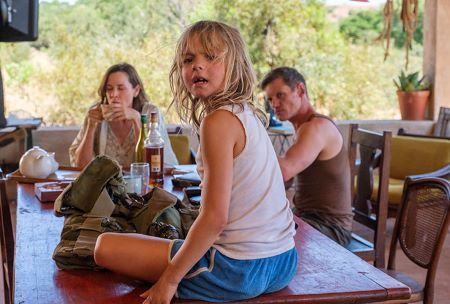
Bobo (Lexi Venter), her mother (Embeth Davidtz) and father (Rob Van Vuuren) know how to fend for themselves.

The film, like the memoir, avoids sentimentality, giving an unvarnished view of the highs and lows of Bobo’s day-to-day life. Her flinty mother (Davidtz) and tough father (Rob Van Vuuren) while fundamentally loving are a far cry from helicopter parents (both sleep with guns at their sides). Bobo’s older sister Vanessa (Anina Reed), almost a teen, considers her a pest. When the family faces a personal tragedy, her mother’s struggles with alcoholism and mental illness are intensified.

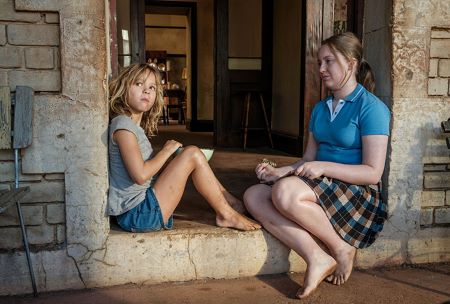
As a result, the rough-and-tumble tomboy is often left to her own devices – riding a horse or a motorbike, steering clear of snakes and scorpions. She finds comfort in smoking cigarettes, snuggling up to the family cat or bugging their kind and patient maid Sarah (Zikhona Bali) to tell her a story. Sarah’s affection for Bobo is mixed with resentment at the privilege unfairly bestowed on the child. Sarah’s husband Jacob (Fumani Shilubana) is tired of being patient and urges Sarah not to get attached.

Bobo often turns to Sarah (Zikhona Bali) when she needs a friend.

In its sensitive, even-handed rendering of quotidian routines and rhythms, the film simultaneously captures broader elements: the magnificent beauty of the African landscape, the turbulent upheaval of the war, the dehumanization of Black workers, the often-hardscrabble existence of the tenant farmers.

Briskly paced (Davidtz’s narrative is much shorter than Fuller’s) and evocatively shot in South Africa by cinematographer Willie Nel, not far from where Davidtz grew up, this ambitious first feature succeeds as an assured and poignant foray into storytelling that resonates long after the ending. “It echoes and mirrors my own childhood,” said Davidtz at the Laemmle q&a.

Bobo and her older sister Vanessa (Anina Reed) share a moment.

She credits much of the film’s authenticity to Fuller’s contributions. “Alexandra Fuller was extremely involved in the process of getting me ready to write the screenplay and make the film,” said Davidtz. “She really educated me on the difference between the Zimbabwean story and the South African story. She was very exacting, and her help was invaluable. I don’t think I would have the details I have without her.”

But perhaps most impressive of Davidtz’s accomplishments is the spontaneous and nuanced acting from her cast, especially the knockout performance from newcomer Lexi Venter, who had no previous acting experience.

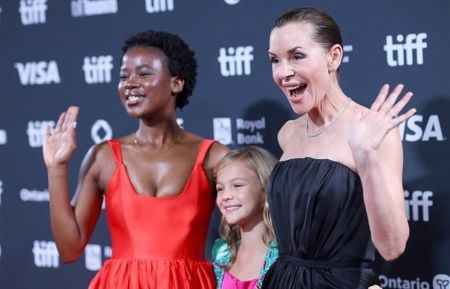
Zikhona Bali, Lexi Venter and Embeth Davidtz promote the film.

Davidtz explained: “I sent out a Facebook post and I said I need a dirty, feral, wild-haired, barefoot, grubby little child – a kid who has grown up barefoot and dirty like I did. And someone knew someone who said, ‘I know a kid like that.’ ”

As soon as they met, Davidtz said, she knew she’d found the right child. Of course, directing a non-actor had its challenges. “There’s a lot of antics – it was me saying, ‘now look sad, now look over here, now look over there’ and then piecing things together. But she has star power, she has that face and she has spirit.”

“I really wanted to play the part of the mother [Nicola Fuller],” said actress, writer and director Embeth Davidtz.

Additionally, she went through an exhaustive search to cast Zikhona Bali. “I think I saw every wonderful South African Black actress of that age group and the minute I saw her take, because she was so still and so deep and had so much humanity, I knew she was the right person.”

Clearly, Davidtz was the right person to helm the project and highlight the experiences of strong, complicated, multidimensional women. And her willingness to take a risk – financially and creatively – paid off. As she puts it: “I approached American producers, and nobody wanted to touch this material. I think people were very scared of the race aspect. It was just too threatening a subject matter to go near. So, I cobbled together the tiniest budget … I put in some of my own money, we got money in South Africa, and it really was stitched together. Every part of this has been a miracle.”

“Don’t Let’s Go to the Dogs Tonight” opens in Los Angeles theaters on July 11.